
The cheapest package isn’t a saving if it lets products arrive damaged. Looking competent to your boss with packaging cost savings starts with identifying cost drivers, consolidating similar SKUs, improving package design, and weighing every change against product protection. For teams in Orange County, Los Angeles, and San Diego, the principle is the same: measure the full operating impact, not just the package’s unit cost.
It’s reasonable to be cautious: a cheaper box or less cushioning can create a larger problem if products are damaged in transit. Assess material use, storage and shipping efficiency, and damage risk together, then make changes that preserve fit and protection. This guide shows how to identify packaging costs worth addressing, where SKU consolidation and design changes may help, and how to present a clear cost-versus-quality case to your boss.
Key Takeaways
- Assess material, production, storage, and shipping expenses together to identify where packaging costs accumulate.
- Review similar packaging SKUs for opportunities to consolidate specifications and simplify purchasing.
- Evaluate packaging design for fit, protection, stackability, and handling, not just unit cost.
- Compare savings against product damage risk so cost reductions preserve the protection shipments require.
- Explore foam packaging, stretch film, or inventory management options when they address a specific packaging cost or supply challenge.
1. Why Do Packaging Costs Matter So Much?
Packaging decisions affect material use, production work, warehouse space, and shipment handling. These costs make packaging a practical place to look when explaining operational savings to your boss.
Start with the material and production components. A package may require a box, cushioning, tape, labels, and protective film, each with its own purchasing and handling needs. Custom packaging can also involve design, labor, and printing costs. For example, a printed package with several components may take more steps to produce than a simpler design. Track each component and production step before deciding what to change.
Labor costs can hide in routine packing work. A worker who trims oversized cushioning, adds extra tape, or searches for the right box spends time on tasks beyond packing the product. Count the steps in a representative order, from retrieving supplies to sealing the shipment. Then look for repeated handling, such as repacking items that shift inside a poorly fitted carton. These observations help connect package design to labor use.
Storage and logistics add costs beyond the packaging purchase. Bulky materials take up warehouse space, while oversized packages can use more room during transport. Using less packaging material can reduce material costs, shipping weight, and transport space, according to the U.S. Bureau of Labor Statistics. Review how packages stack on shelves and pallets, then compare the current design with a more compact option. A packaging cost-savings review can help structure that assessment.
An industrial distributor handling several product lines faces similar trade-offs. Separate cartons and cushioning for each component can take up warehouse space, while packers may spend time locating supplies or preparing shipments. Track packing tasks by product and order type, including material use, storage needs, and preparation time. Those records can show where a more efficient package or process could help without overlooking operational requirements.
Why do these costs matter? Packaging affects the margin on each product and the time required to get orders ready. A change that lowers material use but increases damage or repacking can shift costs rather than remove them. Compare the full workflow, including product protection, handling, storage, and delivery, before presenting a savings proposal.
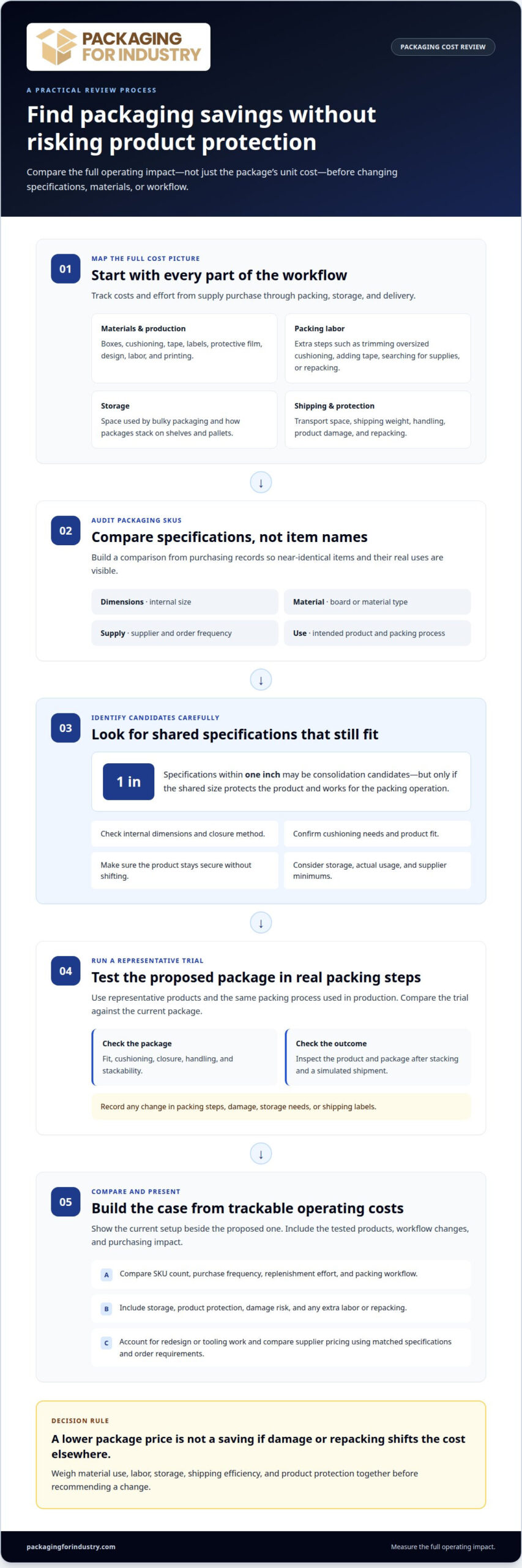
Before changing materials or package design, test representative samples for fit, cushioning, closure, and handling. Use the same packing steps as production, then inspect the product and package after stacking and a simulated shipment. This gives you evidence to compare against the current package. A structured packaging cost savings review can help organize the comparison.
2. Consolidating similar packaging SKUs
A packaging catalog can accumulate separate SKUs for small differences in length, width, or material. Start by exporting purchasing records and listing each item’s dimensions, board or material type, supplier, order frequency, and intended product. This creates a clear comparison instead of relying on names that may hide near-identical specifications. For example, two cartons with different item codes may serve the same product family and packing process.
Compare specifications, not just labels. Packaging specifications within one inch of each other can be consolidated when the shared size still protects the product and fits the packing operation. Check internal dimensions, closure method, cushioning needs, and the space products occupy after packing. A carton that looks similar on a spreadsheet may still be unsuitable if the product shifts or requires extra fill.
Next, group SKUs by function. A warehouse might use separate cartons for related components, but one standard size could work if each item remains secure and the box moves efficiently through storage and shipping. Ask packers to test the proposed standard with representative products. Record whether the change affects packing steps, damage, stackability, or shipping labels. These checks help prevent reducing purchasing complexity at the expense of product protection.
- Compare dimensions and materials across the current SKU list.
- Identify items with overlapping uses and similar packing requirements.
- Trial a shared specification with the products it must accommodate.
- Record changes in purchasing, handling, and storage needs.
Consolidation can simplify supplier coordination and make purchasing records easier to manage. Fewer specifications may also reduce the number of items employees need to locate and replenish. But ordering more of one standard package can require extra storage or create excess stock if demand varies. Compare order quantities with actual usage, available storage, and supplier minimums before changing the purchasing plan.
Build the business case from trackable expenses. Compare current SKU counts, purchase frequency, replenishment effort, and packing workflow with the proposed setup. Include any change in storage or product damage, not only unit pricing. If the new standard requires a tooling change or packaging redesign, account for that work before presenting expected savings. A focused trial helps determine whether broader implementation makes sense.
For a practical proposal, show the current specifications beside the proposed standard, then note which products were tested and what changed in the workflow. This gives managers a concise basis for deciding whether consolidation fits operations. If supplier pricing is part of the review, request packaging pricing using the compared specifications and expected order requirements.
3. Efficient packaging design for shipping and storage
Packaging design affects how products move through a warehouse and arrive at their destination. A complex design can cost more to produce than an efficient one, especially when it requires extra components, assembly steps, or specialized handling. Compare the current package with a simpler design by mapping each component to its job. If a divider only prevents movement, for example, check whether a better-fitting insert can do that work with fewer parts.
Start with the product’s shipping profile. Note its shape, weight, fragility, and how employees pack and handle it. Then identify where the package needs support and where material may be unnecessary. A box with excess internal space can require more cushioning and take up more storage and transport room. A closer fit may improve space use, but it still needs to protect the product during normal handling.
Review package dimensions against warehouse and pallet workflows. A design that stacks evenly can help maximize usable space on a pallet or shelf. Irregular shapes may leave gaps, shift during movement, or prevent stable stacking. For example, compare how the current carton and a revised design fit together on a pallet, then observe whether employees can retrieve and move them efficiently. The comparison should include storage access, not just the packed product.
Shipping protection must remain part of the design decision. A shipment damaged in transit can be undeliverable and require the business to replace items for customers. A lighter or smaller design is not an improvement if it increases product movement or exposes vulnerable edges. Evaluate the complete system: outer container, cushioning, closure, and handling of the finished shipment.
- Map each package component to a specific protection or handling function.
- Compare the design’s fit around the product and its stability during stacking.
- Look for assembly steps that add labor without improving protection.
- Record storage access and shipping outcomes alongside material use.
Use a controlled design review before rollout. Have an employee pack the same product using the existing design and the proposed version. Record assembly steps, material use, ease of closure, and any product movement. This provides useful operational evidence without assuming that a more compact package automatically performs better.
A packaging distributor can help select containers suited to protecting and shipping specific products. Bring product dimensions, current packaging components, and handling requirements to the discussion. These details give the design review practical constraints, so the resulting package can balance protection, storage efficiency, and ease of use rather than optimize only one factor.
4. Finding packaging savings
Start with the current package and identify each component that drives spending: container, cushioning, closure, label, and any special handling step. For each, ask whether it’s necessary and whether another option can provide the same function. This review can reveal costly extras, such as redundant cushioning or a package feature that doesn’t support protection, handling, or identification.
Compare packaging suppliers using the same specifications, order quantities, delivery expectations, and quality requirements. Comparable quotes can help reveal lower-cost sourcing options. Then negotiate using clear purchasing details, such as expected demand, repeat orders, and opportunities to consolidate specifications. A lower unit price matters only if the proposed package performs the required job.
To measure savings, establish a baseline from current usage and purchasing records. Calculate annual packaging spend by multiplying each package’s unit cost by its annual quantity, then include related labor, storage, and damage costs where records support them. Compare that total with the proposed option using the same product volume and cost categories. This annualized comparison shows whether savings come from the package itself or workflow changes.
Buying packaging supplies in bulk may improve unit economics, but larger orders can require more storage and tie up inventory. Compare the quantity needed with the supplier’s minimum order quantity and available warehouse space. If demand varies, model a smaller-volume purchasing approach alongside bulk pricing. The best sourcing decision accounts for both the purchase and the cost of storing unused stock.
- Compare quotes against matching package specifications.
- Track material, labor, storage, and damage-related expenses.
- Test whether each package element serves a necessary function.
- Balance order quantities against usage and storage capacity.
Present the business case to your boss in a short decision format: current baseline, proposed change, annualized comparison, operational impact, and next step. Use purchasing records and a controlled packing trial to support each claim. State the assumptions plainly, including order volume and which labor or damage costs were included. This helps a manager assess the savings without confusing a lower package price with a lower total cost.
If multiple proposals compete for investment, rank them by expected savings, implementation effort, and effect on product protection. A packaging change that requires new procedures may need training or a trial period, while a sourcing adjustment may fit existing operations. Show the evidence behind each option, then recommend the change with the clearest cost case and manageable operational impact.
5. Packaging cost drivers
A package’s total cost depends on more than its purchase price. Material type, dimensions, converting steps, printing, order quantity, and delivery all affect spending. For example, a custom carton may require design work and printing, while a standard container may avoid those steps. Compare the full specification and purchasing process before cutting material or changing suppliers.
Material choices shape both protection and sourcing decisions. A package that uses more board or cushioning than the product needs may be an opportunity to optimize. But reducing material without testing can increase product movement or damage. Compare the current design with a proposed version, then record material use, packing steps, and product condition after handling.
Production complexity creates another cost driver. Special cuts, multiple inserts, printing, or extra assembly can add work to a package. Map each component to its purpose. If a custom insert protects a fragile part, retain that function while assessing whether its shape or assembly can be simplified. A design change should address a specific production step, not remove protection by assumption.
Order patterns and delivery also affect total cost. Small, frequent purchases can involve more ordering and replenishment work, while bulk purchasing can increase storage needs. Compare supplier quotes using the same specifications, order quantities, and delivery expectations. Include receiving and stocking tasks in the review. A lower quoted price may not reduce the full operating cost if it creates extra handling or inventory.
Before changing labels or package materials, identify the requirements that apply to the product, destination, and customer. For U.S. shipments, preserve required label content and ensure it remains accurate and legible. Have the relevant quality or compliance team review label artwork and packaging changes before production, especially for regulated product categories.
Use a cost-driver worksheet to connect each proposed change with measurable evidence. Record the current material specification, purchasing pattern, production steps, storage needs, and known damage or repacking issues. Then compare the proposed package against those same categories. This makes it easier to explain whether savings come from material use, simpler assembly, improved sourcing, or reduced handling.
- Separate material, printing, production, and delivery costs.
- Document each component’s protection or identification function.
- Compare supplier quotes using matching specifications and order assumptions.
- Include label review and operational effects in the change plan.
Present the recommendation with its baseline, proposed change, and supporting records. Explain which cost drivers the change addresses and how the team will monitor package performance after implementation. That gives your boss a practical way to assess the decision alongside product protection and workflow impact.
Packaging For Industry (PFI): Foam Packaging
Packaging For Industry (PFI) provides foam packaging for businesses assessing product protection and packaging use. It serves industrial operations, including aerospace, electronics, and medical device manufacturers, where packaging must suit the product and its handling needs. PFI’s custom packaging services help teams address specific product requirements instead of relying on a one-size-fits-all approach.
Foam packaging may be relevant when a component needs cushioning during shipment. For recurring supply needs, PFI also offers Vendor Managed Inventory (VMI) and Just-In-Time (JIT) inventory programs for packaging. These services can help simplify replenishment planning alongside packaging decisions.
Contact Packaging For Industry to discuss your packaging requirements and next steps.
Turn Your Cost Review Into a Practical Next Step
A strong packaging proposal can do more than identify a lower-cost option. It can show how purchasing, protection, and supply planning fit together, giving your team a focused basis for action. To look competent to your boss while presenting packaging cost savings, make the next step specific: choose one packaging issue, document its operational impact, and identify what evidence would support a change.
Packaging For Industry (PFI) provides foam packaging and stretch film for product protection and shipping needs. Its Vendor Managed Inventory (VMI) program for packaging can also help when replenishment and inventory management are part of the cost challenge. Consider these options when they align with the operational issue you’ve identified, rather than treating a product change as a saving by itself.
Bring your packaging requirements and priorities to Packaging For Industry to discuss a practical next step. A clear, measured review can help your team move forward with confidence.
Frequently Asked Questions
How Do You Balance Cost and Quality?
Balance cost and quality by testing whether a package protects the product through its actual handling and shipping conditions. An electronics shipment may need cushioning that limits movement, while a durable component may need less internal support. Evaluate the package after packing and handling, then track damage, repacking, and customer complaints. A lower material cost matters only if the revised package still performs its required job.
What Are the Most Common Packaging Cost Challenges?
Common challenges include too many package specifications, excess material, complex packing steps, storage pressure, and inconsistent replenishment. A distribution team, for example, may spend time searching for a rarely used carton while frequently used supplies run low. Separate purchasing costs from operational costs, then identify where stock handling, repacking, or emergency orders affect the workflow. This helps teams address a specific cause rather than make a broad cut.
Where Are the Packaging Savings?
Look for savings in packaging components, specifications, packing steps, storage, and replenishment patterns. Start by reviewing purchase records alongside the materials used for representative orders. Check whether a divider, label, or extra layer still serves a clear purpose. Also assess whether replenishment timing creates excess stock or urgent orders. Each opportunity should connect to a change the team can measure and explain to decision-makers.
Why Do Packaging Costs Matter So Much?
Packaging costs matter because they affect product margins and the work required to prepare shipments. The impact can extend beyond purchasing when a package takes extra labor to assemble, occupies warehouse space, or requires repacking. For example, a difficult-to-close carton can slow a packing station across recurring orders. Tracking packaging alongside these operational effects gives managers a fuller view of its business impact and where to focus.
How to identify packaging cost savings without reducing product protection
Identify savings by comparing the package’s protective function with its material and handling requirements. Choose a representative product, document its current packing method, and trial a proposed change under the same workflow. Inspect the product and package afterward for movement, compression, or closure problems. Record packing time and damage reports, too. This evidence helps you look competent to your boss while presenting packaging cost savings tied to real operating results.
What packaging cost reduction opportunities should a procurement manager assess?
A procurement manager should assess specification overlap, purchasing frequency, supplier terms, inventory levels, and packaging complexity. Compare quotes using consistent product requirements and order assumptions, then review how delivery timing affects stock on hand. For recurring materials, compare usage records with replenishment practices. To look competent to your boss while presenting packaging cost savings, connect each proposed change to a documented purchasing or workflow improvement.
Typical packaging material costs and price benchmarks in the United States
There isn’t one useful U.S. price benchmark for packaging materials across different specifications and order conditions. Corrugated board, foam, stretch film, and other supplies vary by dimensions, material requirements, order quantity, and delivery needs. Compare supplier quotes for matching specifications, and include purchasing and handling factors in your evaluation. That gives your team a relevant comparison without relying on a benchmark that may not fit its package requirements.
How much can right-sizing packaging reduce shipping and dimensional weight costs?
The amount depends on package dimensions, shipment characteristics, and the carrier’s pricing method, so assess the specific shipment rather than assuming a standard reduction. Compare the existing carton with a closer-fitting design while retaining needed product protection. Review carrier charges for comparable shipments, and confirm the revised package remains practical for packing and handling. This shows whether right-sizing changes shipping expenses for your operation and supports a measured decision.