
The lowest unit price is a dangerous metric when your high-value equipment relies on custom-engineered protection. While a generic box might look fine on a spreadsheet, it won’t prevent shipping damage or production delays caused by inconsistent material quality. You know that your operation requires a specialized partner, yet getting purchasing department approval for a sole-source packaging vendor often feels like an uphill battle against rigid corporate policy.
We understand that procurement teams are wired to demand multiple quotes to ensure fiscal responsibility. This article will show you how to bridge that gap by proving that certain technical requirements and inventory services are truly unique. We’ll provide the exact steps to justify a sole-source partnership by focusing on long-term cost avoidance and engineering precision rather than just the initial price tag. You’ll learn how to document the necessity of custom foam inserts, specialized crates, or VMI programs to secure the reliable, high-quality vendor your supply chain needs.
Key Takeaways
- Identify the specific engineering requirements, such as custom foam inserts or aerospace-grade crates, that standard catalog suppliers cannot replicate.
- Learn how to shift the procurement conversation from “lowest unit price” to “total cost of ownership” by documenting historical damage and production delays.
- Follow a structured two-phase approach for getting purchasing department approval for a sole-source packaging vendor by combining market research with technical specifications.
- Leverage value-added services like Vendor Managed Inventory (VMI) and local Southern California support to prove unique logistical advantages.
- Distinguish between a preferred vendor and a true sole-source partner to align your request with corporate compliance and risk management policies.
Defining Sole-Source vs. Competitive Bidding in Industrial Packaging
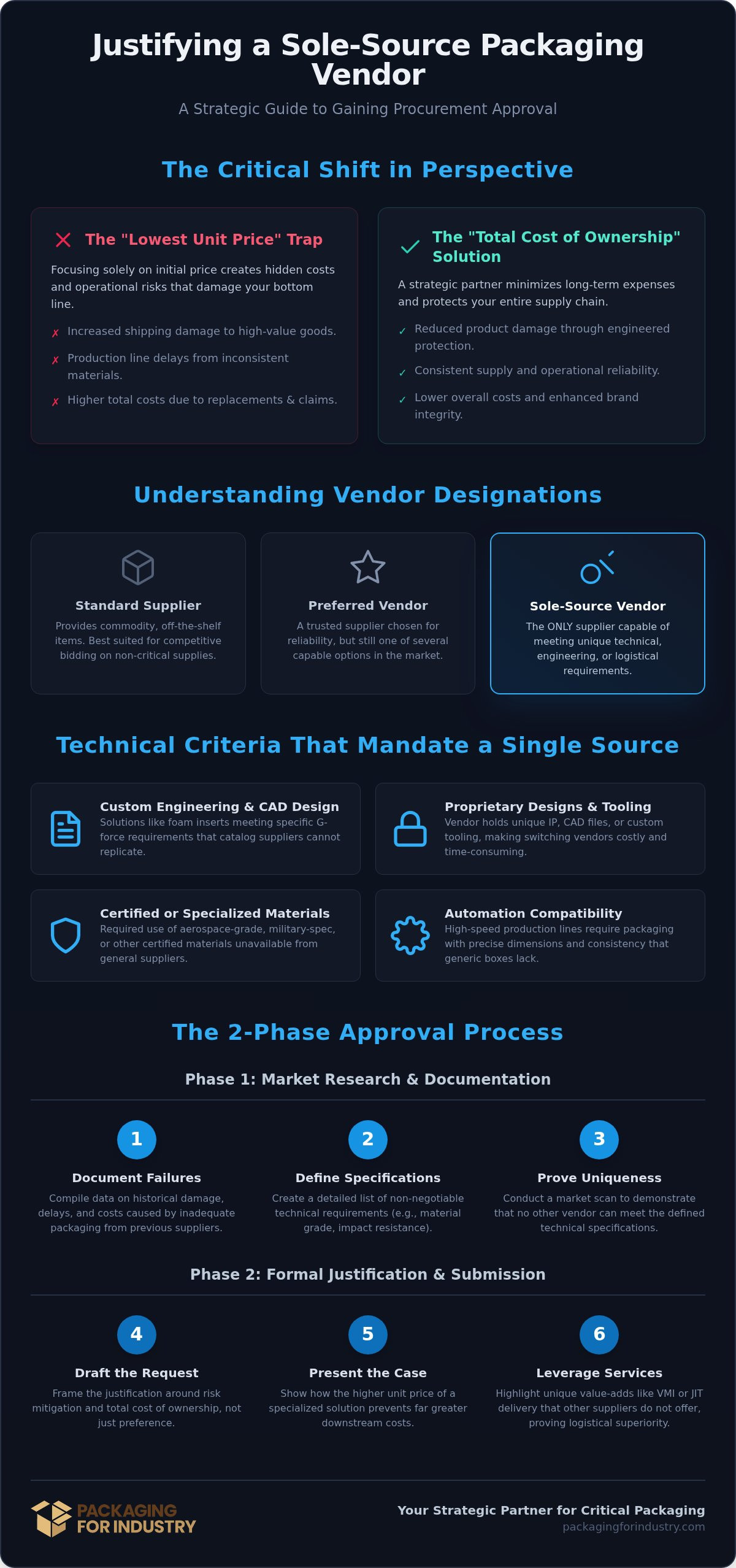
Procurement departments generally default to competitive bidding to ensure they aren’t overpaying for supplies. A “Preferred Vendor” is simply the one you like best because they deliver on time or have a good relationship with your floor manager. A “Sole-Source Vendor” is different; they’re the only supplier capable of meeting your technical or logistical requirements. Successfully getting purchasing department approval for a sole-source packaging vendor requires moving beyond personal preference and proving that no other supplier can fulfill the specific engineering needs of your operation.
Most corporate policies mandate a “Three-Quote Rule” for any purchase over a specific dollar threshold. This process is modeled after sole-source procurement frameworks used in the public sector, where competition is the standard for transparency. Purchasing managers are skeptical of sole-source requests because they eliminate price competition and create a single point of failure. If that one vendor misses a delivery, your entire production line stops. To win approval, you must demonstrate that the risk of using a non-qualified vendor is far greater than the risk of relying on a single source.
The Threshold of Uniqueness
When your packaging involves proprietary designs or highly specialized materials, competitive bidding becomes impossible. If a vendor has developed a specific, custom-engineered foam packaging solution that has been flight-tested for an aerospace component, another supplier cannot simply “quote” that design without violating intellectual property or risking catastrophic failure. This is often referred to as “Brand Specific” procurement, where an integrated packaging system is tied to the original engineering spec. Sole-source justification acts as a critical risk-mitigation strategy for high-value shipping where the cost of a failure outweighs any potential bid savings.
Common Misconceptions in Packaging Procurement
A frequent error in procurement is treating industrial packaging as a commodity like office paper. This leads to the “lowest price per box” trap. While a generic corrugated container might look identical to a custom-engineered one, the board grade, flute structure, and adhesive quality vary significantly. Successfully getting purchasing department approval for a sole-source packaging vendor requires debunking the myth that all packaging supplies are interchangeable. Choosing a cheaper substitute often results in a higher total cost of ownership due to increased shipping damage, rejected loads, and insurance claim denials. If a generic vendor cannot guarantee the same structural integrity, they aren’t a valid “second quote” for a specialized requirement.
Technical Criteria: Why Custom Packaging Often Requires a Single Source
Standard catalog suppliers serve a purpose for general warehouse supplies, but they don’t offer the technical engineering required for specialized components. When getting purchasing department approval for a sole-source packaging vendor, you must highlight that commodity catalog vendors lack the ability to provide custom CAD designs or certified material testing. If your product requires a specific foam packaging insert to meet precise G-force impact requirements, a generic supplier’s “best guess” is a liability. Engineering requirements that demand unique physical properties effectively exclude vendors who only sell pre-made, stock dimensions.
Proprietary design ownership is another technical hurdle that procurement needs to understand. If a vendor holds the specific CAD files and custom tooling for your heavy-duty crates, switching vendors requires a costly and time-consuming re-engineering phase. This logic aligns with the official government criteria for sole-sourcing, which recognizes that substantial duplication of cost is a valid reason to bypass competitive bidding. Standardization also plays a role; using a single source across multiple production lines reduces inventory clutter and simplifies training for your floor staff.
Compatibility with Automated Production Lines
Automation requires precision that generic corrugated boxes often lack. High-speed case sealers and pallet wrappers are calibrated for specific material tolerances. If you switch stretch film manufacturers to save a small percentage on unit price, you may find the new film’s gauge or resin blend causes constant machine downtime or snap-backs. These operational failures quickly erase any perceived savings. Consistent performance in automated environments is a primary technical justification for maintaining a single-source partnership.
Specialized Industry Standards (Aerospace & Military)
In Southern California, the aerospace and defense sectors operate under strict regulatory oversight. These industries require rigorous adherence to military packaging standards like MIL-STD-2073. Not every industrial supplier is equipped to handle these certifications or provide the necessary anti-static properties required for aerospace packaging. Proving that your chosen vendor is the only local partner with the specific expertise to meet these compliance levels is a powerful tool for getting purchasing department approval for a sole-source packaging vendor.
If you’re currently documenting these technical requirements for your procurement team, you can request a packaging quote that includes a detailed technical justification for your specific application.
Building the Data-Driven Business Case for Approval
Procurement departments speak the language of numbers. While engineering requirements are essential, getting purchasing department approval for a sole-source packaging vendor ultimately requires a narrative of fiscal responsibility. You must shift the focus from the “unit price” of a single corrugated box to the “Operational ROI” of the entire supply chain. A vendor who saves you five cents per box but causes a 2% increase in shipping damage is actually costing the company thousands of dollars in lost revenue and replacement freight. Data-driven justification proves that the most expensive packaging is the kind that fails.
The Cost of Damage Analysis
Documenting historical damage rates is the most effective way to prove the value of a specialized partner. If your current generic supplier results in damaged goods, calculate the total cost of those failures, including return shipping, warehouse labor for re-packing, and customer dissatisfaction. Even a 1% reduction in shipping damage can save a high-volume manufacturer tens of thousands of dollars annually. Use prototypes and testing data from your proposed sole-source partner to demonstrate how their custom designs outperform stock options. See our guide on packaging cost savings for specific data points to include in your internal report.
Lead Time and Inventory Reliability
Inventory carrying costs and production downtime are significant financial drains that procurement often overlooks. A sole-source justification is often built on a vendor’s ability to provide Vendor Managed Inventory (VMI). By allowing a local Southern California partner to hold safety stock, you eliminate the risk of production-stopping stockouts. For manufacturers in Anaheim, Irvine, or Los Angeles, local next-day delivery reduces freight risk and warehouse clutter. Getting purchasing department approval for a sole-source packaging vendor is much easier when you can show that the vendor’s proximity and VMI capabilities allow your company to operate with a leaner, more efficient “Just-in-Time” supply chain.
Calculating the true cost of downtime is vital. If a packaging stockout halts your production line for even four hours, the labor costs and missed shipping deadlines likely exceed a year’s worth of “savings” from a cheaper, less reliable vendor. Documenting these operational risks transforms the sole-source request from a vendor preference into a mandatory business continuity plan.
Step-by-Step Guide to Navigating the Internal Approval Process
Navigating the approval process is a methodical exercise in documentation. Purchasing managers don’t want to block your progress; they want to protect the company from audits and supply chain risk. To move forward, you must lead them through a logical four-phase workflow that demonstrates due diligence. Successfully getting purchasing department approval for a sole-source packaging vendor requires a paper trail that proves you’ve prioritized the company’s operational stability over mere convenience.
Phase 1 starts with market research. You must provide evidence that you attempted to find alternative sources. This involves documenting outreach to other industrial packaging suppliers and recording exactly why their standard offerings fell short of your requirements. In Phase 2, you translate your operational needs into a technical specification. By clearly defining “Must-Have” features, such as specific burst strengths for heavy-duty corrugated boxes or ESD protection for electronics, you narrow the field to vendors capable of meeting those exact standards.
Phase 3 is the narrative justification. This is where you explain why a partner like Packaging For Industry (PFI) is the only viable choice based on their integrated manufacturing and local Southern California logistics. Finally, Phase 4 involves the procurement review. Anticipate objections regarding price by referencing the data-driven ROI and cost-avoidance metrics established in the previous sections. When you present a complete package of research and technical specs, you make it easy for procurement to say yes.
Documenting the ‘Failure of Substitutes’
The most persuasive way to win over a skeptical buyer is to show, not just tell. If you’ve tested generic samples from catalog suppliers and they failed to protect your product during a simulated transit test, keep those results as part of your justification. Using custom design packaging prototypes allows you to present a physical solution that a commodity vendor cannot match. Quantitative testing data is the strongest weapon against a procurement veto because it replaces subjective opinion with objective, verifiable proof.
Handling the ‘Emergency’ Justification
Sometimes, getting purchasing department approval for a sole-source packaging vendor happens under extreme pressure. If a primary supplier fails or a sudden supply chain disruption threatens your ability to ship, a reliable local partner becomes an operational necessity. Most corporate policies allow for sole-sourcing when a “significant financial loss” is imminent due to production delays. However, you should avoid “self-created” emergencies caused by poor internal planning. Purchasing departments are much more likely to approve a sole-source request when it’s presented as a proactive solution for long-term reliability rather than a last-minute scramble to fix a stockout.
Why Packaging For Industry (PFI) is Strategic for Sole-Source Partnerships
Packaging For Industry (PFI) occupies a unique space in the industrial landscape by functioning as both an integrated manufacturer and a sophisticated inventory manager. For operations managers, this dual capability is the cornerstone of getting purchasing department approval for a sole-source packaging vendor. We don’t simply supply materials; we engineer the entire protection system and manage the logistical flow directly to your production floor. This comprehensive oversight removes the coordination gaps that often occur when using multiple vendors for corrugated boxes, protective foam, and crates.
Our local presence in Southern California provides a tangible advantage that national catalog suppliers cannot match. For businesses in Orange County, Los Angeles, and the Inland Empire, Packaging For Industry (PFI) offers local next-day delivery and immediate on-site consultations to solve urgent floor issues. Proximity reduces the risk of shipping delays and allows for a more responsive supply chain. To further assist in your justification process, we provide free prototyping for custom designs. This allows your procurement team to verify the technical superiority of our solutions before committing to a contract, effectively eliminating the financial risk of a failed implementation.
Custom Engineering Meets Reliable Supply
A primary reason for sole-sourcing is the need for integrated components that must fit together with exact tolerances. Packaging For Industry (PFI) specializes in combining custom corrugated boxes with precision-engineered foam inserts. This ensures that high-value items, such as aerospace sensors or medical devices, remain immobilized during the most rigorous transit conditions. We have extensive experience managing mil-spec and aerospace requirements nationwide, ensuring that your packaging remains compliant with the strictest industry standards. If you’re ready to document these technical requirements, you can request a custom packaging quote to start your justification file.
A Partner in Your Supply Chain
We focus on moving beyond the traditional vendor relationship to a strategic partner model. By aligning our manufacturing schedule with your production needs, we help you maintain a lean operation. Our VMI and just-in-time inventory programs simplify the purchasing process by automating replenishment and reducing the administrative burden on your procurement team. This partnership also includes a commitment to long-term cost reduction through continuous packaging reviews. We regularly evaluate your material usage and shipping data to identify new ways to lower packaging costs and reduce product damage.
Ready to streamline your procurement and secure a more reliable source? Request a quote from Packaging For Industry (PFI) today.
Streamline Your Procurement with a Specialized Partner
Winning internal support requires more than just a vendor preference; it demands a data-driven narrative that prioritizes long-term business continuity. By focusing on total cost avoidance through technical precision and specialized compliance, you can demonstrate that a single-source partnership is a strategic asset rather than a corporate risk. Getting purchasing department approval for a sole-source packaging vendor becomes a straightforward process when you present documented proof of technical uniqueness and logistical reliability.
PFI actively supports your procurement goals by providing free prototyping for custom engineering and specialized expertise in Aerospace and Defense standards. Our local Southern California VMI programs further strengthen your case by eliminating the hidden costs of inventory mismanagement and production downtime. Transitioning to a reliable industrial packaging supplier ensures your high-value goods reach their destination without damage or delay.
We’re ready to help you build a stronger, more efficient supply chain through expert engineering and reliable local support.
Frequently Asked Questions
What is the difference between a sole-source and a single-source vendor?
Sole-source refers to a situation where only one supplier is capable of providing the required goods; single-source is a choice to use one vendor when others are technically available. In industrial logistics, sole-sourcing is usually driven by proprietary engineering or certifications that other suppliers simply do not possess. Procurement departments view sole-sourcing as a high-risk exception that requires rigorous documentation, whereas single-sourcing is often a strategic decision to consolidate volume for simplified logistics.
Can I justify a sole-source vendor based only on a lower price?
You cannot justify a sole-source request based solely on a lower unit price, as purchasing departments use competition to compare packaging pricing across multiple bids. Sole-sourcing is reserved for situations where competition is technically or legally impossible. Instead, focus your justification on total cost avoidance by proving that using a different vendor would lead to higher total costs through shipping damage, production downtime, or the need for expensive re-engineering.
How do I prove a packaging design is truly unique to one vendor?
Proving uniqueness requires documenting the specific engineering tolerances and proprietary tooling involved in your packaging. If a vendor holds the CAD files and has invested in custom molds for your protective foam, no other supplier can replicate that exact solution without significant duplication of cost. This technical exclusivity is a primary pillar in getting purchasing department approval for a sole-source packaging vendor, especially for aerospace or medical components that require flight-tested or validated designs.
Will purchasing reject my request if they find a similar box from a commodity supplier?
Purchasing will only reject your request if a standard item from a wholesale packaging supplies catalog meets every technical requirement of your specification. To prevent this, you must define your “Must-Have” features narrowly. If a stock box lacks the specific board grade or custom dimensions needed for your automated case sealer, it is not a viable substitute. Documenting the failure of these stock samples during transit testing provides the objective proof procurement needs to move forward with a custom partner.
What documents do I need to prepare for a sole-source justification?
You should prepare a market research report, a detailed technical specification, and a cost-benefit analysis. The market research must show that you contacted more than one bulk packaging supplier and found their capabilities lacking. The technical spec should outline the unique material properties required. Finally, include a narrative that explains why Packaging For Industry (PFI) is the only partner capable of maintaining your production schedule through VMI or specialized military certifications.
How often does a sole-source justification need to be renewed?
Most corporate policies require a sole-source justification to be reviewed annually or at the end of a specific contract term. Procurement teams need to verify that the market has not changed and that new competitors have not developed similar capabilities. Keeping a rolling log of your vendor’s performance metrics and any new custom engineering they provide makes these renewals much easier to navigate when the deadline approaches. It is about maintaining a continuous record of technical necessity.
Can a vendor’s local proximity in Southern California be a reason for sole-sourcing?
Local proximity is a valid justification if your operation relies on Just-in-Time delivery or Vendor Managed Inventory to function. If you need an industrial packaging supplier near me to support a lean production line, a national supplier represents a significant risk. Proximity is a critical factor for a Los Angeles packaging supplier or when sourcing custom boxes in Orange County, as it reduces freight risk and eliminates the need for massive on-site storage of bulky corrugated materials.
Is a ‘Brand Specific’ request the same as a ‘Sole Source’ request?
A brand-specific request is a type of sole-source justification where only one specific manufacturer’s product is compatible with your existing equipment. For example, if your automated pallet wrapper is calibrated for a specific resin blend, a different stretch wrap supplier might cause mechanical failure or snap-backs. While similar to a general sole-source request, brand-specific justifications focus more on operational compatibility than on the vendor’s unique engineering capabilities or custom fabrication services.