
The “oversized” surcharge on your latest carrier invoice isn’t a penalty for shipping too much. It’s effectively a tax on the air inside your boxes. With the 2026 alignment of DIM divisors at 139 across all major carriers, including USPS, shipping empty space has become a significant financial liability for local manufacturers. You can reduce dimensional weight with custom packaging SoCal strategies that prioritize precision engineering over standard stock sizes. This approach doesn’t just save money; it’s a critical step in meeting California’s SB 54 mandate to reduce plastic packaging weight by 10% before 2027.
You likely already feel the pressure of rising freight costs and the operational headache of excessive plastic void fill. This guide will show you how to eliminate the “ship-air tax” and improve your B2B sustainability by right-sizing your industrial packaging for Southern California logistics. We will examine how custom corrugated designs and precise foam inserts lower your freight spend per unit, maximize trailer density, and provide a consistent supply of right-sized boxes for your warehouse.
Key Takeaways
- Understand the 2026 shift in carrier DIM weight divisors and why shipping excess air has become a major financial liability for Southern California manufacturers.
- Learn how to reduce dimensional weight with custom packaging SoCal strategies that utilize 1/8th inch precision to eliminate the need for bulky plastic void fill.
- Discover how right-sized corrugated boxes improve trailer density and help your operation comply with California’s SB 54 sustainability mandates.
- Identify high-volume shipping items and audit current “air gaps” to pinpoint exactly where oversized stock boxes are inflating your freight costs.
- Leverage local Anaheim-based manufacturing and Vendor Managed Inventory (VMI) to maintain a consistent supply of custom boxes without the lead-time risks of national catalogs.
What is Dimensional Weight and Why Does It Impact SoCal B2B Shipping?
Carriers don’t just bill you for the mass of your product. They bill you for the space it occupies on their planes and trucks. This concept, known as dimensional weight, ensures that a box of pillows costs as much to ship as a box of lead if they take up the same volume. For Southern California manufacturers shipping high-value, lightweight components, this pricing model is often the single largest contributor to freight budget overruns.
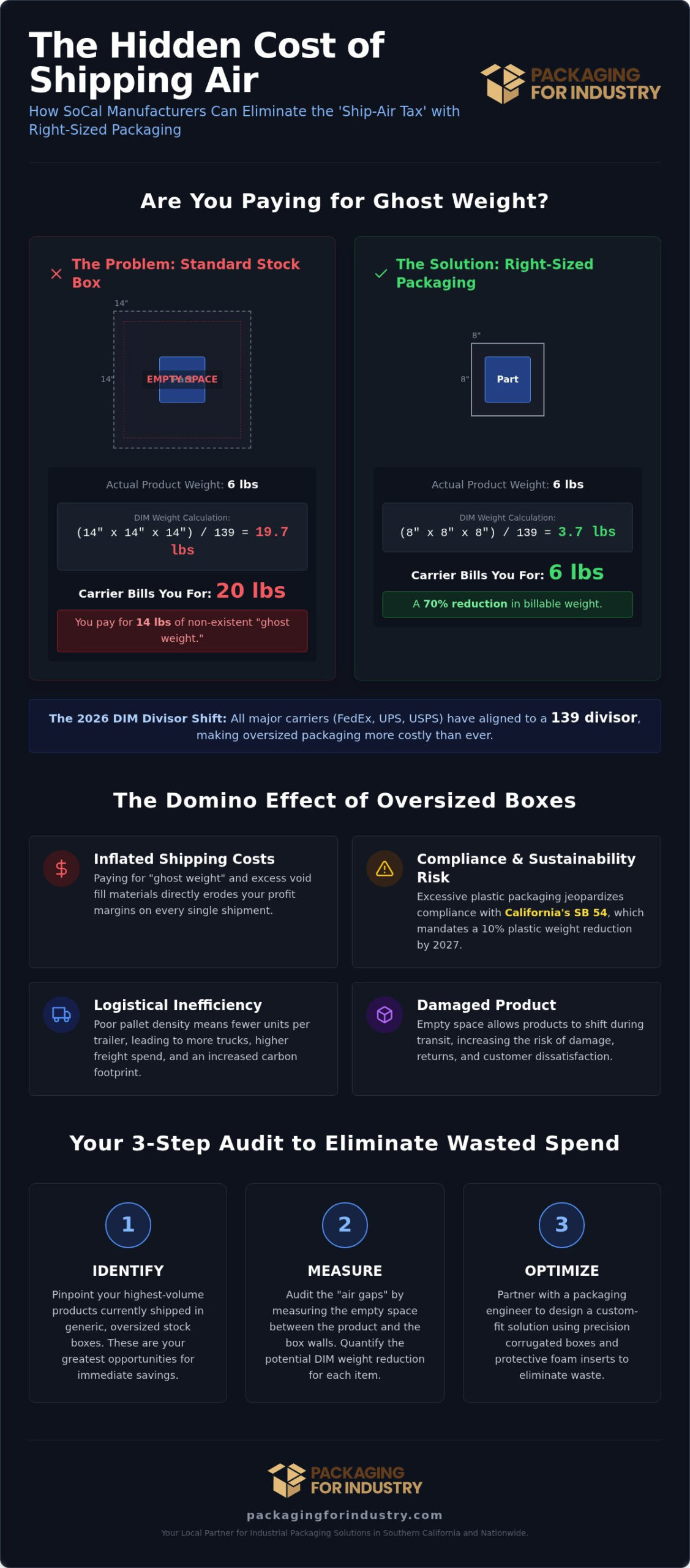
As of July 12, 2026, the USPS aligned its DIM divisor to 139 for Priority Mail, Ground Advantage, and Parcel Select. This change mirrors the standards used by FedEx and UPS, effectively ending the era of more favorable rates for bulky shipments. Furthermore, new regulations require rounding dimensions up to the nearest whole inch. For a business in Anaheim or Riverside, these incremental changes create a “ship-air tax” that directly erodes profit margins. You can reduce dimensional weight with custom packaging SoCal logistics experts recommend to reclaim that lost capital and improve overall supply chain efficiency.
The Math Behind the Surcharge
A DIM divisor is the industry standard for volume-to-weight conversion. To calculate your billable weight, you must multiply the exterior length, width, and height of your package and then divide the total cubic inches by 139. If the resulting number is higher than the actual scale weight, the carrier bills you for the higher value. The math is simple, yet the fiscal impact is severe.
Consider a specialized aerospace part weighing 6 lbs. If that part is shipped in a generic 14-inch cube stock box, the calculation (14x14x14 / 139) results in a billable weight of 20 lbs. In this scenario, you’re paying for 14 lbs of “ghost weight” that doesn’t exist. Precision engineering allows you to reduce dimensional weight with custom packaging SoCal businesses use to ensure the box fits the product with less than 1/8th inch of variance, potentially dropping that billable weight by half.
Why ‘Stock’ Boxes are Sustainable Failures
Standard catalog boxes are designed for general utility, which means they rarely provide an efficient fit for industrial equipment. To prevent transit damage in a loose-fitting stock box, warehouse teams usually resort to excessive plastic void fill, bubble wrap, or air pillows. This isn’t just an added material cost; it’s a compliance risk. Under California’s SB 54, producers must achieve a 10% reduction in plastic packaging weight by January 1, 2027.
Oversized boxes also lead to poor pallet density. When boxes are larger than necessary, you fit fewer units per pallet and fewer pallets per trailer. This inefficiency forces more trucks onto the 5 and 405 freeways, increasing your carbon footprint and total freight spend. Transitioning to custom corrugated boxes eliminates the need for non-recyclable fillers and maximizes trailer space, directly supporting both your bottom line and your B2B sustainability goals.
How Custom Packaging Design Improves B2B Sustainability
Industrial sustainability is often misunderstood as simply choosing a different material. In reality, the most effective way to improve your environmental profile is through engineering. Sustainable packaging strategies prioritize efficiency across the entire supply chain, starting with the dimensions of the box itself. When you reduce dimensional weight with custom packaging SoCal businesses can significantly lower their carbon footprint by eliminating the excess paper and plastic required to fill “dead space” in oversized stock boxes. This shift is becoming an operational necessity as California’s SB 54 requires a 10% reduction in plastic packaging weight by January 1, 2027.
Right-sizing directly impacts trailer density. Every inch of air removed from a box contributes to a more compact pallet. This allows you to ship more units per trailer, reducing the total number of trucks needed to move your inventory across Southern California. Material optimization also involves selecting the correct Edge Crush Test (ECT) rating. By using heavy-duty double-wall or triple-wall corrugated only where the load requires it, you avoid over-engineering with excessive paper. Sourcing these materials from local Southern California suppliers further supports a circular economy by reducing the transit miles of your packaging before it even reaches your warehouse.
Maximizing Cube Utilization
Standard stock boxes often result in inefficient pallet patterns with large gaps. Custom sizing allows for interlocking patterns that utilize every square inch of a 48×40 pallet. The ripple effect is clear; more units per pallet means fewer ocean containers and LTL shipments. This is especially critical for the “last mile” in congested areas like Los Angeles and Orange County, where logistical efficiency translates to lower fuel consumption and reduced transit times.
Right-Sizing with Protective Foam Packaging
Precision is the enemy of waste. By using custom foam packaging, you create a snug fit that prevents industrial components from shifting during transit. Polyethylene (PE) foam offers high-density protection for heavy aerospace or automotive parts, while Polyurethane (PU) provides softer cushioning for delicate medical electronics. Engineering the interior first allows for a smaller exterior box footprint. This method ensures you aren’t paying the “ship-air tax” while also meeting your corporate sustainability goals. If you’re ready to see how right-sizing impacts your bottom line, you can request a packaging quote to compare your current stock box costs against an engineered solution.
Engineering Solutions: Corrugated Design vs. Custom Inserts
Engineering the physical structure of your shipment is the primary way to reduce dimensional weight with custom packaging SoCal operations require. While a Regular Slotted Carton (RSC) is the most common industrial box style, it isn’t always the most efficient choice for every product. For smaller high-value components, die-cut mailers offer a more rigid, precise fit that eliminates the extra material and “flapping” found in oversized RSCs. Designing for the specific footprint of your product allows you to leverage sustainable biobased packaging materials without compromising the structural integrity needed for heavy industrial use.
Prototyping is a critical step in this process. Before a full production rollout, we use CAD design and sample tables to ensure 1/8th inch fit precision. This level of accuracy ensures you aren’t paying to ship even a single cubic inch of unnecessary volume. It also allows warehouse managers to test how the new boxes integrate with existing conveyor systems and palletizing equipment.
Heavy-Duty Corrugated for Industrial Parts
The aerospace and automotive sectors in Southern California often deal with heavy, dense parts that require more than just a single wall of cardboard. Double-wall and triple-wall custom corrugated boxes provide the stacking strength needed for industrial logistics without the massive bulk of wooden crates. The engineering challenge is balancing box strength with wall thickness. By using higher-grade liners, you can maintain protection while keeping the exterior dimensions as tight as possible.
A recent design audit for a local distributor illustrates the impact of this precision. By replacing a standard 24-inch stock cube with a 21-inch custom-engineered box, the client achieved a 12% freight saving per unit. This was possible because the tighter fit prevented internal movement, which actually reduced the need for the heavy outer wall thickness they had previously relied on for protection.
Custom Foam and Edge Protection
Reducing the box size often requires rethinking the interior. Integrating corner and edge protection allows you to use thinner box walls because the structural support is concentrated where the product is most vulnerable. Custom foam end-caps are another highly effective tool. Unlike loose fill that settles during transit, foam end-caps suspend the product in the center of the box, allowing you to reduce the overall box volume significantly.
Packaging kitting is another strategic move for DIM weight reduction. By combining multiple related parts into one optimized custom container, you eliminate the overhead of multiple smaller boxes, each with its own “air tax.” This approach streamlines your warehouse operations and ensures that your shipping costs are tied directly to the product weight rather than carrier volume surcharges. If you want to reduce dimensional weight with custom packaging SoCal experts can help you audit your current kitting processes for maximum efficiency.
How to Audit Your Current Packaging for DIM Weight Efficiency
Auditing your shipping data is the most direct path to uncovering hidden logistical waste. While weight is a fixed variable, volume is a choice. You can reduce dimensional weight with custom packaging SoCal manufacturers use to reclaim floor space and freight budget. This process requires a systematic look at how your products actually sit inside their containers. Follow these five steps to identify where your current stock boxes are failing your bottom line.
- Step 1: Identify your top 20% highest-volume shipping items. These SKUs represent the bulk of your freight spend and offer the fastest ROI.
- Step 2: Measure the “Air Gap.” Open a packed box and measure the distance between the product and the box walls. Anything over two inches of void fill is a red flag.
- Step 3: Calculate the annual “Ship-Air Tax.” Multiply the DIM weight surcharge of a single unit by your annual shipping volume for that SKU.
- Step 4: Request a structural audit. Partner with a local manufacturer to analyze if a die-cut design or a custom-sized RSC can eliminate that empty space.
- Step 5: Test palletization density. Compare how many of the new custom boxes fit on a standard 48×40 pallet versus the old stock boxes.
Conducting a ‘Void Audit’ in the Warehouse
Data on a spreadsheet only tells half the story. To truly understand your efficiency, you must involve the warehouse team in identifying recurring packaging waste. These operators see “over-boxed” items every day. They know which parts require three layers of bubble wrap just to stay centered in a generic catalog box. By documenting damage rates alongside box sizes, you can find the “sweet spot” where protection is maximized and volume is minimized. This hands-on audit often reveals that smaller, tighter-fitting boxes actually reduce shipping damage because the product has no room to build momentum during a drop or shift.
Leveraging Prototyping and CAD Support
Transitioning from a stock box to a custom solution shouldn’t involve guesswork. You should never move to full production without a physical sample to verify the fit and protection level. CAD-designed packaging ensures 1/8th inch precision for industrial components, providing a level of accuracy that generic boxes can’t match. PFI’s free prototyping helps SoCal businesses visualize the DIM weight savings before they commit to a large order. This allows you to test the new dimensions on your own packing lines and verify that your pallet patterns are optimized for maximum trailer density.
Why Choose PFI
Selecting a local partner for your logistical needs is a strategic move that impacts your entire operational overhead. As an Anaheim packaging supplier, we understand that Southern California businesses face unique freight pressures. Many procurement managers rely on national stock catalogs because the unit price per box appears lower on a purchase order. However, when you compare packaging pricing through the lens of Total Cost of Ownership (TCO), a $1.50 stock box that incurs $5.00 in carrier surcharges is significantly more expensive than a $2.00 custom-engineered box. Choosing a reliable industrial packaging supplier near me ensures you have a partner focused on eliminating those hidden fees.
Our Anaheim-based manufacturing facility allows for next-day delivery across Los Angeles, Orange County, and the Inland Empire. This proximity is the backbone of our Vendor Managed Inventory (VMI) programs. VMI allows us to act as your bulk packaging supplier without forcing you to store months of bulky custom inventory on-site. We manufacture your boxes in volume and deliver them on a just-in-time basis, synchronizing with your production schedule to free up valuable warehouse floor space for revenue-generating inventory.
PFI acts as a seasoned consultant for specialized sectors like aerospace and manufacturing. We don’t just sell boxes; we provide a complete system of protection, including wholesale packaging supplies such as heavy-duty corrugated, custom foam, and high-performance stretch film. Whether you need a specialized stretch wrap supplier to secure heavy pallets or an engineering team to lower packaging costs, our focus remains on your ROI. We reduce dimensional weight with custom packaging SoCal experts design to ensure every shipment is lean, protected, and free from carrier penalties.
Ready to eliminate the “ship-air tax” from your 2026 budget? Request a custom packaging quote to start your DIM weight audit.
Optimize Your 2026 Logistics Strategy
Carrier pricing shifts in 2026 have turned warehouse efficiency into a financial imperative. By standardizing the DIM divisor at 139, logistics providers have penalized every cubic inch of wasted space in your shipments. To protect your margins and comply with California’s evolving sustainability mandates, you must transition from generic stock boxes to engineered solutions. Our Anaheim-based manufacturing facility specializes in heavy-duty industrial corrugated and high-precision foam inserts designed for the rigorous needs of the aerospace and medical sectors.
Free structural prototyping ensures that every box fits your product with exact precision, eliminating the need for excessive plastic void fill. This approach allows you to reduce dimensional weight with custom packaging SoCal experts use to maximize trailer density and lower total freight spend. Partnering with a local supplier who understands the unique pressures of Southern California logistics provides the reliability and speed your production schedule demands.
Take control of your shipping costs today and build a more resilient, sustainable supply chain for the future.
Frequently Asked Questions
What is the standard DIM divisor for FedEx and UPS in 2026?
The standard dimensional weight divisor for FedEx, UPS, and USPS in 2026 is 139. This number is the industry standard for converting package volume into billable weight for all domestic ground and express services. Because all major carriers now use this divisor, it’s more important than ever to eliminate “dead space” in your shipments to avoid paying for weight that doesn’t exist.
How much can I actually save by switching to custom-sized boxes?
Savings are primarily driven by the reduction in billable weight and the elimination of secondary materials. When you reduce dimensional weight with custom packaging SoCal freight costs drop because you’re no longer paying the carrier’s “ship-air tax” for oversized containers. Additionally, right-sized boxes require significantly less plastic void fill and tape, which lowers your total material spend per shipped unit.
Is custom packaging more expensive than buying stock boxes in bulk?
The unit price of a custom box might be slightly higher than a generic stock box, but the total cost of ownership is usually lower. Stock boxes often lead to higher freight surcharges and increased shipping damage due to poor fit. When you factor in the reduced DIM weight charges and the decreased need for protective dunnage, custom-engineered solutions provide a much better return on investment.
How do I calculate the dimensional weight of my shipments?
To calculate DIM weight, multiply the length, width, and height of your box and divide the total by 139. Under 2026 carrier rules, you must round each dimension up to the nearest whole inch before multiplying. If the resulting DIM weight is higher than the actual scale weight, the carrier bills you for the higher amount. Precision in box sizing is the only way to control this variable.
Can custom packaging help my company meet its sustainability goals?
Custom packaging is a highly effective tool for improving B2B sustainability and trailer density. By right-sizing your boxes, you reduce the amount of corrugated material used and eliminate the need for non-recyclable plastic fillers. This also helps California businesses comply with SB 54 mandates, which require a 10% reduction in plastic packaging weight by January 1, 2027, compared to 2023 levels.
What industries benefit most from reducing dimensional weight?
Specialized sectors like aerospace, medical device manufacturing, and electronics benefit most from custom-engineered dimensions. These industries often ship high-value, lightweight, or oddly shaped parts that don’t fit standard stock boxes. By using custom corrugated and foam inserts, these companies can reduce dimensional weight with custom packaging SoCal logistics experts recommend to ensure maximum protection while minimizing the exterior footprint of every shipment.
How long does it take to get custom-engineered packaging in Southern California?
Local manufacturing in Anaheim allows for much faster turnaround times than national catalog suppliers. While out-of-state vendors might have lead times of two weeks or more, a local partner can often provide next-day delivery for established custom orders. Implementing a Vendor Managed Inventory (VMI) program further ensures that your custom-sized boxes are always in stock and ready for immediate warehouse release.
Does PFI provide prototypes before I commit to a large order?
We offer free structural prototyping to verify the fit and protection level of your design before a full production rollout. Our engineering team uses CAD software to ensure 1/8th inch fit precision for industrial components and heavy machinery. This sampling process allows you to test the box on your equipment and confirm the DIM weight savings before you make a bulk purchasing commitment.