
Your current shipping boxes might be the biggest hidden leak in your operational budget. With containerboard prices rising by a net $100 per ton in early 2026, the cost of inefficiency is higher than it’s ever been. You’ve likely seen how high shipping damage rates cause customer friction, while rising freight costs from inefficient box dimensions eat into your margins. However, getting budget approval for custom foam or heavy-duty corrugated upgrades is difficult without a data-backed case that speaks the language of the executive suite.
We’ve developed a professional packaging redesign proposal template for management to help you pitch solutions that reduce costs and win executive approval. This guide walks you through building a clear, ROI-focused pitch that justifies the investment in industrial optimization. You’ll learn how to structure your audit, quantify potential freight savings, and understand why partnering with a reliable industrial packaging supplier near me is the key to local logistical stability. Whether you’re shipping aerospace parts or medical devices, these steps will help you win the budget you need to protect your product and your profits.
Key Takeaways
- Learn how to reframe industrial packaging from a branding expense into a strategic logistical asset that improves your bottom line.
- Utilize our packaging redesign proposal template for management to build a data-driven pitch that secures executive approval for material upgrades.
- Identify hidden costs in your supply chain by quantifying transit damage rates and freight inefficiencies caused by “shipping air.”
- Discover how custom engineering and prototyping can reduce UPS and FedEx surcharges while optimizing warehouse space through VMI programs.
Why an Industrial Packaging Redesign is a Strategic Management Priority
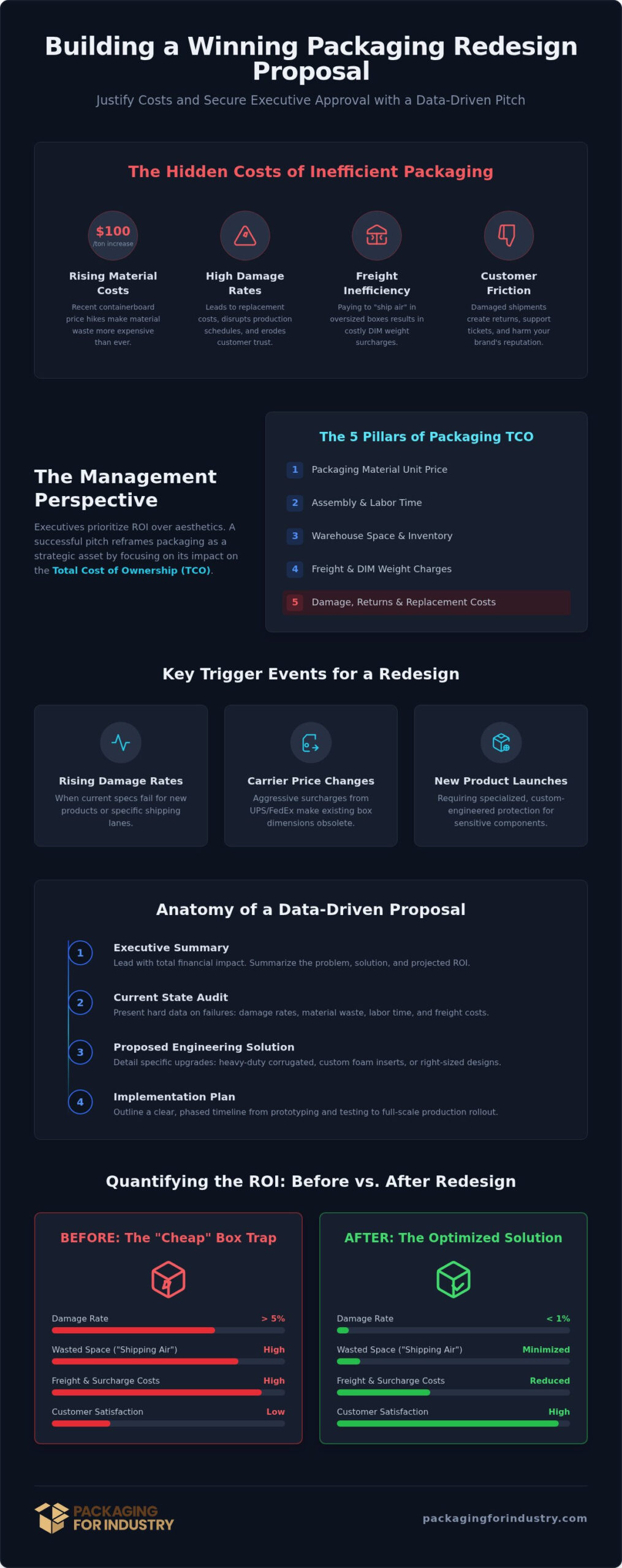
In a high-stakes industrial environment, a packaging redesign is never a branding exercise. It is a calculated logistical strategy. A packaging redesign proposal template for management serves as a data-driven pitch to optimize material use, enhance product protection, and slash shipping costs. When your operations face rising material costs, such as the net $100 per ton increase in North American containerboard prices seen in early 2026, staying with the status quo is a financial risk. Management must view packaging through the lens of engineering and economics rather than just procurement unit prices.
The high cost of “cheap” packaging is a common trap for manufacturers. Utilizing thin, standard-grade corrugated for heavy aerospace parts or sensitive medical equipment might save pennies on the front end, but it erodes profit margins through high shipping damage rates. Transit damage doesn’t just result in replacement costs; it destroys customer trust and disrupts production schedules. Industrial packaging serves functional roles beyond simple containment, involving complex standards for packaging and labeling that ensure regulatory compliance and safety during transit. By focusing on structural integrity and material efficiency, you can reduce waste while actually increasing the protection your product receives.
Identifying the Trigger Events for a Redesign
Operational leaders should recognize specific “trigger events” that signal the need for a formal redesign. If you notice rising damage rates in specific shipping lanes or for new product lines, your current specs are likely failing. Changes in carrier pricing models, such as the aggressive UPS and FedEx surcharge updates common in 2026, often make existing box dimensions obsolete. Additionally, new product launches frequently require specialized custom foam packaging to ensure precision components arrive intact. Recognizing these shifts early allows you to use a packaging redesign proposal template for management to secure the necessary budget before inefficiencies compound.
The Management Perspective: ROI vs. Aesthetics
Executives and procurement managers prioritize the bottom line over the visual appeal of a shipping container. They focus on the Total Cost of Ownership (TCO) rather than the individual unit price of a box or a roll of stretch film. In the context of industrial shipping supplies, TCO represents the cumulative cost of the packaging material, the labor required for assembly, the warehouse space consumed by the inventory, the freight charges based on DIM weight, and the cost of processing returns for damaged goods. A successful redesign reduces this total figure by improving warehouse throughput speed and eliminating “shipping air,” ensuring every dollar spent on logistics is optimized for maximum return.
Core Components of a Packaging Redesign Proposal Template
A successful pitch to leadership requires more than a simple request for new boxes. It demands a structured document that leads with engineering data and financial justification. Most generic templates focus on aesthetics, but a professional packaging redesign proposal template for management must prioritize industrial performance. The core of your document should consist of an executive summary that highlights the total financial impact, followed by a rigorous audit of your current logistical failures. This audit documents existing damage rates, material waste, and freight inefficiencies that are currently draining your operational budget.
Your proposal should then pivot to specific engineering solutions. This might include transitioning from standard containers to heavy-duty corrugated boxes or integrating custom-engineered foam inserts. By outlining a clear implementation timeline, from the initial prototyping phase to full-scale production, you demonstrate a methodical approach that minimizes risk. Sustainable packaging practices should also be integrated here, as reducing material volume through better engineering often aligns with both environmental goals and cost-reduction initiatives. If you need help gathering this data, you can request a packaging quote to begin benchmarking your current costs against optimized alternatives.
Technical Specifications and Material Selection
Management needs to see that you’ve selected materials based on durability and precision rather than just unit price. Your proposal should compare corrugated wall types, such as double wall or triple wall, to show how increased structural integrity reduces the need for excessive void fill. For high-value components in the aerospace or medical sectors, specify foam densities like Polyethylene (PE) or Polyurethane (PU) to ensure shock absorption. Additionally, addressing corner and edge protection is vital for stabilizing palletized loads and preventing the crushing that often occurs during long-haul transit or stacking in the warehouse.
Prototyping and Testing Validation
To eliminate executive hesitation, your proposal must include a section on validation. Modern CAD/CAM design allows for the creation of precision-fit prototypes that match your product’s exact geometry. Including drop testing and vibration analysis results in your pitch provides the “proof of concept” that management requires before approving a large-scale rollout. Leveraging free prototyping ensures that the proposed solution is fully vetted before any capital is committed. This engineering-first approach removes the guesswork from the process and positions the redesign as a reliable, low-risk investment in your supply chain’s stability.
Quantifying ROI: How to Justify Redesign Costs to Management
To move management from curiosity to approval, you must translate engineering specifications into financial outcomes. Your packaging redesign proposal template for management should treat the container not as a line-item expense, but as a strategic lever for profitability. While the technical details discussed in the previous sections are vital for the warehouse, the executive suite requires a clear narrative on how these changes impact the bottom line. Quantifying the Return on Investment (ROI) involves looking beyond the unit price of a box to the total logistical savings generated by a more efficient system.
The most immediate financial gain comes from the reduction in replacement costs and return shipping fees. Every time a product is damaged in transit, you lose the cost of the goods, the labor to process the return, and the freight for two extra shipments. Beyond damage, freight optimization offers significant relief from rising carrier costs. By eliminating “shipping air” through dimension optimization, you avoid the aggressive dimensional weight (DIM) surcharges that carriers use to penalize inefficient packaging. Additionally, custom design packaging streamlines the warehouse floor. When a box is engineered specifically for your product’s geometry, kitting and assembly times drop, increasing your daily throughput without adding headcount.
Warehouse space optimization is another critical factor in your ROI calculation. Integrating Vendor Managed Inventory (VMI) allows you to recover valuable square footage. Instead of storing months of bulky, empty corrugated inventory, you receive exactly what you need based on real-time demand. This shift turns a storage cost into a flexible operational asset.
The Cost of Inaction vs. The Cost of Change
Executives often hesitate because of a perceived increase in unit price for heavy duty materials. However, a 12-month projection usually reveals that freight surcharge savings and damage reduction far outweigh the incremental material cost. You should present a direct comparison: while the unit cost might rise slightly, the total logistics cost per unit will decrease. Furthermore, a professional, damage-free “unboxing” experience is a powerful tool for customer retention. Protecting your brand reputation is a long-term financial win that justifies the initial investment in engineering.
Scalability and Supply Chain Reliability
A successful redesign supports high-volume growth without a corresponding spike in damage rates. It ensures that your protective standards remain consistent even as production speeds increase. For manufacturers in Orange County, Los Angeles, or the Inland Empire, local just-in-time delivery ensures your supply chain remains reliable and responsive to market shifts. Finally, optimized packaging reduces the carbon footprint per shipment by maximizing pallet density and minimizing the fuel required to move each unit of product.
Step-by-Step Template Walkthrough: Pitching Your Redesign
A professional packaging redesign proposal template for management moves beyond theoretical benefits and focuses on a structured sequence of operational facts. Executing a pitch for industrial optimization requires a logical flow that builds confidence in your technical expertise and fiscal responsibility. By following these five steps, you can transform a complex engineering project into a clear business case that aligns with executive goals for supply chain reliability.
- Step 1: Define the Problem. Open with specific, undeniable data points. Instead of stating that damage is “too high,” document a 15% transit damage rate in your primary medical device shipping lane. Use historical records to show how these failures have directly impacted your bottom line.
- Step 2: Present the Engineering Solution. Transition from the problem to the physical upgrade. Show the physical prototype and explain the transition to higher-performance materials. If you are moving from standard boxes to custom-designed containers, explain how the new structure addresses the specific failure points identified in step one.
- Step 3: Show the Math. Detail the projected freight and labor savings. This is where you quantify the reduction in “shipping air” and calculate the decrease in dimensional weight surcharges. Include the labor hours saved on the warehouse floor through faster assembly times.
- Step 4: Risk Mitigation. Address the “what if” questions before they are asked. Explain your testing phase, including drop tests and vibration analysis results. Emphasize supplier reliability to reassure management that the transition will not cause production delays.
- Step 5: Call to Action. Conclude with a specific request. Ask for formal approval for a pilot run or a full-scale rollout of the new design.
Addressing Common Management Objections
Management often pushes back on redesigns due to perceived material costs or inventory hurdles. When an executive claims new materials are too expensive, shift the focus back to Total Cost of Ownership and the reduction in damage-related losses. If the objection concerns warehouse space, introduce VMI and stocking programs as a solution to eliminate on-site storage needs. For concerns regarding implementation speed, highlight local Southern California lead times. Working with a local partner allows for rapid prototyping and next-day delivery in areas like Anaheim and Riverside, ensuring your project stays on schedule.
Visual Aids to Include in Your Proposal
Data is more persuasive when it is visual. Include side-by-side photos of your old packaging versus the new design to highlight structural improvements. Charts showing projected freight cost reductions over a 12-month period provide a clear financial roadmap for leadership. Finally, utilize CAD drawings of custom foam inserts to demonstrate the precision engineering involved in protecting high-value components. These visual elements prove that your proposal is based on rigorous design rather than guesswork.
Why Choose PFI for Your Industrial Redesign?
Choosing the right industrial packaging supplier near me is the final step in moving your proposal from a document to a functional operational upgrade. Packaging For Industry (PFI) provides the engineering expertise and local accountability required to back every claim in your pitch to management. As a leading source for wholesale packaging supplies, we don’t just provide materials; we provide a partnership focused on precision and fiscal responsibility. Our team understands that for manufacturers in Southern California, reliability is a prerequisite for long-term success.
Industrial Products Served
Our facility is engineered to handle high-volume demands for a comprehensive range of protective materials. We specialize in heavy-duty double and triple wall corrugated containers, including custom boxes in Orange County that are designed for maximum stack strength and transit safety. As a dedicated stretch wrap supplier, we also provide high-performance hand and machine films that stabilize palletized loads while reducing material waste. Our core product offerings include:
- Protective foam packaging (PE, PU, and ESD inserts)
- Custom and stock corrugated boxes (Heavy-duty, Double wall, Triple wall)
- Corner and edge protection for pallet stability
- Mailing tubes, pallets, crates, and military-spec packaging
Sectors and Industries Served
PFI is a trusted Los Angeles packaging supplier for specialized sectors where failure is not an option. We understand the rigorous regulatory and durability standards of the aerospace, medical, and electronics industries. Whether you are shipping sensitive medical equipment from Anaheim or aerospace components from Riverside, our team ensures your packaging meets every technical specification. By aligning our custom engineering with your industry’s specific challenges, we help manufacturers across the Inland Empire and beyond improve supply chain reliability and protect their brand reputation.
Ready to move forward? Our engineering team is standing by to provide the data, prototypes, and logistical support needed to execute your redesign with confidence. We offer local next-day delivery and Vendor Managed Inventory (VMI) to ensure your warehouse always has the protection it needs without the burden of excess inventory.
Optimize Your Industrial Logistics Strategy
Optimizing your supply chain starts with viewing every shipping container as a strategic asset rather than a simple expense. By utilizing a comprehensive packaging redesign proposal template for management, you can present a clear, data-driven path toward reducing transit damage and lowering total logistics costs. We’ve established that precision engineering and ROI-focused math move the needle for executives who prioritize fiscal responsibility over simple unit pricing. Transforming your packaging is a practical step toward professional peace of mind and operational stability.
PFI is prepared to serve as your engineering partner during this transition. We are specialists in damage reduction for the aerospace and electronics sectors, providing the technical validation your leadership requires. Our free prototyping for industrial fit ensures your new design works perfectly before a full rollout. Additionally, our local next-day delivery across Southern California keeps your warehouse running at peak efficiency without the long lead times of traditional catalog suppliers. We help you eliminate shipping friction and protect your bottom line with every shipment.
Let’s work together to turn your logistical challenges into measurable cost savings and improved reliability.
Frequently Asked Questions
What should be the #1 focus of a packaging redesign proposal for management?
The primary focus must be the Total Cost of Ownership (TCO) rather than the unit price of individual materials. Executives prioritize how a redesign reduces long-term expenses like shipping damage, freight surcharges, and labor inefficiencies. Using a packaging redesign proposal template for management that highlights these financial outcomes ensures your pitch aligns with corporate fiscal goals and demonstrates a pragmatic approach to logistical optimization.
How do I calculate the ROI of a packaging redesign?
Calculate ROI by totaling the annual savings from reduced product replacement costs, lower return shipping fees, and diminished freight surcharges. Compare these cumulative savings against the initial investment in new materials or custom tooling. You should also factor in labor efficiency gains if the new design speeds up the kitting or assembly process on your warehouse floor, as throughput speed directly impacts your bottom line.
Why is custom foam better than standard void fill for high-value goods?
Custom foam packaging provides a precision fit that standard void fill cannot match, ensuring high-value components remain stationary during transit. It offers superior shock absorption and vibration dampening for sensitive aerospace or medical electronics. While standard fill often leads to over-packing and material waste, custom inserts streamline the assembly process and provide consistent, repeatable protection that eliminates the human error often found in manual packing.
How can a packaging redesign lower my UPS or FedEx freight costs?
Redesigning your containers allows you to optimize box dimensions and eliminate “shipping air” that triggers expensive dimensional weight (DIM) surcharges. By reducing the external volume of your packages without compromising protection, you lower the billable weight assigned by carriers like UPS or FedEx. This engineering-first approach ensures you only pay for the space your product actually requires, significantly reducing your annual freight spend.
What is the typical timeline for an industrial packaging redesign?
A typical redesign timeline ranges from two to six weeks depending on the complexity of the engineering required. The process begins with a logistical audit and CAD design, followed by the creation of physical prototypes for fit and testing. Once the design is validated through drop or vibration analysis, full-scale production and rollout can typically begin within several business days for local Southern California operations.
Does PFI provide the data needed for a management proposal?
Yes, PFI acts as your engineering partner by providing the technical specifications and cost-benefit data required for your packaging redesign proposal template for management. We offer free prototyping to ensure a perfect fit and provide the data points needed to justify material upgrades to your procurement department. This support allows you to present a vetted, low-risk solution to your leadership team with confidence.
How do I address concerns about switching from a large catalog supplier?
Address these concerns by comparing the hidden costs of standardized packaging against the savings of an engineered solution. While catalog suppliers provide convenience for small stock orders, they don’t offer the engineering support required to optimize pallet density or reduce transit damage. PFI offers local Southern California support and custom-tailored designs that catalog distributors can’t provide, ensuring a lower total cost of ownership through precision and scalability.
Can PFI help with mil-spec packaging redesigns for defense contracts?
PFI has extensive experience in military packaging and can assist with redesigns that meet strict defense contract requirements. We understand the durability and labeling standards necessary for mil-spec compliance across various branches of service. Our team ensures your crates, boxes, and protective inserts satisfy government regulations while maintaining the logistical efficiency needed for high-volume manufacturing and secure distribution.