
Most operations don’t have a stretch film problem. They have a stretch film habit. Rolls get used without a wrapping standard in place, operators apply more layers than the load actually needs, and the cost quietly climbs month after month. If that sounds familiar, you’re not alone.
The good news is that you don’t have to choose between load security and cost control. Many manufacturers, distributors, and warehouse operations find that the effort to reduce stretch film usage doesn’t compromise pallet integrity at all. In fact, it often improves it by replacing guesswork with a consistent, repeatable process.
This guide walks you through practical, proven strategies to cut film consumption without cutting corners. You’ll learn how wrapping technique, film selection, and equipment calibration all affect how much material you’re actually using, and where the biggest opportunities for savings typically hide. Whether you’re managing a single shipping dock or a multi-facility distribution network, the steps covered here are directly actionable and built around real operational needs.
Key Takeaways
- Standardized wrapping procedures are one of the most effective ways to reduce stretch film usage without compromising load stability or pallet integrity.
- Equipment calibration and proper tension control directly influence how much film is consumed per load – small adjustments can yield measurable reductions in material cost over time.
- Selecting the right stretch film for your specific load type and transit requirements eliminates the common habit of over-wrapping to compensate for the wrong product.
- Automated wrapping technology and advanced tension control systems can significantly improve film efficiency, delivering consistent results that manual wrapping rarely achieves.
- Partnering with a knowledgeable industrial packaging supplier gives you access to tailored film options and expert guidance that aligns your wrapping process with both operational and cost reduction goals.
Understanding Stretch Film and Its Role in Packaging
Stretch film is a highly elastic polyethylene material used to unitize, stabilize, and protect pallet loads during storage and transit. In industrial environments, it’s one of the most frequently consumed packaging consumables on the floor. Manufacturers, distributors, and warehouse operations rely on it to keep products contained, protect against moisture and dust, and prevent load shifting that leads to shipping damage and customer complaints.
The problem isn’t that stretch film is the wrong tool. It’s that most operations use it without a clear framework for how much is actually needed. That gap between what’s required and what’s applied is where unnecessary cost accumulates. Learning to reduce stretch film usage starts with understanding what you’re working with and why each variable matters.
Types of Stretch Film
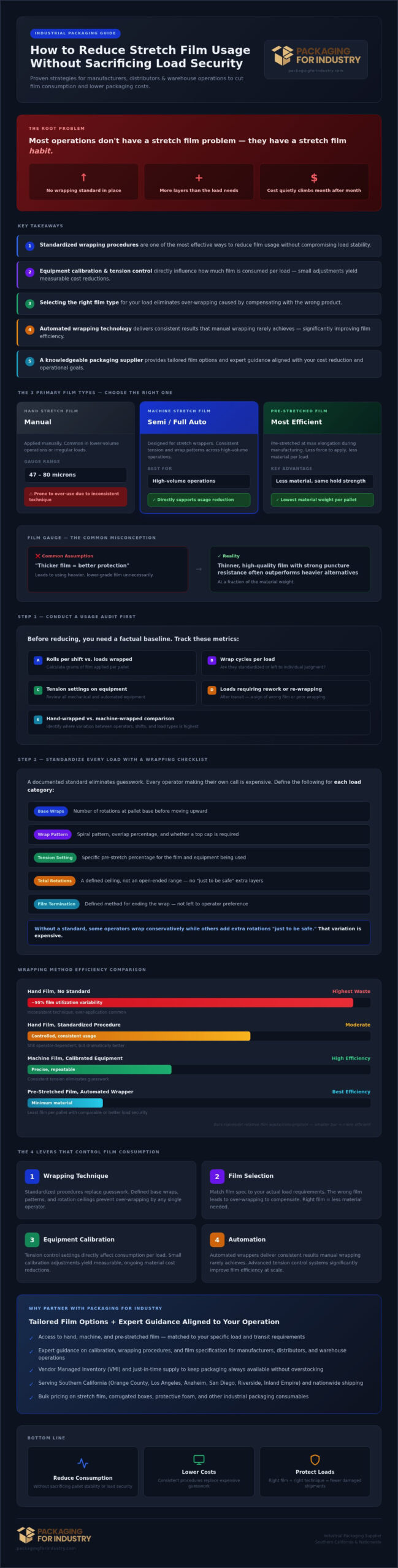
Not all stretch film performs the same way, and selecting the wrong type is one of the fastest paths to over-consumption. The three primary categories used in industrial packaging are:
- Hand stretch film: Applied manually, typically in gauges ranging from 47 to 80 microns. It’s common in lower-volume operations or for wrapping irregular loads, but inconsistent application technique makes it prone to over-use.
- Machine stretch film: Designed for use with semi-automatic or fully automatic stretch wrappers. It delivers consistent tension and wrap patterns, which directly supports efforts to reduce stretch film usage across high-volume operations.
- Pre-stretched film: Manufactured at or near its maximum elongation point before it reaches the operator. Because the stretching work is done in production, it requires less force to apply and typically uses less material per load while maintaining comparable holding strength.
Thickness, or gauge, is equally important. Thicker film isn’t always better. A thinner, higher-quality film with strong puncture resistance and cling often outperforms a heavier, lower-grade alternative at a fraction of the material weight. Matching film specification to your actual load requirements eliminates the guesswork that drives unnecessary consumption.
Evaluating Current Usage
Before you can reduce consumption, you need a clear picture of where film is going. Start by tracking rolls consumed per shift against the number of loads wrapped. From there, calculate grams of film applied per pallet. Compare that figure across operators, shifts, and load types to identify where variation is highest.
Key areas to examine during an initial usage audit include:
- Wrap cycles per load and whether they’re standardized or left to individual judgment
- Film tension settings on any mechanical or automated equipment
- Load types that consistently require rework or re-wrapping after transit
- Differences in consumption between hand-wrapped and machine-wrapped pallets
This kind of structured assessment gives procurement and operations teams a factual baseline. Without it, any reduction effort is just a guess. With it, you can identify the specific points in your process where film is being applied beyond what load stability actually demands.
Strategies to Reduce Stretch Film Usage
Knowing where film is being wasted is only half the equation. The other half is putting systematic controls in place that prevent that waste from recurring. The operations that consistently reduce stretch film usage aren’t doing anything radical. They’ve simply replaced informal habits with defined procedures, and they enforce those procedures through training and accountability.
Standardizing Procedures
Without a documented wrapping standard, every operator makes their own judgment call. Some will wrap conservatively. Others will add extra rotations “just to be safe.” That variation is expensive. A standardized procedure eliminates the guesswork by specifying exactly what each load type requires.
A practical wrapping checklist should define the following for each load category:
- Number of base wraps: How many rotations at the pallet base before moving upward
- Wrap pattern: Spiral, overlap percentage, and whether a top cap is required
- Tension setting: Specific pre-stretch percentage for the film and equipment being used
- Total rotations per load: A defined ceiling, not an open-ended range
- Film termination method: How the tail is secured to prevent unraveling without adding unnecessary layers
Different products need different specifications. A stable, uniform load of boxed goods doesn’t require the same wrap profile as an irregular or top-heavy load. Document both, and make the distinction clear in your standard operating procedure. Review these documents at least quarterly, especially when load types, film suppliers, or equipment change.
Training and Accountability
A checklist on paper doesn’t change behavior on the floor. That requires training that’s hands-on, specific, and repeated. New operators should be walked through the wrapping standard before they wrap a single load independently. Existing staff benefit from periodic refreshers, particularly when equipment settings are adjusted or a new film specification is introduced.
Accountability doesn’t have to mean discipline. It means measuring outcomes. Track film consumption per operator and per shift, and share that data with the team. When an operator consistently uses less film without any increase in transit damage, that’s worth recognizing. When consumption spikes without a clear reason, that’s a signal to investigate, not ignore.
Conduct wrapping audits regularly. A supervisor or lead observing the process in real time will catch technique issues that a consumption report alone won’t reveal: film being applied at the wrong tension, unnecessary overlap, or tail ends left loose. These small corrections compound into meaningful savings over time.
If you’re ready to align your wrapping procedures with the right film specifications for your load types, request a packaging quote from PFI and get recommendations tailored to your operation.
The Economic Benefits of Reducing Stretch Film Usage
Stretch film is rarely the largest line item in a packaging budget, but it’s one of the most consistently mismanaged. When consumption isn’t tracked and wrapping procedures aren’t standardized, the overage compounds quietly across every shift, every pallet, and every facility. The financial case for tightening that process is straightforward: less material applied per load, multiplied across thousands of loads per year, produces meaningful cost reduction without any sacrifice in load security.
The calculation starts with your current baseline. If you know how many rolls your operation consumes per month and the cost per roll, you can model what a 15% or 20% reduction in film consumption would return annually. For high-volume operations wrapping hundreds of pallets daily, that figure is rarely trivial. It often runs into tens of thousands of dollars per year, and it doesn’t require capital investment to achieve. It requires process discipline.
There are several cost categories where optimized film use produces measurable savings:
- Direct material cost: Fewer rolls consumed per period at the same load volume directly reduces procurement spend.
- Labor efficiency: Standardized wrap cycles reduce the time operators spend on each pallet, which adds up across a full shift.
- Damage-related costs: Consistent, properly tensioned wrapping reduces load failures in transit, which cuts claim costs, product replacement, and customer service overhead.
- Storage and inventory carrying costs: Buying less film means storing less film, which frees up warehouse space and reduces the capital tied up in consumable inventory.
Case Studies and Examples
Operations that have moved from informal wrapping habits to documented, enforced standards consistently report measurable reductions in film consumption. A regional food distributor that implemented pre-stretch film alongside defined wrap cycles for its pallet types reported a significant drop in rolls consumed per week without any increase in transit damage claims. A manufacturing facility that switched from hand film to machine film with calibrated pre-stretch settings reduced its per-pallet film weight while improving load consistency across shifts. These outcomes aren’t exceptional. They’re what happens when guesswork is replaced with a repeatable system. The specific savings vary by operation size, load type, and starting baseline, but the direction is consistent.
Understanding Environmental Impact
Reducing stretch film usage also aligns directly with corporate sustainability commitments. Polyethylene film is a petroleum-derived material, and every gram eliminated from the wrapping process represents a reduction in plastic waste entering the supply chain. For operations with ESG reporting requirements or customers who evaluate supplier sustainability practices, demonstrating measurable reductions in film consumption is a concrete, documentable improvement. It connects packaging efficiency to broader organizational goals without requiring separate sustainability initiatives. Efficiency and responsibility, in this case, point in exactly the same direction.
If you want to understand where your current film spend stands and what a more optimized approach could return, explore PFI’s packaging cost savings resources or request a quote to get film recommendations matched to your specific load types and volume.
Leveraging Technology for Efficient Stretch Film Usage
Process discipline and the right film specification will take you far. But technology closes the gap between what a well-trained operator can achieve and what a calibrated, automated system delivers consistently across every shift, every load, and every operator. For operations wrapping at volume, that consistency is where the most durable savings live.
Choosing the Right Equipment
Automated stretch wrappers, both semi-automatic and fully automatic, remove the single largest source of film variability: human judgment. A calibrated machine applies the same tension, the same wrap pattern, and the same number of rotations to every pallet it processes. That repeatability is difficult to achieve manually, and it’s the foundation of any serious effort to reduce stretch film usage at scale.
When evaluating equipment, the most critical specification to examine is the pre-stretch capability. Machines with powered pre-stretch systems elongate the film before it contacts the load, which means more coverage per gram of material. High-performance stretch wrappers can achieve pre-stretch ratios that deliver significantly more film surface area per roll compared to hand application, without sacrificing holding force. The result is fewer rolls consumed per period at the same or greater load stability.
Other equipment factors that directly affect film consumption include:
- Tension control systems: Advanced tension control maintains consistent film force throughout the wrap cycle, preventing the over-application that happens when operators compensate for inconsistent manual tension.
- Programmable wrap cycles: Equipment that stores load-specific programs eliminates guesswork at the machine level. Operators select a profile; the machine executes it identically every time.
- Film carriage design: A well-engineered film carriage minimizes drag and resistance, which reduces film breaks and the material waste that comes with re-starting a wrap cycle mid-load.
Ongoing Monitoring and Adjustment
Equipment doesn’t manage itself. Even a well-calibrated stretch wrapper drifts over time as mechanical components wear, film specifications change, or load types shift. A monitoring system that tracks film consumption per load, per shift, and per machine gives operations teams the visibility they need to catch that drift early.
Start with a simple tracking structure: rolls consumed against loads wrapped, broken down by machine and time period. From there, layer in load-specific data where possible. If one machine is consistently consuming more film than another running the same program, that’s a calibration issue, not a film issue. Catching it through data prevents weeks of unnecessary material spend.
Schedule equipment reviews on a defined cadence, not just when something breaks. Pre-stretch rollers, tension brakes, and film carriages all affect consumption, and their performance degrades gradually. A quarterly review of machine settings against your current film specification keeps the system performing as intended. When film suppliers change or a new load type enters the operation, treat that as a trigger for an immediate equipment review rather than waiting for consumption to spike before investigating.
Why Choose Packaging For Industry for Your Stretch Film Needs
Putting better wrapping procedures in place is straightforward when you have the right supplier behind you. Packaging For Industry works with manufacturers, distributors, and warehouse operations across a wide range of industries, providing stretch film options and packaging expertise that align with real operational requirements, not generic catalog recommendations. The difference between a transactional supplier and a knowledgeable partner shows up quickly when you’re trying to reduce stretch film usage across multiple load types, shifts, and facilities.
PFI’s approach starts with understanding your specific application. Load characteristics, transit conditions, wrapping equipment, and volume all influence which film specification will perform best at the lowest material cost. Rather than defaulting to a standard gauge and leaving the rest to your operators, PFI matches film selection to your actual requirements. That precision eliminates the over-specification habit that quietly inflates consumption month after month.
For operations across Southern California, including Orange County, Los Angeles, Anaheim, San Diego, Riverside, and the Inland Empire, PFI provides reliable local supply with the inventory depth to support consistent volume. Nationwide shipping capabilities extend that reliability to multi-facility operations regardless of location.
Our Value-Added Services
Beyond film supply, PFI offers a set of services designed to remove friction from your packaging supply chain and keep costs predictable. These include:
- Vendor Managed Inventory (VMI): PFI monitors your consumption patterns and manages replenishment proactively, so you’re not carrying excess inventory or scrambling to reorder when stock runs low. VMI reduces the administrative burden on your procurement team while keeping your operation supplied without interruption.
- Just-in-time inventory management: For operations where storage space is limited, just-in-time delivery reduces the capital tied up in consumable stock and frees up floor space for higher-priority uses.
- Custom packaging solutions: When standard film specifications don’t fit your load profile or equipment, PFI develops tailored solutions that address the specific requirements driving your consumption or damage challenges.
These services work together to create a supply chain structure that supports consistent wrapping standards rather than working against them. When the right film arrives on time, in the right quantity, your operators can follow the procedures you’ve built without improvising around shortages or substitutions.
Get Started Today
If your operation is ready to move from informal wrapping habits to a documented, cost-controlled process, PFI is a practical starting point. Request a packaging quote to get film recommendations matched to your load types and volume, or contact PFI directly to discuss how a more structured approach can reduce stretch film usage and lower your overall packaging spend. You can also explore the full range of stretch film products to identify the specifications most relevant to your application.
Turn Film Waste Into a Competitive Advantage
Reducing stretch film usage isn’t a single fix. It’s the result of several decisions working together: the right film specification for your load type, a documented wrapping standard your team actually follows, equipment calibrated to deliver consistent tension, and a supplier who understands your operation well enough to support all of it.
The operations that get this right don’t just spend less on film. They run more predictably, ship with fewer damage claims, and free up procurement bandwidth that was previously spent managing a consumable that nobody was really watching.
PFI brings the expertise in custom packaging solutions, the commitment to reducing your packaging costs, and the supply chain reliability to make that consistency achievable. Whether you’re starting with a usage audit or ready to evaluate new film specifications, the next step is straightforward.
Your packaging spend deserves the same operational discipline you apply everywhere else in your facility. The right partner makes that easier than you’d expect.
Frequently Asked Questions
What are the best practices for using stretch film efficiently?
The most effective practice is replacing informal wrapping habits with a documented standard that specifies wrap cycles, tension settings, overlap percentage, and film termination method for each load type. Without that structure, individual operators make their own judgment calls, and that variation is where unnecessary consumption hides. Consistent procedures applied across every shift are more impactful than any single equipment upgrade or film switch.
Conducting regular wrapping audits reinforces those standards. A supervisor observing the process in real time catches technique issues that consumption reports alone won’t surface, such as excessive overlap or incorrect tension, before they compound into significant material waste.
How can I ensure my packaging remains secure with less stretch film?
Load security with less film comes down to applying the right tension consistently rather than adding extra layers to compensate for inconsistent technique. Properly tensioned film creates stronger holding force per layer than loosely applied film does with additional rotations. Matching your film specification to your actual load weight, shape, and transit conditions eliminates the over-wrapping habit that develops when operators don’t trust the film they’re using.
Pre-stretched film is particularly effective here. Because it’s manufactured near its elongation limit, it delivers strong cling and containment force with less material weight per pallet, without sacrificing the stability your loads need in transit.
What equipment can help reduce stretch film waste?
Semi-automatic and fully automatic stretch wrappers are the most direct equipment solution. They apply consistent tension, repeat the same wrap pattern on every load, and eliminate the variability that drives over-consumption in manual wrapping environments. Machines with powered pre-stretch systems are especially efficient, elongating film before it contacts the load so each roll covers more surface area than hand application allows.
Programmable wrap cycles take that consistency further by storing load-specific profiles. Operators select the correct program, and the machine executes it identically every time, removing guesswork at the point of application and preventing the informal adjustments that quietly inflate film usage.
Are there specific types of stretch film that are more efficient?
Pre-stretched film and high-performance machine film are generally the most efficient options for operations focused on reducing stretch film usage. Pre-stretched film requires less force to apply and uses less material per load because the elongation work is done during manufacturing. High-performance machine film in thinner gauges with strong puncture resistance often outperforms heavier, lower-grade alternatives at a fraction of the material weight.
The key is matching film specification to your specific load type rather than defaulting to a standard gauge across all applications. A thinner, higher-quality film suited to your load profile will consistently outperform a heavier film applied to loads it wasn’t designed for.
How can reducing stretch film usage benefit my business financially?
The financial benefit operates across several cost categories simultaneously. Direct material spend drops as fewer rolls are consumed per period. Labor efficiency improves because standardized wrap cycles reduce the time spent on each pallet. Consistent, properly tensioned wrapping also reduces load failures in transit, which cuts damage claims, product replacement costs, and the customer service overhead that follows.
For high-volume operations, the cumulative effect of optimizing film consumption across thousands of pallets per year is meaningful. It doesn’t require capital investment to achieve; it requires process discipline applied consistently across shifts and facilities.
What impact does stretch film waste have on the environment?
Stretch film is a petroleum-derived polyethylene material, so every gram eliminated from the wrapping process represents a direct reduction in plastic waste entering the supply chain. Operations that tighten their wrapping standards and match film specification to actual load requirements generate less plastic waste per period without any reduction in load protection.
For businesses with ESG reporting requirements or customers who evaluate supplier sustainability practices, documented reductions in film consumption provide a concrete, measurable improvement. Packaging efficiency and environmental responsibility point in the same direction here, making this one of the more straightforward sustainability gains available to warehouse and distribution operations.