
If your automated case packer is jamming multiple times per shift, you likely don’t have a machinery problem; you have a design flaw in your corrugated supplies. It’s a common frustration for operations managers in Southern California who invest heavily in automation only to see throughput throttled by inconsistent box folding or suction cup failures on porous materials. You’ve likely felt the sting of high waste rates and the professional stress of a stalled production line when hardware and materials aren’t in sync.
We understand that seamless integration between your hardware and your packaging is the only way to protect your bottom line. This technical guide will teach you how to engineer corrugated and foam solutions that eliminate machine jams and maximize the ROI of your systems. By focusing on precision scoring and specific material finishes, you can finally achieve the reliable, high-volume output your facility requires without the constant threat of downtime.
We’ll explore the critical role of packaging design for automated case packing lines, covering everything from moisture-resistant coatings to the exact tolerances needed for robotic arms. Whether you’re looking for a custom packaging quote or a reliable industrial packaging supplier near me in Anaheim or Los Angeles, this overview provides the engineering-first perspective needed to lower your per-unit costs and improve supply chain reliability.
Key Takeaways
- Discover why recurring machine jams are often caused by material tolerances rather than mechanical failure and how to engineer your way out of downtime.
- Learn the technical requirements for packaging design for automated case packing lines, focusing on the rigid consistency required for robotic suction and pick-and-place systems.
- Understand the critical role of precision scoring and selecting the right corrugated flute profiles to ensure clean, repeatable 90-degree folds in high-speed environments.
- Explore how CAD/CAM simulation and free prototyping allow you to verify fit and function before committing to high-volume production runs.
- Find out how integrated engineering and Vendor Managed Inventory (VMI) programs ensure your automated lines never stop due to supply chain shortages or material inconsistencies.
The Critical Role of Packaging Design in Automated Case Packing
Automated case packing design is the specialized engineering of corrugated boxes and inserts to meet the rigid tolerances of robotic systems. Unlike manual packaging, where human operators can adjust for minor inconsistencies, automated systems require absolute uniformity. If a box is slightly out of square or a score line is shallow, the machine doesn’t compensate; it simply jams. This precision is what separates high-performance logistics from a production line plagued by constant restarts.
Many manufacturers attempt to use manual-grade packaging in robotic top-load or drop-pack environments to save on material costs. This is a strategic error. Manual-grade supplies often suffer from wider dimensional variances that robots cannot process. When your automated hardware encounters a warped blank or an improperly glued joint, the resulting downtime erodes the ROI of your equipment. High waste rates and labor costs spent clearing jams quickly outweigh any perceived savings from cheaper, non-optimized materials.
Bridging the Gap Between Hardware and Corrugated
High-speed hardware and raw materials often exist in tension. Precision packaging design for automated case packing lines serves as the bridge that resolves this conflict. Robotic grippers and suction cups rely on predictable surface tension and placement. If your corrugated board has inconsistent caliper, your case erector might pull two blanks at once or fail to secure a grip entirely. Consistent board thickness is a non-negotiable requirement for maintaining machine speed and reliability. Through custom design packaging, we ensure that the material specs match the mechanical requirements of your specific packing brand and model.
Common Failures in Non-Optimized Designs
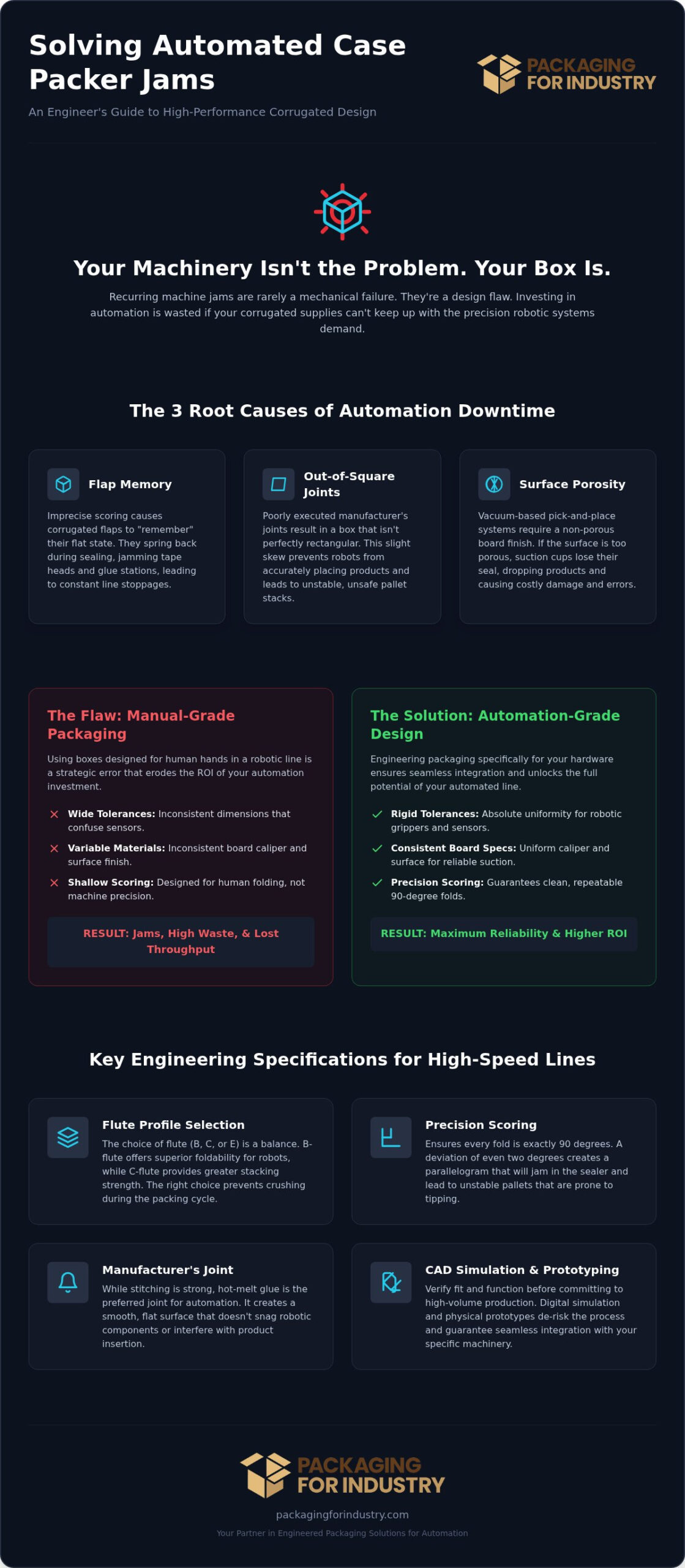
Identifying why a design fails is the first step toward optimization. In our experience as a Southern California industrial supplier, most automation failures stem from three specific areas:
- Flap Memory: If scores are not deep or precise enough, the corrugated flaps “remember” their flat state. They spring back during the sealing process, causing jams in the tape head or glue station.
- Out-of-Square Joints: A poorly executed manufacturer’s joint results in a box that isn’t perfectly rectangular. This prevents the robot from accurately placing products inside or stacking the finished cases on a pallet.
- Surface Porosity: Vacuum-based pick-and-place systems require a specific board finish. If the corrugated surface is too porous, the suction cups lose their seal, leading to dropped products and damaged goods.
Engineering around these failures requires a deep understanding of both material science and mechanical engineering. By focusing on these technical details during the design phase, you ensure that your automated line runs at its rated capacity without interruption.
Engineering Corrugated Boxes for High-Speed Automation
Engineering high-speed corrugated solutions requires moving beyond standard catalog options. When you’re refining your packaging design for automated case packing lines, the choice of flute profile is your foundation. C-flute provides excellent vertical stacking strength, but B-flute offers superior foldability and crisp score lines that robotic folders prefer. For smaller applications, E-flute provides a thinner profile that reduces storage space while maintaining the rigidity needed for vacuum pickers. Selecting the wrong profile often leads to “crush” during the packing cycle, which ruins the structural integrity of the case before it even leaves your facility.
Precision scoring ensures that every fold occurs at exactly 90 degrees. If the fold is even two degrees off, the box will travel through the sealer as a parallelogram rather than a rectangle. This misalignment causes jams in the tape head and results in pallets that are unstable and prone to tipping. Beyond the folds, the manufacturer’s joint is a critical decision point. While stitching offers high strength for heavy-duty loads, hot-melt glue is the preferred joint for automation because it creates a flatter profile that doesn’t snag on machine rails. By optimizing these dimensions, you don’t just reduce internal movement of your product; you also minimize the outer footprint to lower your freight costs.
Precision Scoring and Folding Tolerances
The “break” of the corrugated board depends entirely on the depth of the score. Deep-score engineering ensures the board yields exactly where intended, preventing the “tenting” effect where flaps bulge upward. Calculating the precise gap between inner and outer flaps is essential; if the gap is too tight, the flaps will collide and prevent a square closure. We use CAD-driven cutting systems to maintain sub-millimeter accuracy, ensuring that every blank in a high-volume run is identical to the prototype. If you’re struggling with inconsistent folding, you can request a packaging quote to see how precision-engineered blanks improve your uptime.
Material Finish and Suction Reliability
Robotic vacuum heads require a specific linerboard finish to maintain a seal. High recycled content in corrugated boxes can increase board porosity, causing suction cups to drop the case mid-cycle. Additionally, the color of your board affects machine sensors. Natural kraft is the industrial standard, but bleached kraft or white-top liners provide the high contrast necessary for optical sensors to detect flap position at high speeds. Balancing these aesthetic choices with technical requirements ensures your hardware handles the packaging without errors.
Manual vs. Automated Packaging Design: Key Differences
Manual packing allows for a high degree of on-the-fly adjustment. If a box is slightly warped, a human operator uses their hands to force it into square and applies tape to hold it there. In contrast, packaging design for automated case packing lines must account for the fact that a robot has no such intuition. If the material doesn’t arrive in the exact specified dimension, the process stops. Robots require 100% consistency because they operate on fixed coordinates; any deviation is treated as a collision or a failure.
Closure methods also differ significantly between these two environments. Tape is the industrial standard for manual lines because it’s easy for humans to apply and correct. However, hot-melt glue is often the superior choice for automation. Glue systems provide a faster, more permanent bond that reinforces the structural integrity of the box. Unlike tape, glue doesn’t peel or snag on conveyor rails, which is a common cause of jams in high-speed facilities. Designing for glue requires specific flap overlaps that aren’t necessary for tape-closed boxes.
Mechanical vacuum opening is another critical area where manual boxes fail. A human can easily find the edge of a flat box and pop it open. A machine uses suction cups to pull the panels apart. If the manufacturer’s joint is too thick or the board is too stiff, the vacuum may fail to break the score, leading to a “no-pick” error. This requires a level of engineering that catalog boxes simply don’t provide. We focus on the physics of the “break” to ensure your case erector works every time.
Case Erecting and Squaring Requirements
Squareness is the single most important factor for downstream success. If a case erector produces a box that is even slightly out of square, every subsequent step fails. Products won’t fit correctly, and the automated palletizer will struggle to create a stable load. Consistent glue tab placement is vital here; even a millimeter of drift in the tab’s position can prevent the box from squaring up. Our Manufacturing Packaging Solutions focus on these minute details to ensure your line maintains maximum throughput.
Robotic Grip Points and Clearance
When designing inserts, we must prioritize robotic drop-in capability. Manual packing often involves tucking foam around a product, which is difficult for a robotic arm. We design protective foam packaging with clear grip zones so mechanical end-of-arm tools can securely hold the part. We also account for robotic arm swing and interior clearance. If the foam insert is too bulky or lacks defined suction zones, it will interfere with the robot’s movement, causing collisions or dropped components. Proper clearance ensures the robot can enter and exit the case without snagging the corrugated walls.
Prototyping and Testing for Case Packing Success
Prototyping is the phase where engineering theory meets the reality of the conveyor belt. For packaging design for automated case packing lines, a digital concept is insufficient. You must verify how the physical material reacts to the mechanical force of your specific case erector and loader. We provide free prototyping for fit and function to ensure that your design is optimized before you commit to a high-volume production run. This proactive approach identifies potential mechanical conflicts early, preventing the costly mistake of ordering thousands of unusable blanks.
While a single sample confirms the dimensions, a pilot run of at least 50 boxes is essential for validating high-speed performance. This quantity allows you to test the machine’s ability to pull blanks from a stack, which is where issues like “blank sticking” or friction variances often appear. During these tests, we also validate the protection levels of our custom inserts through drop testing and vibration analysis. This ensures that your products survive the rigors of the supply chain without the need for over-engineered, expensive materials.
The Importance of CAD-Driven Prototypes
Digital blueprints provide the foundation for total consistency across multiple production runs. By utilizing CAD/CAM technology, we move from initial design to a physical sample in as little as 24 hours at our Anaheim facility. This rapid iteration allows your team to test physical samples on your actual hardware without delaying your production schedule. Our custom design packaging services ensure that every box produced matches the original master file with sub-millimeter accuracy, maintaining the tight tolerances your robotic sensors require.
Stress-Testing Material Consistency
Environmental factors can change how corrugated board behaves on an automated line. We test board moisture levels because excess humidity can soften the board, leading to “crush” during the mechanical folding process. Similarly, we evaluate the compression set of our foam packaging to ensure it maintains its shape after being compressed by robotic grippers. Burst strength, or Mullen test rating, measures the pressure required to rupture a corrugated board face, which is a vital metric for ensuring bottom-loading automated systems don’t fail under product weight. By stress-testing these variables, we guarantee a material that remains stable in various warehouse conditions.
Optimizing Your Automated Line with PFI Custom Solutions
Achieving peak efficiency requires an integrated approach that treats every component of the pack-out as a single engineered system. When we provide packaging design for automated case packing lines, we don’t just look at the box in isolation. We synchronize custom corrugated containers with precision-matched foam packaging to ensure total compatibility with your robotic hardware. This eliminates the common friction between disparate suppliers and ensures that your internal inserts don’t interfere with the automated sealing or stacking process. For high-stakes sectors like aerospace and electronics in Southern California, this level of coordination is the difference between a fluid supply chain and a bottlenecked operation.
Our proximity to major manufacturing hubs in Anaheim and Los Angeles allows us to offer Just-In-Time (JIT) delivery programs. These programs maximize your warehouse floor space by reducing the need for massive on-site safety stocks. Instead of cluttering your facility with pallets of empty boxes, you receive exactly what your automated line requires for the upcoming shift. This logistical agility is a core part of our commitment to helping local manufacturers lower their total cost of ownership while maintaining a reliable supply of high-performance materials.
VMI for Automated Environments
An automated line that stops for lack of boxes is a massive drain on ROI. Our Vendor Managed Inventory Services remove the burden of manual ordering from your procurement team. We monitor your actual material usage and trigger automatic replenishment shipments before your stock reaches a critical level. This proactive oversight eliminates the “emergency order” trap that leads to expensive overnight freight and forced production halts. By managing the flow of your consumables, we ensure your robotics keep moving at their intended speed.
Custom Protective Inserts for Robotics
Robotic pick-and-place systems require inserts that are as predictable as the machinery itself. We engineer die-cut foam inserts specifically for automated handling, focusing on orientation-sensitive designs. These designs include chamfered edges or specific notches that help sensors identify the correct positioning for the robot. This ensures the part is seated perfectly every time, reducing the risk of product damage during the “drop” or “press” phase of packing. If your current inserts are causing robotic errors, it’s time to transition to a design that prioritizes mechanical compatibility alongside product protection.
Optimizing Production with Engineering-First Packaging
Successful automation is built on the foundation of consistent, high-tolerance materials. The gap between mechanical failure and peak efficiency is often found in the technical details of your corrugated and foam supplies. By prioritizing packaging design for automated case packing lines, you eliminate the variables that cause machine jams and high waste rates. Precision scoring, proper flute selection, and robotic-friendly inserts are not just design choices; they’re essential investments in your facility’s ROI.
PFI provides the specialized engineering support required to keep your aerospace or manufacturing lines running at full capacity. We offer free CAD prototyping and physical samples from our Anaheim facility to ensure a perfect fit before your first order. Combined with our local next-day delivery across Southern California and Vendor Managed Inventory programs, we act as a dependable partner in your operational success.
Don’t let inconsistent packaging stall your production. We’re ready to help you optimize your design and improve your supply chain reliability today.
Frequently Asked Questions
What are the most common packaging design mistakes for automated lines?
The most frequent mistakes are ignoring flap memory and using inconsistent board caliper. If the score lines aren’t deep or precise enough, the corrugated flaps will spring back and jam the sealing mechanism. Additionally, slight variances in board thickness can cause case erectors to pull multiple blanks at once, leading to immediate production halts and increased waste rates.
Can I use standard stock boxes for my automated case packer?
Standard stock boxes are generally unsuitable for high-speed automation because they lack the necessary dimensional tolerances. Catalog boxes often feature wider variances in joint alignment and board quality that robots cannot accommodate. Effective packaging design for automated case packing lines requires custom-engineered blanks that provide the 100% consistency needed to prevent mechanical collisions and vacuum failures.
How does board thickness (caliper) affect automated erecting?
Board caliper directly impacts the feeding reliability and suction efficiency of your case erecting hardware. If the board is too thin, the machine’s vacuum heads may pull two blanks simultaneously; if it’s too thick, the magazine feed may jam. Maintaining a consistent caliper ensures that your robotic system can reliably grip and pop open every box without a “no-pick” error.
Why is box ‘squareness’ so important for robotic palletizing?
Box squareness is the primary factor in ensuring stable pallet loads and preventing downstream jams. If a box is even slightly out of square, it becomes a parallelogram that robotic arms cannot accurately stack. This leads to unstable pallets that are prone to tipping and causes the finished cases to snag on conveyor rails or tape heads during the sealing process.
Does PFI offer local delivery for automated packaging supplies in Orange County?
Yes, PFI provides local next-day delivery for all custom and bulk packaging supplies throughout Orange County, Los Angeles, and the Inland Empire. Our Anaheim facility is strategically located to support high-volume manufacturing lines with just-in-time delivery. This ensures your automated systems stay operational without requiring you to dedicate excessive warehouse floor space to empty corrugated inventory.
What type of foam is best for automated pick-and-place systems?
Closed-cell polyethylene (PE) foam is typically the best choice for automated pick-and-place systems due to its rigidity and predictable surface tension. Unlike softer foams, PE maintains its shape under the pressure of robotic grippers and provides a smooth surface for vacuum suction. We engineer custom PE inserts with defined grip zones to ensure your robotics maintain a secure hold during the packing cycle.
How do I request a custom packaging quote for my automated line?
You can request a custom packaging quote by submitting your machine specifications and product dimensions through our online quote form. As a reliable industrial packaging supplier near me, we provide a comprehensive technical review of your needs. We also offer free CAD prototyping and physical samples to verify that the design performs perfectly on your specific hardware before you place a bulk order.
Can PFI help reduce shipping damage on my automated packing system?
Yes, we reduce shipping damage by engineering integrated solutions that combine heavy-duty corrugated with precision-cut foam inserts. By optimizing the packaging design for automated case packing lines, we ensure your products have a secure, movement-free fit. This specialized engineering protects sensitive electronics and aerospace components from the vibration and impact stresses common during long-distance transit and international shipping.