
Most industrial shipping damage doesn’t occur because of a lack of padding; it happens because the material’s cell structure wasn’t matched to the component’s specific G-factor. You’ve likely experienced the frustration of seeing a high-value part arrive at its destination damaged despite being buried in off-the-shelf bubble wrap or loose fill. It’s a costly cycle that drives up replacement rates and erodes customer trust, especially when dealing with the unpredictable rigors of LTL shipping. We understand that for procurement and operations managers, generic packaging often leads to inconsistent results and rising freight costs due to oversized boxes.
This guide provides a professional framework on how to select cushioning for fragile industrial components to ensure zero-damage shipping cycles. You’ll learn how to move beyond standard supplies and implement engineered solutions like custom PE or ESD foam inserts that stabilize your products. We will explore how to balance material density with structural integrity to optimize your box sizes, helping you reduce DIM weight surcharges while meeting stringent Mil-Spec requirements. Partnering with a specialized industrial packaging supplier allows you to turn your protection strategy into a reliable asset that stabilizes your supply chain and protects your bottom line.
Key Takeaways
- Master the ‘G-Factor’ to ensure your cushioning provides controlled deceleration instead of simply filling empty space in a box.
- Compare the performance of Polyethylene (PE) and Polyurethane (PU) foams to determine which provides the rigid support or soft cushioning your specific parts require.
- Follow an engineering-led five-step process on how to select cushioning for fragile industrial components to eliminate shipping damage while optimizing package size.
- Identify industry-specific requirements, including Mil-Spec standards and ESD protection, to ensure full compliance for aerospace and electronics shipments.
- Streamline your supply chain by leveraging local Southern California prototyping and Vendor Managed Inventory (VMI) to prevent stockouts of critical protective materials.
Understanding Fragility: The G-Factor in Industrial Cushioning
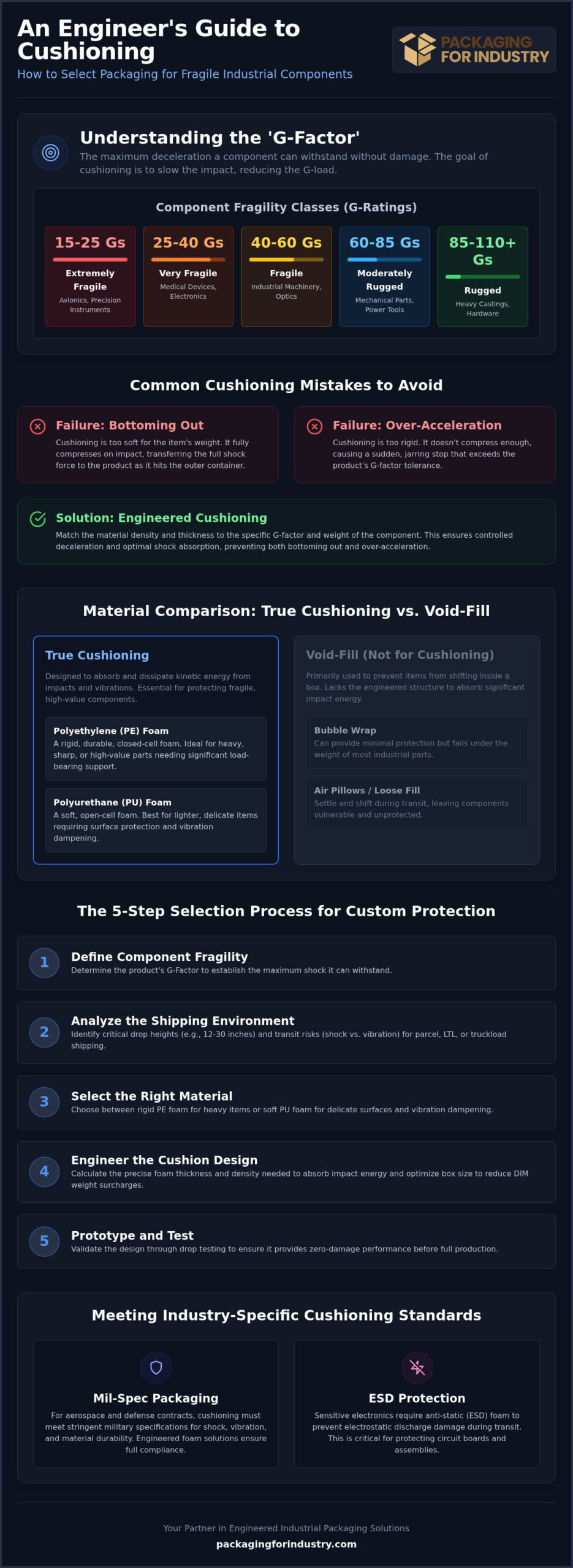
Understanding how to select cushioning for fragile industrial components begins with a technical measurement known as the G-factor. This value represents the maximum deceleration a component can withstand without suffering functional or structural damage. When a package is dropped, the cushioning material’s job is to extend the time it takes for the item to come to a complete stop. By spreading the impact over a longer duration, the “G-load” on the part is reduced. If you don’t know the G-factor of your component, you’re essentially guessing at the level of protection required, which often leads to either catastrophic damage or expensive over-packaging.
A common mistake in warehouse operations is assuming that more padding automatically equals better protection. This is a misconception that can lead to two specific failure points: bottoming out and over-acceleration. If a cushion is too soft for a heavy part, the material will fully compress upon impact, causing the part to strike the outer container at full force. Conversely, if the material is too rigid, it won’t compress enough, resulting in a sudden stop that exceeds the part’s G-factor. This is why protective foam packaging must be engineered to the specific weight and fragility of the item.
It’s also vital to distinguish between void-fill and true cushioning. Products like standard bubble wrap or air pillows are often used as void-fill to prevent items from shifting; however, they rarely provide the energy absorption needed for high-value industrial parts. True cushioning, such as engineered polyethylene or polyurethane foam, is designed to absorb and dissipate kinetic energy. To determine your needs, you must identify your component’s fragility class:
- Extremely Fragile (15-25 Gs): Precision laboratory instruments and avionics.
- Very Fragile (25-40 Gs): Medical devices and sensitive electronic assemblies.
- Fragile (40-60 Gs): Calibrated industrial machinery and optics.
- Moderately Rugged (60-85 Gs): Large mechanical components and power tools.
- Rugged (85-110+ Gs): Heavy castings and reinforced hardware.
Calculating Critical Drop Heights
The shipping environment dictates the drop height requirements for your packaging design. Parcel shipping involves more frequent manual handling and automated sorting, whereas LTL shipping involves fewer drops but higher risks of pallet-level impacts. Industrial logistics standards typically define drop heights based on package weight; for most manual handling scenarios, these range from 12 to 30 inches. Our engineers at PFI use these drop heights alongside your product’s G-factor to determine the exact thickness and density of foam required through custom design packaging services.
Shock vs. Vibration Protection
While shock protection focuses on the sudden impact of a drop, vibration protection addresses the steady-state energy experienced during long-haul transit. Road vibration can cause “resonance,” where internal components vibrate at their own natural frequency until they fail or loosen. Sensitive electronics require different vibration dampening than heavy machinery. While a rigid foam might protect a motor from a drop, it may transfer too much high-frequency vibration to a circuit board. Selecting the right material ensures that both impact energy and transit frequencies are effectively dampened before they reach your product.
Material Comparison: PE vs. PU vs. Specialized Industrial Foams
Selecting the right material is a critical phase in how to select cushioning for fragile industrial components. While generic suppliers might suggest simple bubble wrap or packing peanuts, these materials often fail under the weight of industrial parts or settle during transit, leaving your components unprotected. Professional-grade protection requires a choice between two primary foam families: Polyethylene and Polyurethane. Each serves a distinct purpose based on the weight, fragility, and surface sensitivity of your part.
Polyethylene (PE) foam is a closed-cell material known for its durability and rigid support. It’s the workhorse for heavy, sharp, or high-value industrial parts that require significant load-bearing capacity. Because the cells are sealed, PE foam is naturally resistant to moisture, chemicals, and grease. This makes it an excellent choice for automotive components or heavy machinery that might be exposed to warehouse environments. Conversely, Polyurethane (PU) foam is an open-cell material. It’s much softer and more flexible, providing the gentle deceleration needed for lightweight, highly delicate items. PU foam is ideal for protecting fragile glass, sensitive laboratory equipment, or lightweight electronic assemblies.
The effectiveness of these foams depends heavily on density, typically measured in pounds per cubic foot (pcf). Higher density foams offer greater load-bearing capabilities but less “give.” To ensure your packaging remains cost-effective and functional, you must match the density to the part’s weight:
- Low Density (1.2 – 1.5 pcf): Best for light cushioning and vibration dampening of delicate parts.
- Medium Density (1.7 – 2.2 pcf): The standard for most industrial electronics and mechanical assemblies.
- High Density (4.0 – 6.0+ pcf): Required for heavy castings, tool kitting, and structural support.
If you need help matching material density to your specific part weight, you can request a packaging quote for custom engineered solutions that balance protection with material costs.
When to Use Anti-Static (ESD) Foam
For semiconductors and electronic components, standard foam can actually cause damage through electrostatic discharge. Pink anti-static foam, available in both PE and PU varieties, is chemically treated to prevent the buildup of static electricity. This is vital for preventing latent damage. Latent defects are particularly dangerous because the part may pass initial testing but fail shortly after the end-user installs it, leading to expensive field failures and warranty claims.
Cross-Linked Polyethylene (XLPE) for Aerospace
Aerospace components and medical devices often require a higher tier of protection known as Cross-Linked Polyethylene (XLPE). This material features a much finer, more uniform cell structure than standard PE. It’s non-abrasive, making it safe for Class-A surfaces and highly polished turbine parts that cannot tolerate even minor scratches. XLPE is also a low-outgassing material, which is a strict requirement for cleanroom environments and sterile medical packaging. Its durability makes it the standard for reusable kitting applications in high-cycle manufacturing environments where the packaging must survive years of daily use.
The 5-Step Selection Process for Custom Protection
Engineering a reliable packaging system requires a methodical approach that moves from data collection to physical validation. Guessing at material thickness or using oversized containers leads to inconsistent protection and inflated shipping costs. When determining how to select cushioning for fragile industrial components, procurement and operations managers should follow a technical roadmap to ensure every part arrives in factory condition. This process balances the physical needs of the product with the economic realities of the supply chain.
- Step 1: Define Physical Properties. Document the product’s exact weight, dimensions, and center of gravity. An off-center load can cause the package to tip or shift, placing uneven stress on the cushioning material.
- Step 2: Establish Protection Requirements. Identify the component’s G-factor and the anticipated drop height based on the shipping environment. This data dictates the minimum thickness of the foam required to prevent the part from bottoming out.
- Step 3: Select Material. Choose between PE, PU, or XLPE based on the part’s fragility and environmental exposure. For components shipped through humid or high-heat regions, closed-cell PE foam provides superior resistance to moisture absorption.
- Step 4: Design Geometry. Determine if the part requires full encapsulation, end caps, or corner pads. End caps often provide the best balance of protection and material efficiency for rectangular assemblies.
- Step 5: Prototype and Test. Create a physical sample using CAD/CAM precision to verify the fit and performance before committing to a bulk production run.
Prototyping and Fit-Testing
Relying on a 2D drawing is rarely enough for high-value industrial parts. Free prototyping from a manufacturer like PFI is essential for any major rollout because it allows you to test the packaging in a real-world setting. Our engineers use CAD design to ensure foam inserts fit complex geometries perfectly, leaving no room for movement during transit. This phase is critical for identifying potential ‘pinch points’ where the foam might exert too much pressure on delicate leads, connectors, or sensors. For our Southern California clients in Anaheim and Los Angeles, these prototypes can often be produced and delivered quickly to keep your project on schedule.
Optimizing for DIM Weight and Freight Costs
Engineered cushioning does more than just stop damage; it allows you to use smaller outer corrugated boxes. By precisely calculating the amount of foam needed, you can reduce the ‘air’ in your package and avoid the expensive dimensional (DIM) weight surcharges imposed by carriers like UPS and FedEx. We focus on balancing protection levels with the total cost of the shipping footprint. This approach ensures you aren’t paying to ship empty space while still maintaining a zero-damage shipping cycle for your high-value parts.
Industry-Specific Cushioning Standards
Standard packaging often fails when faced with the specialized requirements of regulated sectors. Learning how to select cushioning for fragile industrial components involves understanding that protection goes beyond G-force calculations to include material purity and chemical stability. For instance, a material providing excellent shock absorption might still be rejected if it introduces contaminants into a cleanroom or fails to meet strict fire-retardant standards. Professional procurement requires matching the material properties to the specific compliance landscape of your industry.
Aerospace & Defense Requirements
In the aerospace sector, precision is mandatory. Turbine parts and avionics require precision-cut foam that prevents Foreign Object Debris (FOD), a critical safety concern in aviation manufacturing. Defense contractors must often adhere to military packaging compliance, which dictates everything from material density to shelf-life stability. We often implement specialized foam inserts that support recurring kitting for production lines. This organization reduces assembly time and ensures every high-value component is accounted for during transit. It’s common for our engineers to act as fixers for contractors who need to eliminate damage in high-value avionics transit by switching from generic wrap to custom-engineered XLPE inserts.
Medical and Cleanroom Packaging
Medical device manufacturers face unique challenges regarding outgassing and particulate contamination. Selecting materials that meet strict cleanliness standards is essential for sterile equipment transit. Foam-lined boxes are typically preferred for sensitive diagnostic equipment because they provide a stable environment that doesn’t degrade or react with medical-grade finishes. Using non-outgassing foams ensures that no chemical vapors settle on optical lenses or sensitive sensors during long-haul shipping or storage. This level of detail prevents the professional stress of field failures caused by poor material selection.
The automotive industry relies on heavy-duty PE foam to protect engine components and exterior parts with Class-A finishes. These materials must withstand exposure to oils and lubricants without losing their structural integrity. For military applications, cushioning must meet Mil-Spec requirements for extreme temperatures and long-term storage. Whether a part is sitting in a desert warehouse or being shipped across the ocean, the cushioning material must maintain its protective properties for years. Our role is to ensure your operational challenges are solved through methodical, engineering-led material selection.
Sourcing Custom Cushioning in Southern California
Local manufacturers often find that catalog-based solutions fail when protecting high-value parts because standard sizes rarely account for the precise G-factor requirements discussed earlier. If you’re searching for a reliable industrial packaging supplier near me, the primary advantage is the ability to conduct fast, physical fit-testing. As a specialized Anaheim packaging supplier, Packaging For Industry (PFI) provides regional manufacturers with the agility needed to adjust designs on the fly. We focus on providing custom boxes in Orange County, Los Angeles, and the Inland Empire that are engineered specifically for your part’s geometry, rather than forcing your product into a generic container. This local presence allows us to offer next-day delivery on critical supplies, ensuring your operations never experience downtime due to packaging shortages.
Working with a local partner also allows for the implementation of Vendor Managed Inventory (VMI) and just-in-time delivery models. These programs prevent stockouts of critical cushioning materials and free up your warehouse space for production. By reducing lead times and eliminating the need for large on-site safety stocks, you improve your operational efficiency and cash flow. Our proximity to major shipping hubs in Southern California ensures that your custom-engineered protection arrives exactly when your production schedule demands it.
Why Choose PFI
Choosing Packaging For Industry (PFI) means partnering with a bulk packaging supplier that understands the intersection of engineering and economics. We don’t just sell foam; we solve the complex problem of how to select cushioning for fragile industrial components through data-driven design and CAD/CAM precision. When you request a custom packaging quote, you gain access to our professional ‘fixers’ who identify cost-reduction opportunities across your entire shipping footprint. Our VMI programs further streamline your operations by automating replenishment, which frees up your warehouse space and improves overall cash flow.
Our commitment to reliability is backed by free prototyping and fit-testing, ensuring your high-value components are secure before you commit to a full production run. We help you lower packaging costs by optimizing box sizes to avoid DIM weight surcharges and by drastically reducing product damage rates. We combine heavy-duty corrugated boxes, custom foam inserts, and specialized crates into a single, integrated solution that protects your reputation. From aerospace avionics to sensitive medical devices, we provide the specialized expertise and local support necessary to stabilize your supply chain and protect your bottom line.
Optimizing Your Protective Packaging Strategy
Selecting industrial protection is an engineering decision that directly impacts your bottom line. By mastering the G-factor and choosing the correct material density, you eliminate the high costs of shipping damage and returns. We’ve shown that a methodical approach to how to select cushioning for fragile industrial components involves more than just padding; it requires a precise understanding of your product’s fragility and the shipping environment.
PFI serves as your local Southern California partner to bridge the gap between design and delivery. Our team specializes in aerospace and industrial protection, providing free prototyping and CAD design to ensure a perfect fit for every component. Whether you’re in Anaheim, Los Angeles, or Orange County, our local next-day delivery keeps your production lines moving without interruption.
Protecting your high-value parts doesn’t have to be a source of operational stress. With the right engineered solution, you can achieve a zero-damage shipping cycle and improve your long-term supply chain reliability.
Frequently Asked Questions
What is the difference between PE and PU foam for cushioning?
Polyethylene (PE) is a closed-cell foam providing rigid support and moisture resistance, while Polyurethane (PU) is an open-cell, softer material. PE is ideal for heavy components that require structural stability and chemical resistance during transit. PU is better suited for lightweight, delicate items that need a soft, controlled deceleration during impact. Selecting between them depends on whether your part needs to be held firmly or cushioned gently.
How do I determine the fragility (G-factor) of my industrial component?
You can determine a component’s G-factor by consulting its engineering specifications or conducting laboratory shock tests. This value indicates the maximum acceleration force the part can withstand before failing. Knowing this number is essential when learning how to select cushioning for fragile industrial components, as it dictates the required thickness of the protective material. Our engineers can help you interpret these ratings to design the most efficient insert possible.
Can custom foam inserts actually save me money on shipping?
Custom foam inserts save money by optimizing the shipping footprint and eliminating product damage expenses. By engineering a precise fit, you can often use smaller outer corrugated boxes, which reduces dimensional (DIM) weight surcharges. Additionally, preventing a single damaged shipment can save the total cost of the replacement part, freight, and administrative labor. It’s a strategic investment that lowers the total cost of ownership in your supply chain.
Is anti-static foam necessary for all electronic components?
Anti-static foam is mandatory for semiconductors, circuit boards, and other sensitive electronic assemblies to prevent electrostatic discharge. While not every metal housing requires it, using ESD-safe foam for all electronic-related shipments prevents latent damage. This type of damage is often invisible during initial inspection but leads to premature failure once the end-user installs the part. We offer both PE and PU foams in anti-static pink varieties.
How much space should I leave between my product and the box wall for cushioning?
The required clearance between your product and the box wall typically ranges from two to three inches, depending on the part’s fragility and weight. This space allows the cushioning material to compress and absorb energy during a drop. If the space is too small, the material will bottom out and transfer the shock directly to the part. If it’s too large, you’re paying for unnecessary dimensional weight and oversized boxes.
Do you offer local delivery for custom foam inserts in Orange County?
We provide local next-day delivery for custom foam inserts and packaging supplies throughout Orange County, Los Angeles, and the Inland Empire. Our Anaheim-based manufacturing facility ensures that Southern California businesses receive their orders with minimal lead times. This local advantage supports just-in-time production schedules and reduces the need for large on-site inventory storage. We can also ship our custom-engineered solutions nationwide to support your other facilities.
What are the benefits of using engineered cushioning over bubble wrap?
Engineered cushioning provides predictable, measurable energy absorption that bubble wrap and loose-fill peanuts cannot match. Bubble wrap can pop under heavy loads, while peanuts often settle during transit, leaving parts vulnerable to impact. Custom foam maintains its structural integrity throughout the entire shipping cycle and can be designed for reusable kitting applications. This consistency ensures that every part arrives at its destination in factory condition, regardless of the carrier.
How does foam density affect the protection of heavy industrial parts?
Foam density, measured in pounds per cubic foot (pcf), directly determines the material’s load-bearing capacity. Heavy industrial parts require high-density foam to provide enough resistance to prevent the part from sinking through the material. Understanding density is a key part of how to select cushioning for fragile industrial components to ensure the weight is distributed evenly. Using the wrong density leads to bottoming out, which is a leading cause of shipping damage.