
Every square inch of empty space in your shipping container is a direct hit to your profit margin. Learning how to avoid over-packaging and reduce material costs isn’t just an environmental goal; it’s a financial necessity for manufacturers facing rising DIM weight surcharges and corrugated prices. You’ve likely seen your freight bills climb as carriers penalize bulky, inefficient boxes that take up too much room on the truck while your warehouse space is consumed by oversized stock packaging.
We understand that balancing product protection with fiscal responsibility is a constant challenge. This guide will show you how precision engineering and strategic inventory management can eliminate waste, lower your shipping costs, and slash your total industrial packaging spend. We’ll explore how custom corrugated designs, tailored foam inserts, and Vendor Managed Inventory (VMI) programs create a leaner, more reliable supply chain that protects your bottom line as much as your product.
Key Takeaways
- Identify how carriers use dimensional (DIM) weight to penalize oversized shipments and learn to calculate the hidden costs of shipping dead air.
- Discover how to avoid over-packaging and reduce material costs through CAD/CAM design that eliminates excess void fill while improving product protection.
- Compare the long-term savings of custom foam inserts and optimized stretch film against the recurring expense of bulky, one-size-fits-all catalog packaging.
- Streamline your warehouse operations and reduce inventory congestion by leveraging local Southern California VMI and just-in-time delivery programs.
- Learn why an integrated engineering approach to boxes, foam, and crates results in a lower total cost per shipped unit for specialized industrial sectors.
The Financial Impact of Over-Packaging on Industrial Supply Chains
Every square inch of excess material represents a hidden tax on your logistics budget. When procurement teams look at how to avoid over-packaging and reduce material costs, they often focus on the unit price of the box. However, the true cost of industrial packaging is found in the freight bill and the warehouse floor plan. Over-packaging creates a ripple effect of inefficiency that touches every part of your supply chain, from the packing line to the final mile of delivery.
Decoding Dimensional Weight (DIM) Surcharges
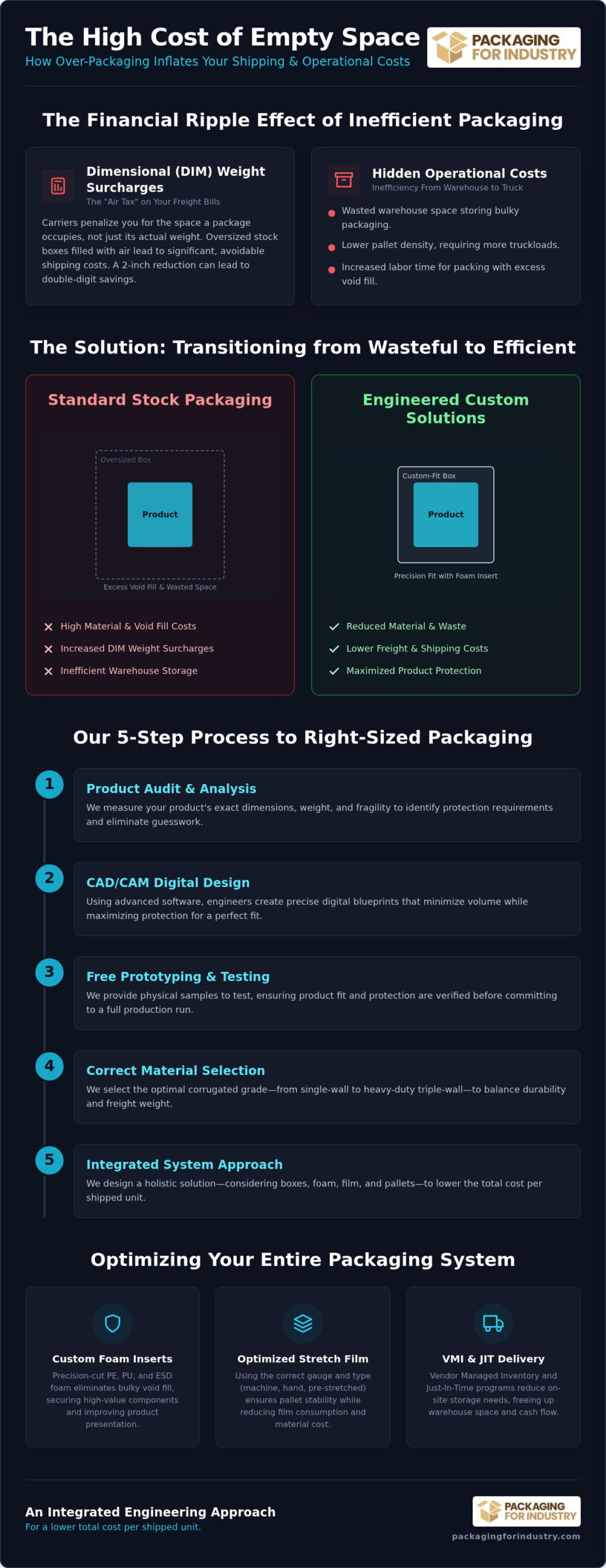
Carriers like UPS, FedEx, and regional LTL providers use dimensional weight (DIM) to ensure they are paid for the space a package occupies, not just its actual weight. If you ship a lightweight aerospace component in a standard large box, you pay for the volume of that box. This “air tax” is one of the most common ways companies lose money. A 2-inch reduction in a box’s dimensions can often move a shipment into a lower weight bracket, leading to double-digit shipping savings over thousands of units. Stock boxes from catalog suppliers are designed for general use, meaning they almost always include unnecessary air. Custom-fit corrugated boxes eliminate this cost at the source.
Hidden Operational Costs of Excess Material
The financial impact extends into your facility. Storing bulky packaging inventory is expensive. Every pallet of oversized boxes or rolls of bubble wrap takes up prime real estate that could hold finished goods or raw materials. You’re essentially paying to store air. This inefficiency also impacts pallet density. If your boxes are 10% larger than necessary, you fit fewer units per pallet. This increases the total number of truckloads required to move the same volume of product, driving up fuel and labor costs.
Labor efficiency also suffers when packages are poorly designed. Packers spend more time managing multiple layers of void fill or applying excessive tape to secure a product in an ill-fitting container. PFI helps identify these bottlenecks through a comprehensive packaging cost review. We analyze your current workflow to find the balance between material reduction and protection. It’s a precise calculation; while we aim to reduce waste, we also protect you from the “under-packaging” trap. Shipping damage is the most expensive cost of all, and our engineering team ensures your material reductions never compromise product integrity.
By streamlining your materials, you don’t just save on the cost of the protective foam packaging or the box. You optimize your entire operation for better throughput and lower freight overhead.
5 Steps to Engineering Right-Sized Custom Corrugated Solutions
Transitioning from oversized stock boxes to precision-engineered solutions requires a methodical approach. When procurement managers ask how to avoid over-packaging and reduce material costs, the answer lies in a structured engineering process. It starts with a comprehensive product audit where we measure exact dimensions and identify fragile points that require specific support. By understanding the product’s geometry, we can eliminate the waste found in standard catalog offerings that force you to pay for unused space.
The Role of CAD/CAM and Free Prototyping
Digital design is the foundation of modern industrial packaging. Using CAD/CAM software, our engineers create digital blueprints that minimize external volume while maximizing internal protection. This technology eliminates the guesswork that often leads to oversized boxes and excess void fill. For high-value aerospace and medical components, precision is non-negotiable. We don’t just rely on digital models; we provide physical samples for your team to handle. PFI’s free prototyping ensures product fit and protection are verified before you commit to a full production rollout. This step prevents costly errors and ensures the transition to custom containers is seamless.
Choosing the Right Corrugated Grade
Selecting the correct material is a balancing act between durability and freight weight. You don’t always need a heavy-duty double-wall box for every application. Sometimes, a high-performance single-wall corrugated grade provides sufficient stacking strength while reducing the overall shipping weight. Conversely, for heavy machinery or export shipments, we might recommend triple-wall corrugated or mil-spec options that resist moisture and compression. You can explore our specific material options at our Custom Corrugated Boxes page to see which grade fits your specific application.
Once the material and design are finalized, the prototyping phase involves stress-testing the package to simulate the rigors of your distribution environment. Finally, implementation involves a strategic shift from stock catalog boxes to custom-engineered containers. This transition often includes optimizing pallet patterns to increase density and reduce the number of shipments required. If you’re ready to see how a custom design could impact your bottom line, you can request a packaging quote to start the engineering process.
Optimizing Protective Materials: Foam, Film, and Edge Protection
While the box provides the structure, the materials inside determine the final footprint of your shipment. Understanding how to avoid over-packaging and reduce material costs requires looking past the corrugated exterior and evaluating the efficiency of your internal cushioning and stabilization methods. In many industrial applications, the wrong choice of protective material forces the use of a larger container, which triggers the shipping surcharges we’ve already identified as a major profit drain.
Engineered Foam Inserts vs. Loose Fill
Traditional void fill like crumpled paper or packing peanuts requires a significant “safety buffer” around the product to be effective. This forced clearance increases the external dimensions of the box, essentially shipping air. Custom-engineered Protective Foam Packaging solves this by securing the product in a fixed, shock-absorbing position. Die-cut foam inserts eliminate the need for oversized buffers because the material’s density is calculated to the product’s specific fragility and weight.
The choice of material is critical for both protection and cost. Polyethylene (PE) foam offers high-density protection for heavy industrial parts or aerospace components, while Polyurethane (PU) provides a softer, non-abrasive cushion for delicate medical devices. For the semiconductor and electronics sectors, we integrate anti-static (ESD) foam inserts to prevent electrostatic discharge. These precision-cut solutions allow for a much tighter fit, often enabling a significant reduction in the total cubic volume of the package.
Load Stabilization and Film Gauge Reduction
Material waste also occurs during the palletization phase. Many warehouses use standard hand film and over-wrap every load to ensure stability, which wastes pounds of plastic per pallet. Switching to high-performance pre-stretch film or automated machine wrapping allows you to use a thinner gauge while maintaining higher containment force. It’s a pragmatic shift: you use less material by weight but achieve a more secure load.
Integrating Corner and Edge Protection is the secret to reducing corrugated thickness without sacrificing safety. By reinforcing the corners of a pallet or a large container, you can often drop from a heavy double-wall box to a lighter single-wall box. The edge guards provide the structural integrity needed for vertical stacking strength, letting the corrugated focus solely on containment. This hybrid approach is a proven way to lower your cost per unit while maintaining the durability required for industrial transit.
Leveraging VMI and Just-In-Time Delivery to Cut Inventory Costs
Engineering the right box is only half the battle. A truly efficient supply chain requires a logistics strategy that prevents warehouse congestion and minimizes capital tied up in packaging stock. When searching for how to avoid over-packaging and reduce material costs, procurement managers often overlook the carrying cost of their inventory. Storing six months’ worth of bulky corrugated boxes or protective foam inserts isn’t just an organizational challenge; it’s a financial drain that limits your operational flexibility. Every pallet of “safety stock” sitting in your warehouse is real estate that could be used for revenue-generating production.
How Vendor Managed Inventory (VMI) Works
VMI is a proactive partnership where we take full accountability for your packaging availability. Instead of your team manually tracking SKUs and placing reactive orders, we establish a structured review cycle. This involve weekly or monthly audits of your stock levels to ensure you never run out of critical supplies. The primary benefit is financial liquidity. You only pay for the packaging you use, freeing up cash that would otherwise be sitting on your shelves. This systematic approach also eliminates the “bullwhip effect” in your supply chain, where over-ordering leads to wasted space and eventual material obsolescence. You can find more details on our Vendor Managed Inventory services page.
Strategic Sourcing in Southern California
For companies operating in Los Angeles, San Diego, or the Inland Empire, proximity to your supplier is a competitive advantage. As a local Anaheim packaging supplier, PFI provides next-day delivery that supports a true just-in-time (JIT) manufacturing model. This local presence is essential for reducing the total cost of ownership for your packaging materials. Incoming freight costs for bulky items like heavy-duty double-wall boxes or large foam planks can be substantial if they’re shipped across state lines. By sourcing locally, you eliminate these high freight charges and significantly reduce the carbon footprint of your operations.
Our delivery network covers the entire Southern California region, ensuring that specialized sectors like aerospace and medical manufacturing have the reliable supply chains they require. Whether you need custom crates in Riverside or ESD-safe packaging in Orange County, local sourcing ensures that your production lines never stall due to packaging shortages. This reliability is a core component of how to avoid over-packaging and reduce material costs by removing the need for excess safety stock that clutters your facility.
Why Custom Packaging Engineering is the Ultimate Cost-Reduction Strategy
Large catalog suppliers provide a convenient service for low-volume needs, but high-volume manufacturers pay a heavy premium for that convenience through wasted materials and excessive freight charges. Choosing a specialized industrial packaging supplier near me allows you to move away from the “one-size-fits-all” model that often results in oversized boxes and inadequate protection. Custom engineering is the only sustainable way to address how to avoid over-packaging and reduce material costs because it treats the package as a functional component of the product itself, not just an afterthought. When you engineer the “air” out of your shipments, you don’t just save on corrugated; you optimize your entire logistical footprint.
Integrated Solutions for Complex Logistics
Our approach at PFI involves more than just selling a box. We provide integrated solutions that combine heavy-duty corrugated, custom foam inserts, and heat-treated pallets or crates into a single, cohesive SKU. This integration is particularly vital for aerospace and medical device sectors where damage rates must be near zero. By utilizing our Custom Packaging Design services, you can also leverage packaging kitting and assembly. This reduces on-site labor costs in your Southern California facility by delivering pre-assembled kits directly to your packing line. Instead of your team managing five different material vendors, they receive one ready-to-use solution. For international shipments, we ensure all custom crates meet ISPM-15 export compliance standards, preventing costly customs delays and protecting your reputation with global distributors.
Start Saving with a Packaging Review
The first step toward optimization is a data-driven analysis of your current spend. To prepare for a custom packaging quote, you should gather your current usage data, including internal box dimensions, material types, and annual volumes. During a PFI packaging cost-reduction analysis, we look beyond the unit price. We analyze your shipping damage history and freight bills to identify exactly where oversized packaging is triggering DIM weight surcharges. We’ll demonstrate how a bulk packaging supplier focused on engineering can outperform catalog pricing by reducing your total cost per shipped unit. This process provides a clear roadmap for streamlining your inventory and reclaiming warehouse space.
If you’re ready to stop paying for “dead air” and start protecting your margins, our team is ready to help. We serve manufacturers and distributors across Orange County, Los Angeles, and the Inland Empire with local expertise and nationwide shipping capabilities.
Optimize Your Logistics Chain for Maximum Efficiency
Refining your packaging strategy is a direct way to improve operational throughput and bottom-line performance. By moving away from generic catalog boxes and implementing custom-engineered solutions, you eliminate the dimensional weight surcharges and material waste that erode profit margins. Our specialized expertise in Aerospace and Defense packaging ensures that even the most complex components are protected with a minimal footprint. Using free prototyping and CAD/CAM support, we provide a clear path for how to avoid over-packaging and reduce material costs across your entire supply chain.
With local next-day delivery across Southern California, we’re ready to help you streamline your inventory and lower your total cost of ownership. We look forward to partnering with you to optimize your logistics chain and eliminate unnecessary waste from your daily operations.
Frequently Asked Questions
How can I calculate if I am over-packaging my products?
You can identify over-packaging by auditing the ratio of product volume to box volume. If your shipments consistently require more than two inches of void fill on any side, you are paying to ship air. Compare your carrier’s dimensional (DIM) weight to the actual weight of the package; a large discrepancy usually indicates that your boxes are oversized for the contents they hold.
Does custom packaging always cost more than stock boxes?
Custom packaging often has a higher unit price than stock boxes, but it reduces your total cost of ownership. The savings come from lower freight surcharges, reduced labor on the packing line, and the elimination of expensive secondary materials like bubble wrap or loose fill. When you evaluate the entire logistics chain, custom solutions are frequently the most economical choice.
What is the best way to reduce shipping damage without adding weight?
Precision-engineered foam inserts are the most effective way to secure fragile items without significantly increasing the shipment’s weight. By using materials like polyethylene or polyurethane foam, we create a secure fit that absorbs shock more efficiently than heavy layers of corrugated. This allows you to use a lighter external box while maintaining superior protection for high-value components.
Can Vendor Managed Inventory (VMI) really lower my material costs?
VMI lowers costs by eliminating the need for emergency rush orders and reducing the capital tied up in safety stock. It’s a strategic part of how to avoid over-packaging and reduce material costs because it ensures you only have the specific, right-sized materials you need on hand. This prevents warehouse congestion and stops your team from using oversized boxes when the correct size runs out.
How do I avoid UPS and FedEx dimensional weight surcharges?
The only way to avoid DIM weight surcharges is to reduce the external dimensions of your shipping containers. Carriers charge based on the space a package occupies on their trucks. By using CAD/CAM design to create a tighter fit around your product, you can often move your shipments into a lower weight bracket, resulting in immediate freight savings.
What industries benefit most from custom foam inserts?
Aerospace, medical device, and electronics manufacturers see the greatest return on investment from custom foam inserts. These industries often ship high-value, sensitive equipment that requires exact fitment to prevent movement during transit. Custom foam also allows these sectors to integrate anti-static (ESD) protection directly into the packaging, ensuring both physical and electrical safety.
Do you offer local delivery for packaging supplies in Orange County?
Yes, we provide local next-day delivery to Orange County, Los Angeles, and the Inland Empire from our Anaheim facility. Being a local industrial packaging supplier near me allows you to implement a just-in-time inventory model. This proximity reduces your incoming freight costs and ensures your production lines stay moving without the need for massive on-site storage.
How long does the custom packaging prototyping process take?
The prototyping process typically takes only a few business days once we have your product dimensions. Our in-house design team uses CAD/CAM technology to create a digital blueprint and a physical sample for your review. This rapid turnaround allows you to test the fit and durability of a new design before committing to a full production run.