
USA cardboard prices hit $554 per metric ton in June 2026, making every millimeter of wasted material a direct hit to your bottom line. Most procurement managers recognize that a “safe guess” on core strength leads to one of two expensive outcomes: a collapsed production line or over-paying for over-engineered materials. If you’re searching for an industrial packaging supplier near me in Southern California, you need a partner who understands that core concentricity is non-negotiable for high-speed winding.
This guide explains how to choose the right wall thickness for cardboard cores to prevent operational failure and eliminate shipping damage. We’ll analyze the physics of radial tension, establish industry benchmarks, and demonstrate how a local bulk packaging supplier can streamline your logistics. Whether you’re looking to lower per-unit costs or need a custom packaging quote for specialized industrial dimensions, the following technical breakdown provides the clarity required to optimize your Southern California supply chain.
Key Takeaways
- Understand how the measurement between the inside and outside diameter dictates a core’s structural integrity under high-speed winding loads.
- Learn how to choose the right wall thickness for cardboard cores by balancing radial crush strength against your specific material tension requirements.
- Identify the standard thickness ranges for common industrial applications, from light-duty label cores to heavy-duty textile rolls.
- Recognize signs of operational failure like “ovalization” and de-lamination to determine exactly when your production line needs higher-strength specifications.
- Optimize your Southern California supply chain by leveraging local procurement strategies that reduce lead times and lower per-unit packaging costs.
Understanding Cardboard Core Wall Thickness and Structural Integrity
Wall thickness defines the structural boundary between the inside diameter (ID) and outside diameter (OD). It’s the primary indicator of how much pressure a core can withstand before it collapses or deforms during use. For manufacturers across Southern California, selecting the correct gauge is a balance between operational safety and material cost. Understanding these dimensions is the first step in learning how to choose the right wall thickness for cardboard cores to avoid costly line stoppages and product waste.
The Geometry of the Core: ID, OD, and Wall
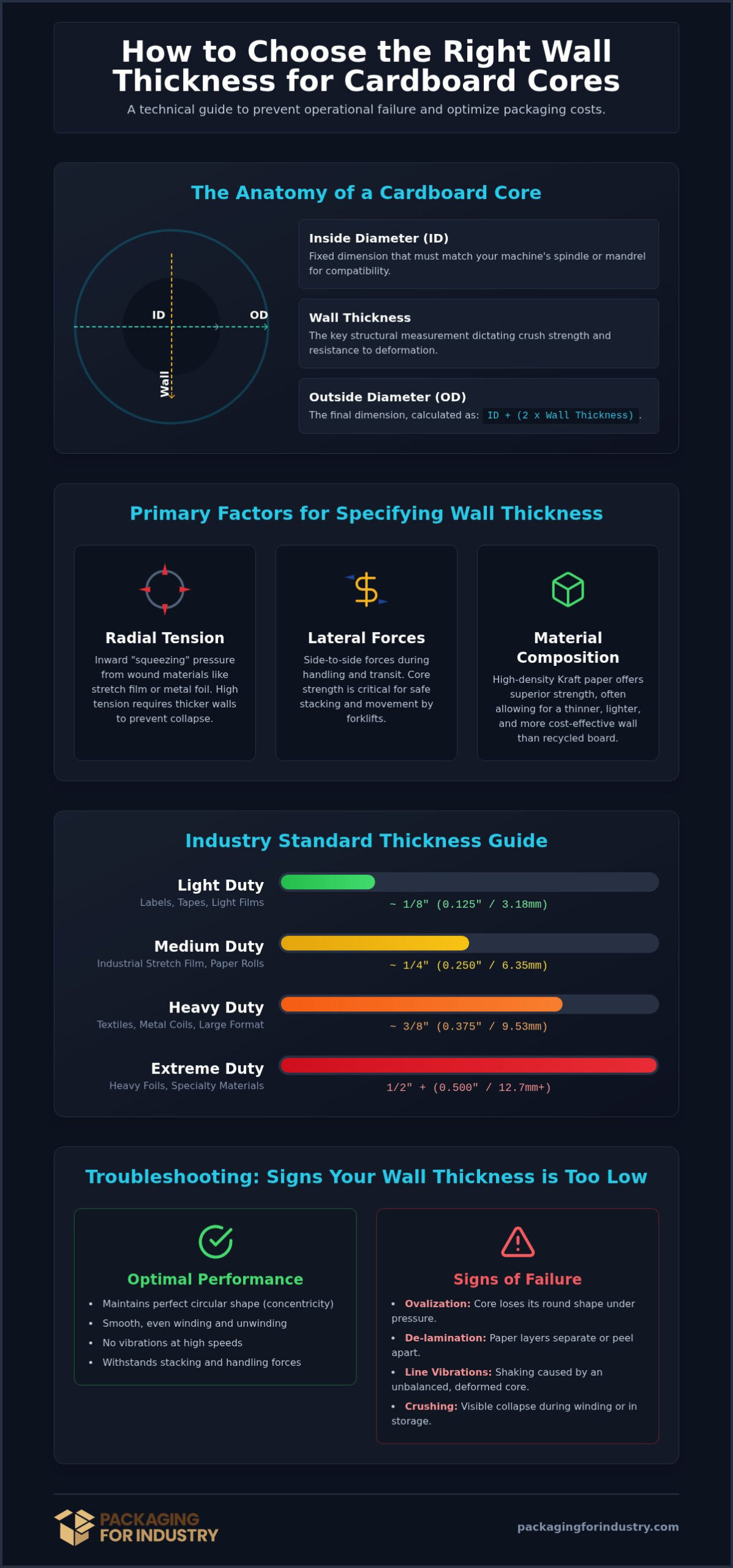
Geometric precision is vital for machine compatibility. The ID is almost always fixed because it must match your winding machine’s spindle or mandrel. To calculate the final OD, you double the wall thickness and add it to the ID. For example, a 3-inch ID core with a 0.250-inch wall results in a 3.5-inch OD. This thickness directly impacts the core’s ability to maintain concentricity at high speeds. If a core loses its roundness under load, it creates vibrations that can damage expensive winding equipment or cause uneven material application. Choosing a 1/2 inch wall for heavy loads provides massive crush resistance, but it also adds significant weight to your shipping units. Conversely, a 1/8 inch wall might be sufficient for light labels but will fail under the heavy radial tension of industrial stretch film.
Material Composition: Kraft vs. Recycled Board
The quality of the paper determines how much thickness you actually need to meet your performance goals. High-density Kraft paperboard offers superior radial crush strength compared to standard recycled board. This allows you to often specify a thinner wall if you use a higher grade of material, which reduces the total weight of your shipping units and lowers freight expenses. Cardboard tube construction relies on the bond between these layers. If the adhesive is weak or the winding is loose, the walls will delaminate under lateral pressure. Industrial users should prioritize high-density materials to optimize their tubes and cores for both strength and fiscal efficiency. Balancing recycled content with these industrial performance requirements ensures your supply chain remains sustainable without risking operational failure.
Radial crush strength is the core’s resistance to inward pressure. While a 1/8 inch wall might suffice for lightweight tapes, heavy industrial rolls like textiles, metal foils, or large-format paper require thicker walls to prevent the core from “ovalizing.” PFI helps local procurement teams match these technical specs to actual production loads, ensuring you don’t over-pay for over-engineered cores that add unnecessary bulk and weight to your logistics flow. Using the right material density means you can achieve the necessary structural integrity without defaulting to the thickest possible wall.
Primary Factors for Specifying Wall Thickness in Industrial Applications
Specifying core dimensions requires more than just measuring a machine spindle. You must account for the physical forces applied to the core throughout its entire lifecycle, from the initial wind to the final warehouse stack. Understanding the difference between radial and lateral tension is essential when deciding how to choose the right wall thickness for cardboard cores. If you overlook these dynamics, you risk core failure that can halt an entire production line or ruin expensive inventory during transit.
Radial tension is the inward pressure exerted by materials like stretch film, metal foils, or steel as they’re wound onto the core. These materials often contract slightly after the winding process, creating a constant, heavy squeezing force. High winding speeds amplify this problem. Rapid rotations can cause vibrations that lead to “ovalization,” where the core loses its circular shape and becomes impossible to unspool. This usually happens when the wall is too thin to resist the combined centrifugal and compressive forces. PFI’s technical team often sees this in high-speed manufacturing environments where procurement has prioritized lower costs over necessary wall gauge.
Lateral tension and stacking requirements also dictate your core specifications. Lateral tension involves side-to-side forces during handling, particularly when rolls are moved by forklifts or automated sorters. Additionally, you must evaluate how many layers of finished product will sit on the bottom core in your warehouse. The core at the base of a pallet carries the weight of every layer above it. In a non-climate-controlled warehouse, a thin-walled core might support the product weight initially but fail over time as the cardboard fibers absorb ambient humidity and lose their rigidity.
Calculating Radial Crush Strength
Radial crush strength is the ability to resist inward pressure without collapsing. Manufacturers often rely on Industry standards for core strength to quantify this resistance through standardized testing. If you notice the inner diameter of your cores shrinking or see visible ripples on the inner ply after winding, your radial tension is exceeding the current wall thickness. This is a clear signal to increase the gauge or move to a higher-density Kraft paperboard to maintain structural integrity under load.
Handling and Transit Durability
Transit durability is often the most overlooked factor in core specification. Forklift movement and sudden stops in a delivery truck can cause “end-crushing” if the core walls aren’t thick enough to maintain their shape under impact. Moisture absorption in Southern California’s coastal regions can further weaken the structure during long-term storage. To mitigate these risks, many logistics managers integrate corner and edge protection to distribute weight and shield the cores from direct impact during palletization. Balancing these factors ensures your operational flow remains uninterrupted. If you’re unsure about the specific forces your application generates, you can request a packaging quote to have an expert evaluate your winding and shipping requirements.
Industry Standards: Matching Thickness to Your Winding Requirements
While the physics of radial tension provides the engineering foundation, established industry benchmarks help Southern California procurement managers narrow down their options quickly. Knowing how to choose the right wall thickness for cardboard cores often starts with identifying your specific sector’s standard operating range. These benchmarks exist because they’ve proven to balance material costs with the structural demands of specific winding equipment and material weights. Deviating from these standards without a clear engineering reason usually leads to either unnecessary packaging spend or preventable core failure.
Tape, Label, and Ribbon Cores
In the world of pressure-sensitive tapes and industrial labels, precision in the inside diameter (ID) is often more critical than extreme wall thickness. Most label and ribbon cores fall within a standard thickness range of 0.125 inches to 0.250 inches. For 1-inch and 3-inch ID cores used in high-speed applicators, maintaining a consistent wall is vital for machine compatibility. If the wall is too thin, you risk “core pop-out,” where the core deforms slightly and loses its grip on the machine’s mandrel. This causes the roll to slip or wobble, leading to uneven winding and wasted material. Specifying a 0.125-inch wall is typically sufficient for lightweight ribbons, but moving toward 0.250 inches provides the extra rigidity needed for wider, heavier tape rolls.
Textile and Flexible Packaging Cores
Textile manufacturing and flexible packaging converters face a different challenge: managing heavy weight over long spans. Fabric bolts and large rolls of plastic film can be several feet wide, creating immense pressure on the center of the core. If the wall thickness isn’t properly matched to the roll width, you’ll encounter “bowing” or sagging in the middle. This deflection ruins the material’s alignment on manufacturing production lines and makes automated handling nearly impossible. For these applications, walls often start at 0.375 inches and can exceed 0.500 inches depending on the material’s density and the total roll weight. A thicker wall ensures the core remains perfectly straight, protecting the material from permanent creasing or stretching during long-term warehouse storage.
Extreme applications require even more robust specifications. Industries dealing with steel, aluminum, or heavy industrial films often utilize cores with wall thicknesses of 0.750 inches or greater to withstand massive radial crush forces. These sectors can’t afford a core collapse, as the weight of the metal could crush the entire pallet. Similarly, specialized sectors require custom-engineered solutions that meet rigorous performance criteria. For example, aerospace and defense components often demand cores with specific adhesive chemistries and reinforced walls to handle sensitive or high-value materials. PFI works with local engineering teams to specify these high-performance cores, ensuring that specialized components remain secure from the factory floor to the final assembly site.
Troubleshooting Core Failure: When to Increase Wall Strength
Troubleshooting core failure is a critical skill for operations managers across Southern California. When a core fails, it isn’t just a material loss; it’s a disruption that ripples through your entire production schedule. Understanding the physical symptoms of failure is the most practical way to refine how to choose the right wall thickness for cardboard cores. If you wait until a complete collapse to adjust your specifications, you’ve already lost valuable time and inventory.
Ovalization occurs when the core loses its concentric shape under the radial pressure of the wound material. This makes it impossible to mount the roll back onto a spindle for downstream processing, effectively turning a finished product into scrap. De-lamination is another common failure where the individual plies of cardboard separate. This typically indicates either poor adhesive quality or a wall that’s too thin to handle the shear forces during high-speed winding. When the core’s structural integrity fails in these ways, you often see the ‘telescoping’ effect. This happens when the layers of material slide laterally off the core because the foundation is no longer stable.
Visual Signs of Insufficient Wall Strength
Look for visible cracks or creases appearing on the inner diameter of the core. These are early warning signs that the material’s radial tension is exceeding the core’s crush strength. You might also notice difficulty mounting the core onto standard 3-inch or 6-inch spindles, which suggests the ID has been compressed or distorted during storage. End-flare serves as a primary indicator of lateral handling damage during transit or warehouse movement.
The Hidden Costs of Core Failure
The price of a single core is negligible compared to the cost of the material wound around it. If a core collapses, you lose the entire roll, the labor hours spent winding it, and the potential revenue from that unit. These failures also damage customer relationships when products arrive damaged or difficult to unspool. Implementing a Vendor Managed Inventory program helps mitigate these risks by ensuring you always have the correct, engineered specifications on hand. This prevents the need for emergency re-orders after a failure occurs on the line.
While increasing wall strength solves failure issues, you must avoid the trap of over-specifying. Every extra millimeter of cardboard adds weight to your shipments and cost to your procurement budget. A professional assessment helps you find the technical balance where you achieve zero failures without paying for excess material you don’t need.
Custom Core Solutions and Local Procurement in Southern California
Local manufacturers in Anaheim, Irvine, and Los Angeles require more than just a vendor; they need an industrial packaging supplier near me that understands the high-speed demands of the Southern California market. Relying on national catalog suppliers often leads to operational delays and over-paying for generic specifications. As a specialized bulk packaging supplier, PFI provides custom-engineered tubes and cores that are optimized for your specific machinery, ensuring your supply chain remains lean and responsive.
Why Choose PFI for Your Industrial Core Requirements?
Our custom engineering process removes the risk from determining how to choose the right wall thickness for cardboard cores. We offer free prototyping to verify that your core gauge matches your winding tension, preventing the costly failures discussed in previous sections. Choosing PFI as your local partner provides several distinct operational advantages:
- Local Next-Day Delivery: We service Orange County, San Diego, Riverside, and the Inland Empire with our own fleet to ensure your line never stops.
- Expert Engineering: Our team tailors IDs, lengths, and wall thicknesses to your specific industrial load requirements.
- Cost-Efficiency: We offer a direct, cost-saving alternative to large catalog distributors by eliminating excessive freight and markup.
- Vendor Managed Inventory (VMI): We manage your stock levels so you can reallocate warehouse space to production.
Streamlining Operations with Wholesale Packaging Supplies
Consolidating your procurement with a single partner reduces administrative overhead and lowers your total landed costs. Beyond heavy-duty cores, PFI is a comprehensive provider of wholesale packaging supplies, allowing you to bundle your core orders with protective foam packaging, custom corrugated boxes, and pallets. If you’re looking for a reliable stretch wrap supplier to secure your finished rolls, our high-performance films are designed to work in tandem with our cores for maximum load stability.
Optimizing how to choose the right wall thickness for cardboard cores is the first step toward a more reliable production cycle. By integrating your core specifications with our specialized protective foam packaging or heavy-duty crates, you create a total protection system for your high-value goods. Our Anaheim-based team is ready to audit your current packaging spend and demonstrate how local, engineered solutions can improve your bottom line. Request a custom packaging quote today to secure your 2026 production schedule with a partner that values precision and reliability.
Optimize Your Winding Operations with Precision Engineering
Specifying the correct core gauge is a strategic decision that directly affects your operational uptime and shipping reliability. By moving away from generic catalog sizes and toward custom-engineered solutions, you eliminate the risks of core collapse and material waste. Learning how to choose the right wall thickness for cardboard cores allows you to match radial crush strength to your specific winding tension, creating a more stable supply chain while lowering your per-unit packaging costs.
PFI serves as your local Southern California engineering partner, providing expert guidance on industrial sizes and heavy-duty applications. Choosing a local supplier allows you to leverage next-day delivery across Los Angeles, Orange County, and the Inland Empire, providing a reliable and cost-saving alternative to national distributors. Our team is ready to help you finalize your 2026 specifications to ensure zero failures on your production line.
Your production efficiency depends on reliable components. We look forward to helping you streamline your logistics and protect your bottom line with precision-engineered cores.
Frequently Asked Questions
How do I calculate the outside diameter (OD) of a cardboard core?
You calculate the outside diameter by doubling the wall thickness and adding that figure to the inside diameter (ID). For example, if your core has a 3-inch ID and a 0.250-inch wall, the OD is 3.5 inches. Accurate OD measurements are vital for ensuring the finished roll fits within your machine’s safety clearances and your warehouse’s storage racking limits.
What is the standard wall thickness for a 3-inch ID cardboard core?
Standard wall thicknesses for 3-inch ID cores typically range from 0.125 inches for lightweight labels to 0.500 inches for heavy industrial applications. The specific gauge you need depends entirely on the radial tension and weight of the material being wound. Most Southern California manufacturers find that a 0.250-inch wall is a reliable starting point for medium-duty film and tape winding.
Can I use a thinner wall if I use higher-grade Kraft paperboard?
You can often reduce wall thickness without sacrificing structural integrity by switching to a higher-density Kraft paperboard. Kraft fibers provide superior radial crush strength compared to standard recycled board, allowing for a more efficient use of material. This is a primary strategy when learning how to choose the right wall thickness for cardboard cores while attempting to minimize total packaging volume and weight.
How does wall thickness affect the shipping cost of my products?
Wall thickness directly impacts the total weight of your shipping units, which can significantly increase your freight expenses. Every extra millimeter of cardboard adds cumulative weight to a pallet, potentially pushing your shipment into a higher freight class. By optimizing the wall to the minimum gauge required for safety, you reduce dead weight and lower your overall per-unit shipping costs across your supply chain.
What causes a cardboard core to collapse during the winding process?
Core collapse happens when the radial tension of the wound material exceeds the core’s crush strength. Materials like stretch film or certain plastics often contract after they’re wound, creating a constant, heavy inward pressure. If the wall is too thin or the material density is too low to resist this force, the core will “ovalize” or fail entirely, causing immediate production downtime and inventory loss.
Do you offer custom wall thicknesses for aerospace-grade tubes in Orange County?
PFI provides custom-engineered, heavy-duty tubes and cores for the aerospace sector throughout Orange County and the wider Southern California region. We specialize in specifying exact wall gauges that meet rigorous defense and aviation performance standards. Our local Anaheim facility allows for rapid prototyping and next-day delivery, ensuring that your specialized components remain secure during both the manufacturing process and final transit.
Is it possible to over-engineer a core, and how does that affect my ROI?
Over-engineering a core by specifying an unnecessarily thick wall negatively impacts your ROI by increasing both procurement costs and freight fees. While a thicker wall provides a larger safety margin, paying for excess cardboard that doesn’t improve performance is a form of fiscal waste. PFI helps you determine the technical balance where you achieve zero core failures without over-paying for over-engineered supplies that don’t add value.
What is the difference between spiral-wound and parallel-wound cores for thickness?
Spiral-wound cores are the industry standard for consistent wall thickness and high radial strength because they’re made by winding multiple plies of paperboard at an angle. This creates a continuous tube with uniform strength along its entire length. Parallel-wound cores are typically used for shorter, specialized applications where lateral strength is the priority. For most industrial winding needs, spiral-wound construction offers the most reliable and efficient performance.