
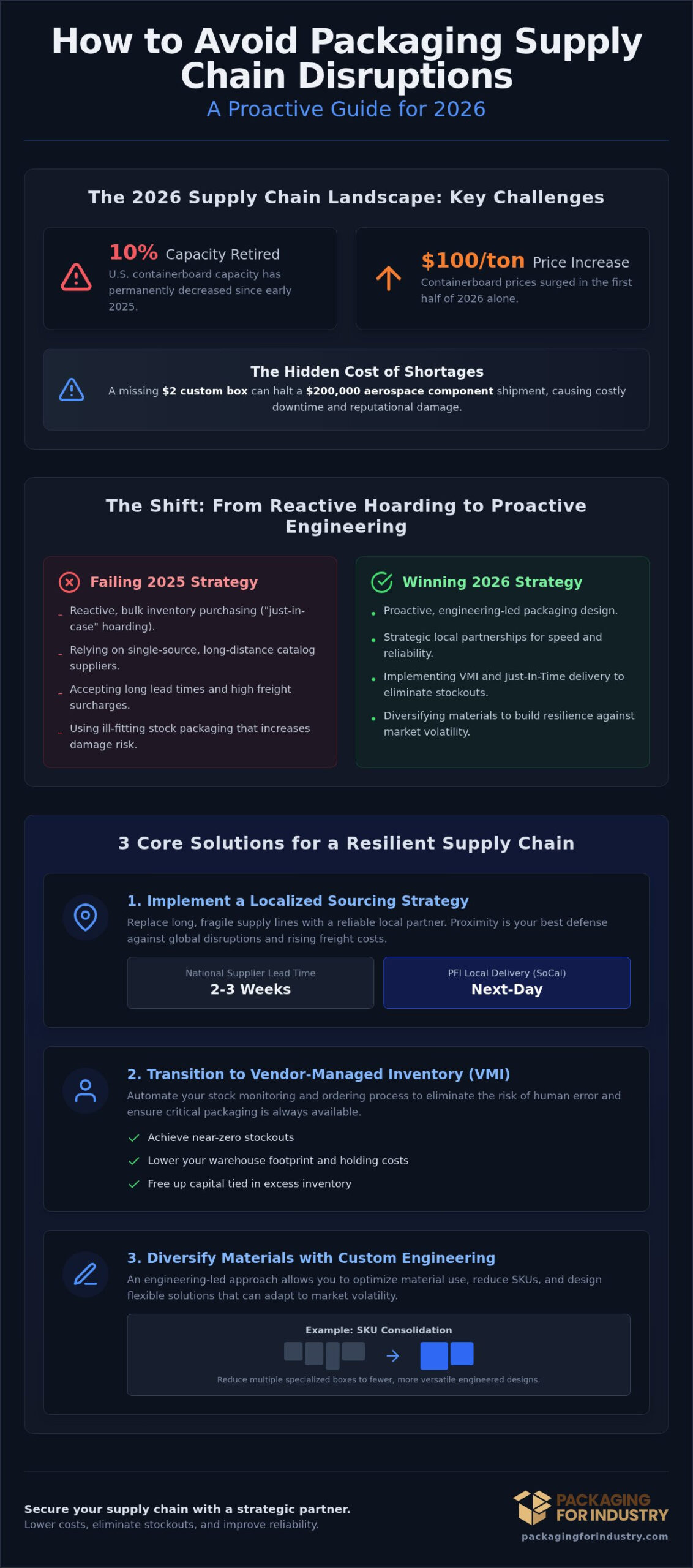
With over 10% of US containerboard capacity permanently retired since early 2025, the traditional strategy of hoarding bulk inventory is no longer a viable way to protect your production line. Manufacturers are currently facing a landscape where containerboard prices rose by $100 per ton in the first half of 2026 alone. Learning how to avoid packaging supply chain disruptions 2026 requires a fundamental shift from reactive buying to proactive, localized engineering. You likely feel the pressure when an assembly line stalls because a shipment of custom double-wall boxes or specialized ESD foam is delayed by material shortages or rising freight costs.
It’s a common operational stressor, but it’s one we can solve through better logistics and smarter sourcing. This guide will show you how to secure your 2026 packaging supply through localized sourcing, inventory automation, and custom material engineering. We’ll explore how implementing vendor-managed inventory (VMI) and just-in-time delivery can help you achieve zero stockouts on critical packaging while simultaneously lowering your warehouse footprint. By focusing on the intersection of engineering and economics, you can maintain predictable pricing despite ongoing market volatility and new regulatory burdens.
Key Takeaways
- Secure your production line by understanding how to avoid packaging supply chain disruptions 2026 through localized inventory management and material diversification.
- Leverage Vendor Managed Inventory (VMI) to automate stock monitoring and eliminate the risk of running out of critical corrugated boxes or protective foam.
- Shorten lead times and lower freight expenses by sourcing from a local Southern California partner capable of next-day delivery in the Inland Empire and San Diego.
- Use custom material engineering to consolidate your packaging SKUs, reducing both your storage footprint and overall material costs.
- Future-proof your operations by designing flexible packaging solutions that allow for material alternatives during periods of market volatility.
Understanding the 2026 Packaging Supply Chain Landscape
In the industrial sector, a packaging supply chain disruption is any break in the material flow that forces a production halt. It’s the missing corrugated boxes or the lack of specialized foam that keeps a finished product on the warehouse floor. Understanding how to avoid packaging supply chain disruptions 2026 requires looking at the current data. With 10% of US containerboard capacity retired between 2025 and 2026, and prices increasing by $100 per ton, the landscape is volatile. These shifts, combined with persistent labor shortages in logistics, make traditional “lowest cost” sourcing a high-risk gamble. Modern supply chain management now favors strategic local partnerships over global “just-in-case” hoarding.
The Hidden Costs of Packaging Shortages
A packaging shortage creates an expensive bottleneck. When a $2 custom box isn’t available, a $200,000 aerospace component cannot ship. This downtime isn’t just a scheduling inconvenience; it’s a direct hit to your bottom line. Manufacturers often attempt to bridge these gaps with rush-ordered stock packaging, but this leads to massive freight surcharges that erode profit margins. For Tier 1 aerospace and medical contractors, these delays also damage brand reputation. Reliability is a core requirement for high-stakes contracts, and a failure to deliver due to packaging issues can jeopardize long-term agreements.
Why Traditional Procurement Fails in 2026
Relying on a single-source catalog buyer for custom requirements is a major vulnerability. Large catalog suppliers often prioritize high-volume stock items over specialized, low-volume needs. Long-distance shipping lanes remain the weakest link in your chain, as any port congestion or fuel price spike immediately impacts your lead times. In 2026, off-the-shelf options rarely meet the precision required for modern manufacturing. You need custom design packaging that is engineered for your specific product dimensions and fragility. Transitioning to an engineering-led approach allows you to optimize material use and reduce the total number of SKUs, making your inventory easier to manage and less prone to disruption.
Implementing a Localized Sourcing Strategy in Southern California
Proximity to your packaging partner is the most effective defense against port closures and international logistical delays. When you source from a national supplier, you’re often forced to maintain a two or three week transit buffer. This buffer is designed to absorb shipping delays, but it also ties up capital and warehouse space. Localized sourcing in Southern California eliminates this necessity. PFI provides local next-day delivery for manufacturers in Anaheim, Irvine, and Los Angeles, ensuring your production schedule remains uninterrupted. By using regional manufacturing and distribution, you also reduce freight costs and your overall carbon footprint. If you are looking to stabilize your expenses, you can compare packaging pricing for local delivery versus national shipping.
Reducing Lead Times in the Orange County and LA Corridor
Local sourcing removes the uncertainty of long-haul logistics. National suppliers rely on interstate trucking networks that are prone to weather delays and fuel surcharges. In contrast, PFI operates within the regional manufacturing hubs of Southern California. This proximity allows for strategic delivery scheduling to high-volume areas like Santa Ana and Carson. It also facilitates on-site visits for custom foam packaging design. When an engineer can physically inspect your product and prototype a protective solution in person, you eliminate the back-and-forth shipping cycles that typically delay product launches. This direct collaboration is a cornerstone of how to avoid packaging supply chain disruptions 2026.
The Security of Domestic Manufacturing
Domestic corrugated boxes offer significantly more price stability than imported alternatives. While overseas manufacturers might offer lower initial unit costs, those savings are often erased by fluctuating ocean freight rates and unpredictable lead times. For industries requiring Mil-Spec compliance, working with a local, vetted industrial supplier is a necessity to ensure material integrity and documentation accuracy. Local manufacturing also provides a hedge against geopolitical volatility. With US tariffs on imported goods from 60 designated economies increasing by 10% to 12.5% as of July 24, 2026, domestic sourcing directly mitigates the risk of sudden price spikes on foreign-made materials. This shift toward domestic production ensures that your packaging costs remain predictable even as global trade policies shift.
Transitioning to VMI to Eliminate Stockouts
Many manufacturers respond to market volatility by over-ordering; however, hoarding stock is a capital-intensive mistake that often leads to warehouse congestion. Transitioning to Vendor Managed Inventory (VMI) is the gold standard for 2026 resilience. This model shifts the responsibility of inventory oversight from your procurement team to your supplier. PFI utilizes a precise “Min-Max” system to monitor your stock levels. When your inventory reaches a predetermined minimum, we automatically trigger a replenishment order to restore it to the maximum level. This ensures you never face a production halt due to missing materials while simultaneously improving your cash flow. You only pay for the packaging you use, rather than letting capital sit idle in a stack of unused pallets.
Implementing this system is a primary strategy for how to avoid packaging supply chain disruptions 2026. It removes the administrative burden of tracking thousands of SKUs and eliminates the need for emergency purchase orders. By allowing PFI to manage the logistics of your industrial packaging, your team can focus on core manufacturing goals. This partnership creates a reliable buffer against the price spikes and material shortages that currently define the containerboard market.
How PFI’s VMI Program Works
Our VMI process begins with a comprehensive usage assessment. We analyze your monthly packaging consumption to establish accurate baseline requirements. Once the Min-Max levels are set, we perform scheduled replenishment reviews. These weekly or bi-weekly audits ensure that your stock levels never hit zero. A significant advantage for Southern California facilities is space optimization. By moving the bulk of your inventory to our local distribution centers, you free up valuable warehouse floor space for production equipment or finished goods storage.
Just-In-Time (JIT) vs. Stockpiling
The danger of stockpiling is “obsolete inventory.” If a product design changes or a contract ends, a warehouse full of custom boxes becomes a total loss. Using Just-In-Time inventory management allows you to maintain lean operations without risking stockouts. This approach is particularly effective for specialized sectors. For example, one of our aerospace clients recently eliminated stockouts entirely by switching from a stockpiling model to PFI’s local stocking program. This transition allowed them to respond to rapid design iterations without wasting thousands of dollars on outdated packaging. In 2026, agility is just as important as availability.
Diversifying Materials and Custom Engineering for Resilience
Resilience in your supply chain often begins at the design phase. If your packaging is engineered to only work with one specific material, you’re vulnerable to localized shortages. Designing for alternative materials is a critical part of how to avoid packaging supply chain disruptions 2026. Through custom design packaging, you can also consolidate your inventory. Instead of maintaining dozens of different box sizes, an engineered solution might allow one universal box with adjustable inserts. This consolidation reduces the number of SKUs you must track and order, simplifying your procurement process. This adaptability allows your production line to remain functional even if a specific material grade becomes temporarily unavailable.
Working with a single partner for “multi-material” solutions-combining corrugated boxes, protective foam, and crates-ensures that all components fit perfectly. We offer free prototyping for custom designs, which allows you to verify the structural integrity of your packaging before a supply shock occurs. This proactive testing prevents the need for emergency redesigns when material availability shifts. By testing different foam densities or board strengths during the prototyping phase, you create a flexible specification that can survive market volatility.
Simplifying the Chain with Packaging Kitting
Implementing packaging kitting is a strategic move for how to avoid packaging supply chain disruptions 2026 because it stabilizes your material flow through a single, reliable point of contact. This process involves combining all necessary components, such as boxes, corner protection, and tape, into a single SKU. When your team receives a kit, they have everything they need for a specific product in one package. This reduces assembly time on the warehouse floor, helping you manage the ongoing labor shortages affecting the logistics sector. It also eliminates the risk of having boxes but no tape, or foam but no boxes, which can halt shipping just as easily as a major material shortage.
Engineering for Damage Reduction
Financial resilience also depends on protecting your finished goods. While some procurement teams focus on the unit cost of a box, the real expense is a damaged shipment. Over-engineering your packaging with heavy-duty triple-wall corrugated is often cheaper than a single insurance claim or a lost customer. For high-value industrial equipment, the structural strength of triple-wall provides a necessary safety margin during transit. This material is specifically engineered to withstand the stacking pressures of long-haul freight and international shipping. Additionally, custom foam inserts prevent transit damage for sensitive electronics by suspending the item and absorbing vibration. These engineered solutions ensure your products arrive intact, regardless of the shipping conditions, protecting both your profit margins and your brand reputation.
Secure Your 2026 Supply Chain with Packaging For Industry
PFI is the logical choice for Southern California manufacturers because we provide a comprehensive system of protection rather than just a collection of products. By combining Vendor Managed Inventory with local production, we remove the variables that typically cause stockouts. This integrated approach is the definitive answer for how to avoid packaging supply chain disruptions 2026. We prioritize fiscal responsibility by ensuring your capital isn’t trapped in excess inventory, while our engineering expertise guarantees your products are protected by the most efficient materials available. We act as a steady, dependable partner that values long-term reliability over transactional sales.
The PFI Difference: Reliability Over Catalogs
Industrial buyers are moving away from impersonal, mass-market catalog distributors that prioritize stock volume over technical support. These transactional relationships often fail when custom requirements or material shortages arise. PFI offers a consultative, engineering-first relationship that focuses on your specific logistical flow. We provide manufacturing packaging solutions that are tailored to your assembly line’s specific requirements. While our core strength is focused on the Southern California region, we also maintain nationwide shipping capabilities to support organizations with a distributed footprint across the US, ensuring consistent quality across all your facilities.
Request Your 2026 Packaging Audit
Securing your supply chain begins with a thorough evaluation of your current vulnerabilities. Our local experts in Anaheim, Irvine, and Santa Fe Springs are available for on-site reviews to help you lower packaging costs and optimize your inventory levels. With decades of experience serving the aerospace and industrial sectors, PFI has the technical depth to identify risks before they manifest as production delays. This audit provides a clear roadmap for how to avoid packaging supply chain disruptions 2026, giving you the peace of mind that your logistics are optimized for the specific challenges of the coming year.
Future-Proof Your Southern California Manufacturing Supply Chain
Resilience in 2026 depends on your ability to move away from rigid, global supply chains and toward flexible, local partnerships. By prioritizing localized sourcing and transitioning to a Vendor Managed Inventory (VMI) model, you protect your production line from the volatility of international logistics. These strategies ensure that critical items like heavy-duty corrugated boxes and custom foam inserts are available when you need them. Our local Southern California next-day delivery service provides the speed your warehouse needs to stay productive.
It’s time to leverage custom engineering and free prototyping to ensure your packaging is both material-efficient and durable. This proactive approach is the most effective method for how to avoid packaging supply chain disruptions 2026 while simultaneously lowering your total warehouse footprint. You can maintain a lean operation without sacrificing the reliability of your shipments or the integrity of your aerospace and industrial components.
Take the first step toward a more secure and cost-effective logistical future. We’re ready to help you optimize your packaging operations.
Frequently Asked Questions
How does a VMI program prevent packaging supply chain disruptions?
A Vendor Managed Inventory (VMI) program prevents disruptions by transferring inventory oversight to the supplier, who uses automated Min-Max monitoring. This ensures your stock levels are consistently reviewed and replenished before they hit zero. By removing the administrative burden from your procurement team, you eliminate the risk of late purchase orders and human error. It’s a foundational strategy for how to avoid packaging supply chain disruptions 2026, as it maintains a reliable buffer against market volatility.
What are the lead times for custom corrugated boxes in 2026?
Lead times for custom corrugated boxes in 2026 are heavily influenced by the reduction in North American containerboard production capacity. While national suppliers may require lead times of several weeks due to transit buffers, PFI’s local manufacturing model significantly shortens this window. By sourcing regionally, you avoid the logistical delays associated with long-haul trucking and port congestion. We recommend scheduling an audit to establish a predictable delivery timeline tailored to your specific volume.
Can I reduce my packaging costs by switching to a local Southern California supplier?
You can lower packaging costs by switching to a local supplier through the elimination of excessive freight charges and reduced warehouse storage fees. Local sourcing in Southern California removes the need to pay for long-distance shipping from national hubs. Additionally, when you source locally, you can operate with leaner inventory levels, which reduces the capital tied up in “just-in-case” stock. This logistical efficiency directly improves your bottom line and overall fiscal responsibility.
What is the best way to manage inventory for custom foam inserts?
The best way to manage inventory for custom foam inserts is through a managed stocking program that utilizes local distribution. Foam takes up significant warehouse space, which is expensive to maintain. PFI stores your custom foam in our regional facilities and delivers it just-in-time for your production needs. This approach ensures your sensitive electronics or medical devices are always protected without cluttering your floor space with bulky cushioning materials.
How do I avoid price spikes in industrial packaging materials?
Avoiding price spikes requires a shift toward domestic manufacturing and material diversification. With tariffs on imported goods increasing in mid-2026, domestic corrugated boxes provide a more stable pricing structure than foreign alternatives. You should also work with engineers to specify alternative materials that can be substituted if a primary material grade faces a sudden shortage. This flexibility allows you to compare packaging pricing and choose the most cost-effective, available option.
Does PFI offer next-day delivery for stock packaging supplies in Anaheim?
Yes, PFI offers local next-day delivery for stock packaging supplies in Anaheim and throughout the Orange County area. Our regional distribution network is designed to support the immediate needs of Southern California manufacturers. Whether you need stretch film, pallets, or standard RSC boxes, our local fleet ensures your supplies arrive quickly. This speed is essential for maintaining a high-velocity supply chain and preventing any interruptions to your daily warehouse operations.
How can custom packaging engineering help with labor shortages?
Custom packaging engineering addresses labor shortages by simplifying the assembly process through kitting and ergonomic design. When all components are delivered as a single kit, your warehouse team spends less time searching for materials and more time packing finished goods. This efficiency is a key component of how to avoid packaging supply chain disruptions 2026, as it reduces the total man-hours required for every shipment. By engineering packaging that is intuitive to assemble, you lower training requirements.
What industries benefit most from a managed packaging supply program?
High-precision sectors like aerospace, medical device manufacturing, and electronics benefit most from managed packaging programs. These industries often require Mil-Spec packaging or specialized ESD foam to protect sensitive, high-value components. A managed program ensures that these specialized materials are always in stock and meet all regulatory requirements. By partnering with an expert who understands these technical needs, manufacturers in these sectors can focus on production while ensuring total logistical reliability.