
In the competitive Irvine medical hub, your protective packaging is either a strategic asset or a major financial liability. When you ship high-value optics or diagnostic electronics, relying on generic materials often leads to unacceptable damage rates and expensive warehouse space being wasted on bulky stock. Finding the right foam packaging for medical device manufacturing in Irvine is essential to protect both your product integrity and your operational margins. Most manufacturers look to lower packaging costs while still meeting the rigorous precision required by the FDA’s Quality Management System Regulation (QMSR) standards effective February 2, 2026.
This guide explores how to select the correct medical-grade materials, utilize custom sizes available for complex devices, and optimize your logistics with local, just-in-time delivery. You’ll discover how to compare packaging pricing across different foam densities and why an engineering-focused approach is the only way to achieve zero-damage shipping cycles. Before you request a packaging quote, it’s vital to understand how material science and Irvine’s unique logistical constraints impact your total cost of ownership.
Key Takeaways
- Understand the technical differences between Polyethylene (PE) and Polyurethane (PU) to ensure your device has the correct shock absorption and vibration protection.
- Discover how custom-engineered foam packaging for medical device manufacturing in Irvine reduces box dimensions and freight costs compared to generic void-fill.
- Learn how to reclaim valuable Orange County warehouse space by implementing Vendor Managed Inventory (VMI) and just-in-time delivery systems.
- Identify the specific scenarios where Anti-Static or ESD foam is mandatory to protect sensitive medical electronics from irreparable transit damage.
- Leverage local engineering expertise and next-day delivery to maintain a leaner, more responsive supply chain than national catalog suppliers provide.
The High Stakes of Medical Device Shipping in Irvine
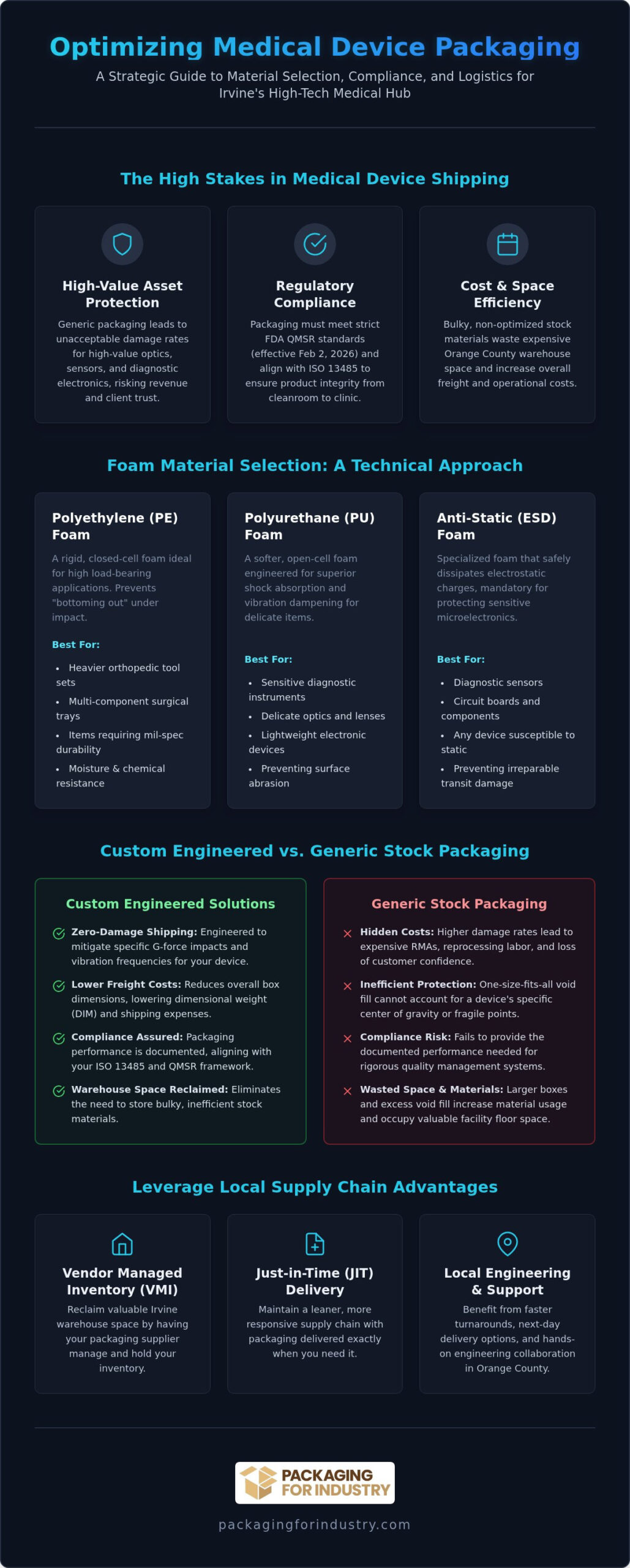
Precision is the baseline for medical device manufacturing. When shipping high-value assets like surgical lasers or robotic surgical components, foam packaging acts as more than just a cushion. It’s a precision-engineered barrier designed to mitigate the specific frequencies of vibration and the G-force impacts inherent in global logistics. For firms specializing in foam packaging for medical device manufacturing in Irvine, the margin for error is non-existent. A single hairline fracture in a lens or a shifted sensor during transit doesn’t just result in an RMA; it triggers a cascade of lost revenue, delayed clinical procedures, and unwanted regulatory scrutiny.
Generic void fill or standard bubble wrap cannot account for the specific center of gravity or fragile points of a robotic surgical arm. These failures lead to hidden costs that far exceed the price of the packaging itself. You have to account for the labor involved in reprocessing returned units and the potential loss of a hospital contract due to unreliable delivery. True protection requires a material science approach that balances density, compression sets, and surface abrasion resistance.
Irvine: A Global Center for Medical Innovation
Irvine has solidified its position as a premier hub for biotechnology and healthcare innovation. Recent data shows the 30 largest medical device companies in Orange County increased their workforce by 2.2%, now totaling over 24,000 employees. This concentration of high-value manufacturing requires a supply chain that moves with equivalent speed and precision. Off-the-shelf catalog solutions often fail here because they lack the specific density and ESD protection required for sensitive diagnostic sensors. Local sourcing in Orange County is the most effective way to mitigate the logistics risks introduced by the 2026 regulatory shift toward ISO 13485 harmonization.
Regulatory and Safety Compliance in Packaging
Compliance doesn’t end at the cleanroom door. Materials used in foam packaging for medical device manufacturing in Irvine must meet strict purity standards to prevent outgassing or particulate contamination. If a device is manufactured in a controlled environment, its packaging must preserve that integrity until the point of use. We focus on ensuring that your protective solutions align with the latest quality standards.
- Material Purity: Selecting medical-grade foams that won’t compromise sterile barriers or leave residue.
- Calibration Security: Engineering inserts that prevent internal component shifting during rough handling.
- ISO 13485 Alignment: Documenting packaging performance as part of a comprehensive quality management system.
The FDA’s final rule on Quality System Regulations, effective February 2, 2026, reinforces the need for rigorous standards across the entire supply chain. Protective packaging is a critical component of this compliance framework, ensuring that every device arrives in its validated state. By choosing an engineered approach, you protect the patient as much as the product.
Selecting the Right Foam Material: PE, PU, and ESD Options
Choosing the correct substrate is a calculation of load-bearing capacity and vibration damping. For foam packaging for medical device manufacturing in Irvine, we match the foam’s firmness to the device’s G-force rating. We often integrate these materials with heavy-duty RSC boxes to ensure the outer container supports the internal protection during high-volume distribution. This technical approach prevents “bottoming out,” where the foam collapses under impact and transfers energy directly to your sensitive hardware. Selecting the wrong density can be just as damaging as using no foam at all, especially when shipping high-value diagnostic tools.
Polyethylene (PE) Foam for Durable Tray Inserts
Polyethylene is a closed-cell foam known for its rigidity and high load-bearing capacity. It is the industry standard for heavier orthopedic tool sets and multi-component surgical trays. Because PE foam meets the durability requirements often found in mil-spec packaging, it performs exceptionally well in rigorous hospital logistics cycles where boxes are frequently moved and stacked. Its moisture-resistant and chemical-resistant properties also make it ideal for devices that require long-term storage in varying environmental conditions without the risk of material degradation or bacterial growth.
Polyurethane (PU) and Convoluted Foam for Fragile Optics
Polyurethane is open-cell and flexible, providing a soft-touch advantage for delicate diagnostic optics and calibrated sensors. We frequently utilize this material in complex kitting projects where multiple fragile components must be organized and secured within a single master shipper. Convoluted PU foam, or egg-crate foam, allows the device to sink into the material, distributing pressure across the entire surface area. This vibration damping is critical for maintaining the precise calibration of diagnostic tools during long-distance air or ground transit where constant micro-vibrations can lead to sensor drift.
ESD Foam for Electronics-Heavy Medical Devices
ESD foam, available in black conductive or pink anti-static varieties, is mandatory for devices containing sensitive motherboards or diagnostic sensors. To provide total protection, we integrate these inserts with corner boards and edge protection to ensure the shipment maintains its structural integrity under the weight of palletized loads. This prevents the “crush” effect that can occur in high-density warehouse environments common in Southern California. When you compare packaging pricing, it’s essential to look at the material’s performance over the entire shipping cycle. We can help you determine if custom sizes available for these foams will provide better protection than stock generic options while helping you lower packaging costs through optimized material usage.
Engineering Precision: Custom Inserts vs. Stock Solutions
Many procurement managers initially lean toward stock items to minimize unit costs. However, generic void fill frequently results in “over-boxing,” a scenario where you’re essentially paying to ship air. Custom-engineered foam packaging for medical device manufacturing in Irvine addresses this inefficiency directly. By contouring the foam exactly to your device’s dimensions, we reduce the outer corrugated footprint. This reduction in volume translates to lower dimensional weight (DIM) charges and allows for more units per pallet, significantly lowering your total cost of distribution.
PFI provides a technical bridge between your engineering blueprints and the realities of global logistics through dedicated CAD/CAM support. We don’t simply supply material; we solve complex structural challenges. Our design team takes your device’s 3D models and translates them into precise die-cut or CNC-routed patterns. This ensures that every delicate component, from a laser lens to a circuit board, has a dedicated and secure seat within the pack, eliminating the vibration and movement that causes transit damage.
The Prototyping and Testing Phase
Validation is a non-negotiable requirement in medical manufacturing. We provide free prototyping to Irvine engineers so they can verify fit and function before committing to a full production run. This phase often includes rigorous drop testing and vibration simulation to ensure the packaging meets the protective requirements of sensitive diagnostic equipment. CAD drawings accelerate the design cycle for Irvine engineers, allowing for rapid iterations and helping you meet tight product launch deadlines without sacrificing safety.
Custom Kitting for Surgical Trays
Efficiency in the clinical setting begins on your assembly line. We design custom foam kitting that organizes complex surgical trays, making them intuitive and organized for medical staff. These kits often integrate specialized foam with corner and edge protection to reinforce the outer shipping container against the heavy-duty handling common in hospital receiving docks. By delivering pre-inserted foam in boxes, we help streamline your assembly line and reduce the labor hours required for manual packing. This holistic approach ensures your devices stay protected and organized from the manufacturing floor to the operating room.
Optimizing Irvine Operations: VMI and JIT Delivery
Irvine is home to some of the most expensive industrial real estate in Southern California. For firms utilizing foam packaging for medical device manufacturing in Irvine, the physical footprint of packaging stock often conflicts with production capacity. Storing bulky foam inserts and corrugated boxes on-site consumes valuable square footage that should be dedicated to cleanrooms or assembly lines. This “Irvine Challenge” forces a choice between maintaining high safety stock or maximizing operational space.
Freeing Up Valuable Warehouse Space
Implementing Vendor Managed Inventory (VMI) transforms your packaging from a storage headache into a streamlined utility. We take full responsibility for monitoring your stock levels and replenishing supplies before a stockout occurs. This proactive approach allows manufacturers to reduce their on-site packaging inventory by as much as 40%. By shifting the storage burden to our facility in Anaheim, you reclaim floor space for high-value manufacturing activities while improving your overall cash flow. You don’t have to tie up capital in months of excess stock when you can rely on a partner to manage the buffer for you.
Local Logistics Advantage
Proximity is a strategic asset in medical logistics. Because we are located in nearby Anaheim, we provide local next-day delivery across Orange County, including the Irvine Spectrum and surrounding tech hubs. This geographic advantage enables a true Just-In-Time (JIT) model. You receive your foam packaging for medical device manufacturing in Irvine exactly when the production schedule demands it. Local sourcing also eliminates the heavy freight surcharges and long lead times associated with national catalog suppliers. It reduces the carbon footprint of your supply chain by minimizing the distance traveled for bulky materials, ensuring your logistics are as lean as your manufacturing.
Efficiency isn’t just about the material; it’s about the flow. A well-managed supply chain ensures that your sensitive optics and electronics are never sitting on a dock waiting for a box. By aligning your procurement with actual production cycles, you eliminate the fiscal stress of over-ordering while maintaining the agility needed for rapid market shifts.
Why Choose PFI for Medical Foam Packaging in Irvine?
PFI operates as an engineering-driven partner rather than a simple distributor. When you source foam packaging for medical device manufacturing in Irvine, you require technical accountability that national catalog suppliers simply cannot provide. Many firms find that big-box vendors offer a “one-size-fits-all” inventory that ignores the specific fragility of a surgical laser or the unique calibration of a diagnostic sensor. We offer direct access to packaging engineers who understand how material science impacts your bottom line. Our team has extensive experience serving high-compliance sectors, ensuring that every design meets the rigorous standards of the Orange County innovation hub.
We provide comprehensive protection systems that go beyond simple inserts. By combining custom foam with heavy-duty corrugated boxes and specialized crates, we create a unified barrier against the hazards of global transit. This holistic approach ensures that your device remains secure from the moment it leaves your Irvine facility until it reaches the end user. We don’t just deliver materials; we deliver a complete system of protection designed for high-value assets and sensitive medical equipment.
Lowering Your Total Cost of Ownership
Successful procurement requires looking beyond the initial per-unit price of a foam insert. We focus on your total cost of ownership by analyzing how better engineering reduces freight expenses and eliminates the massive financial hit of shipping damage. When you compare packaging pricing, it’s vital to look at how a precision-engineered pack reduces dimensional weight charges and product loss. A single damaged medical device can cost thousands in lost revenue and reprocessing labor. Our commitment to damage reduction and supply reliability ensures that you lower packaging costs over the long term. You can request a packaging quote to start a comprehensive cost-reduction analysis for your shipping cycles.
Partnering with an Irvine-Specific Expert
We understand the exacting standards and rapid pace required by Irvine manufacturers. The local MedTech community operates on tight development cycles and zero-tolerance quality requirements. PFI supports these needs with custom sizes available for any device footprint, ensuring a perfect fit every time. Our facility in Anaheim allows for rapid response times and a deeper understanding of the Southern California logistics landscape. We offer Vendor Managed Inventory (VMI) and local next-day delivery to keep your production lines moving without interruption. We don’t just sell you a product; we provide a system of logistical optimization that keeps your operations lean and your devices safe.
Streamline Your Medical Logistics and Eliminate Shipping Damage
Protecting high-value medical electronics and optics requires more than just standard cushioning. It demands a technical alignment between material density and the specific fragility of your device. By moving from stock solutions to custom-engineered inserts, you reduce shipping damage and lower your total freight expenses. Optimizing your logistics through local sourcing is the most effective way to manage the high cost of warehouse space in Orange County.
PFI provides the engineering expertise and local reliability needed for successful foam packaging for medical device manufacturing in Irvine. Our team supports your production cycles with free CAD prototyping to ensure a perfect fit before mass production. We manage your inventory levels so you don’t have to; freeing up capital and floor space for your core manufacturing operations. With local next-day delivery from our Anaheim facility, your supply chain remains lean and responsive.
We look forward to helping you eliminate transit damage and streamline your Irvine-based logistics.
Frequently Asked Questions
What is the best foam for shipping fragile medical electronics in Irvine?
ESD (Electrostatic Discharge) foam is the industry standard for sensitive medical electronics. It prevents static buildup that can destroy internal circuit boards during transit. We typically utilize black conductive or pink anti-static foams depending on your specific protection requirements. This choice ensures device integrity throughout the local and global shipping cycle, protecting your reputation for reliability in the medical sector.
How much does custom foam tooling cost for medical device inserts?
Tooling costs for custom inserts depend on the complexity of the die-cut or CNC-routed design. We provide technical quotes on a per-project basis to ensure you only pay for the precision your device requires. Factors like foam density and the number of cavities in the insert influence the final pricing. Custom solutions often pay for themselves by reducing shipping damage and lowering freight costs through smaller box dimensions.
Can PFI provide cleanroom-compatible foam packaging?
Yes, we offer low-sloughing and non-abrasive foam options suitable for cleanroom environments. These specialized materials are engineered to minimize particulate shedding, which preserves the sterile integrity of your medical devices. This is a critical requirement for manufacturers meeting the FDA’s Quality Management System Regulation standards. We help you select materials that won’t compromise your controlled manufacturing space or contaminate sensitive components.
What is the lead time for custom foam prototypes in Orange County?
We typically deliver custom foam prototypes within a few business days for manufacturers in Orange County. Our CAD/CAM support allows us to move quickly from your device blueprints to a physical sample for testing. This rapid turnaround helps Irvine engineers validate their shipping plans without delaying product launch schedules. We prioritize speed and precision to keep your innovation cycle moving forward without logistical bottlenecks.
Do you offer anti-static (ESD) foam for medical devices?
We provide a full range of ESD and anti-static foam packaging for medical device manufacturing in Irvine. These specialized materials protect sensitive diagnostic sensors and electronic components from invisible electrostatic discharge. Integrating these inserts into custom corrugated boxes creates a comprehensive shield. This prevents irreparable damage during transit, which is a common cause for costly RMAs and regulatory scrutiny in the medical device sector.
How does a VMI program work for my Irvine manufacturing facility?
Our Vendor Managed Inventory (VMI) program involves PFI monitoring your stock levels and replenishing packaging supplies automatically. We store the bulky inventory at our Anaheim facility and deliver it to your Irvine site as needed. This reduces the amount of expensive warehouse space you waste on packaging stock. It improves your cash flow by ensuring you only pay for the materials you use, precisely when you need them.
Can you provide foam-lined corrugated boxes for heavy medical gear?
We specialize in engineering heavy-duty corrugated boxes with custom foam linings for substantial medical equipment. These packs are designed to support the weight of surgical lasers or robotic components while providing superior shock absorption. By using high-density polyethylene foam, we ensure the gear remains stationary and protected from vibration. This integrated approach simplifies your packing process and reduces the labor hours required on the assembly line.
What is the difference between PE and PU foam for medical trays?
Polyethylene (PE) is a closed-cell foam that offers high rigidity and moisture resistance, making it ideal for heavy surgical tool sets. Polyurethane (PU) is an open-cell, softer foam used for delicate diagnostic optics that require gentle cushioning. Choosing the right material depends on the weight and surface sensitivity of your device. We help you balance these technical factors to optimize protection and reduce your total cost of ownership.