
A spiral wound tube is an engineered structural container, not just a simple cardboard mailer. Treating these components as a commodity is a costly mistake, especially following the 7% price increase for converted paperboard products that took effect in July 2026. Choosing the right spiral wound tube for shipping requires a precise understanding of ply-strength and wall thickness to protect high-value components from the rigors of a logistics market where truckload rates have surged 50% over the last year. If your packaging fails, the financial impact extends far beyond the cost of the tube itself.
You likely deal with the recurring stress of products arriving bent or crushed due to inadequate wall strength. It’s a frustrating waste of material, freight, and production time that eats into your bottom line. This article provides the technical roadmap you need to eliminate transit damage and optimize your industrial shipping costs. We’ll examine the exact specifications required for high-value protection and show you how to establish a reliable, recurring supply that reduces packaging waste while helping you avoid expensive shipping surcharges.
Key Takeaways
- Understand how angled paperboard layering creates the structural beam strength necessary to prevent crushing during high-volume transit.
- Master the technical criteria for choosing the right spiral wound tube for shipping by prioritizing specific wall thickness measurements to avoid product deformation.
- Evaluate specialized liners and protective coatings that safeguard sensitive components in aerospace and manufacturing environments.
- Discover how custom-tailored dimensions and stocking programs reduce packaging waste while streamlining your warehouse logistics.
- Learn how to leverage local supply chains in Southern California to secure a reliable, next-day supply of heavy-duty shipping tubes.
Understanding Spiral Wound Construction and Its Shipping Advantages
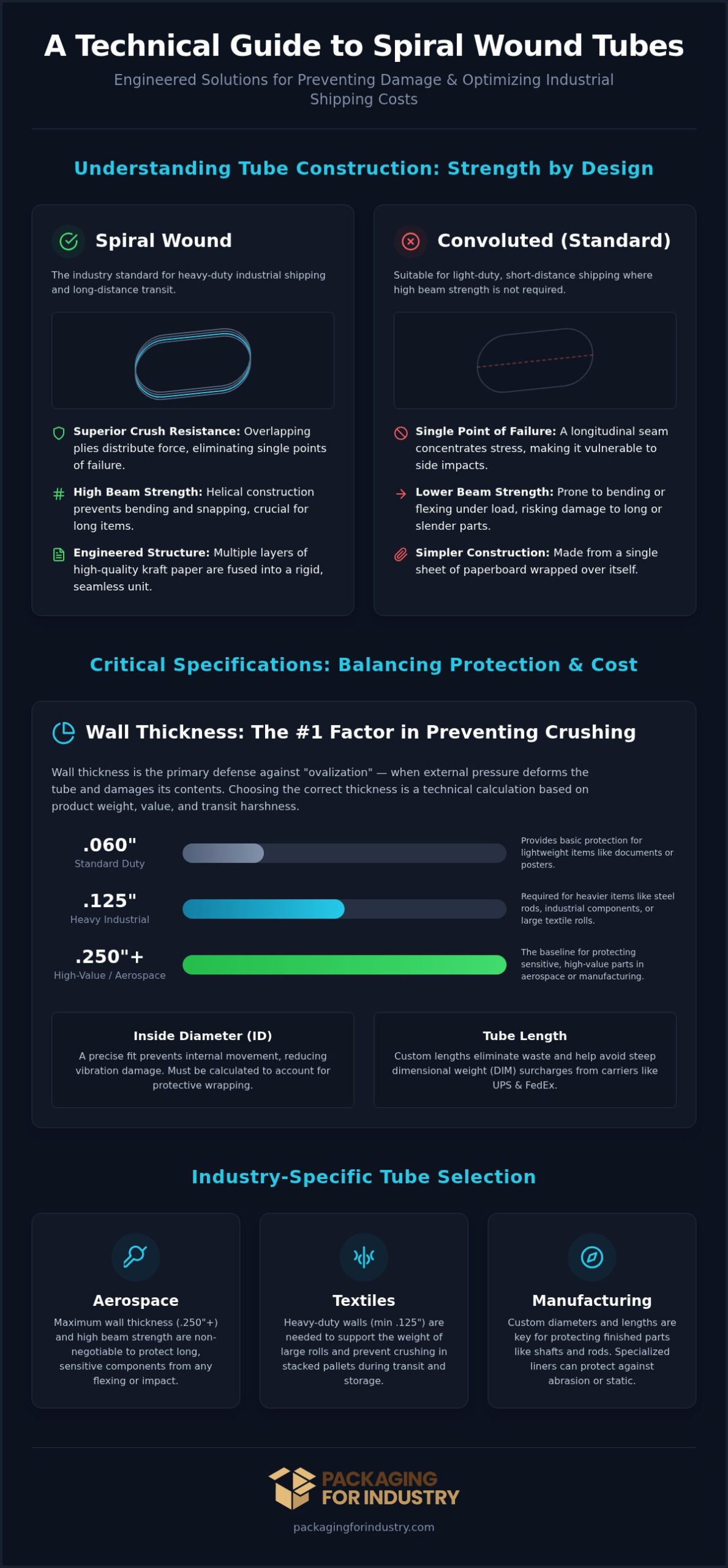
Choosing the right spiral wound tube for shipping begins with understanding that these aren’t just paper products; they are precision-engineered tools. A spiral wound tube is a composite structure formed by winding multiple layers of paperboard around a stationary mandrel at a specific angle. This helical construction method is the foundation for superior crush resistance. Unlike simple folded cardboard, these tubes and cores utilize overlapping plies to create a continuous, seamless cylinder that maintains its shape under significant pressure.
The structural integrity of the tube depends heavily on the adhesive bonding between each ply. Industrial-grade tubes use specialized glues that fuse the layers into a single, rigid unit. When this bonding is combined with high-quality kraft paper, the result is a container capable of protecting heavy or delicate industrial parts. High-quality kraft paper is essential for industrial-grade shipping because its long-fiber composition provides the necessary tensile strength to resist tearing and puncture under the stress of transit. This engineering-first approach ensures that the tube acts as a shield rather than just a wrapper.
Spiral Wound vs. Convoluted Tubes: Which Is Better for Shipping?
Convoluted tubes are manufactured by wrapping a single sheet of paperboard directly over itself, creating a longitudinal seam. This method produces high vertical crush strength, which is sometimes sufficient for light-duty applications or basic shipping and mailing tubes. However, spiral winding remains the industry standard for long-distance transit and heavy industrial use. The helical wrap eliminates the single point of failure found in longitudinal seams. While convoluted tubes might work for short-distance, lightweight items, the spiral process provides the dimensional stability required for the rigorous freight environments that most industrial manufacturers face.
The Physics of Beam Strength in Industrial Tubes
Industrial logistics involves more than just downward pressure. It involves complex bending forces during manual handling and constant vehicle vibration. The overlapping layers in a spiral wound design distribute these external forces across the entire surface area of the tube rather than concentrating them on a single seam. As the ply count increases, the tube’s resistance to bending grows exponentially. This structural rigidity is vital for protecting long, slender items like drive shafts or specialized aerospace components that cannot tolerate even minor flexing. Beam strength is the primary defense against tube snapping.
Critical Specifications: Inside Diameter, Wall Thickness, and Length
Choosing the right spiral wound tube for shipping involves a technical calculation of dimensions that balances structural integrity against freight costs. While construction method provides the foundation, the specific measurements of the tube dictate its performance in the field. Adhering to the General requirements for packagings ensures your shipment can withstand normal transportation conditions, but industrial parts often require even more stringent tolerances to avoid failure.
Wall thickness is the most critical factor in preventing “ovalization.” This occurs when external pressure from stacking or strap tension forces a circular tube into an oval shape, potentially crushing the product inside. Beyond diameter and thickness, tube length significantly impacts your bottom line. Major carriers like UPS and FedEx apply steep dimensional weight surcharges for tubes exceeding specific length thresholds. Precision in length not only protects the product but also eliminates these unnecessary logistics fees. It’s a matter of balancing engineering requirements with the economic reality of modern freight.
Calculating Minimum Wall Thickness for Heavy Loads
Standard wall thicknesses typically range from .060″ for lightweight documents to .250″ or more for heavy industrial components. A .060″ wall provides basic protection, but heavier items like steel rods or textile rolls often require at least .125″ to maintain their crush rating. For high-value aerospace parts, a .250″ wall thickness is often the baseline for professional-grade protection. If you’re unsure of the vertical or side-load requirements for your specific application, consider requesting a packaging quote to conduct custom load testing and ensure your specs meet actual transit demands.
Matching ID to Product Clearance
The Inside Diameter (ID) should provide a snug fit with minimal clearance. Leaving too much “air” inside the tube allows the product to shift during transit, which often leads to internal impact damage or end cap failure. When measuring irregular industrial parts, always use the widest point of the component as your baseline for the ID. If a product has variable diameters, you can use foam inserts or specialized tubes and cores accessories like end caps to occupy excess internal space and prevent movement. This precision ensures that the tube and the product function as a single, stable unit throughout the supply chain.
Material Selection and Protective Features for Industrial Use
Choosing the right spiral wound tube for shipping requires looking beyond the outer surface to the specific paperboard grades and protective additives used in construction. Industrial applications often favor 100% recycled kraft paper because it balances structural durability with fiscal responsibility. While virgin liners provide maximum tensile strength for high-pressure winding, recycled kraft delivers sufficient integrity for most logistics cycles. This material choice is particularly relevant given that paperboard currently accounts for 61% of the composite cardboard tube market. Selecting the appropriate material grade from PFI’s tubes and cores page ensures your packaging matches the specific physical demands of your product.
For tubes stored in unconditioned warehouses or shipped via ocean freight, moisture-resistant coatings are essential. High humidity can soften paperboard fibers, compromising the tube’s crush rating and leading to failure under load. Applying a wax or polymer coating preserves the structural rigidity of the container even in volatile environments. This protection is a necessary investment to prevent the professional stress of mass product loss due to environmental factors.
Ply-Bonding and Adhesive Integrity
The integrity of the tube relies on the chemical bond between paper layers. High-performance adhesives prevent delamination, which is the separation of plies often caused by extreme temperature swings during transit. In manufacturing environments where high-torque cores are required for winding textiles or films, the adhesive must resist shear forces that would otherwise cause the tube to unravel. PFI focuses on industrial-grade adhesives that maintain their grip from the production floor to the final destination, ensuring the tube remains a single, solid unit.
End Cap Security and Friction Fit
A shipping tube is only as strong as its closure. Heavy industrial parts can act as a battering ram during sudden stops, making end cap security a primary concern. A tight friction fit is the first line of defense to prevent heavy items from punching through the ends. While plastic end caps are standard for many e-commerce applications, metal or wood plugs offer superior resistance for heavy-duty loads. For added security, some shippers use stapled or taped closures to ensure the cap remains seated throughout the journey. Plastic plugs provide a cost-effective, reusable option, while metal caps offer the highest level of puncture resistance for heavy steel or aerospace components.
Industry-Specific Selection: Aerospace, Textiles, and Manufacturing
Choosing the right spiral wound tube for shipping requires a deep understanding of the specific stressors within your vertical. A one-size-fits-all approach often leads to over-spending on over-engineered materials or, worse, under-protecting high-value assets. In the aerospace and defense sector, the priority is absolute precision and damage prevention for mission-critical components. Conversely, textile and film manufacturers focus on cores that can withstand the extreme torque of high-speed winding. By aligning tube specifications with actual environmental demands, manufacturing teams can lower packaging costs while maintaining a professional standard of protection.
Custom lengths are a fundamental part of this optimization. Using standard off-the-shelf sizes often creates “damage-prone” voids at the ends of the tube. When a product has room to move, it gains momentum during handling, which eventually leads to end cap failure or internal surface marring. Engineering the tube to the exact length of the product eliminates this movement and reduces the need for secondary dunnage. By prioritizing these technical specifications, choosing the right spiral wound tube for shipping becomes a proactive strategy for operational efficiency.
Protective Tubes for Precision Aerospace Components
Precision aerospace parts, such as sensors or machined housings, often require specialized internal protection. In manufacturing hubs like Anaheim and across Orange County, engineers frequently utilize foam-lined spiral wound tubes. This combination of a rigid outer shell and a soft inner liner provides a secondary layer of security against vibration during transit. These solutions must comply with rigorous industrial standards for high-value logistics, where even a microscopic scratch can result in a rejected shipment.
Industrial Cores for Heavy Roll Goods
For textiles, paper, and film, the spiral wound tube functions as a core that must maintain its circularity under crushing tension. Torque resistance is the defining metric for these applications. If a core deforms under the weight of the rolled material, it can jam automated winding equipment or cause uneven tension in the final product. Consistency in wall thickness and ID is vital for keeping production lines moving at peak efficiency. Integrating these high-strength cores into a Vendor Managed Inventory program ensures a reliable recurring supply, preventing the professional stress of production delays caused by stock-outs.
Optimizing Procurement with Custom Tubes and PFI’s VMI Programs
Choosing the right spiral wound tube for shipping involves more than selecting a diameter; it requires a strategic approach to inventory and labor costs. Many manufacturing facilities lose significant time and material by purchasing standard stock lengths and cutting them in-house. This process creates unnecessary dust, labor expenses, and scrap waste. Custom-length tubes eliminate these inefficiencies by arriving ready for immediate use. By specifying exact dimensions, you also avoid the dimensional weight surcharges that major carriers often apply to oversized packaging. It’s a pragmatic shift from reactive buying to engineered procurement.
High-volume users in Southern California benefit from local logistics that catalog suppliers cannot match. PFI offers local next-day delivery in the Inland Empire, Orange County, and Los Angeles, providing a level of responsiveness that minimizes downtime. For operations focused on lean principles, Just-In-Time (JIT) inventory management ensures that packaging arrives exactly when needed. This approach frees up valuable warehouse floor space and improves cash flow by reducing the capital tied up in idle stock. Before placing your next order, it’s wise to compare packaging pricing against large catalog suppliers to see the fiscal impact of a localized, custom-engineered supply chain.
Streamlining Supply with Vendor Managed Inventory (VMI)
A Vendor Managed Inventory (VMI) program transfers the burden of stock monitoring from your operations manager to the supplier. PFI monitors your tube usage and replenishes stock automatically, preventing the professional stress of production-stopping shortages. This system is particularly effective for high-volume manufacturing lines where consistent supply is non-negotiable. By stocking only what you need for the immediate production cycle, you reduce your warehouse footprint and simplify the entire purchasing workflow. It’s a methodical solution for maintaining logistical flow without the administrative overhead.
The Cost Benefit of Custom Engineering
The unit price of a “stock” tube from a national catalog often appears lower on the surface, but the total landed cost tells a different story. When you factor in freight costs, which have risen significantly with the SONAR National Truckload Index reaching $3.78 per mile in June 2026, and the potential for transit damage, custom engineering becomes the more economical choice. PFI’s expertise in solving UPS and FedEx surcharge issues ensures that your tube length is optimized for the lowest possible freight bracket. This precision protects your high-value components while safeguarding your bottom line. Professional-grade protection is an investment in stability, not just an expense.
Secure Your Supply Chain with Engineered Protection
Choosing the right spiral wound tube for shipping is a strategic decision that impacts both product safety and operational costs. Precision matters. By prioritizing precise wall thickness and custom lengths, you’ll eliminate the voids that lead to transit damage and the surcharges that inflate freight budgets. These engineered containers provide the structural beam strength necessary for the most demanding aerospace and manufacturing applications.
Stabilizing your supply chain requires a partner that understands the intersection of engineering and economics. PFI serves as a cost-effective alternative to large catalog suppliers by offering custom-tailored solutions and local next-day delivery throughout Orange County and Los Angeles. Our Vendor Managed Inventory programs ensure you maintain the stock you need without overextending your warehouse footprint.
Take control of your logistics with a steady, dependable packaging partner. We look forward to optimizing your shipping process and providing the professional peace of mind your operations deserve.
Frequently Asked Questions
What is the standard wall thickness for heavy-duty shipping tubes?
Standard heavy-duty wall thicknesses typically range from .125″ to .250″. For industrial manufacturing and high-value aerospace parts, a .250″ wall provides the necessary crush resistance to survive long-haul transit. Choosing the right spiral wound tube for shipping requires matching this thickness to your product weight. Thinner walls like .060″ are generally reserved for lightweight commercial mailers rather than industrial components.
How do I measure the inside diameter (ID) of a spiral wound tube?
To measure the Inside Diameter (ID), use a caliper to determine the widest point of your product. Add a minimal clearance buffer, typically between 1/16″ and 1/8″, to ensure the item slides in without force while remaining snug. A precise ID prevents internal shifting, which is a leading cause of end cap failure and surface marring during vehicle vibration.
Can spiral wound tubes be customized with foam inserts for extra protection?
Yes, spiral wound tubes are frequently customized with foam inserts to protect sensitive electronics or machined surfaces. PFI specializes in engineering foam packaging that fits precisely within the tube’s ID. This dual-layer protection combines the rigid exterior of the tube with a soft, shock-absorbing interior, creating a professional-grade solution for the aerospace and defense sectors.
Are these tubes strong enough for international export shipping?
These tubes are engineered to withstand the rigors of international export when specified correctly. For ocean freight, we recommend using high-ply counts and moisture-resistant coatings to prevent the paperboard from softening in humid environments. These technical enhancements ensure the tube maintains its beam strength and crush rating throughout the extended global supply chain.
Does PFI offer local delivery for bulk tube orders in Southern California?
PFI provides local next-day delivery for bulk orders throughout Southern California, including Orange County and Los Angeles. This localized service allows manufacturing teams to maintain lean inventory levels without the risk of production delays. By bypassing national catalog suppliers, you reduce freight costs and ensure a more reliable, responsive supply of critical packaging materials.
What is the maximum length available for custom spiral wound tubes?
Custom spiral wound tubes can be manufactured in lengths exceeding 20 feet for specialized industrial applications. However, most manufacturers prefer tubes cut to the exact length of their product to avoid “damage-prone” voids. Choosing the right spiral wound tube for shipping often involves balancing these extreme lengths against carrier surcharges to optimize your total landed cost.
How can I lower my packaging costs when ordering shipping tubes in bulk?
Transitioning from a large catalog supplier to a specialized manufacturer like PFI is the most effective way to lower bulk costs. Implementing a Vendor Managed Inventory (VMI) program further reduces expenses by streamlining procurement and freeing up warehouse space. Custom engineering also eliminates the labor costs associated with in-house tube cutting and the waste of unused material.
Do you provide end caps that match custom tube diameters?
We provide a full range of end caps, including plastic, metal, and wood plugs, designed to match custom tube diameters exactly. A secure friction fit is essential for preventing heavy items from punching through the ends during handling. For high-torque or heavy-duty loads, metal or wood plugs offer the highest level of security and structural integrity.