
What if the “standard” foam you’ve used for years is actually the primary driver of your increasing per-unit shipping costs? Choosing the wrong material can lead to high product damage rates, especially when navigating a polyethylene vs polyurethane foam comparison for packaging without a clear technical framework. With North American polyethylene suppliers proposing a 5 cent per pound price increase in August 2026 and polyurethane costs surging globally, sticking with the status quo is a luxury your bottom line can’t afford. You likely feel the pressure of rising material costs from catalog suppliers while still struggling to find custom-fit protection for irregular industrial parts.
This guide will help you break that cycle. We’ll provide a clear roadmap to select the right material based on your specific product weight and fragility. You’ll learn how to optimize your protection levels to lower overall expenses and find a reliable local Southern California partner for custom-engineered solutions. We’ll examine the critical differences in density and durability to ensure your aerospace or electronic components arrive intact every time. By the end of this comparison, you’ll have the data needed to streamline your warehouse logistics and secure your supply chain.
Key Takeaways
- Conduct a technical polyethylene vs polyurethane foam comparison for packaging to determine whether your components require rigid structural support or high-flexibility vibration damping.
- Identify why high-density polyethylene is the industrial standard for heavy-duty automotive parts and equipment that require chemical resistance and long-term durability.
- Evaluate the performance of polyurethane foam for lightweight, fragile electronics and medical devices that need superior cushioning against repeated transit shocks.
- Learn how custom CAD engineering and prototyping can lower packaging costs by eliminating excess material and ensuring a precision fit for irregular industrial parts.
- Leverage local Southern California manufacturing for next-day delivery and vendor-managed inventory to improve your supply chain reliability and warehouse efficiency.
Understanding the Role of Foam Selection in Industrial Protection
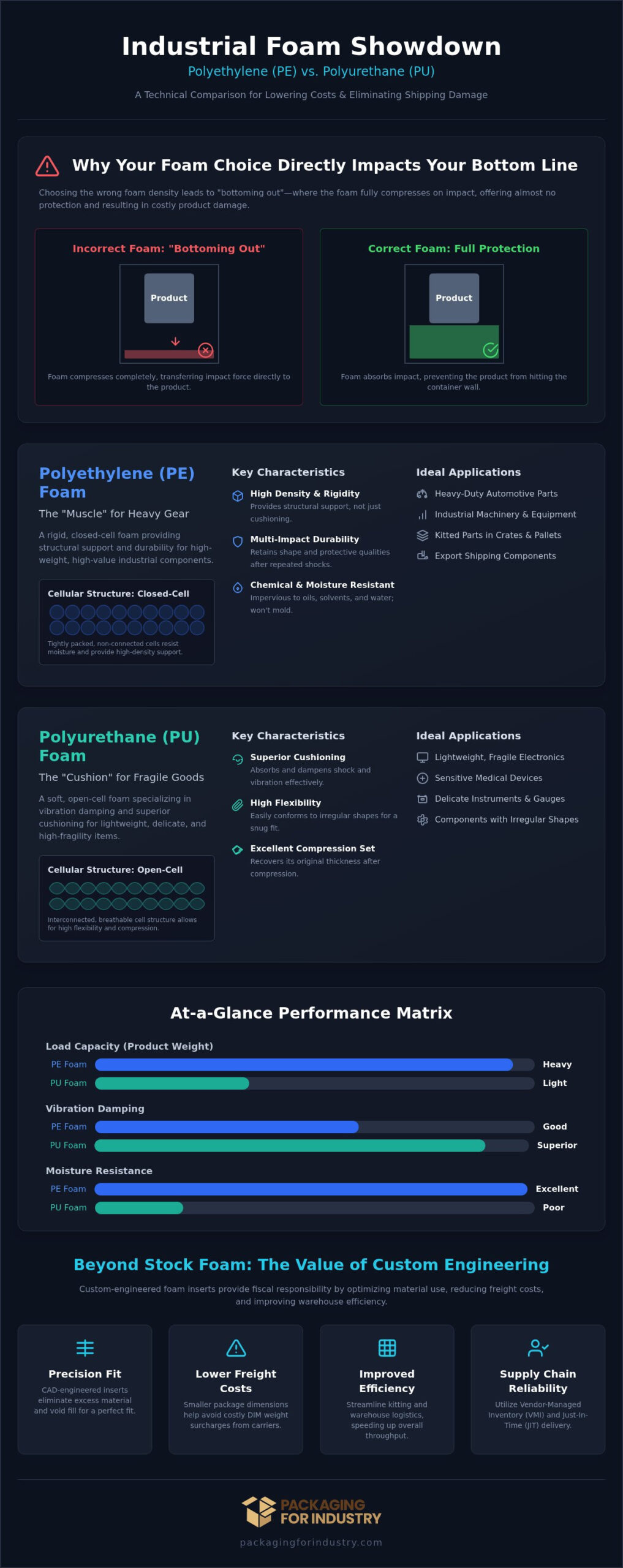
Protective foam serves as your frontline defense against the inevitable impacts and vibrations of the global supply chain. For industrial manufacturers, shipping damage isn’t merely a logistical inconvenience; it represents a significant erosion of profit margins. Every returned part carries the hidden costs of reverse logistics, administrative labor, and diminished client trust. When conducting a polyethylene vs polyurethane foam comparison for packaging, the goal is to match material performance with the specific G-force threshold of your product. Selecting an incorrect density often results in “bottoming out.” This occurs when the foam reaches its maximum compression during a drop, causing the product to strike the outer container with nearly the same force as if no cushioning existed.
The Economics of Engineered Foam Inserts
Engineered foam inserts provide a level of fiscal responsibility that off-the-shelf solutions can’t match. Custom-cut inserts allow you to minimize the “air” inside your shipments. This is critical for reducing package dimensions and avoiding the steep dimensional (DIM) weight surcharges that carriers like UPS and FedEx use to penalize inefficient packaging. By integrating these custom inserts with custom corrugated boxes, you create a cohesive system that simplifies kitting and speeds up warehouse throughput. The initial investment in custom tooling often pays for itself through reduced damage claims and lower per-unit freight expenses. It’s a pragmatic approach to logistics that focuses on total cost of ownership rather than just the price of raw materials.
Closed-Cell vs. Open-Cell: A Quick Primer
Understanding the cellular structure of these materials is essential for proper specification. Polyethylene (PE) is a closed-cell foam, characterized by tight, interconnected cells that trap air and resist moisture. This structure provides the rigidity and buoyancy required for heavy industrial parts that might face harsh environments. On the other hand, Polyurethane (PU) Foam is an open-cell material. Its breathable, interconnected structure allows for high vibration damping and a softer tactile feel.
Aerospace and medical device manufacturers often choose between these based on “compression set,” which measures how well a material recovers its thickness after being compressed. While PE excels at supporting high-weight loads without collapsing, PU is the superior choice for lightweight, high-fragility components that require a gentle cradle during transit. A detailed polyethylene vs polyurethane foam comparison for packaging shows that PE is the “muscle” for heavy gear, while PU is the “cushion” for delicate instruments. Choosing correctly ensures you don’t overspend on over-engineered protection or risk failure with an under-specified material.
Polyethylene (PE) Foam: The High-Durability Choice for Heavy Gear
Polyethylene (PE) foam stands as the primary choice for manufacturers dealing with high-weight loads and rigorous shipping cycles. Its closed-cell structure provides a level of rigidity and structural integrity that lighter foams simply cannot match. When you perform a polyethylene vs polyurethane foam comparison for packaging, the most striking difference is PE’s ability to resist compression over long periods. It doesn’t just cushion; it supports. This material is inherently buoyant and chemically resistant, making it impervious to oils, solvents, and grease commonly found in industrial environments.
Durability is a key differentiator for PE foam. Unlike softer materials that may deform after a single shock, PE foam can withstand multiple impacts during a single transit leg without losing its protective geometry. This resilience makes it the industry standard for automotive parts, heavy machinery, and industrial equipment. Additionally, its moisture-resistant properties are essential for export crates. If your goods are sitting in a humid shipping container or on a coastal dock in San Pedro, PE foam won’t absorb water or harbor mold. This reliability ensures your assets remain protected regardless of the environmental conditions during transit.
Key Applications for PE Foam Planks and Sheets
Industrial operations utilize PE planks for heavy-duty blocking and bracing. This is particularly effective when secured inside custom wood crates to prevent shifting. PE is also the preferred material for end caps protecting server racks and heavy electronics. In manufacturing facilities, high-density PE sheets are frequently used for tool control and shadow boards, ensuring that every piece of equipment has a dedicated, durable home. If you are unsure which density fits your load, you can request a packaging quote to get an expert assessment of your specific shipping requirements.
Anti-Static PE Foam for Sensitive Electronics
For the electronics and semiconductor sectors in Orange County, standard foam isn’t enough. We provide pink anti-static PE foam specifically designed to protect against triboelectric charging. This material dissipates static charges that could otherwise fry sensitive circuits during handling. When you factor ESD protection into your polyethylene vs polyurethane foam comparison for packaging, PE is often favored for its structural strength in shipping heavier electronic assemblies. Combining this foam with static shielding bags creates a comprehensive protection system that meets the strict standards of modern tech manufacturing. This ensures your components remain operational from the cleanroom to the end user.
Polyurethane (PU) Foam: Superior Cushioning for Fragile Goods
While PE provides the structural rigidity needed for heavy gear, Polyurethane (PU) foam is the industry standard for lightweight, high-value protection. Its open-cell structure makes it exceptionally soft and flexible, providing superior vibration damping during transit. In any polyethylene vs polyurethane foam comparison for packaging, PU stands out for its “memory” and ability to conform to complex geometries. This makes it the ideal choice for medical sensors, delicate glassware, and precision instruments that require a gentle cradle rather than a rigid block. It’s the “cushion” to PE’s “muscle,” specifically designed to absorb the minor shocks that can ruin sensitive calibration.
From a fiscal perspective, PU is generally more cost-effective for one-way shipping of lighter loads. It offers excellent protection without the higher material density costs associated with PE planks. This allows manufacturers to lower packaging costs while maintaining a high standard of protection for e-commerce and retail distribution. Because it’s easy to die-cut and manipulate, PU is often the fastest route to a custom-fit solution for irregular parts.
Convoluted Foam and Custom PU Inserts
Convoluted or “egg crate” foam is a staple in industrial kitting. Its peaked surface allows a single insert to secure items of varying heights within the same container, simplifying your warehouse inventory needs. Integrating these inserts into your e-commerce packaging also creates a premium unboxing experience that reinforces your brand’s perceived value. However, operations managers must recognize PU’s limitations. It lacks the load-bearing capacity of closed-cell materials. Heavy parts will likely “bottom out” and sustain damage if PU is used as the primary support for high-weight equipment.
PU Foam Densities and Indentation Force Deflection (IFD)
We measure the performance of PU through Indentation Force Deflection (IFD). This metric quantifies the amount of force required to compress the foam by 25% of its original height. When reviewing a polyethylene vs polyurethane foam comparison for packaging, the IFD rating is the technical benchmark for determining which material can safely suspend your specific product weight. This is critical for specifying protection for delicate aerospace instrumentation where even slight over-compression can be catastrophic.
You can specify PU in various densities and colors, typically charcoal or natural. Charcoal is the preferred choice for industrial tool kits and electronics because it hides oils and warehouse dust. Natural foam is frequently used in medical sectors where a clean, white appearance is required. Selecting the right IFD ensures your components stay suspended within the “sweet spot” of the foam’s compression range, neutralizing external forces before they reach the product.
Comparative Analysis: Performance, Cost, and Industry Applications
Selecting the right material requires an engineering trade-off between shock absorption and vibration damping. Polyethylene (PE) excels at shock absorption. It’s designed to dissipate the energy from a high-impact drop, making it the superior choice for heavy industrial components. Polyurethane (PU) specializes in vibration damping. Its open-cell structure absorbs the high-frequency “jitters” of truck beds and aircraft holds, which is essential for preserving the calibration of sensitive instruments. When you perform a polyethylene vs polyurethane foam comparison for packaging, you must weigh the initial material cost against the reusable lifespan of the insert. PE foam is highly recyclable and maintains its structural integrity over dozens of trips. PU foam, while less moisture-resistant, offers incredible longevity in “memory” for long-term storage applications.
Fabrication methods also influence your total packaging spend. At PFI, we utilize three primary methods to transform raw planks into finished protection systems. Die-cutting is the most cost-effective for high-volume production runs. Water-jet cutting provides extreme precision for intricate parts without the need for expensive tooling. CNC routing allows for complex, multi-depth pockets in high-density PE, which is perfect for tool shadow boards and specialized kitting. Choosing the right fabrication method is just as critical as the material itself for lowering per-unit costs.
PE vs. PU Comparison Table
| Feature | Polyethylene (PE) | Polyurethane (PU) |
|---|---|---|
| Weight Capacity | High (Heavy machinery) | Low to Medium (Fragile goods) |
| Cell Structure | Closed-cell (Waterproof) | Open-cell (Breathable) |
| Reusability | Excellent (Multi-impact) | Good (Conforms to shape) |
| Moisture Resistance | Excellent | Poor (Absorbent) |
| Best For | Blocking and Bracing | Cushioning and Damping |
A hybrid approach often provides the best of both worlds. We frequently design inserts using a rigid PE base for structural support topped with a soft PU layer to protect delicate surfaces. This ensures the part stays in place while preventing scratches or “chatter” during transit.
Which Foam Wins for Your Industry?
Aerospace manufacturers dominantely use high-density PE for landing gear and engine components, yet they rely on PU for cockpit displays and avionics. In the medical sector, cleanroom-compatible foams must be non-dusting and chemically inert. Industrial machinery requires the uncompromising strength of PE for heavy-duty shipping of steel assemblies. A thorough polyethylene vs polyurethane foam comparison for packaging reveals that your industry’s specific G-force requirements and environmental exposure should dictate the final spec.
Custom Foam Engineering and Prototyping in Southern California
Choosing the right material is only the first step in securing your supply chain. While a polyethylene vs polyurethane foam comparison for packaging provides the material baseline, the final performance depends on precision engineering. Packaging For Industry (PFI) bridges the gap between raw foam planks and a finished protection system. We don’t just sell foam; we design custom-fit environments for your most sensitive industrial assets. This data-driven approach ensures that your polyethylene vs polyurethane foam comparison for packaging translates into a functional insert that prevents bottoming out and minimizes package volume.
From CAD to Crate: The PFI Design Process
Our design process begins with CAD/CAM support to ensure a precision fit for your parts. We take your digital files or physical samples and engineer an insert that accounts for every irregular angle and fragile protrusion. We offer free prototyping for recurring industrial orders because we believe in “measure twice, cut once.” This phase allows you to test the fit and performance of the foam before committing to a full production run. While the initial polyethylene vs polyurethane foam comparison for packaging identifies the material, our prototyping phase confirms the physical performance under real-world stress.
Regional manufacturers in Anaheim, Irvine, and Santa Ana benefit from our local manufacturing presence. We understand that warehouse space is at a premium in Southern California. By manufacturing locally, we can offer next-day delivery on stock items and significantly reduced lead times for custom die-cut orders. This proximity allows your team to maintain leaner inventory levels without risking a stockout on critical packaging supplies.
Lowering Costs with Integrated Packaging Solutions
Managing recurring foam needs shouldn’t be a source of professional stress. We help you streamline procurement through our Vendor Managed Inventory (VMI) program. Under this system, we monitor your stock levels and replenish your foam inserts automatically. This eliminates the administrative burden of constant reordering and ensures you always have the protection you need. To further secure your shipments, we often recommend combining custom foam with corner and edge protection to reinforce the structural integrity of your outer cartons.
We help your business transition from expensive catalog pricing to wholesale savings. PFI serves as a cost-saving alternative to national catalog suppliers by providing custom engineering that reduces material waste. It’s a pragmatic shift from buying “off-the-shelf” to investing in a tailored system that lowers your total cost of ownership. Our focus remains on fiscal responsibility and the elimination of shipping damage for every client we serve.
Secure Your Supply Chain with Engineered Foam Solutions
Selecting between PE and PU isn’t just about material price; it’s about engineering a system that eliminates shipping damage and lowers your total cost of ownership. This polyethylene vs polyurethane foam comparison for packaging highlights that while PE provides the structural muscle for heavy equipment, PU offers the delicate cushioning required for high-sensitivity electronics. PFI specializes in bridging this gap through precision CAD support and free prototyping, ensuring your custom inserts meet rigorous aerospace and defense standards.
For manufacturers across Orange County and the broader Southern California region, our local presence means you don’t have to choose between custom engineering and rapid turnaround. We provide local next-day delivery to keep your warehouse logistics moving at peak efficiency while reducing your dependence on generic catalog suppliers. Our team is focused on delivering the fiscal responsibility and operational peace of mind your business requires.
We look forward to partnering with you to solve your most complex logistical challenges with stability and precision.
Frequently Asked Questions
Which foam is better for heavy industrial parts, polyethylene or polyurethane?
Polyethylene (PE) is the correct choice for heavy industrial components because its closed-cell structure provides the necessary structural support to prevent shifting. Unlike softer materials, PE doesn’t collapse under high-weight loads, making it the standard for automotive assemblies and steel parts. It acts as a rigid block and brace within your shipping container, ensuring heavy assets remain stationary during the most turbulent transit cycles.
Is polyethylene foam waterproof for international shipping?
Polyethylene foam is waterproof and remains the preferred material for international sea freight and long-term storage in humid environments. Because it’s a closed-cell material, it won’t absorb moisture or harbor mold even when exposed to coastal conditions in San Pedro or Long Beach. This moisture barrier is critical for protecting metal parts from corrosion during extended export timelines where environmental control is limited.
Can I get anti-static (ESD) versions of both PE and PU foam?
Yes, we provide anti-static (ESD) versions of both materials to protect sensitive electronics from triboelectric charging. When you perform a polyethylene vs polyurethane foam comparison for packaging for the electronics sector, you’ll find that pink anti-static PE is used for structural support of heavier assemblies, while anti-static PU is ideal for cushioning delicate circuit boards. Both options ensure your components arrive without latent static damage.
How do I determine the correct foam density for my product?
Determining the correct density requires a technical assessment of your product’s weight and its fragility rating, often referred to as the G-factor. Heavier industrial parts require high-density polyethylene to prevent bottoming out. Conversely, lightweight, fragile items need lower-density polyurethane to provide adequate deceleration during a drop. Our engineering team uses these metrics to specify the exact foam grade needed to lower your per-unit shipping costs.
Does PFI offer custom die-cut foam inserts in Southern California?
PFI specializes in custom die-cut foam inserts manufactured at our Anaheim facility to serve the entire Southern California region. We provide free prototyping to ensure a precision fit before you commit to a full production run. Our local presence allows us to offer next-day delivery to manufacturers in Orange County, Los Angeles, and the Inland Empire, helping you maintain lean inventory levels through our VMI programs.
What is the difference between open-cell and closed-cell foam for packaging?
The primary difference lies in the cell geometry; open-cell foam (PU) has interconnected pores that make it soft and breathable for cushioning, while closed-cell foam (PE) has sealed cells for rigidity. This structural distinction is the most important factor in a polyethylene vs polyurethane foam comparison for packaging. PU excels at absorbing repeated minor vibrations, whereas PE is designed to withstand significant shocks and provide a waterproof barrier for heavy gear.
Is custom foam packaging more expensive than standard bubble wrap?
Custom foam has a higher initial price than bubble wrap, but it typically results in lower total shipping costs by significantly reducing product damage rates. Engineered inserts allow for smaller box dimensions, which helps you avoid dimensional weight surcharges from carriers like FedEx. By switching from generic void fill to custom-fit foam, industrial manufacturers often see a measurable improvement in their bottom-line margins through reduced returns and simplified warehouse kitting.