
How much of your bottom line is disappearing into the scrap bin because of inadequate transit protection? If you’re managing a warehouse in Southern California, you know that shipping heavy engine blocks or sensitive electronics isn’t just about finding a box; it’s about engineering a survival strategy. Finding the right packaging for aftermarket automotive parts City of Industry requires balancing the need for extreme durability with the reality of rising freight costs. You’ve likely dealt with the frustration of high damage rates on heavy components or realized that national catalog suppliers simply can’t meet your lead times during peak demand.
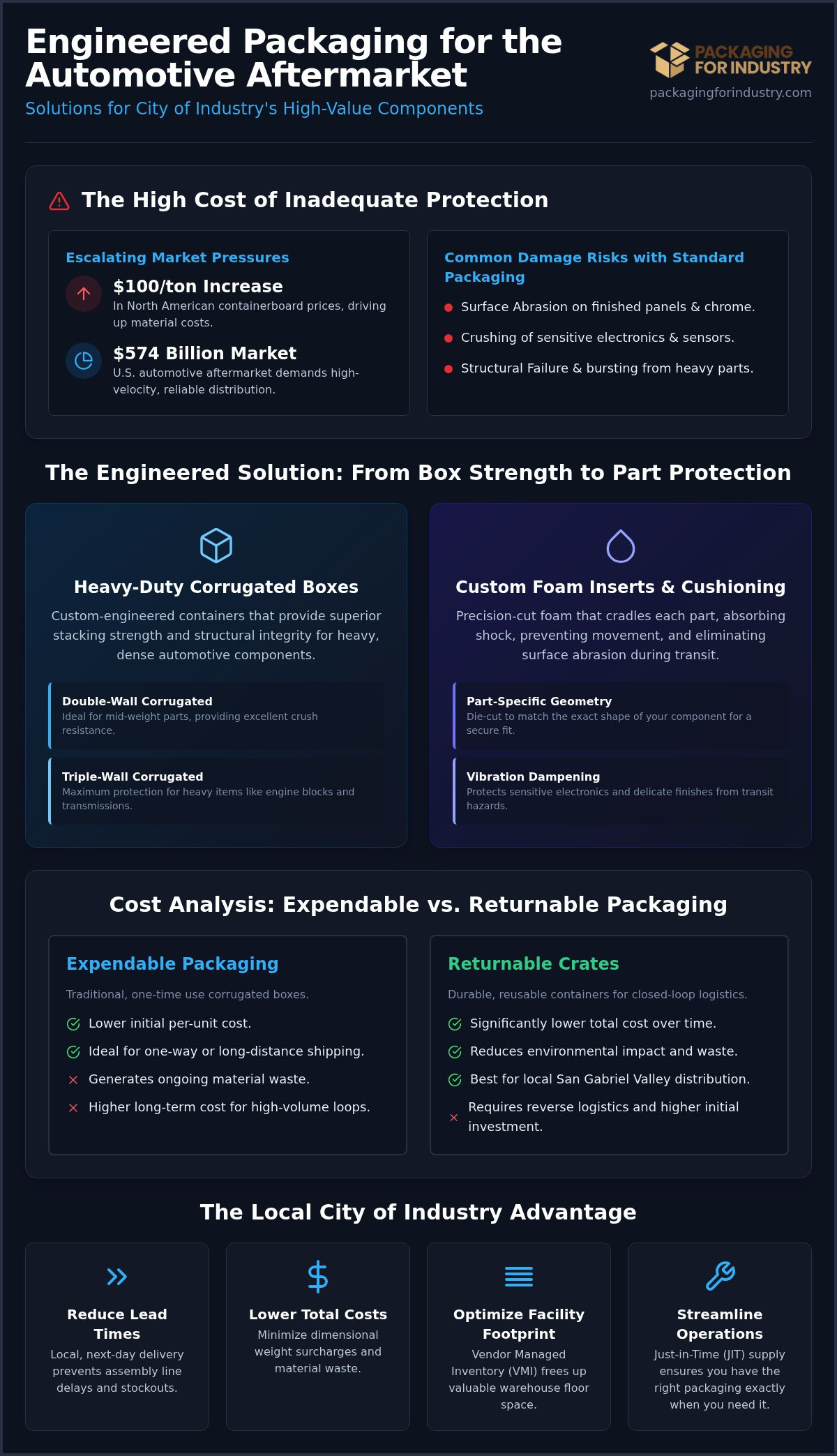
We understand that every shipment represents a significant investment, especially with North American containerboard prices increasing by $100 per ton in early 2026. This guide will show you how to protect high-value auto components, reduce shipping damage, and optimize your City of Industry supply chain with custom-engineered packaging solutions. We’ll explore how to lower total cost per shipment by minimizing UPS and FedEx dimensional weight surcharges and ensure you stay compliant with California’s SB 54 fee schedule. From heavy-duty double-wall corrugated boxes to custom-cut foam inserts, you’ll discover how a local, just-in-time supply chain provides the reliability your operations demand.
Key Takeaways
- Learn why heavy-duty double and triple-wall corrugated boxes outperform standard catalog options for protecting dense engine and transmission components.
- Evaluate the financial benefits of returnable crates versus expendable packaging for local San Gabriel Valley distribution loops.
- Discover how sourcing packaging for aftermarket automotive parts City of Industry with local next-day delivery reduces lead times and prevents assembly line delays.
- Optimize your facility’s footprint by utilizing Vendor Managed Inventory (VMI) to manage high-volume stock without cluttering your warehouse floor.
- Reduce total shipping costs by implementing custom-engineered designs that minimize dimensional weight surcharges and material waste.
Logistical Challenges of Packaging for Aftermarket Automotive Parts in City of Industry
City of Industry serves as the logistical engine of the San Gabriel Valley. For operations managers overseeing packaging for aftermarket automotive parts City of Industry, the environment presents a unique set of challenges that off-the-shelf solutions simply can’t solve. When you’re shipping heavy castings or precision-machined components, a generic box is often a liability rather than an asset. The density of these parts requires a level of structural integrity that standard single-wall corrugated materials can’t provide, leading to high damage rates and inflated insurance claims.
The financial stakes have shifted recently. With North American containerboard prices seeing a net increase of $100 per ton in the first half of 2026, the cost of using inefficient or over-specified materials has never been higher. Efficient logistics in Southern California demand a precise balance between material strength and weight optimization. If your packaging isn’t engineered for the specific part it carries, you’re likely overpaying for material or incurring unnecessary freight surcharges due to excessive dimensional weight.
Why City of Industry is a Critical Automotive Hub
The geographic advantage of the City of Industry is undeniable. Its proximity to the Ports of Los Angeles and Long Beach makes it a primary hub for imported Tier 2 and Tier 3 components. Local distribution centers must maintain a rapid replenishment cycle to keep up with the $574 billion U.S. automotive aftermarket. This high-velocity environment means packages are handled frequently, increasing the risk of damage during transit. Manufacturers in this region need a partner who understands the local freight lanes and the specific stresses of palletized stacking in high-volume warehouses.
Common Damage Risks for Aftermarket Components
Standard packaging often overlooks the specific vulnerabilities of automotive hardware. Without specialized protection, several common failure points emerge during the “last mile” of distribution:
- Surface Abrasion: Finished body panels and chrome accents often suffer micro-scratches from shifting inside a box that lacks custom inserts or protective film.
- Crushing of Sensitive Electronics: Lightweight plastic sensors and delicate connectors are easily crushed when palletized under heavier metal parts if the outer container lacks sufficient stacking strength.
- Structural Failure: Heavy metal castings, such as engine blocks or rotors, can burst through the bottom of standard RSC boxes during rough handling or forklift maneuvers.
Addressing these risks requires moving away from one-size-fits-all solutions toward custom design packaging that accounts for part geometry and weight distribution. Relying on national catalog suppliers often leads to lead time delays that can stall your entire production line. A local approach ensures you have the right materials exactly when you need them, reducing both damage and downtime.
Custom Corrugated and Foam: Engineering the Ultimate Auto Part Protector
Effective packaging for aftermarket automotive parts City of Industry relies on an integrated strategy where the outer container and internal cushioning work in tandem. Protecting high-value components like transmissions or alloy wheels requires an engineered system that can withstand the rigors of Southern California’s freight environment. While standard catalog boxes might seem cost-effective initially, they often lack the structural integrity to prevent damage during high-volume distribution. Transitioning to custom-engineered solutions is a proven way to reduce transit damage claims and lower your total cost per shipment.
Heavy-Duty Corrugated Solutions for Heavy Parts
The choice between a standard Regular Slotted Carton (RSC) and a custom die-cut design depends on the part’s geometry and weight distribution. For heavy metal castings, double-wall or triple-wall corrugated boxes are essential to provide the necessary stacking strength. Triple-wall material is particularly effective for international engine transport or heavy-duty axles; it offers a lightweight but incredibly rigid alternative to heavy wood crates. These materials help mitigate the impact of the $100 per ton containerboard price increase seen in early 2026 by allowing for more efficient material use without sacrificing protection. You can explore our corrugated box options to find the right strength for your specific inventory.
Precision Protection with Die-Cut Foam Inserts
Generic void fill often fails to keep heavy automotive parts stationary, leading to internal shifting and surface damage. Custom die-cut foam inserts provide repeatable precision, ensuring every part is nested securely. When selecting materials, we prioritize Polyethylene (PE) foam for heavy automotive weights because of its high load-bearing capacity and durability. For lighter, more sensitive items like electronic control modules or plastic sensors, Polyurethane (PU) foam provides superior cushioning and vibration dampening. We also offer anti-static (ESD) foam to meet the specific requirements of modern vehicle electronics. Custom foam packaging for industrial parts ensures that sensitive components arrive in factory condition, regardless of the distance traveled.
To further secure palletized shipments, integrating corner and edge protection is a critical step. These reinforcements prevent the stretch film from crushing the edges of your boxes and allow for higher stacking, which optimizes your warehouse floor space. If you’re looking to improve your current protection levels while managing costs, you might want to compare packaging pricing for a custom-engineered solution tailored to your production line.
Expendable vs. Returnable Packaging: A Cost-Benefit Analysis
Choosing between one-way expendable materials and multi-use returnable systems for packaging for aftermarket automotive parts City of Industry requires a detailed look at your distribution map. It’s not a simple choice between sustainability and cost; it’s a strategic decision based on transit distance and the ability to reclaim containers. For many manufacturers in the San Gabriel Valley, the most efficient path involves a mix of both depending on the final destination of the components.
The Case for Expendable Custom Boxes
Expendable packaging is the most pragmatic choice for shipping to nationwide retail distributors or international markets where reclaiming a container is cost-prohibitive. These systems utilize high-strength corrugated materials that provide excellent protection without the logistical burden of return freight. From a regulatory standpoint, paper and fiber-based packaging currently faces lower fees under California’s SB 54, set at 0.4 cents per pound for the 2026 program year. This makes industrial-grade corrugated a fiscally responsible option for high-volume, one-way shipments. These materials are also fully recyclable, aligning with corporate sustainability goals without requiring the capital investment of a returnable fleet.
Implementing Returnable Systems for Local Routes
Returnable systems make the most financial sense for short-range, “local loop” deliveries between City of Industry and nearby hubs like Anaheim or Santa Fe Springs. If you’re moving heavy engine components or transmissions between facilities on a daily basis, custom wood crates or heavy-duty plastic bins can drastically lower packaging costs over time. The ROI for these systems is calculated by the number of “turns” a container can survive; a well-built wood crate can often replace dozens of single-use boxes before requiring maintenance.
However, you must account for the wood and metal fees under SB 54, which are 0.8 cents per pound for 2026. A hybrid approach often yields the best results. This might involve using heavy-duty corrugated outer boxes for protection during the outbound leg, paired with reusable foam inserts that can be collected and returned in bulk. This strategy minimizes material waste while ensuring that high-value parts remain secure throughout the entire supply chain. By analyzing your specific shipping lanes, you can implement a system that balances operational reality with long-term fiscal efficiency.
Optimizing Your Supply Chain: The Local City of Industry Advantage
Operating in the heart of the San Gabriel Valley provides distinct logistical advantages, but only if your supply chain is built on local reliability. For manufacturers managing packaging for aftermarket automotive parts City of Industry, the distance between your warehouse and your packaging supplier directly impacts your operational agility. Relying on national catalog suppliers often introduces unnecessary lead times that can stall a production line for days. A local partnership ensures that your protective materials arrive exactly when they’re needed, allowing you to maintain a lean inventory and respond quickly to shifts in market demand.
The high cost of warehouse space in Los Angeles County makes efficient floor-space management a financial necessity. Every pallet of empty boxes sitting in your facility represents capital that isn’t working for you. By sourcing your packaging locally, you can shift from a “just-in-case” inventory model to one focused on active throughput. This proximity also allows for personalized, on-site packaging reviews. Our specialists can visit your facility to identify specific failure points in your current packing process, helping you reduce damage rates through better material application and load stabilization.
Just-In-Time (JIT) Packaging Delivery
Storing months of corrugated inventory is an inefficient use of premium industrial real estate. A localized supply chain enables just-in-time inventory management services, where your boxes and foam inserts arrive in coordination with your production schedule. This approach eliminates bottlenecks by ensuring you never run out of critical shipping supplies during peak aftermarket seasons. It also improves your cash flow by reducing the amount of capital tied up in stagnant packaging stock.
Local Support for San Gabriel Valley Businesses
Proximity is the ultimate insurance policy against supply chain disruptions. Being near key service areas like Santa Fe Springs and the Inland Empire means we can provide local next-day delivery on most stock items. This local presence is also vital for rapid prototyping. When you launch a new aftermarket component or redesign an existing part, we can develop and test custom-engineered prototypes in a fraction of the time required by out-of-state vendors. Additionally, sourcing locally reduces delivery mileage, helping you lower your operation’s carbon footprint while maintaining a high-velocity distribution network.
Streamline Your Operations with PFI’s Automotive Packaging Solutions
Streamlining a high-volume facility requires more than just high-quality boxes; it requires a partner who integrates with your daily workflow. For those sourcing packaging for aftermarket automotive parts City of Industry, PFI acts as an extension of your operations team. We move beyond simple supply to offer comprehensive systems that address the friction points in your warehouse. By combining custom-engineered protection with advanced logistics services, we help you maintain the pace required by the growing automotive aftermarket without ballooning your overhead. Our focus remains on delivering industrial-grade protection at competitive pricing that reflects the reality of your bottom line.
The VMI Process for Automotive Suppliers
Managing a rotating inventory of RSC boxes, die-cut foam, and corner boards can be a full-time job that distracts from your core manufacturing goals. Our Vendor Managed Inventory for packaging program removes this burden by shifting stock monitoring to our team. We track your usage patterns and replenish your supplies automatically, ensuring you never face a stockout during a critical production run. This proactive approach eliminates the need for emergency rush orders and the expensive shipping surcharges that often accompany them. By reclaiming the floor space previously dedicated to stagnant stock, you can expand your actual manufacturing or assembly areas.
Beyond inventory management, we offer specialized packaging kitting and assembly services. This is particularly valuable for aftermarket repair kits that require multiple components, such as gaskets, fasteners, and specialized sensors, to be housed in a single, secure container. We handle the assembly and kitting in-house, delivering a shelf-ready product to your distribution center. This reduces your internal labor costs and ensures that every kit is packed with the same level of precision and structural integrity, regardless of the part’s complexity.
Request a Quote for Your Automotive Parts
Securing custom sizes and competitive pricing starts with a straightforward consultative process. We focus on tangible outcomes rather than generic catalog selections. To begin optimizing your supply chain, follow our established onboarding process:
- Step 1: Provide your part dimensions, weight, and transit destination for an initial protection and cost-reduction assessment.
- Step 2: Receive a custom design proposal including a free prototype to verify fit, durability, and ease of assembly.
- Step 3: Implementation of a stocking program tailored to your specific monthly usage and warehouse constraints.
Ready to lower your total cost per shipment and improve your supply reliability? Request a Quote for Automotive Packaging to see how our engineered solutions can protect your high-value components.
Secure Your Automotive Supply Chain with Engineered Protection
High-value automotive components require more than just a box; they need an engineered system that balances protection with fiscal responsibility. By moving away from generic catalog suppliers and toward a local, specialized partner, you can significantly reduce transit damage and shipping surcharges. Effective packaging for aftermarket automotive parts City of Industry is about securing your bottom line while maintaining a high-velocity distribution network. Our approach ensures that every material used, from triple-wall corrugated to custom-cut foam inserts, serves a specific functional purpose in your logistics flow.
We specialize in heavy-duty and mil-spec packaging designed to survive the most demanding freight environments. Our process includes free custom prototyping to ensure a perfect fit for your specific components, from heavy engine blocks to delicate sensors. With local next-day delivery available throughout the San Gabriel Valley, you can eliminate production bottlenecks and keep your supply chain moving. Whether you’re navigating new SB 54 fee schedules or optimizing warehouse floor space through Vendor Managed Inventory, we have the technical expertise and local presence to solve your most complex logistics challenges.
We’re ready to help you build a more resilient and cost-effective supply chain today.
Frequently Asked Questions
What is the best packaging for heavy automotive engine parts?
Heavy-duty triple-wall corrugated boxes and reinforced wood crates are the most effective solutions for dense engine components. These materials provide the high stacking strength required for metal castings while preventing structural failure during forklift handling. Unlike standard catalog boxes, these industrial-grade containers are engineered to support weights exceeding several hundred pounds without compromising the integrity of the pallet load. This ensures your high-value mechanical parts arrive without bottoming out or bursting through the container.
How can I reduce shipping damage for fragile aftermarket electronics?
Implementing anti-static (ESD) foam inserts within a double-wall corrugated box is the most effective way to protect sensitive electronic modules. Fragile aftermarket electronics are highly susceptible to both electrostatic discharge and high-frequency vibrations during transit. Custom-cut foam nests the components securely, preventing internal shifting that leads to connector damage. This precision-engineered approach provides a repeatable level of protection that generic void fill cannot match, significantly lowering your overall transit damage rates.
Does PFI offer custom-sized boxes for oddly shaped car parts?
Yes, we provide custom-sized corrugated boxes and die-cut inserts specifically designed for oddly shaped components like exhaust manifolds or spoilers. Finding the right packaging for aftermarket automotive parts City of Industry often requires a tailored approach to accommodate unique geometries. We offer free prototyping to ensure a perfect fit before you commit to a high-volume production run. This allows you to verify that every curve and mounting point is protected while minimizing excess material usage.
Can I get next-day delivery for packaging supplies in City of Industry?
Local next-day delivery is available for Southern California businesses, including those located within the City of Industry logistics hub. Our proximity to the San Gabriel Valley allows us to maintain a rapid replenishment cycle for your most critical shipping supplies. By sourcing your packaging for aftermarket automotive parts City of Industry locally, you can eliminate the lead time delays common with national suppliers. This ensures your distribution line stays active without requiring you to store months of empty inventory on-site.
What are the benefits of using a VMI program for my packaging inventory?
A Vendor Managed Inventory (VMI) program allows you to reclaim premium warehouse floor space by shifting stock monitoring and replenishment to us. We track your usage patterns in real-time and deliver packaging materials only when they’re needed. This prevents capital from being tied up in stagnant inventory and eliminates the stress of emergency rush orders. It’s a pragmatic solution for high-volume facilities looking to optimize their operational throughput and improve cash flow.
How do I avoid UPS and FedEx oversized surcharges for auto parts?
You can avoid expensive oversized surcharges by using custom-engineered packaging that minimizes the exterior dimensions of your shipments. UPS and FedEx calculate costs based on dimensional (DIM) weight, which penalizes boxes with excessive void space. Our designers analyze your part’s footprint to create the smallest possible protective container. By reducing the box size even by a few inches, you can significantly lower your total cost per shipment and avoid large package fees.
Do you provide military-spec packaging for automotive components?
We provide a full range of military-spec packaging materials and crates designed to meet rigorous government and defense standards. Many automotive components require mil-spec protection for long-term storage or international transport in harsh environments. Our specialists understand the specific material requirements and documentation needed for compliance. Whether you need specialized barrier materials or heavy-duty wood crates, we ensure your components are packed to survive extreme logistical conditions without degradation.
Is custom foam packaging worth the extra cost for aftermarket parts?
Custom foam packaging is a fiscally responsible investment because it reduces the total cost of ownership by lowering damage claims and packing labor. Generic void fill requires more time for warehouse staff to apply and often fails to keep heavy parts stationary. Precision die-cut foam allows for faster kitting and provides superior vibration dampening. When you factor in the reduction in replacement costs and improved customer satisfaction, custom foam inserts typically pay for themselves within a few shipping cycles.