
Relying on generic pluck-foam for high-value gear is a gamble that often ends in expensive repair bills and broken deadlines. Tour-grade protection requires a precise match between foam density and equipment weight to prevent internal shifting during rough transit. If you’re currently sourcing custom foam for audio-visual equipment road cases Anaheim manufacturers provide, you need a solution that balances high-impact resistance with long-term material durability. Standard inserts simply don’t offer the structural integrity needed for sensitive electronics that travel through demanding environments.
We understand that equipment downtime isn’t just a logistical nuisance; it’s a direct hit to your operational bottom line. You need precision-fit inserts that remain reliable through multiple tours without crumbling or losing their shape. This 2026 buyer’s guide explains how to select the right technical materials, such as closed-cell polyethylene or specialized anti-static foam, to safeguard your most sensitive inventory. We will also explore how localized engineering and fast delivery within Orange County can streamline your logistics and help you maintain a much more predictable maintenance budget.
Key Takeaways
- Identify the critical differences between high-density polyethylene for structural support and polyurethane for delicate cushioning to ensure your gear survives high-impact transit.
- Learn how to procure custom foam for audio-visual equipment road cases Anaheim businesses rely on, utilizing CNC routing for sub-millimeter precision that generic inserts cannot match.
- Leverage local Southern California manufacturing to secure next-day delivery in Orange County, significantly reducing lead times compared to national catalog suppliers.
- Lower packaging costs and equipment repair budgets by engineering precision-fit environments that prevent gear shifting and internal component fatigue.
- Master the design process by gathering accurate 3D dimensions and planning case layouts that improve on-site accessibility and crew efficiency during setup and strike.
Protecting High-Value AV Gear: Why Custom Foam is Non-Negotiable
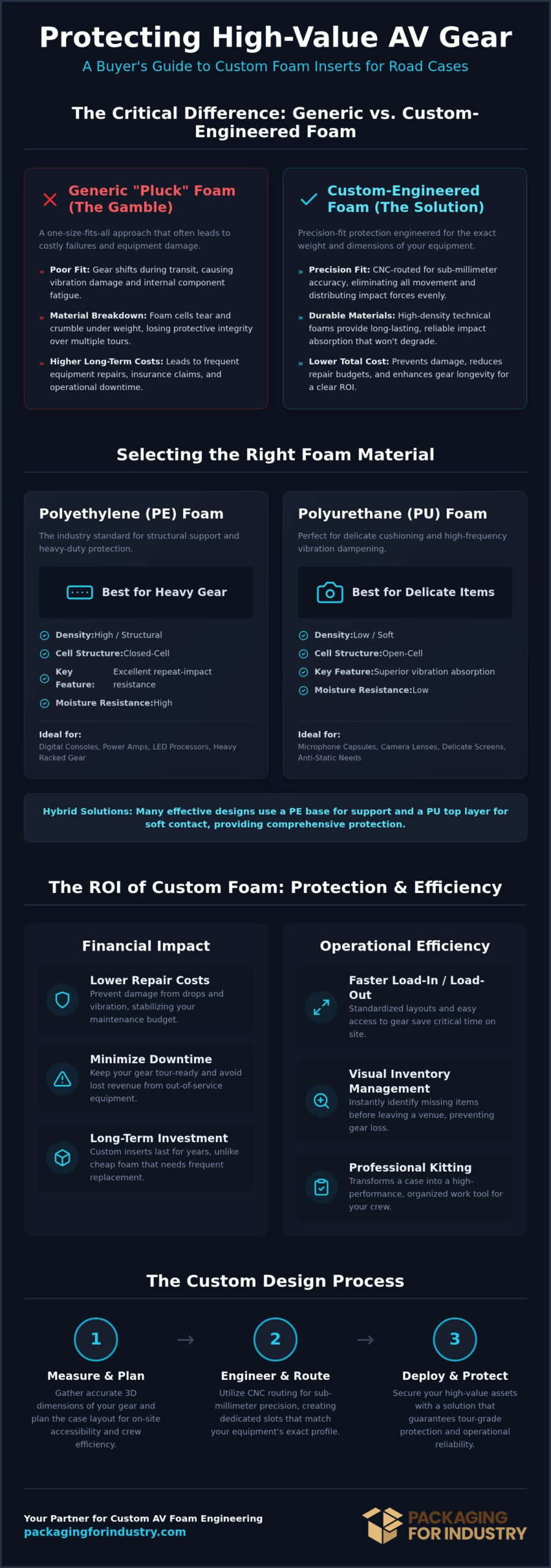
Professional AV equipment represents a significant capital investment. When digital consoles, LED processors, or high-end lenses are in transit, they face constant vibration and mechanical shock. Standard pick-and-pluck foam often fails because it lacks the material density to support heavy gear over multiple tours. As the foam cells break down, equipment shifts, leading to internal component fatigue or catastrophic failure. For production companies in Southern California, investing in custom foam for audio-visual equipment road cases Anaheim manufacturers provide is a strategic move to ensure equipment longevity and tour reliability.
A high-quality Road case is only as effective as its internal cushioning. Custom inserts are engineered to match the exact center of gravity and fragility of your gear. Unlike generic foam, which provides a one-size-fits-all approach, custom routed inserts distribute impact forces evenly. This prevents the point loading that often cracks screens or bends connectors during rough handling by stagehands or freight carriers.
The Financial Impact of Improper Packaging
The ROI on custom foam is realized the moment a case is dropped during a difficult load-out. Repairing a professional-grade digital mixing console can cost thousands of dollars, not including the lost revenue from equipment downtime. By engineering the internal environment of the case, you reduce the frequency of insurance claims and minimize the need for emergency rentals. Implementing these strategies for packaging cost savings directly impacts the bottom line by stabilizing your annual maintenance and repair budget. Custom foam lasts for years, whereas cheap foam requires frequent replacement, adding hidden costs to your operations.
Organizing for Efficiency in the Field
Beyond physical protection, custom foam serves as a critical tool for visual inventory management. When every cable, remote, and lens has a dedicated, precision-cut slot, your crew can identify missing items instantly before leaving a venue. This prevents the gear bleed that often plagues large tours and multi-city productions.
Standardizing layouts across your entire inventory allows production crews to work faster. They don’t have to hunt through cases to find specific components because everything is in its logical place. We integrate ergonomic finger-pull cutouts into the foam design to ensure that even heavy or tightly fitted gear can be removed safely and quickly. This level of organization transforms a simple storage box into a high-performance kitting solution, drastically improving load-in and load-out efficiency for busy Anaheim-based production houses.
Selecting the Right Foam Material for Road Case Inserts
Engineering the internal environment of a road case requires a technical understanding of material density and shock absorption. The primary goal is to mitigate G-force impact during handling, ensuring that the energy from a drop is absorbed by the foam rather than the sensitive internal components of your gear. When sourcing custom foam for audio-visual equipment road cases Anaheim professionals must evaluate how different polymers react to repeated compression. A heavy power amplifier requires a high-density material that won’t bottom out, while a lightweight wireless receiver needs softer cushioning to prevent rattling. Matching material properties to equipment weight is the foundation of high-performance transit protection.
Polyethylene vs. Polyurethane: When to Use Each
Polyethylene (PE) is a closed-cell foam known for its structural integrity and resistance to moisture. It’s the industry standard for heavier AV equipment because it maintains its shape under significant weight and provides excellent repeat-impact protection. In contrast, Polyurethane (PU) is an open-cell, softer foam that excels at dampening high-frequency vibrations. It’s the ideal choice for delicate items like microphone capsules and camera lenses. Many of our most effective designs utilize modern foam engineering to create hybrid inserts. By using a PE base for structural support and a PU top layer for soft contact, we provide comprehensive protection for complex kits.
Specialized Protection for Electronics
For digital consoles, LED processors, and server blades, physical cushioning is only half of the requirement. Static electricity can be a silent killer for sensitive circuit boards, especially in the dry climate of Southern California. We prioritize the use of ESD and anti-static foam to prevent electrostatic discharge during transit and storage. These materials are chemically treated to dissipate static charges, providing a safe environment for high-value digital assets. You can easily identify these materials by their color: pink typically indicates anti-static properties, while charcoal or black is used for standard protective grades.
Choosing the correct material ensures your gear remains operational through the rigors of a long tour. If you’re managing a growing inventory of sensitive production equipment, you can compare packaging pricing for various foam grades to find the right balance of protection and cost-effectiveness for your specific application.
Engineering Precision: Custom Cut vs. Generic Foam Solutions
Generic foam solutions often fall short when protecting sophisticated production assets. While some online forums suggest DIY foam cutting as a cost-saving measure, these methods fail to provide the structural consistency required for repeated industrial transport. Professional engineering ensures that every cavity is calculated to match the specific geometry of your gear. When sourcing custom foam for audio-visual equipment road cases Anaheim businesses need to consider the manufacturing process that best aligns with their inventory volume and equipment complexity.
The Advantages of CNC Routed Foam
CNC routing involves the use of computer-controlled cutting tools to remove material with sub-millimeter precision, making it the superior choice for custom design packaging that requires intricate geometries. This method is particularly effective for odd-shaped items such as gimbal stabilizers, cameras, and specialized sensors. Unlike die-cutting, which uses a fixed mold, CNC routing allows for multi-level depth profiles within a single block of foam. This capability enables tiered storage, where smaller accessories sit safely above larger components in the same case footprint. It’s an efficient way to reduce shipping weight and logistical complexity by consolidating gear into fewer cases.
Volume Considerations: Die-Cutting vs. CNC
The choice between CNC routing and die-cutting is primarily driven by production volume and the need for repeat accuracy. CNC routing is ideal for prototyping and small-to-medium production runs because it requires no physical tooling. However, once you transition to standardizing hundreds of identical road cases for a large AV fleet, die-cutting becomes the more economical alternative. While die-cutting involves upfront tooling fees for the creation of steel-rule dies, the per-unit cost drops significantly at higher volumes. We help clients analyze their fleet requirements to determine the exact point where tooling investment provides the best return.
For comprehensive protection, we often combine these precision-cut inserts with other materials. Convoluted foam remains a versatile choice for road case lids because it provides compression without exerting excessive force on the gear below. In heavy-duty applications, we also engineer hybrid assemblies that integrate foam inserts with corrugated partitions or wood reinforcements. This multi-material approach ensures the outer structure handles the weight load while the custom foam for audio-visual equipment road cases Anaheim professionals rely on provides the necessary deceleration during an impact.
Measuring and Designing Your Custom AV Road Case Layout
Designing a layout requires more than a tape measure; it involves a deep understanding of the dynamic forces at play during industrial transport. When engineering custom foam for audio-visual equipment road cases Anaheim production crews use, we prioritize “crush zones.” These are the critical foam wall thicknesses between equipment that prevent one item from impacting another during a high-impact drop. If walls are too thin, the material compresses to its limit and transfers energy directly to your gear. We also plan the logistical “flow” of the case, placing frequently used items on top and heavier components near the bottom to stabilize the case’s center of gravity.
The Step-by-Step Measurement Process
Accurate data is the foundation of a successful build. We don’t rely on manufacturer spec sheets alone because they often omit protruding knobs, antennas, or cooling fins. Using digital calipers ensures we capture the exact 3D profile of every lens, digital console, and processor. We then add a calculated clearance factor for every cavity. This ensures items stay secure during transit but can be removed easily by technicians without tearing the foam. Mapping the internal footprint also includes dedicated compartments for packaging kitting, where cables and peripherals are organized alongside the main units to prevent loose parts from scratching sensitive surfaces.
Prototyping: Testing Before Full Production
Even the most detailed CAD model can benefit from a physical check. This is why we offer free prototyping for fitment verification to our local partners. It allows you to test the layout with your actual gear before we commit to a full production run. If a camera body feels too tight or a cable tray requires more depth for specialized connectors, we adjust the digital design immediately. This iterative process eliminates the risk of receiving hundreds of inserts that don’t fit your equipment perfectly. Once you approve the prototype, we finalize the CAD files for precision routing. Because we’re located locally, we can move from prototype to final production rapidly, helping you meet tight tour deadlines with reliable, precision-engineered protection.
PFI: Anaheim Partner for Custom AV Foam Engineering
PFI operates as a specialized industrial partner rather than a generic catalog supplier. Our strategic location in Anaheim, CA allows us to provide a level of responsiveness that national distributors cannot match. For production companies managing tight tour schedules, the ability to secure custom foam for audio-visual equipment road cases Anaheim engineers produce locally is a major competitive advantage. We don’t just ship products; we integrate into your supply chain to ensure your high-value assets are protected from the moment they leave the warehouse.
Serving the Southern California AV Industry
Our logistical infrastructure supports local next-day delivery across Orange County, including hubs like Anaheim and Huntington Beach. This proximity enables our team to conduct on-site design consultations for complex manufacturing projects that require more than just a standard foam insert. We understand the unique demands of the local entertainment and events corridor, where equipment must be ready for immediate deployment. By maintaining a local presence, we eliminate the long lead times and high shipping costs associated with out-of-state fabricators.
Our commitment to reliability extends to long-term inventory support. Through Vendor Managed Inventory (VMI), we help production houses maintain a steady supply of recurring inserts for their most popular road case configurations. This just-in-time approach reduces your on-site storage requirements while ensuring you never face a shortage during a peak tour season. This service is particularly valuable for companies that frequently refresh their rental inventory and need consistent, precision-fit protection for new gear arrivals.
Start Your Custom Foam Project Today
The transition from a raw concept to a final protective environment is streamlined through our engineering department. We handle the entire process, starting with precision CAD designs and moving through rapid prototyping to final delivery. For items that require transport outside of a road case, we can also integrate your foam inserts with custom corrugated boxes or heavy-duty wood crates. This multi-layered approach ensures that whether your gear is moving via a local production truck or an international freight carrier, it remains secure.
We prioritize fiscal responsibility by helping you identify the most durable materials for your specific application. Our goal is to lower your overall equipment repair budget through better engineering and local logistical efficiency. Whether you need a single prototype or a full fleet of tour-ready inserts, we provide the technical expertise to safeguard your investment.
Secure Your Production Assets with Engineered Protection
Securing high-value electronics for the rigors of the road requires more than just a sturdy exterior; it demands an internal environment engineered for maximum impact resistance. By selecting specific foam densities like polyethylene for heavy structural support and anti-static materials for sensitive digital components, you ensure your inventory remains operational through every load-in and load-out. Choosing the right custom foam for audio-visual equipment road cases Anaheim professionals rely on is a strategic investment that stabilizes your maintenance budget and eliminates the professional stress of transit damage.
PFI provides the technical expertise needed to transform your logistics through expert CAD/CAM design support and free prototyping for fitment verification. Our local presence in Southern California allows us to offer next-day delivery in Anaheim and the surrounding Inland Empire, helping you meet tight production deadlines without compromising on quality. We’re ready to help you optimize your road case layouts for maximum efficiency and long-term durability.
Take the guesswork out of your packaging and experience the reliability of a precision-fit solution designed for the most demanding professional environments.
Frequently Asked Questions
What is the best foam for heavy audio-visual equipment?
High-density polyethylene (PE) foam is the superior choice for heavy audio-visual gear. Its closed-cell structure provides the necessary structural integrity to support heavy amplifiers and speakers without bottoming out. Unlike softer materials, PE foam maintains its shape over multiple tours and resists moisture absorption. This ensures your equipment remains centered and protected against the high-impact shocks common during freight handling and stage setup.
Can I get custom foam inserts made for existing road cases in Anaheim?
Yes, we specialize in designing custom foam for audio-visual equipment road cases Anaheim businesses already have in their inventory. Our team takes precise internal measurements of your existing cases to ensure a sub-millimeter fit. This service allows you to upgrade your protection without the expense of purchasing entirely new road cases. You can request a packaging quote to begin the retrofitting process for your current fleet.
How much does custom CNC foam routing cost for a single case?
Custom CNC foam routing costs are determined by the complexity of the equipment geometry and the volume of the order. While we don’t provide flat rates, our engineering focus is on helping you lower packaging costs by reducing equipment damage and repair bills. We recommend that you compare packaging pricing by submitting your specific gear dimensions for a tailored quote that accounts for material density and routing depth.
What is the difference between polyethylene and polyurethane foam?
Polyethylene (PE) is a rigid, closed-cell foam used for heavy structural support, while polyurethane (PU) is a soft, open-cell foam used for delicate cushioning. PE is ideal for the base and sides of a road case to prevent gear from shifting. PU is better suited for protecting sensitive items like microphone capsules or camera lenses from high-frequency vibrations. We often combine these materials in a single case for hybrid protection.
Does PFI offer anti-static foam for sensitive AV electronics?
PFI provides specialized anti-static (ESD) foam to protect digital consoles, LED processors, and other sensitive electronics. This chemically treated foam prevents electrostatic discharge, which can cause silent but catastrophic failure to internal circuit boards during transit. We typically use pink anti-static foam for these applications to provide a clear visual indicator that the gear is stored in a safe, static-dissipative environment.
How long does the custom foam design and prototyping process take?
The custom design and prototyping process is highly efficient due to our local Anaheim presence. We can typically move from initial CAD design to a physical prototype for fitment verification within a few business days. This rapid turnaround allows you to test the layout with your actual gear before committing to a full production run, ensuring a perfect fit for complex kitting setups and specialized production tools.
Do you offer local delivery for businesses in Orange County?
We offer local next-day delivery for businesses throughout Orange County, including Anaheim, Huntington Beach, and Irvine. Our logistical proximity to the Southern California entertainment corridor allows us to provide faster response times than national catalog suppliers. This local service reduces your lead times and helps you maintain a just-in-time inventory of protective inserts for upcoming tours or rental stock refreshes.
Can custom foam be used inside corrugated shipping boxes instead of road cases?
Custom foam inserts are frequently used inside heavy-duty corrugated boxes for high-value shipping and kitting. While road cases are ideal for recurring tours, custom-fit foam inside a double-wall or triple-wall corrugated box provides excellent one-way transit protection for manufacturing and e-commerce distribution. This approach lowers shipping weight while maintaining the precision protection required for sensitive aerospace or medical-grade electronics.