
Shipping a high-end VR headset in a standard shipping container isn’t just a risk; it’s a calculated gamble with your bottom line. You understand that a single microscopic scratch on a precision lens or a jarred internal sensor can turn a premium product into a costly RMA. In a market where containerboard prices increased by $100 per ton in the first half of 2026, manufacturers can’t afford to pay for “shipping air” or inefficient designs that drive up dimensional weight surcharges.
Finding specialized packaging solutions for virtual reality hardware Orange County tech firms can rely on is about balancing extreme protection with fiscal responsibility. This article outlines how custom-engineered foam inserts and corrugated systems ensure your hardware meets the rigorous ANSI/ESD S541-2026 standards for electronic protection. We’ll examine how localized prototyping and Vendor Managed Inventory (VMI) help Anaheim and Irvine manufacturers navigate the new SB 54 plastic reduction mandates while maintaining zero-damage delivery cycles. You’ll learn how to optimize your package footprint to lower UPS and FedEx costs without compromising the integrity of your sensitive optics or the speed of your local supply chain.
Key Takeaways
- Learn why standard cushioning fails to protect high-precision VR optics and how custom-engineered foam assemblies eliminate costly transit damage.
- Compare specialized foam materials and corrugated grades to ensure your shipments meet rigorous ANSI/ESD S541-2026 safety standards for sensitive electronics.
- Discover how localized packaging solutions for virtual reality hardware Orange County tech firms utilize can streamline production through Anaheim-based prototyping and next-day delivery.
- Identify strategies to lower your total cost of ownership by reducing package footprints to minimize UPS and FedEx dimensional weight surcharges.
- Understand the operational advantages of Vendor Managed Inventory (VMI) in maintaining a reliable supply of custom materials for high-growth manufacturers in Irvine and Huntington Beach.
Why VR Hardware Requires Specialized Packaging Solutions
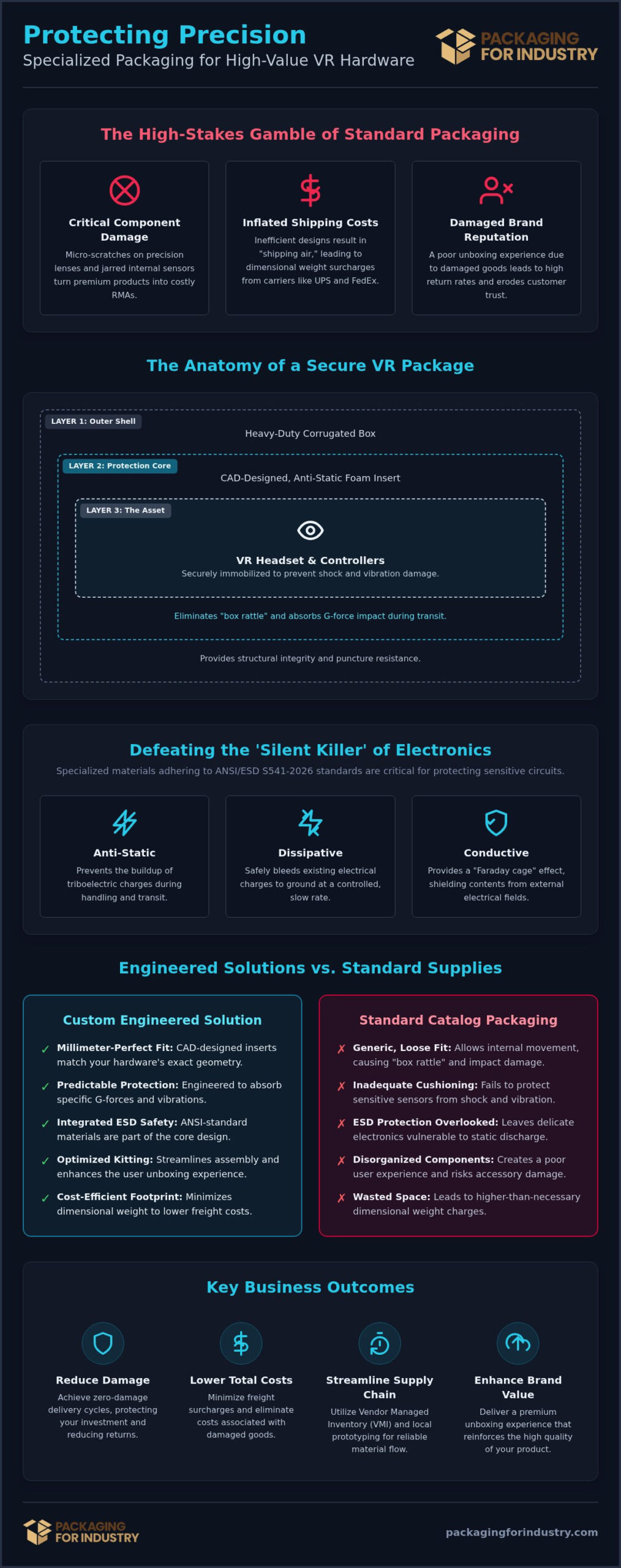
Virtual reality hardware represents a significant capital investment for both manufacturers and end-users. Unlike consumer goods that can survive minor impacts in a generic box, VR headsets are sophisticated optical instruments. If a shipment arrives with misaligned sensors or scratched lenses, the “savings” found in cheap bubble wrap vanish instantly. High return rates and brand erosion are the true costs of inadequate protection. We define Electronic packaging for this sector as a multi-layered system designed to mitigate specific transit risks. This involves a heavy-duty outer corrugated box and custom-engineered internal foam packaging that locks the device in place. This engineered approach provides predictable deceleration during a drop, protecting the delicate internal calibration that generic catalog suppliers often ignore.
The Vulnerability of VR Optics and Sensors
Precision is the priority in AR/VR logistics. Fresnel lenses and high-resolution OLED displays are prone to micro-scratches from dust or abrasive packing materials. Even more critical are the Inertial Measurement Units (IMU). These sensors are calibrated to minute tolerances. Excessive vibration during long-haul transit can knock these sensors out of alignment, rendering the hardware useless upon unboxing. Standard packaging solutions often fail to account for these G-force sensitivities. However, professional packaging solutions for virtual reality hardware Orange County manufacturers utilize are built to absorb these specific shocks. By using CAD-designed inserts, we ensure that the most sensitive components don’t bear the weight of the device during a collision or drop.
The Role of ESD Protection in Electronics Shipping
Electrostatic Discharge (ESD) is a silent killer of high-tech hardware. A static shock too small for a human to feel can permanently damage integrated circuits. Effective packaging must adhere to the ANSI/ESD S541-2026 standard to ensure product reliability. Our team integrates ESD protection directly into the primary packaging design using specialized materials:
- Anti-static: These materials prevent the buildup of static electricity during handling.
- Dissipative: These safely bleed off existing electrical charges at a controlled rate.
- Conductive: These act as a shield against external electrical fields, providing a “Faraday cage” effect.
Utilizing the right packaging solutions for virtual reality hardware Orange County tech firms require means choosing materials that address both physical and electrical threats. Integrating these properties into the primary design ensures your hardware remains functional from the assembly line in Anaheim to the customer’s doorstep in Irvine.
Custom Engineering: Foam Inserts and Precision Protection
Precision in virtual reality development doesn’t end at the software level; it extends to the physical delivery of the device. At PFI, we treat packaging as a functional extension of your hardware’s engineering. By utilizing CAD/CAM support, we develop millimeter-perfect foam inserts that mirror the exact geometry of your VR headsets and controllers. These specialized packaging solutions for virtual reality hardware Orange County manufacturers utilize ensure that sensitive components remain static during the most turbulent phases of logistics. When you eliminate “box rattle,” you eliminate the internal impacts that lead to sensor calibration errors and lens abrasions.
Efficient packaging also involves multi-part kitting. We design assemblies that organize headsets, hand controllers, and peripheral cables into a single, cohesive unit. This approach doesn’t just protect the product; it enhances the end-user’s unboxing experience and streamlines your own assembly line operations. To maintain compliance with the latest ANSI/ESD S541 standards, we ensure these custom inserts utilize anti-static or dissipative materials where necessary. You can request a packaging quote to see how our engineering team can optimize your current layout.
Die-Cut Foam vs. Convoluted Foam for VR
Choosing the right foam geometry is critical for high-value electronics. Die-cut foam is our primary recommendation for the main headset unit because it provides superior bracing and load-bearing capacity. It allows for deep, precise cavities that lock the device in place. In contrast, convoluted or “egg-crate” foam is highly effective for protecting lighter accessories. By employing intelligent foam nesting in our die-cut designs, we help manufacturers reduce material waste and lower their overall package footprint. This balance of protection and efficiency is a hallmark of the packaging solutions for virtual reality hardware Orange County tech startups require to scale effectively.
The Prototyping Phase: Ensuring a Perfect Fit
We understand that committing to a custom design requires confidence in the final product’s performance. PFI provides free prototyping for custom designs to our partners in Anaheim, Irvine, and across Southern California. This phase allows you to test the actual drop-survivability of the foam assembly with your specific hardware before moving to bulk production. Learn about our custom design services and how our local presence allows for rapid iterations that catalog suppliers simply can’t match. This hands-on approach ensures your hardware survives the “last mile” while keeping your lead times short and your logistics costs predictable.
Material Selection: Balancing Cushioning and ESD Safety
Selecting the right materials is the foundation of effective packaging solutions for virtual reality hardware Orange County manufacturers depend on. Precision hardware requires more than just a barrier against impact; it needs a material strategy that addresses surface friction, structural support, and electrical safety. With North American containerboard prices increasing by $100 per ton in early 2026, optimizing material usage isn’t just an engineering goal. It’s a financial necessity. Choosing the wrong foam density or corrugated grade leads to either damaged products or excessive shipping fees due to dimensional weight surcharges.
We focus on the intersection of protection and logistics efficiency. High-value VR headsets often require a multi-material approach to survive the rigors of modern supply chains. By utilizing specialized additives, we ensure that every internal component remains safe from the latent failures caused by electrostatic discharge. This methodical selection process ensures your hardware arrives in the same calibrated state it left the factory.
Polyethylene vs. Polyurethane Foam
The choice between Polyethylene (PE) and Polyurethane (PU) foam depends on the specific component’s fragility and weight. Polyethylene is a closed-cell foam known for its high load-bearing capacity and resilience. It serves as the ideal material for heavy bracing, as it can withstand recurring impacts without losing its shape. This makes it perfect for the main “cradle” of a VR headset. Polyurethane, on the other hand, is an open-cell, softer foam. It provides superior cushioning for sensitive lens surfaces and light controllers that require a non-abrasive touch. While Polyethylene provides the structural bracing necessary to secure the headset’s weight, Polyurethane offers the delicate surface protection required for sensitive optical lenses.
Selecting the Right Corrugated Grade
The outer container must be as robust as the internal cushioning. For domestic shipments, a high-quality single-wall RSC (Regular Slotted Container) often suffices, provided the internal kitting is engineered correctly. However, international transit or bulk palletized shipments frequently demand heavy-duty double-wall corrugated boxes. These provide the stacking strength necessary to prevent box crush in high-humidity environments or during long-haul transport. Explore our corrugated box options to determine which board grade fits your specific distribution model. Optimizing material density is a key component of the packaging solutions for virtual reality hardware Orange County startups use to stay competitive in a high-cost logistics environment. Balancing the weight of double-wall protection against shipping surcharges requires precise engineering to ensure you aren’t over-packaging and driving up freight costs.
Streamlining Your Orange County Supply Chain
Orange County’s tech corridor moves at a pace that generic nationwide suppliers simply can’t match. For startups in Anaheim or Irvine, the high cost of industrial real estate makes on-site storage of bulky corrugated boxes and foam inserts a significant financial burden. Every square foot dedicated to empty packaging is a square foot taken away from production or R&D. By sourcing packaging solutions for virtual reality hardware Orange County manufacturers can leverage local, responsive partnerships that prioritize logistical flow over static inventory.
Relying on out-of-state vendors often leads to lead time volatility that disrupts your fulfillment cycle. A three-week delay on a custom-cut foam order can halt an entire production line, leading to missed deadlines and strained retail relationships. We solve this by offering local next-day delivery and Just-In-Time (JIT) scheduling. This approach ensures that your packaging arrives exactly when it’s needed for assembly, effectively turning our Anaheim warehouse into a seamless extension of your own facility.
Vendor Managed Inventory (VMI) for Tech Hardware
Managing packaging supplies shouldn’t distract your operations team from hardware innovation. Through our stocking programs, we take full accountability for your inventory levels. Our team monitors your usage patterns and replenishes stock automatically, which eliminates the need for emergency rush orders or costly overnight freight. This system provides peace of mind by ensuring you never miss a shipping window due to a stockout. You can discover our VMI solutions to see how we help local firms reclaim valuable warehouse space for their core business activities.
Local Prototyping and Fast Turnaround
Speed to market is a competitive necessity in the VR space. When hardware undergoes version updates, such as moving from Gen 1 to Gen 2, your packaging must adapt instantly to new form factors. Our Anaheim-based engineering team provides the rapid iteration required for these transitions. Being local allows for face-to-face design consultations and immediate physical prototyping, which significantly reduces the friction found in digital-only design processes. We provide direct support for Irvine-based technology companies, ensuring that your specialized packaging solutions for virtual reality hardware Orange County requirements are met with precision and speed.
Optimizing Costs with PFI’s Custom VR Packaging Programs
Investing in professional packaging solutions for virtual reality hardware Orange County manufacturers depend on requires a shift in perspective from unit price to the total cost of ownership. While generic suppliers often compete on the lowest per-box rate, they rarely account for the hidden expenses of transit damage or logistical inefficiency. A design that leads to a 3% damage rate or results in oversized shipping footprints is a liability to your bottom line. We focus on eliminating these variables through precise engineering that balances protection with economic performance.
Our custom programs are designed to lower packaging costs by integrating material efficiency with streamlined assembly. By utilizing custom sizes available for every component, we ensure your team isn’t wasting time with excessive tape or void-fill. This methodical approach ensures your hardware is secure while your operational overhead remains as lean as possible. When you optimize the physical dimensions of your shipment, you reclaim control over your high-volume distribution expenses.
Reducing Dimensional Weight Surcharges
Carrier fees are increasingly dictated by volume rather than actual weight. When operations managers compare packaging pricing from various vendors, the unit cost of the box often masks the true expenditure. A cheaper, stock-sized container that is even one inch larger than your hardware requires will trigger dimensional weight penalties that can increase annual freight spend by thousands of dollars. We utilize CAD software to minimize the exterior footprint of your package while maintaining the necessary “crush zone” for your optics. You can review our strategies for packaging cost savings to see how an engineered reduction in box volume directly correlates to lower UPS and FedEx invoices.
Start Your Custom Design Process Today
Transitioning to an optimized packaging program is a straightforward process when working with our local engineering team. To start, we require specific data regarding your hardware, including exact dimensions, weight, and the G-force sensitivity of your sensors. Once these specifications are defined, we move into the free prototyping phase to validate the performance of the foam and corrugated assembly. This step ensures the final production run meets your protection standards and your budgetary goals. Having this information ready allows us to provide an accurate, competitive quote tailored to your specific volume and local delivery requirements.
Secure Your VR Supply Chain with Local Precision Engineering
Protecting high-value optics requires a shift from generic boxes to engineered systems. We’ve explored how custom foam inserts and corrugated materials work together to eliminate transit damage and meet rigorous ANSI/ESD S541 standards. By optimizing your package footprint, you don’t just protect your hardware; you also lower your total cost of ownership by avoiding dimensional weight surcharges. It’s about making your logistics as precise as the technology you manufacture.
PFI provides the specialized packaging solutions for virtual reality hardware Orange County manufacturers need to stay competitive. Our Anaheim-based team offers free prototyping and CAD design to ensure a perfect fit before bulk production begins. With local next-day delivery across Southern California and expertise in ESD and anti-static material assemblies, we ensure your components are protected from both physical and electrical threats. Our VMI programs further streamline your operations by managing inventory levels so your team can focus on innovation.
Partner with a local expert who understands the intersection of engineering and economics. We’re ready to help you eliminate professional stress and ensure your hardware arrives in perfect condition every time.
Frequently Asked Questions
Do you offer anti-static (ESD) foam for VR headsets?
Yes, we provide specialized anti-static and dissipative foam materials that adhere to ANSI/ESD S541-2026 standards. These materials are essential for protecting the sensitive internal circuits and sensors of VR hardware from latent electrical damage. Our engineers integrate these properties into your custom inserts to ensure every device remains functional from the assembly line to the end user.
Can PFI design custom foam inserts for VR controllers and accessories?
Yes, we utilize CAD/CAM support to create millimeter-perfect kitting solutions for the entire hardware suite. Our designs include dedicated cavities for hand controllers, peripheral cables, and base stations. This organized approach prevents internal impact and box rattle while significantly enhancing the unboxing experience for your customers. We offer various foam densities to balance structural support with soft surface protection.
What is the lead time for custom corrugated boxes in Orange County?
Lead times depend on the specific design requirements and material availability, but our local Anaheim facility provides a significant speed advantage. We prioritize responsive timelines to help you maintain your production schedule. You can request a packaging quote to receive an accurate estimate for your specific project. Our local presence allows us to bypass the logistical delays common with out-of-state suppliers.
How do I reduce shipping damage for fragile VR optics?
The most effective strategy is utilizing engineered packaging solutions for virtual reality hardware Orange County tech firms trust to secure precision lenses. We combine rigid Polyethylene for structural bracing with soft Polyurethane for non-abrasive lens contact. This multi-material system provides a predictable “crush zone” that absorbs G-forces during transit, keeping your optics aligned and scratch-free throughout the entire distribution cycle.
Do you provide free packaging prototypes for local tech companies?
Yes, we offer free prototyping for custom designs to eliminate buyer friction and ensure performance. This allows your team to test the actual drop-survivability and fitment of the foam assemblies with your hardware before moving to bulk production. Rapid iteration is a core part of our service, especially for Irvine and Anaheim manufacturers who need to adapt quickly to hardware version updates.
Can you help reduce UPS and FedEx dimensional weight surcharges?
Yes, our engineering team focuses on minimizing the exterior footprint of your corrugated boxes to eliminate “shipping air.” Since carriers charge based on package volume, even a one-inch reduction in box size can save your company thousands in annual freight costs. We analyze your current packaging to identify where custom sizing can lower your total cost of ownership without compromising product safety.
Do you offer local next-day delivery in Anaheim and Irvine?
Yes, we provide local next-day delivery for in-stock items and scheduled Just-In-Time (JIT) orders throughout Southern California. Our Anaheim headquarters is strategically located to serve the tech corridors in Irvine, Huntington Beach, and Costa Mesa. This localized service model helps you reduce on-site warehouse requirements and maintain a lean supply chain that responds instantly to fluctuating market demands.
Can you handle high-volume wholesale orders for VR hardware launches?
Yes, we are fully equipped to manage high-volume packaging solutions for virtual reality hardware Orange County startups and established firms require for product launches. We offer Vendor Managed Inventory (VMI) to monitor your stock levels and replenish supplies automatically. This proactive approach prevents stockouts during critical sales periods and ensures you have the custom sizes available to meet every shipping window.