
How much of your profit margin is currently evaporating into the Southern California heat because of outdated, bulky insulation that no longer meets 2026 environmental standards? You’re likely already feeling the pressure of maintaining gourmet quality during a July heatwave in the Inland Empire, especially now that expanded polystyrene foam is prohibited across the state. Finding the right insulated shipping boxes for meal kit delivery services SoCal providers can trust requires balancing thermal performance with the strict requirements of SB 54. It’s a complex logistical challenge that directly impacts your bottom line and customer retention.
This 2026 guide will show you how to protect your perishables while lowering per-unit packaging costs and reclaiming valuable warehouse space. We’ll explore custom-engineered thermal systems, strategies to avoid rising UPS and FedEx dimensional surcharges, and how just-in-time delivery can streamline your entire operation. You’ll discover how to transition toward compliant, recyclable materials without sacrificing the fresh quality your customers expect. By the end of this article, you’ll have a clear roadmap for optimizing your packaging spend while meeting California’s latest regulatory and environmental mandates.
Key Takeaways
- Learn how to engineer a multi-layer thermal barrier using corrugated boxes and flexible liners to survive 100°F Southern California summers.
- Understand the operational impact of California SB 54 and why transitioning to recyclable materials is essential for 2026 regulatory compliance.
- Discover how to select the optimal insulated shipping boxes for meal kit delivery services SoCal by evaluating transit duration and specific internal temperature requirements.
- Reduce warehouse overhead and shipping surcharges by leveraging local vendor-managed inventory (VMI) and custom-sized packaging solutions.
- Streamline your procurement process with local next-day delivery and CAD/CAM prototyping available directly from our Anaheim headquarters.
The SoCal Thermal Challenge: Why Standard Shipping Boxes Aren’t Enough
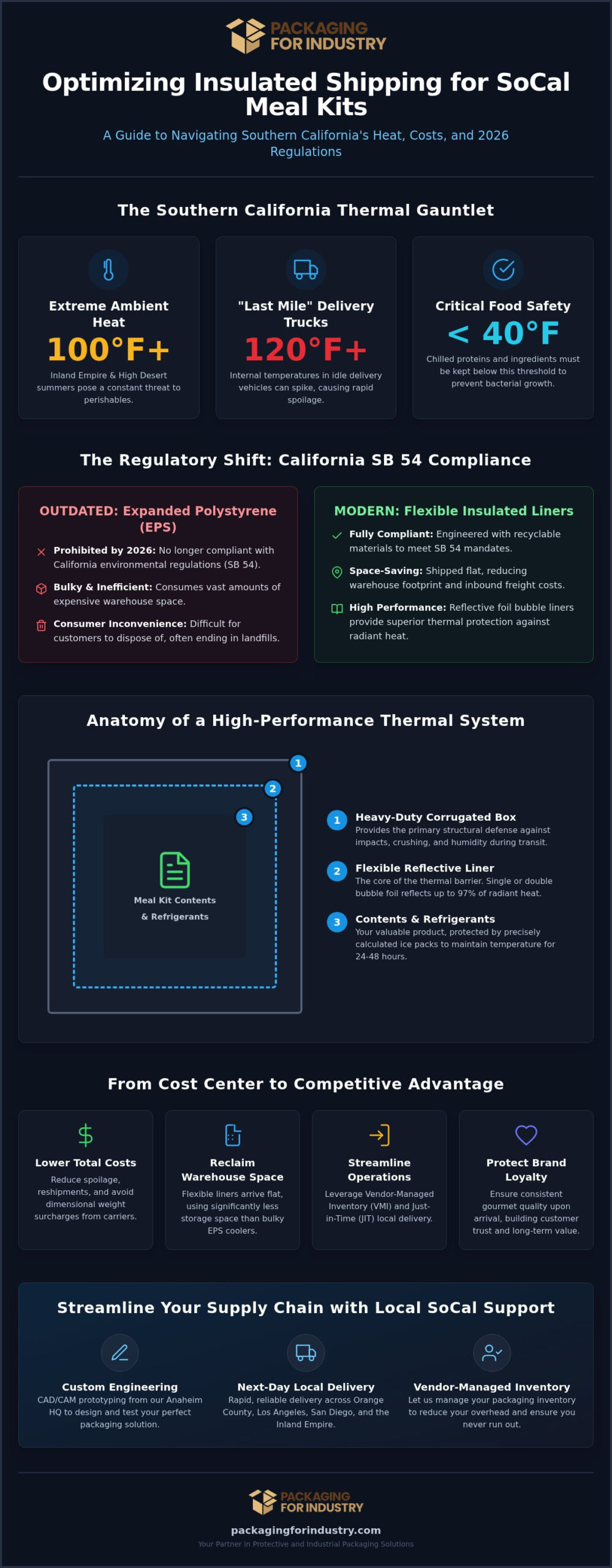
Standard corrugated boxes are designed for structural protection, not temperature control. For meal kit providers, relying on basic packaging during a Southern California summer is a recipe for operational failure. Effective insulated shipping boxes for meal kit delivery services SoCal companies use are actually multi-layer thermal barrier systems. These systems combine high-grade corrugated boxes with specialized liners and refrigerants to maintain a specific internal environment. Without this synergy, even the best ice packs will fail long before the package reaches its destination.
The “last mile” represents the most significant risk to food safety. While a warehouse might be climate-controlled, a delivery truck idling in Los Angeles or San Diego heat can reach internal temperatures exceeding 120°F. Without a robust thermal barrier, heat penetrates the box within minutes. This thermal breakthrough is particularly dangerous for chilled proteins that must remain below 40°F, compared to frozen components that have more thermal mass to resist ambient temperature spikes. If your packaging isn’t engineered for these extremes, you’re essentially gambling with your inventory.
Regional Heat Factors in Southern California
Logistics planning must account for microclimates. In the Inland Empire and High Desert, extreme heat is the primary adversary. Transit times often stretch as drivers navigate heavy traffic in 100°F+ weather. Conversely, coastal areas like Huntington Beach present a different challenge: high humidity. Moisture can compromise the structural integrity of standard corrugated materials, leading to crushed boxes and broken thermal seals. Understanding the types of insulated shipping containers and how their materials react to these specific environmental stressors is vital for maintaining a 24-hour to 48-hour protection window.
The Cost of Spoilage vs. The Cost of Protection
Investing in premium insulated liners isn’t just a packaging expense; it’s an insurance policy for your brand. High spoilage rates during heatwaves lead to expensive reshipments and, more importantly, lost customer lifetime value. Consistent gourmet quality upon arrival is what builds long-term loyalty in the competitive ecommerce meal kit space. To manage these logistics, engineers focus on thermal lag, which is the time delay for the internal temperature of a package to respond to a change in the outside ambient temperature. By maximizing this lag, you ensure that even if a box sits on a sunny porch in Riverside, the contents remain safe and fresh.
Types of Insulated Packaging for Meal Kit Delivery
Selecting the right insulated shipping boxes for meal kit delivery services SoCal requires a specialized approach. While traditional Expanded Polystyrene (EPS) coolers were once the industry standard, modern logistical and regulatory shifts in California have favored more efficient alternatives. EPS is notoriously bulky, consuming vast amounts of warehouse space and complicating waste management for the end consumer. In contrast, modern flexible liners offer a significant reduction in storage footprint while maintaining the thermal integrity required by the Sanitary Transportation of Human and Animal Food rule.
The foundation of any thermal system is the outer shell. High-quality custom corrugated boxes serve as the primary structural defense. These boxes must withstand the rigors of transit while providing a stable environment for internal insulation. For meal kits containing high-value or fragile items, adding protective foam packaging ensures that delicate ingredients remain intact during the chaotic last mile of delivery. If you want to optimize your current setup and reduce overhead, you can request a packaging quote to compare custom configurations tailored to your specific menu.
Flexible Box Liners: Single vs. Double Bubble
Metallic foil bubble liners are engineered to reflect radiant heat, which is a primary cause of spoilage in unshaded delivery vehicles. Single bubble liners provide a lightweight barrier suitable for shorter transit times. Double bubble options offer higher R-values by creating more air pockets for insulation. These liners ship flat, allowing you to store thousands of units in the space a few dozen EPS coolers would occupy. This efficiency speeds up warehouse kitting operations as workers can quickly insert liners into boxes without handling bulky, pre-molded components.
Custom Foam Inserts for Temperature Sensitivity
Polyethylene foam provides both structural support and excellent thermal buffering. It’s particularly effective for creating custom-cut inserts that separate frozen gel packs from temperature-sensitive produce. This prevents cold burn on delicate greens while keeping proteins at safe temperatures. By prototyping custom inserts, meal kit providers can ensure a perfect fit for their unique container sizes. This precision reduces the amount of empty space within the box, which naturally improves thermal performance and lowers shipping costs. Selecting the right insulated shipping boxes for meal kit delivery services SoCal involves balancing these materials to meet both thermal and economic goals.
Choosing the Right Insulated Box: A Decision Framework
Selecting the ideal insulated shipping boxes for meal kit delivery services SoCal requires a methodical evaluation of your specific logistics chain. Transit duration is the most critical factor. Local courier deliveries within Los Angeles or Orange County may only require 12 to 24 hours of protection, whereas shipping via national carriers often necessitates a 48-hour thermal window. Temperature requirements also dictate material choice; maintaining a frozen environment at -10°F requires significantly more thermal mass and insulation thickness than keeping chilled produce at a steady 40°F. Adhering to USDA food safety guidelines ensures your packaging strategy aligns with federal expectations for perishable transport while protecting your brand from spoilage claims.
Structural integrity cannot be overlooked during the selection process. While single-wall corrugated boxes suffice for light, single-meal kits, heavy-duty double-wall options are necessary for family-sized subscriptions to prevent box failure during transit. Beyond physical protection, the economic impact of dimensional weight (DIM weight) is a primary concern for operations managers. Carriers like UPS and FedEx apply significant surcharges to oversized boxes regardless of their actual weight. Minimizing the external dimensions of your package is the most effective way to lower per-unit shipping costs and avoid these unnecessary fees.
Optimizing Box Sizing to Lower Shipping Costs
Using custom design services allows you to eliminate “dead air” space that compromises thermal performance. Precision-engineered boxes ensure that every cubic inch is utilized by product or insulation rather than empty space. This reduction in volume directly lowers shipping surcharges and decreases the need for expensive void fill materials, which effectively streamlines your warehouse kitting process. By right-sizing your insulated shipping boxes for meal kit delivery services SoCal, you maximize pallet density and reduce the number of truckloads required for distribution.
Material Selection Based on Seasonal Fluctuations
A static packaging specification often leads to wasted spend. Southern California’s climate allows for seasonal adjustments; you might utilize lighter insulation during winter months and upgrade to moisture-resistant corrugated during humid coastal summers to manage condensation. For heavier, multi-day kits, integrating corner and edge protection prevents the box from buckling during high-stacking in transit. This adaptable approach ensures you aren’t overpaying for protection when the environment doesn’t demand it, allowing you to reallocate those savings into higher-quality ingredients or customer acquisition.
Streamlining Your Supply Chain with Local SoCal Support
Logistics shouldn’t be a bottleneck for your growth. Maintaining a steady supply of insulated shipping boxes for meal kit delivery services SoCal requires more than just a vendor; it requires a strategic partner. Operating from our headquarters in Anaheim, we provide local next-day delivery that traditional national suppliers can’t match. This proximity is a critical advantage for meal kit providers who must respond instantly to marketing-driven demand spikes or seasonal menu shifts. By utilizing our facility as your off-site packaging room, you effectively reclaim thousands of square feet in your own warehouse for food preparation and assembly.
One of the most significant operational hurdles in the meal kit industry is inventory management. We address this through Vendor Managed Inventory (VMI) programs. Instead of tying up your capital in stacks of bulky corrugated materials, we monitor your stock levels and replenish them automatically. This system eliminates the risk of stockouts during holiday peaks or promotion-driven surges. You no longer have to worry about whether you have enough insulated shipping boxes for meal kit delivery services SoCal to fulfill a sudden influx of orders; the inventory is always there when you need it.
Just-In-Time Packaging for High-Growth Startups
Cash flow is the lifeblood of any growing business. Our just-in-time management services ensure you only pay for the packaging you’re currently using. This approach is particularly valuable when menus change frequently, as it drastically reduces the risk of being stuck with obsolete packaging inventory. Our local delivery routes cover key hubs including Irvine, Santa Ana, and Los Angeles, ensuring that your production line never grinds to a halt due to a late shipment. We handle the logistical hardware so you can stay focused on the culinary side of your business.
Packaging Kitting and Assembly Services
Labor costs in Southern California are a major factor in your per-unit economics. We offer specialized packaging kitting and assembly to speed up your production line. We can pre-insert thermal liners into your custom corrugated boxes before they arrive at your facility. This simple step removes a time-consuming task from your assembly team, allowing them to focus entirely on food prep and quality control. By streamlining these logistics, you lower your overall operational costs and ensure a faster, more reliable flow from warehouse to doorstep.
How to Request a Custom Insulated Packaging Quote
Transitioning to a more efficient supply of insulated shipping boxes for meal kit delivery services SoCal requires a methodical onboarding process. Our goal is to move you from a generic, high-waste setup to a precision-engineered thermal system. The first step involves defining your specific thermal requirements. We need to know if you’re shipping frozen proteins or chilled produce and your maximum transit window. A kit traveling from Anaheim to the Inland Empire in July faces different stressors than a local delivery in coastal San Diego. Providing these details allows us to calculate the necessary R-value for your insulation.
Once we establish the thermal baseline, you’ll provide the exact dimensions of your internal meal containers. We use this data to eliminate “dead air” space, which is the primary cause of thermal failure and inflated DIM weight surcharges. After these specifications are set, our team uses CAD/CAM prototyping to create a sample for your review. You’ll receive a physical prototype to conduct real-world thermal testing within your own logistics chain. Finally, we’ll finalize a delivery schedule, whether you require bulk shipments or a recurring VMI program to manage your warehouse floor space.
The PFI Prototyping Advantage
A “fit test” is essential before you commit to a full production rollout. Our prototyping phase ensures that every component, from the corrugated outer box to the flexible liner, works as a single, cohesive unit. This process allows you to verify thermal performance in actual Southern California conditions before investing in high-volume inventory. Beyond technical performance, this is also the stage where we discuss custom printing options. Enhancing your brand’s unboxing experience with high-quality graphics helps differentiate your service in a crowded market while maintaining the professional image your customers expect.
Get Started Today
If your current packaging isn’t surviving the heat or is simply costing too much in shipping fees, it’s time for a more pragmatic solution. We provide comprehensive coverage across Orange County, the Inland Empire, and San Diego, offering the local reliability that national vendors lack. Our team is ready to help you lower packaging costs and improve your delivery success rates through better engineering and local support. You can begin the process by reaching out to our Anaheim headquarters for a technical consultation.
Secure Your Supply Chain and Protect Your Margins
Maintaining a competitive edge in the meal kit industry requires a packaging strategy that balances thermal performance with economic efficiency. You’ve seen how right-sizing your containers and selecting engineered liners can eliminate the “last mile” spoilage risks common in Southern California. By partnering with a local supplier, you gain access to next-day delivery across Orange County and San Diego, ensuring your production line never stalls.
Selecting the right insulated shipping boxes for meal kit delivery services SoCal is a critical decision that impacts both food safety and operational profitability. Our team provides the specialized VMI programs and free CAD prototyping needed to refine your logistics. We focus on reducing your warehouse footprint and lowering your overall shipping costs through precision design.
We’re ready to help you build a reliable, cost-effective thermal system that keeps your brand’s gourmet quality intact from warehouse to doorstep. Let’s start optimizing your logistics today.
Frequently Asked Questions
What are the best insulated shipping boxes for 48-hour meal kit delivery?
The most effective 48-hour solution involves a multi-layer system combining heavy-duty double-wall corrugated boxes with high-R-value double-bubble metallic liners or polyethylene foam inserts. These materials create the necessary thermal lag to protect perishables against Southern California’s ambient temperature spikes. For extended transit, we recommend precision-engineered configurations that maximize refrigerant efficiency and structural integrity during the entire 48-hour window.
How can I reduce shipping damage in my meal kit business?
Reducing shipping damage requires a combination of structural reinforcement and volume optimization. We recommend using custom-sized corrugated boxes to eliminate the “dead air” that allows internal shifting during transit. Integrating corner and edge protection prevents crushing when pallets are stacked. For fragile components like glass jars or delicate produce, high-density polyethylene foam inserts provide the necessary cushioning to absorb mechanical shocks throughout the delivery route.
Do you offer custom-sized insulated boxes for unique meal kit containers?
Yes, we provide custom-sized insulated shipping boxes for meal kit delivery services SoCal can use for their unique container dimensions. Our Anaheim facility utilizes CAD/CAM prototyping to design packaging that fits your product dimensions exactly. This precision minimizes movement within the box and optimizes thermal performance. Custom sizes available through our design team also help you avoid shipping surcharges by reducing the overall volumetric footprint of your packages.
Can I get next-day delivery on shipping supplies in Orange County?
We provide local next-day delivery for stock and custom orders across Orange County, Los Angeles, and San Diego. Being headquartered in Anaheim allows us to serve Southern California businesses with a speed that national suppliers can’t match. This local support is essential for meal kit companies that need to respond quickly to sudden order spikes or inventory shortages without maintaining massive on-site stock levels.
What is the difference between bubble liners and foam inserts for cold shipping?
Metallic bubble liners are designed to reflect radiant heat and are shipped flat to save significant warehouse space. They’re ideal for high-volume kitting operations where assembly speed is a priority. Polyethylene foam inserts provide superior thermal buffering and structural support for heavier kits. Foam is the preferred choice when you need to separate frozen refrigerants from temperature-sensitive produce to prevent cold burn on delicate ingredients.
How does a Vendor Managed Inventory (VMI) program help meal kit companies?
Our VMI programs eliminate the risk of stockouts during holiday peaks by having us monitor and replenish your packaging levels automatically. This service frees up valuable warehouse floor space, allowing you to use that area for food preparation instead of storing bulky corrugated inventory. It also improves cash flow, as you only pay for the materials you need, supported by our just-in-time delivery infrastructure in Southern California.
Are your insulated shipping materials recyclable?
Our corrugated outer boxes are 100% recyclable and align with California’s latest environmental mandates under SB 54. We also offer various insulation options that are designed for easier disposal or recycling compared to traditional expanded polystyrene foam. When you request a quote, we can discuss specific material combinations that help your meal kit service meet 2026 sustainability goals while maintaining gourmet-level thermal protection during transit.
How do I avoid UPS/FedEx dimensional weight surcharges on large meal kits?
The most effective way to avoid dimensional weight surcharges is by right-sizing your insulated shipping boxes for meal kit delivery services SoCal to match your internal contents precisely. Carriers apply these fees based on the external volume of the box rather than its actual weight. By utilizing custom-engineered sizes that eliminate empty space, you lower your per-unit shipping costs and ensure you aren’t paying to ship “dead air” across the region.