
With UPS Large Package Surcharges now exceeding $280 per shipment for certain zones in 2026, the cost of shipping air is no longer just a minor inefficiency; it’s a direct hit to your bottom line. You’ve likely seen the impact of these rising freight costs alongside the frustration of high damage rates during LTL transit for sensitive electronics. As the NEVI program drives rapid infrastructure deployment this year, your packaging must be as engineered as the components inside it.
This guide will show you how to specify custom corrugated boxes for EV charging station components that provide the heavy-duty protection needed for DC fast-chargers while eliminating unnecessary dimensional weight fees. You’ll learn how to navigate the 2026 IATA and ISTA revisions to ensure compliance and safety. We’ll also cover how a strategic partnership can streamline your procurement through vendor-managed inventory and local next-day delivery in Southern California, allowing you to focus on scaling production rather than managing box inventory.
Key Takeaways
- Understand why standard containers fail and how double or triple-wall corrugated provides the structural integrity required for heavy industrial EV charging units.
- Discover how rightsizing your custom corrugated boxes for EV charging station components eliminates expensive 2026 carrier surcharges and reduces wasted warehouse space.
- Learn how to integrate specialized ESD foam and corner protection to secure high-value internal electronics against vibration and impact during LTL shipping.
- Explore the long-term cost benefits of custom CAD/CAM prototyping compared to using oversized, generic stock boxes that increase freight expenses.
- See how Southern California manufacturers utilize Vendor Managed Inventory (VMI) to ensure a steady supply of packaging without overcrowding their own production floors.
The Critical Role of Custom Corrugated Boxes for EV Charging Station Components
Standard off-the-shelf shipping containers consistently fail when tasked with transporting heavy metal EV enclosures. These units often exceed 100 pounds and feature concentrated weight points that can easily puncture single-wall corrugated material. When a box fails, the damage isn’t just cosmetic. Dented cabinets or compromised mounting plates can delay entire EV infrastructure rollout schedules, leading to missed deadlines for NEVI-funded projects. For manufacturers, a single transit failure can trigger a chain reaction of field repairs and replacement costs that far exceed the initial price of the packaging.
Effective protection requires custom corrugated boxes for EV charging station components designed as an integrated system. This approach combines heavy-duty corrugated with custom foam inserts and specialized pallets to ensure the unit remains stationary. High-value components like DC fast-charging cabinets, internal power modules, and mounting hardware each present unique logistical hurdles that generic packaging simply can’t clear. By engineering the package to fit the specific footprint of the component, you eliminate the “dead space” that leads to movement and damage.
Why EV Components Demand Specialized Protection
EV charging units present a unique engineering paradox. They feature heavy, rigid steel exteriors but house extremely sensitive power electronics and PCBAs. During LTL transit, constant vibration and shifting can loosen internal connections or shatter delicate user-interface screens. Understanding Corrugated fiberboard properties is essential when selecting the right board grade to withstand these forces. Custom-engineered boxes prevent internal shifting by creating a snug, reinforced environment that shields the unit from humidity and mechanical shock. This level of precision is only possible with custom design packaging that accounts for both weight and fragility.
Cost Implications of Poor Packaging Choices
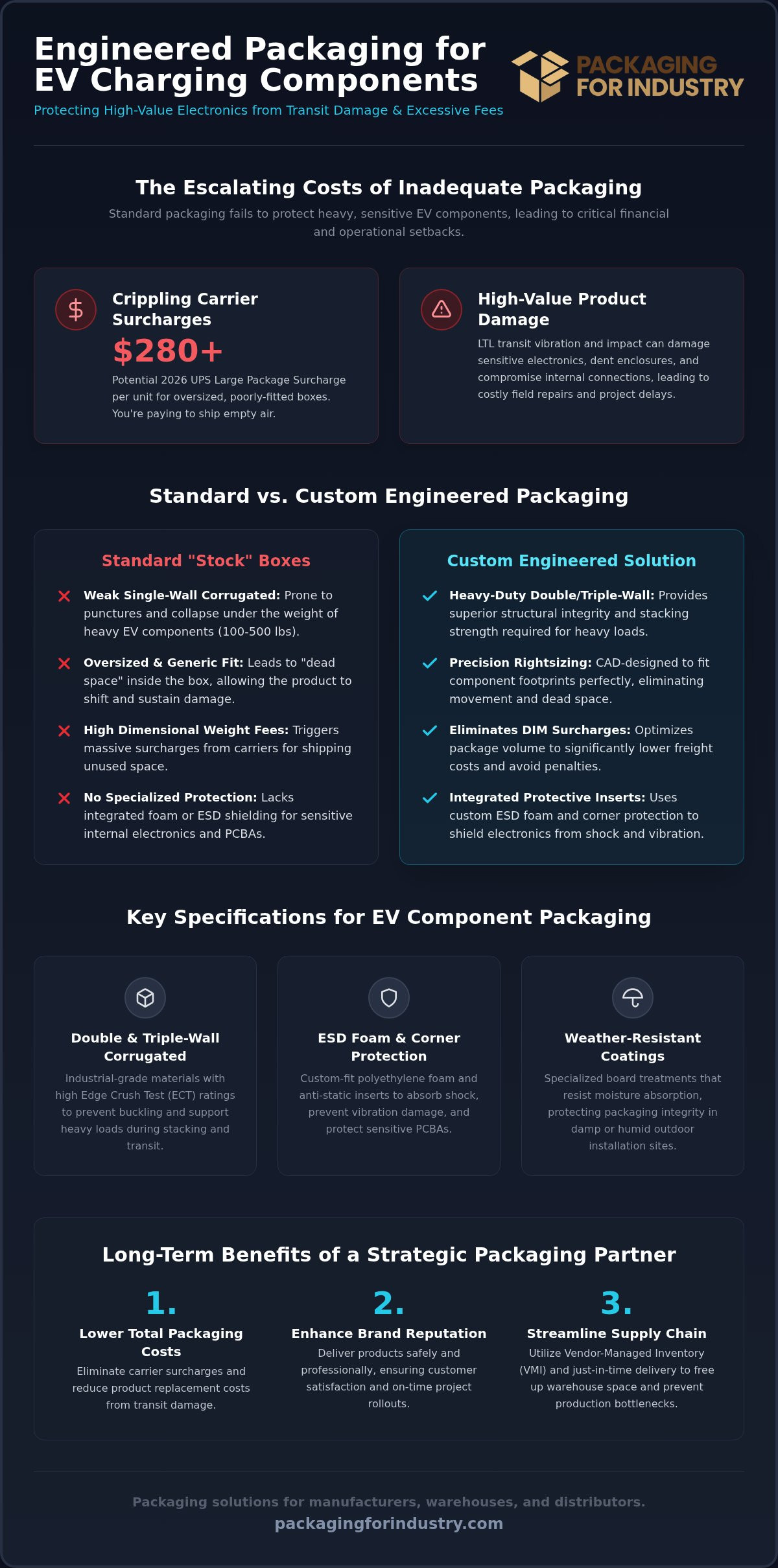
Selecting the wrong packaging creates a cascade of hidden expenses. Beyond the obvious cost of product returns, oversized stock boxes trigger significant dimensional weight (DIM) surcharges. Under the 2026 UPS rate schedules, Large Package Surcharges can exceed $280 per unit for long-zone shipments. If your packaging isn’t rightsized, you’re paying to ship air while increasing the risk of transit damage. Reliability is also a factor; a shortage of high-quality packaging can stall an entire production line, creating bottlenecks that jeopardize contract fulfillment. Using rightsized custom corrugated boxes for EV charging station components allows you to lower packaging costs while maintaining operational flow and protecting your brand’s reputation for quality.
Engineering Heavy-Duty Protection: Double and Triple Wall Corrugated Solutions
EV charging enclosures frequently weigh between 100 and 500 pounds, creating extreme pressure on the bottom flaps of a shipping container. Standard single-wall boxes don’t possess the structural integrity to manage these loads, especially during the vertical compression experienced in a stacked warehouse. Specifying custom corrugated boxes for EV charging station components requires a transition to industrial-grade double or triple-wall materials. These solutions provide the necessary Edge Crush Test (ECT) ratings to ensure the box doesn’t buckle under its own weight or the weight of units stacked above it.
For outdoor installation sites where equipment might sit before being bolted down, weather-resistant corrugated is a critical specification. We offer board treatments that resist moisture absorption, preventing the box from softening in humid or damp environments. When shipping high-value power modules or sensitive controllers, adhering to U.S. compliance requirements for packaging durability is non-negotiable. If you need to compare packaging pricing for heavy-duty board grades, our design team can provide a prototype based on your specific cabinet weight and stacking requirements.
Selecting the Right Corrugated Grade
Double-wall corrugated is the workhorse of the EV industry. It features two layers of fluting sandwiched between three liners, providing a significant jump in stacking strength over standard boxes. When designing heavy-duty RSC boxes (Regular Slotted Containers) for the heaviest DC fast-charging cabinets, triple-wall solutions act as a viable alternative to heavy wood crates. Triple-wall board offers maximum puncture resistance and can support thousands of pounds of top-load weight. This allows you to protect your assets while reducing the overall tare weight of the shipment, which directly lowers freight costs.
Custom Inserts and Internal Bracing
Protection isn’t limited to the outer shell. Internal organization ensures that all installation hardware and cable entry systems stay secure. We utilize custom corrugated boxes with integrated partitions and corner boards to separate sub-assemblies, preventing them from colliding during transit. These internal components distribute the load of the heavy enclosure across a wider surface area, significantly reducing the risk of localized crushing. By using these structural reinforcements, you eliminate surface scratches on powder-coated metal enclosures and ensure the unit remains pristine until it’s ready for final installation.
Custom Design vs. Off-the-Shelf: Why EV Components Require Bespoke Packaging
Purchasing managers often face the temptation of lower unit prices found in stock box catalogs. However, the true total cost of ownership (TCO) for packaging heavy infrastructure tells a different story. Stock boxes are designed for generic utility, which means they rarely fit the unique geometries of power modules or charging pedestals. This mismatch forces your team to use excessive amounts of bubble wrap, paper, or foam void fill to prevent movement. These extra materials don’t just add cost; they increase the labor time required for every single shipment. Navigating EV supply chain challenges effectively requires a shift toward engineered solutions that eliminate these hidden expenses.
Investing in custom corrugated boxes for EV charging station components ensures that every inch of the container serves a protective purpose. Because the box is built to the exact specifications of the component, you can reduce the overall package volume. This rightsizing is essential for high-visibility brands that want to project a professional image. A custom-printed, perfectly fitted box looks better on a job site than a generic container overflowing with tape and loose fill. It’s a pragmatic choice that balances brand reputation with fiscal responsibility.
The Prototyping Advantage
PFI offers free prototyping and CAD/CAM design support to bridge the gap between concept and production. This process allows us to create physical samples that your engineering team can test for real-world durability. We focus on load-bearing capacity and drop protection, ensuring the double or triple-wall board grade is sufficient for the component’s weight. Refining the design at this stage prevents costly errors during mass production. It also allows us to optimize the folding patterns and closure methods, which makes the packing process much faster for your warehouse staff. When the box is easy to assemble, your throughput increases without adding headcount.
Optimizing for Logistics and Freight
Logistical efficiency is often won or lost in the dimensions of the box. By reducing the footprint of your packaging, you can frequently increase the number of units that fit on a standard pallet. This improves your warehouse storage density and lowers your per-unit freight costs. Our designs focus on compliance with the latest 2026 UPS and FedEx industrial shipping requirements to help you avoid expensive surcharges. Learn more about our custom design services to discover how a bespoke approach can lower packaging costs while enhancing product safety during transit.
Key Specifications for EV Charging Component Packaging: From ESD to Load Bearing
Protecting an EV charging station requires more than just a strong outer layer. While previous sections detailed the structural necessity of heavy-duty board, the internal components require a specific set of engineering standards to survive the logistics chain. You’re shipping high-value assets that combine heavy structural steel with delicate microelectronics. This duality necessitates a multi-material approach where custom corrugated boxes for EV charging station components serve as the chassis for a broader, integrated protective system.
High-performance charging controllers and power conversion boards are susceptible to electrostatic discharge (ESD). Many manufacturers overlook this risk, focusing only on physical impact. We address this by integrating anti-static materials that prevent static buildup during the friction of transport. Additionally, for heavy enclosures, we use custom foam end caps to suspend the unit within the box. This prevents the metal base from making direct contact with the corrugated floor, creating a buffer zone that absorbs the vertical shocks common in LTL shipping. This system ensures that even if a box is dropped, the shock is dissipated before it reaches the internal circuitry.
Protective Foam Integration
Polyethylene foam is the ideal partner for heavy-duty corrugated because of its high load-bearing capacity and non-abrasive surface. Unlike lighter foams that crush and stay compressed, polyethylene regains its shape after impact, providing continuous protection through multiple handling points. By exploring our protective foam packaging options, you can find the right density to match your component’s weight and fragility. We also offer specialized ESD foam grades to ensure your electronics arrive in working order, reducing the risk of expensive field failures or product returns.
Load Stabilization and Bulk Shipping
For smaller sub-assemblies like cable harnesses, connectors, and mounting hardware, bulk shipping in heavy-duty Gaylord boxes is often the most efficient route. These large-format containers allow you to consolidate hundreds of smaller items into a single palletized unit, simplifying inventory control. To ensure these loads don’t shift or lean during transit, the use of high-performance industrial stretch film is essential. You can see our industrial stretch film solutions to understand how high-cling, high-gauge films provide the containment force necessary for securing palletized industrial loads.
Kitting is the final piece of the logistical puzzle. By organizing all components-from the main cabinet to the smallest mounting bracket-into a single, partitioned custom box, you streamline the installation process for field technicians. This “one box per site” approach reduces the chance of missing parts and ensures that the assembly sequence is intuitive. It’s a pragmatic way to improve field efficiency while maintaining total accountability for every component in the kit.
Partnering with PFI for EV Infrastructure Packaging Solutions
Securing a reliable supply of custom corrugated boxes for EV charging station components is a critical step in maintaining a consistent production schedule. As the industry scales to meet 2026 infrastructure demands, manufacturers can’t afford delays caused by packaging shortages or damaged arrivals. PFI positions itself as a seasoned industrial partner, providing the logistical oversight necessary to keep your assembly lines moving. We move beyond the role of a simple vendor by providing heavy-duty RSC boxes and engineered inserts that lower packaging costs while protecting your high-value assets.
Our commitment to industrial reliability ensures that your charging cabinets and power modules are always protected by precision-engineered packaging. We understand the pressure of meeting contract deadlines, especially for projects funded by federal grants. By integrating our solutions into your workflow, you can compare packaging pricing against large catalog suppliers and see the fiscal benefits of rightsized protection. Whether you’re shipping locally within California or coordinating nationwide delivery, our team provides the stability your operations demand.
Streamlining Procurement with VMI
Inventory management is a common bottleneck for EV manufacturers. Storing large volumes of heavy-duty corrugated or bulky foam inserts consumes warehouse space that should be dedicated to production. Our Vendor Managed Inventory (VMI) program solves this by shifting the burden of stock management to us. We conduct regular reviews to align your packaging supply with your current EV production schedules, ensuring you never face a production stop. Discover our VMI services for manufacturers to see how we optimize inventory flow and support just-in-time assembly.
Local Service in Southern California
PFI offers a significant geographical advantage to the SoCal EV market. With local next-day delivery capabilities across Anaheim, Orange County, and Los Angeles, we provide responsiveness that distant suppliers can’t match. We understand that EV startups and established providers in tech hubs like Irvine and Costa Mesa have unique requirements, which is why we have custom sizes available for every component in your catalog. This proximity allows us to provide personalized support and rapid prototyping for new charging station models.
Our reach extends through the Inland Empire and down to San Diego County, providing a seamless logistical network for the entire region. We also maintain robust partnerships to support your nationwide shipping requirements, ensuring your components are protected from the warehouse floor to the final installation site. To request a packaging quote or discuss a custom design for your next project, request a quote for local or nationwide delivery today. We’re ready to help you streamline your procurement and protect your high-value assets with precision.
Securing Your EV Infrastructure Supply Chain
The rapid build-out of EV charging networks in 2026 demands a packaging strategy that prioritizes both structural durability and logistical efficiency. You’ve seen how standard containers fail under the weight of industrial enclosures and how rightsized custom corrugated boxes for EV charging station components eliminate the burden of carrier surcharges. By combining heavy-duty double or triple-wall board with specialized ESD foam, you protect your high-value assets from the warehouse floor to the final installation site.
PFI serves as your proactive partner in industrial logistics. We offer free prototyping and CAD/CAM support to verify your design before you commit to bulk quantities. For manufacturers in Orange County, Los Angeles, and the Inland Empire, our next-day local delivery and VMI programs ensure you never face a production bottleneck. We specialize in the heavy-duty materials and integrated kitting solutions required to move sensitive infrastructure safely and affordably.
We’re ready to help you optimize your supply chain and protect your brand’s reputation for quality through precision engineering and reliable service.
Frequently Asked Questions
Why should I use custom corrugated boxes instead of stock sizes for EV components?
Custom boxes eliminate wasted space and the need for excessive void fill materials. Stock sizes often fail to meet the specific weight distribution and dimensions of EV cabinets, which increases the risk of transit damage. Custom sizing also ensures compliance with 2026 carrier dimensional weight rules, helping you avoid expensive surcharges. It is a pragmatic choice that balances material savings with superior product protection for high-value infrastructure.
What is the difference between double-wall and triple-wall corrugated for heavy parts?
Double-wall corrugated uses two layers of fluting for standard heavy parts, while triple-wall adds a third layer for maximum structural integrity. Triple-wall is often a lightweight alternative to wood crates for units weighing several hundred pounds. It offers much higher Edge Crush Test ratings. This ensures that stacked EV cabinets won’t buckle during long-term warehouse storage or rough LTL transit conditions.
Do you provide foam inserts specifically for sensitive EV electronics?
Yes, we integrate specialized anti-static foam inserts to protect sensitive charging controllers and PCBAs. These custom-cut foam pieces absorb mechanical shock and prevent electrostatic discharge, which is critical for power electronics. Pairing custom corrugated boxes for EV charging station components with the right foam density ensures that delicate internal parts remain suspended and secure throughout the entire shipping process.
Can PFI help with packaging design and prototyping for new charging station models?
PFI provides full CAD/CAM design support and free prototyping to ensure a perfect fit before you begin mass production. Our engineers create physical samples that allow your team to test load-bearing capacity and drop protection. This consultative approach prevents costly sizing errors. It also allows us to refine the packaging for faster assembly on your warehouse floor, which improves your overall operational throughput.
How does a Vendor Managed Inventory (VMI) program benefit EV manufacturers?
A Vendor Managed Inventory program frees up your warehouse space by shifting box storage and stock tracking to our team. We review your production schedules to ensure a steady supply of packaging is always available. This eliminates the risk of production stops due to packaging shortages. It allows you to focus your capital on manufacturing rather than maintaining large, space-consuming stockpiles of boxes.
Do you offer local delivery for EV companies in Orange County or Los Angeles?
We provide local next-day delivery across Orange County, Los Angeles, and the Inland Empire. Our proximity to tech hubs in Irvine, Anaheim, and Costa Mesa allows for rapid response times and personalized service for Southern California manufacturers. We also support nationwide shipping through our partner network. This ensures your infrastructure components reach installation sites safely regardless of their destination across the country.
What are the common causes of shipping damage for EV charging stations?
Most damage occurs due to internal component shifting or box failure under vertical compression. EV charging stations are often top-heavy or have concentrated weight points that puncture standard single-wall boxes. Without custom edge protection and proper load stabilization, vibration during transit can loosen internal connections or scratch powder-coated metal surfaces. These failures lead to expensive product returns and avoidable field repairs.
How can I lower my packaging costs for recurring high-volume orders?
Lowering packaging costs for high-volume orders is achieved through rightsizing and material optimization. By using custom corrugated boxes for EV charging station components, you reduce the overall package volume and eliminate the need for expensive secondary void fill. Consolidating smaller parts into heavy-duty Gaylord boxes and utilizing JIT inventory programs also reduces freight expenses and minimizes the overhead costs of warehouse management.