
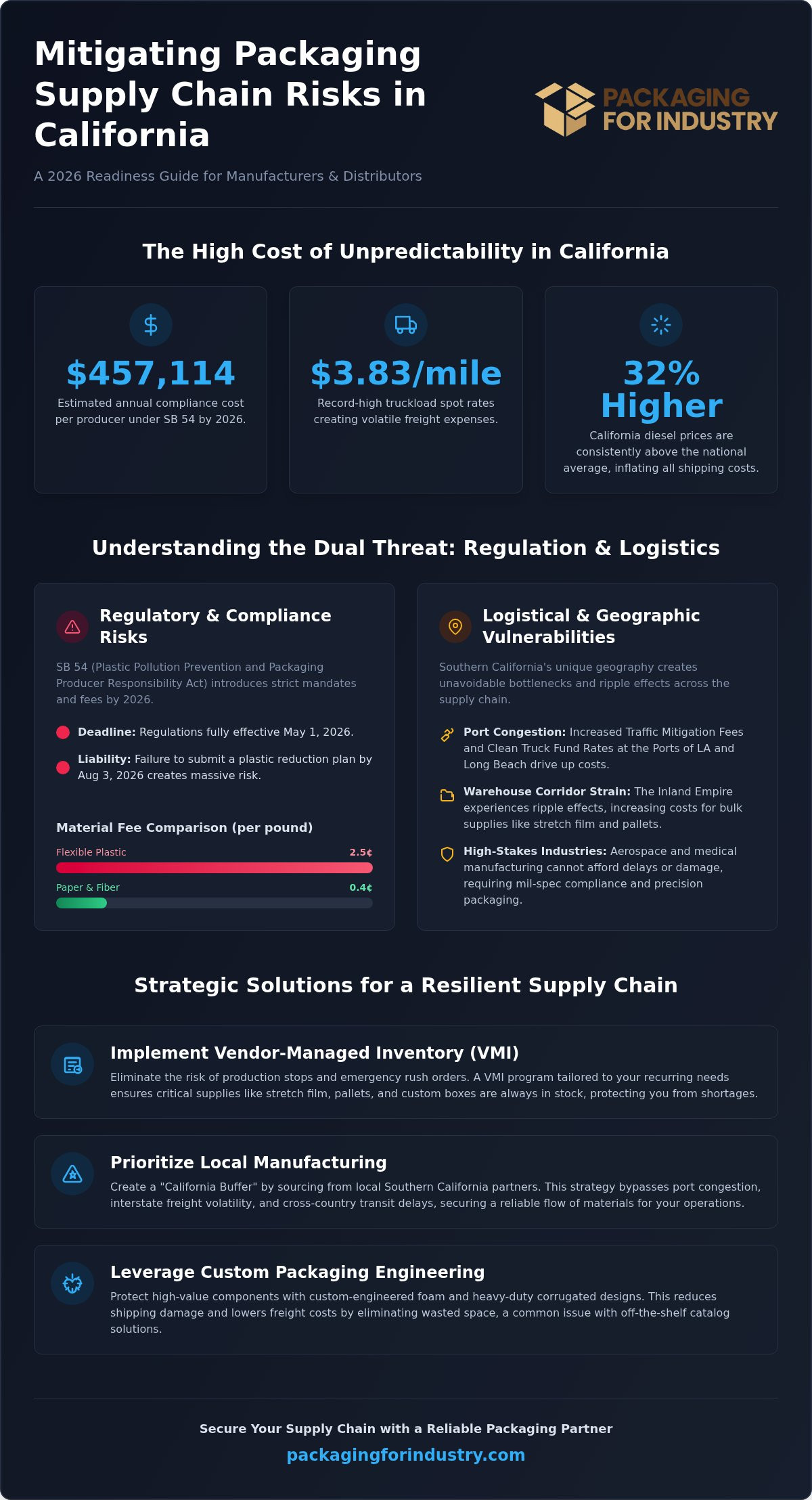
By the end of 2026, the average California producer faces an estimated $457,114 in annual compliance costs under SB 54, yet many still gamble their operations on unpredictable lead times. With truckload spot rates hitting record highs of $3.83 per mile, you can’t afford a single stockout or a shipment of damaged goods. Learning how to mitigate packaging supply chain risks in California is now the difference between a profitable quarter and a logistical nightmare. It’s clear that the old way of ordering from a catalog won’t cut it in this regulatory environment.
You’ve likely felt the mounting pressure of rising diesel prices and the constant threat of congestion at the Ports of Los Angeles and Long Beach. This guide promises to show you how to shield your bottom line from these specific regional disruptions using custom engineering and vendor-managed inventory (VMI). We’ll examine the 2026 packaging mandates, explain how to eliminate shipping damage, and provide a roadmap for securing reliable local delivery for your corrugated boxes and protective foam. It’s time to move toward a more resilient, compliant, and cost-effective logistics strategy.
Key Takeaways
- Prepare your operations for 2026 mandates by learning how to navigate SB 54 compliance and Extended Producer Responsibility (EPR) reporting.
- Learn how to mitigate packaging supply chain risks in California by prioritizing local manufacturing to bypass port congestion in Long Beach and San Pedro.
- Eliminate the risk of production stops and emergency rush orders through a Vendor Managed Inventory (VMI) program tailored to your recurring packaging needs.
- Protect high-value aerospace and medical components with custom-engineered foam and heavy-duty corrugated designs that reduce shipping damage and freight costs.
- Shift from catalog-buying to engineering-led inventory partnerships to ensure zero stockouts on critical supplies like stretch film, pallets, and custom boxes.
Identifying California-Specific Packaging Supply Chain Risks in 2026
California’s industrial base operates within a unique economic ecosystem. As the world’s fourth largest economy, the state’s logistics network is under constant pressure from high volume and strict oversight. In this environment, supply chain risk management isn’t just about moving goods; it’s about maintaining operational continuity despite local bottlenecks. Understanding how to mitigate packaging supply chain risks in California requires a deep dive into the specific friction points found in Southern California’s manufacturing hubs.
Regulatory and Compliance Risks
The implementation of SB 54 marks a shift in how companies manage their SKU strategy. As of May 1, 2026, the Plastic Pollution Prevention and Packaging Producer Responsibility Act regulations are fully effective. Producers must now align with the Circular Action Alliance (CAA) fee schedule, which imposes rates based on material weight. For example, flexible plastic carries a fee of 2.5 cents per pound, while paper and fiber are significantly lower at 0.4 cents. Failure to submit a plastic reduction plan by the August 3, 2026, deadline creates a massive liability for non-compliant businesses. These mandates force a move away from single-use plastics toward fiber-based corrugated boxes and recyclable materials to avoid heavy surcharges and lower packaging costs.
Logistical and Geographic Vulnerabilities
Southern California’s geography creates specific vulnerabilities. The Ports of Los Angeles and Long Beach are currently managing increased Traffic Mitigation Fees and Clean Truck Fund Rates. These costs ripple through the Inland Empire’s warehouse corridors, driving up the cost of stretch film and bulk supplies. In June 2026, truckload spot rates reached $3.83 per mile, while California diesel prices averaged $6.07 per gallon. This is 32% above the national average.
Industrial sectors like aerospace and medical manufacturing face the highest stakes. Unlike retail goods, these components require precision-engineered foam packaging and mil-spec compliance. A delay at the Port of San Pedro or a shortage of specialized resins can halt a production line for weeks. Localizing your supply chain in Anaheim or the surrounding Orange County area provides a critical buffer against these external shocks. This is a primary strategy for those looking at how to mitigate packaging supply chain risks in California without sacrificing speed or quality. When you request a packaging quote from a local manufacturer, you’re buying more than boxes; you’re securing a reliable flow of materials that bypasses port-related delays.
Strategic Sourcing: Diversifying vs. Localizing Your Supply
Many procurement managers rely on national catalog suppliers for convenience, yet these sources often struggle with regional logistics. When you look at how to mitigate packaging supply chain risks in California, the distance between the manufacturer and your warehouse becomes a primary variable. Relying on out-of-state vendors exposes you to interstate freight volatility and the record-high spot rates discussed earlier. Localizing your source provides a “California Buffer,” ensuring that your production schedule isn’t dictated by cross-country transit delays or overbooked national carriers.
Smart purchasing teams don’t just look at the first number they see. You should actively compare packaging pricing between catalog stock and local custom runs, especially when transit fees are factored into the total landed cost. While a catalog might offer a lower unit price on paper, the lack of custom sizes available often leads to wasted space and higher freight surcharges. A local partner can engineer a box specifically for your product, which helps you lower packaging costs by eliminating air and reducing material waste.
The Case for Local Southern California Partnerships
Proximity to manufacturing centers like Anaheim or the Inland Empire provides a strategic advantage that national suppliers can’t match. Localizing your supply chain allows for local next-day delivery in Orange County and Los Angeles, bypassing the gridlock at the Port of Long Beach. This regional agility is vital for maintaining lean operations. It ensures that your inventory of corrugated boxes and stretch film remains stable even when global shipping lanes are congested.
Qualifying Your Packaging Partners
Vetting a supplier requires a technical evaluation of their operational resilience. You need to ensure they have the raw material stock to weather local shortages. A reliable partner should provide in-house CAD/CAM support and rapid prototyping for custom design packaging. This engineering capability allows you to pivot quickly if a product specification changes or a specific material becomes unavailable.
To maintain a secure vendor network, many industrial firms utilize the Cybersecurity Supply Chain Risk Management framework as a guide for qualifying partner reliability. This systematic approach helps identify suppliers who can truly support “just-in-time” logistics during market shifts. If your current provider can’t guarantee regional availability, it’s time to request a packaging quote from a partner with local manufacturing assets. This move secures your logistical flow and provides the engineering oversight needed for long-term stability.
Mitigating Shortages with Vendor Managed Inventory (VMI)
Vendor Managed Inventory is a strategic arrangement where your supplier takes full responsibility for maintaining agreed-upon stock levels at your facility. It’s a shift from traditional, reactive purchasing to a collaborative logistical flow. This model serves as the ultimate insurance policy for manufacturers wondering how to mitigate packaging supply chain risks in California. By letting a partner manage your stock, you ensure your warehouse never runs out of critical shipping supplies like corrugated boxes or foam packaging.
The financial impact of VMI is immediate and measurable. You improve cash flow by reducing the capital tied up in excess on-site stock. It also eliminates the need for emergency rush orders, which often carry heavy freight surcharges and higher packaging costs. To implement this effectively, we establish precise “min/max” levels. The “min” represents your safety stock, while the “max” ensures you aren’t wasting valuable floor space in high-rent areas like Orange County or Los Angeles.
How VMI Protects Your Production Lines
A single missing component, even a specific size of mailing tube, can halt an entire production line. Utilizing vendor managed inventory is particularly valuable for items with long lead times, such as custom-engineered inserts for the medical or aerospace sectors. Instead of reacting when a shelf is empty, you move to a planned replenishment cycle. This transition allows your team to focus on production goals rather than chasing down late deliveries of pallets or crates.
Implementing VMI in Your California Facility
Successful implementation starts with a historical usage review and close collaboration with your production teams. For industrial facilities in the Inland Empire or Anaheim, managing warehouse space is a constant challenge. We set up regular review cycles, often weekly, to monitor high-volume items. This ensures you only store what you need for the immediate future, with the rest of your inventory staged at our local manufacturing site. When you’re ready to stabilize your supply chain, it’s time to request a packaging quote that includes a managed inventory component. This proactive system keeps your logistics moving at the speed of a well-oiled machine.
Reducing Damage Risks Through Custom Packaging Engineering
While VMI and local sourcing stabilize the flow of materials, custom engineering ensures those materials actually protect your investment. Transit damage is a critical supply chain failure that often goes overlooked until it impacts the bottom line. If a high-value aerospace component arrives with a hairline fracture due to vibration, the entire logistics cycle has failed regardless of how fast it was delivered. Custom engineering moves beyond generic cushioning to create a system of protection that accounts for the specific G-force and vibration risks found in the Southern California transit corridor.
Engineering Protection for High-Value Goods
Industrial sectors require more than a standard container. We design heavy-duty RSC boxes (Regular Slotted Containers) with double or triple-wall corrugated to prevent structural collapse during high-density stacking. To reinforce these units, we integrate corner boards that provide essential vertical stacking strength and prevent strap damage during transit. For complex assemblies, we utilize custom foam packaging and specialized kitting services. Kitting allows your warehouse team to receive all necessary protective components in one organized set, which reduces assembly errors and ensures every part is secured according to mil-spec packaging standards. This integrated approach helps you lower packaging costs by reducing the need for redundant materials while ensuring maximum safety.
- Heavy-duty RSC boxes to eliminate structural collapse in high-density storage
- Corner boards for increased vertical strength and edge protection
- Industrial kitting to streamline warehouse assembly and ensure part accountability
- Mil-spec packaging compliance for aerospace and defense contracts
Prototyping and Testing for Reliability
Engineering-led risk mitigation relies on physical verification before you commit to a full-scale production rollout. The process begins with a technical CAD/CAM design tailored to the specific dimensions and center of gravity of your product. We then produce a physical prototype at our Anaheim facility to ensure the fit is perfect. This phase allows us to simulate the stresses of the Southern California logistics network, from port handling to the “last mile” delivery in Los Angeles or Orange County. Validating packaging performance early reduces the risk of costly insurance claims and the logistical headache of processing returns. It ensures your protective system is optimized for both durability and long-term cost-effectiveness.
Navigating 2026 Compliance and Regulatory Risk in CA
Compliance is the final, most complex layer of supply chain stability. As of 2026, California’s regulatory environment has shifted from suggested guidelines to enforced mandates. The legal status of SB 54 remains a focal point for procurement managers, especially with the ongoing 17-state challenge to the law’s reach. However, waiting for a court ruling is not a viable strategy for those looking at how to mitigate packaging supply chain risks in California. The state’s deadline for submitting a plastic reduction plan was August 3, 2026, and the Circular Action Alliance (CAA) has already implemented its fee schedule. Producers who haven’t registered with a Producer Responsibility Organization (PRO) are now facing significant operational and financial liabilities.
Extended Producer Responsibility (EPR) reporting now requires granular data on every SKU in your warehouse. Rigid plastics incur a fee of 1.3 cents per pound, while flexible plastics are penalized at 2.5 cents. In contrast, paper and fiber-based materials are only 0.4 cents. This price gap makes fiber-based solutions like heavy-duty corrugated crates and RSC boxes the most fiscally responsible choice for bulk shipping. For defense contractors and government suppliers, these state mandates must be balanced against mil-spec packaging requirements. Maintaining compliance with both local environmental laws and federal military standards is essential for securing and keeping high-value contracts.
Sustainable Packaging Without Operational Risk
Moving away from single-use plastics doesn’t have to mean compromising on durability. Identifying recyclable alternatives for foam cushioning, such as molded pulp or specialized paper-based inserts, can satisfy SB 54 requirements while protecting sensitive equipment. Weather-resistant corrugated materials can also replace less sustainable plastic wraps in many industrial applications. When managing aerospace packaging, the priority is always protection. We help you evaluate materials that meet both the state’s 2026 sustainability goals and your industry’s rigorous safety standards. It’s about finding the intersection of engineering and economics to avoid the “greenwashing” risks identified in pending legislation like AB 2253.
Future-Proofing Your Supply Chain
A long-term SKU strategy is the only way to insulate your operations from shifting legislation. This involves auditing your current material usage and working with suppliers who have a deep understanding of the “California Effect.” By consolidating your packaging into compliant, high-performance materials, you reduce the risk of future tax hikes and supply shortages. It’s time to move toward a proactive, engineering-led strategy that ensures total accountability from design to delivery. Working with a local partner who understands these regional nuances is your best defense against the volatility of the 2026 market.
Securing Your 2026 Industrial Packaging Strategy
Navigating the current logistics landscape requires a shift away from generic catalog orders toward engineering-led partnerships. You’ve seen how localized sourcing and Vendor Managed Inventory (VMI) provide a critical buffer against port congestion and record-high diesel prices. By integrating custom engineering and prototyping early in your design phase, you eliminate the threat of transit damage and ensure your SKUs remain compliant with SB 54 mandates. Understanding how to mitigate packaging supply chain risks in California is no longer optional; it’s a fundamental requirement for protecting your manufacturing margins and operational continuity.
Packaging For Industry (PFI) acts as your technical consultant in this effort. We specialize in aerospace and mil-spec packaging, providing the precision required for high-value industrial sectors. Our local Anaheim manufacturing facility supports next-day delivery across Southern California, ensuring you never face a stockout on critical shipping supplies. We also offer free prototyping for custom designs to help you validate performance before full production begins. It’s time to replace logistical stress with a steady, engineered flow of materials.
Take control of your logistics today. A more resilient and cost-effective supply chain is within reach when you prioritize local expertise and strategic inventory management.
Frequently Asked Questions
What industrial products does PFI supply to Southern California?
We provide a comprehensive range of industrial supplies including heavy-duty corrugated boxes (RSC, double/triple wall), protective foam packaging (polyethylene and ESD), and stretch film. Our inventory also features mailing tubes, pallets, crates, and corner boards. Every product is selected to improve reliability and lower packaging costs. We ensure that custom sizes available for all corrugated and foam designs meet your specific manufacturing requirements.
Which industries benefit from PFI’s specialized packaging solutions?
PFI is a dedicated partner for the aerospace, medical, and electronics industries. We understand the rigorous standards of these sectors, providing mil-spec packaging and specialized kitting services to ensure component integrity. Whether you are a distributor in the Inland Empire or a medical manufacturer in San Diego, our solutions are engineered to handle the high-value, sensitive nature of your products while maintaining total regulatory compliance.
What are the business-critical benefits of choosing PFI?
Choosing PFI provides you with local next-day delivery in Southern California and access to our Vendor Managed Inventory (VMI) programs. These services act as an insurance policy against stockouts and shipping delays. Additionally, we offer free prototyping for custom industrial designs, allowing you to validate performance before a full rollout. Our expertise helps you navigate how to mitigate packaging supply chain risks in California by providing a steady, local flow of materials.
How can I compare packaging pricing and request a packaging quote?
You can request a packaging quote to compare packaging pricing based on your specific volume and delivery needs. While bulk purchasing can reduce unit costs, our just-in-time inventory management reduces your warehouse overhead and improves cash flow. We work with your procurement team in Anaheim or Los Angeles to find the most cost-effective balance, ensuring you have the necessary supplies without the burden of excessive on-site inventory.
How does PFI help me mitigate packaging supply chain risks in California?
We provide a complete roadmap for how to mitigate packaging supply chain risks in California through 2026 and beyond. This includes auditing your current SKU strategy to satisfy SB 54 mandates and transitioning to compliant, heavy-duty RSC boxes. Our team stays current on California’s evolving environmental laws, ensuring your packaging remains compliant while still providing the mil-spec protection required for high-stakes aerospace and industrial applications.