
In 2026, the difference between a profitable production line and a costly operational halt often comes down to the reliability of your corrugated boxes and the expertise of the vendor who provides them. If you’ve dealt with unpredictable lead times or watched your margins disappear into carrier surcharges, you know that a cheap box isn’t always a cost-effective solution. Finding a packaging supplier that acts as a strategic partner is the only way to move beyond these transactional headaches and secure your supply chain. You need more than a vendor; you need a proactive problem solver who understands the intersection of engineering and economics.
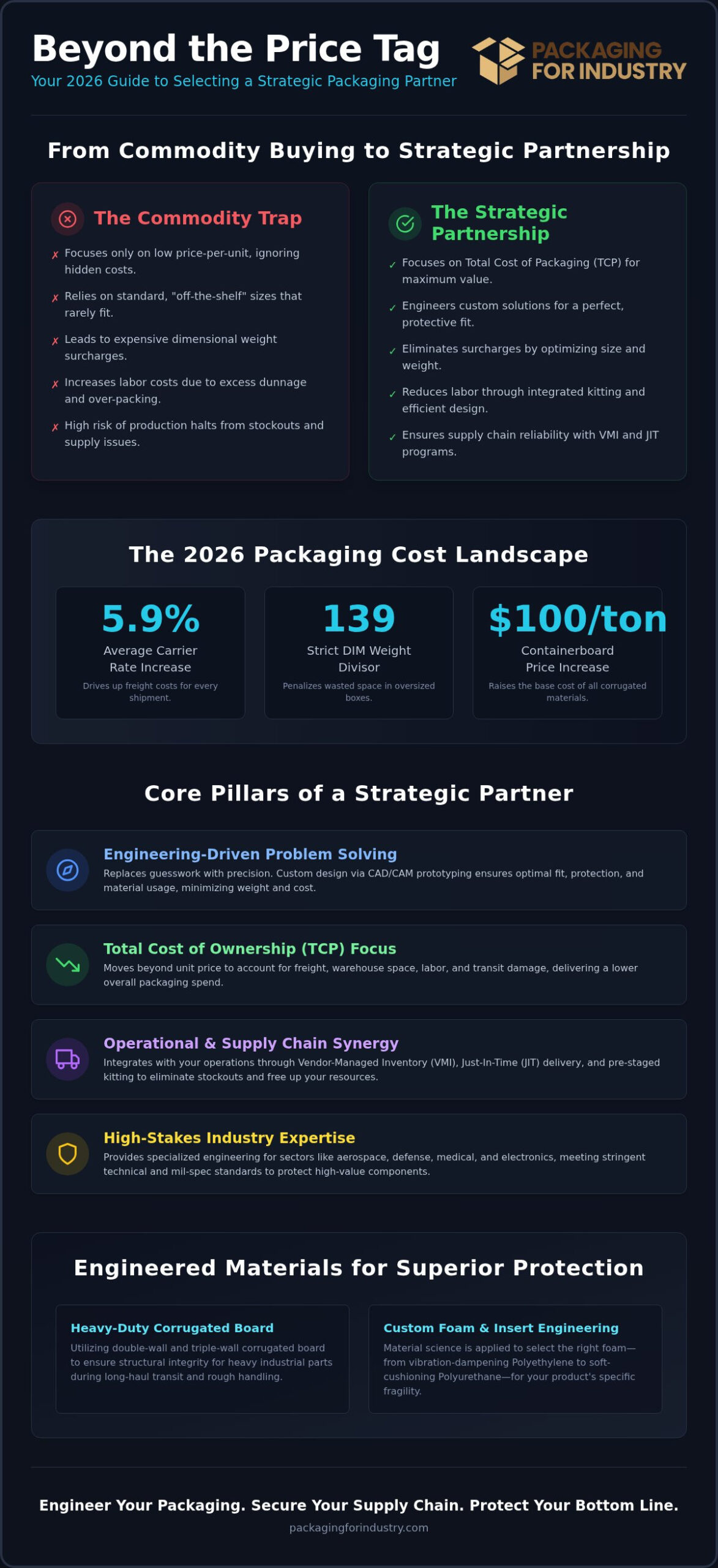
We understand the pressure of managing high-value industrial products while facing a 5.9% average carrier rate increase and rising containerboard costs. This guide shows you how to transition to a strategic partnership that reduces your total cost of ownership and eliminates stockouts through just-in-time delivery. We will explore how professional engineering support stops transit damage and how custom programs like vendor-managed inventory can finally free up your warehouse space. You’ll learn to identify a partner that provides the peace of mind and stability required for modern industrial logistics.
Key Takeaways
- Focusing on price-per-unit is a deceptive metric. Learn how to evaluate suppliers based on the total cost of ownership to maximize your operational budget.
- Custom-engineered boxes and advanced foam packaging can eliminate expensive carrier surcharges. Discover how precision sizing addresses the 2026 dimensional weight rules.
- Finding a packaging supplier that acts as a strategic partner is essential for preventing production halts. Learn how vendor-managed inventory programs eliminate the risk of stockouts.
- High-stakes sectors like aerospace and electronics require specialized engineering expertise. Identify the technical standards necessary to protect high-value components during transit.
- Move beyond simple price bidding to a value-based procurement model. Use our strategic evaluation checklist to assess supplier responsiveness and technical depth.
What Defines a Strategic Packaging Partner in 2026?
Many procurement managers still view packaging as a commodity. They focus exclusively on the price-per-unit. In 2026, this approach is a liability. With North American containerboard prices seeing a net increase of $100 per ton in the first half of the year, unit costs are rising across the board. Finding a packaging supplier that acts as a strategic partner requires a shift in perspective from buying products to managing a Supplier Relationship Management strategy. A true partner doesn’t just ship boxes; they engineer the entire logistical flow to protect your bottom line.
The strategic model focuses on the Total Cost of Packaging (TCP). This metric accounts for every dollar spent from the design phase to the moment the customer opens the box. It includes freight costs, warehouse footprints, assembly labor, and the devastating cost of transit damage. Instead of fragmented sourcing, a strategic partner provides integrated material solutions. This means your corrugated boxes, protective foam packaging, and pallets are designed to work together as a single, optimized unit.
The Catalog Trap: Why Big Box Suppliers Often Fail Manufacturers
Catalog vendors thrive on volume and standardization. They offer thousands of “off-the-shelf” sizes that rarely provide a perfect fit for specialized industrial components. When you use a box that’s two inches too large, you aren’t just paying for extra cardboard. You’re triggering significant dimensional weight surcharges. Since 2026 carrier rules use a strict 139 DIM divisor, shipping air is an expensive mistake. Generic materials also fail to account for the specific vulnerabilities of high-value parts. Without dedicated technical support, manufacturers often over-pack with excess dunnage, which increases labor costs and waste.
The Core Pillar: Engineering-Driven Problem Solving
Engineering is the foundation of a strategic partnership. It replaces guesswork with precision. Through custom design packaging, we analyze the weight, fragility, and orientation of your product to create the most efficient footprint possible. Our team uses CAD/CAM prototyping to produce physical samples for testing. This allows you to verify the fit and protection levels before committing to a full production run. Prototyping is especially critical for industries like aerospace or medical devices, where even a minor design flaw can lead to damage during transit. By focusing on the physics of protection, a strategic partner ensures your products arrive intact while keeping shipping weights at an absolute minimum.
Evaluating Technical Depth: Engineering and Customization
Finding a packaging supplier that acts as a strategic partner involves looking beyond a standard inventory list and assessing their engineering depth. In 2026, technical precision is the most effective way to combat shipping inflation. For instance, UPS and FedEx now use a dimensional (DIM) weight divisor of 139 for domestic shipments. If your box dimensions aren’t perfectly calibrated to your product, you’re paying for empty space at a premium rate. Custom sizing isn’t just about protection; it’s a direct cost-reduction strategy that keeps your billable weight as low as possible.
Beyond dimensions, the material composition of your container determines its durability. For heavy industrial parts, we utilize heavy-duty double-wall and triple-wall corrugated board to ensure structural integrity during long-haul transit. We also offer integrated kitting services. By delivering your boxes, inserts, and pallets as a pre-staged kit, we simplify your assembly line and reduce internal labor costs. This focus on building strategic partnerships ensures that your packaging is an asset to your production process, not a bottleneck.
Custom Foam and Insert Engineering
Material science is critical when designing protective foam packaging. We select materials based on the specific fragility and weight of your product. Polyethylene offers excellent vibration dampening for heavy parts, while polyurethane provides soft cushioning for delicate surfaces. For electronics, anti-static ESD foam prevents catastrophic static discharge during handling. Precision die-cut foam inserts secure high-value components in place, eliminating the need for loose-fill dunnage. Custom foam-lined crates provide a rigid exterior while absorbing the continuous transit vibrations that often lead to mechanical failure.
Prototyping as a Risk Mitigation Strategy
You shouldn’t commit to a bulk order based on a 2D drawing. Finding a packaging supplier that acts as a strategic partner means having an expert who validates every design before it hits your warehouse floor. Prototyping allows you to test for fit, shock absorption, and stack strength before full-scale production. We provide CAD/CAM samples so your team can verify that every component fits exactly as intended. This process identifies potential failure points early, saving you from the high cost of damaged returns. PFI’s free prototyping service accelerates your procurement cycle, allowing you to move from design to delivery without unnecessary delays. If you’re ready to see how an engineered solution can protect your components, you can compare packaging pricing for your custom project today.
Operational Synergy: Supply Chain Reliability and VMI
Procurement isn’t just about purchasing boxes; it’s about ensuring those boxes are on the floor when the product is ready. A production line halt due to a packaging stockout is a preventable disaster that compromises your shipping deadlines and customer trust. Finding a packaging supplier that acts as a strategic partner means moving away from reactive, manual ordering. Instead of placing emergency orders that carry high freight costs and long lead times, you gain a system that manages itself. This transition shifts the focus from managing vendors to optimizing the entire supply chain.
Implementing a Vendor Managed Inventory (VMI) program allows you to reclaim valuable warehouse floor space. Most manufacturers tie up significant capital in “safety stock” just to avoid shortages. A strategic partner takes over that burden, holding your inventory at their facility and delivering exactly what you need. This significantly improves your cash flow by shifting costs to planned replenishment cycles rather than bulk upfront purchases. It also eliminates the administrative burden of tracking every pallet of corrugated board or roll of tape.
How a VMI Program Actually Works
The process begins with a thorough assessment of your usage history and production lead times. We don’t guess; we use data to set precise minimum and maximum inventory levels for your specific SKUs. Once these triggers are established, the replenishment process becomes automated. Our team conducts weekly or monthly on-site reviews to adjust levels based on your current production demands. This hands-on approach ensures that your inventory levels remain optimized even as your business scales or seasonal demands shift. It provides a level of oversight that a standard catalog vendor simply cannot offer.
Just-In-Time (JIT) Delivery for Southern California
For businesses in Orange County and Los Angeles, proximity is a major strategic advantage. Our local hub allows for next-day delivery, which is the backbone of a successful Just-In-Time (JIT) strategy. You don’t have to waste capital or warehouse space on excessive inventory when reliable delivery is only hours away. This model extends beyond heavy-duty boxes to include critical consumables like stretch film, pallet wrap, and corner protectors. Finding a packaging supplier that acts as a strategic partner ensures that every component of your shipping process is synchronized. This operational synergy eliminates the stress of supply chain gaps and allows your team to focus on manufacturing rather than logistics.
Industry-Specific Expertise: Aerospace, Defense, and Electronics
High-stakes sectors like aerospace and defense operate under strict regulatory frameworks where a single packaging failure can lead to contract termination or damaged mission-critical equipment. Finding a packaging supplier that acts as a strategic partner is essential for navigating these complexities. You need a team that understands the specific demands of aerospace packaging, including the protection of fragile avionics and oversized engine components. These industries don’t just need boxes; they need a partner capable of interpreting technical drawings and meeting rigorous compliance standards.
For the semiconductor and electronics industries, the focus shifts to microscopic threats. Electrostatic discharge (ESD) can destroy sensitive components without any visible sign of damage. Finding a packaging supplier that acts as a strategic partner ensures your high-value inventory remains protected throughout the entire cleanroom-to-delivery lifecycle. By engineering a complete ESD-safe environment using specialized foam and shielding materials, we eliminate the risks that standard packaging vendors often overlook. This level of expertise is mandatory for maintaining the integrity of your supply chain.
Compliance and Mil-Spec Packaging
Defense contracts require adherence to specific military specifications, commonly known as Mil-Spec. This involves utilizing moisture barrier bags, desiccants, and static shielding to protect equipment from harsh environments during storage or transit. Compliance also extends to the shipping materials themselves. As of January 1, 2026, the US Animal and Plant Health Inspection Service (APHIS) has resumed full enforcement of the ISPM 15 hyphen requirement. This means every wood pallet or crate must have a correctly formatted mark with a hyphen separating the country and facility codes. A strategic partner ensures all wood packaging is heat-treated and marked correctly to avoid cargo rejection at international ports.
Specialized Protection for Sensitive Electronics
Protecting delicate panels and circuitry requires a combination of internal cushioning and external structural support. We use custom corner and edge protection to prevent impact damage to the most vulnerable parts of your product. By integrating anti-static ESD foam with precision-cut inserts, we eliminate movement within the container. Heavy-duty machinery and industrial equipment also require specialized structural engineering. We design double and triple-wall corrugated solutions that support significant weight without collapsing. This methodical approach to protection is a hallmark of a seasoned industrial consultant; it moves beyond simple containment to focus on total product preservation.
The Selection Process: A Strategic Evaluation Checklist
Transitioning from a transactional vendor to a long-term partner requires a fundamental change in your procurement strategy. Price-only bidding often leads to higher total costs because it ignores the expenses associated with transit damage, excessive freight, and production downtime. Finding a packaging supplier that acts as a strategic partner means looking for a “fixer” who can identify hidden inefficiencies in your current workflow. You aren’t just buying corrugated board; you’re investing in a system that protects your margins and streamlines your operations.
Proximity and responsiveness are critical factors in this evaluation. While national catalog hubs offer convenience, they often lack the technical depth required for complex industrial parts. A local partner in Southern California provides the advantage of on-site consultations and next-day delivery that national vendors can’t match. This local presence allows for a deeper understanding of your specific warehouse logistics and assembly line constraints. It’s the difference between a supplier that just takes orders and one that proactively engineers solutions to your daily challenges.
Red Flags to Avoid in a Packaging Vendor
Identifying a weak supplier early saves your company from future supply chain disruptions. Avoid vendors who exhibit these common warning signs:
- Lack of CAD support: If a supplier cannot provide CAD/CAM prototyping, they aren’t engineering your protection; they’re guessing.
- Inconsistent lead times: Frequent stockouts or fluctuating delivery dates indicate a lack of operational control.
- Refusal to offer VMI: A vendor that won’t manage your inventory on-site is forcing you to carry the financial burden of safety stock.
- Standard-only mindset: If they only push “off-the-shelf” sizes, they’re ignoring the freight savings found in custom dimensions.
Questions to Ask Potential Strategic Partners
Finding a packaging supplier that acts as a strategic partner requires asking the right technical questions. Don’t settle for surface-level answers. Instead, use these queries to gauge their expertise:
- “How specifically do you help reduce my freight and carrier surcharge costs?” Look for answers involving DIM weight optimization and custom sizing.
- “Can you manage my inventory on-site to prevent shortages?” A strategic partner should offer clear VMI or stocking programs with regular reviews.
- “What is your process for designing custom foam or corrugated inserts?” They should describe a methodical approach involving prototyping and fit-testing.
The final step in your selection process should be a direct comparison of capabilities. You can request a packaging quote to benchmark your current supplier against an engineered, value-based model. This diagnostic tool reveals where you’re overpaying for materials or shipping air. Benchmarking ensures that your packaging spend is an investment in reliability rather than just a recurring expense.
Secure Your Supply Chain for 2026 and Beyond
Transitioning from a transactional vendor to a strategic partner is no longer optional in an era of rising containerboard costs and strict carrier surcharges. Finding a packaging supplier that acts as a strategic partner provides the technical depth needed to engineer out waste while ensuring total supply reliability. By leveraging custom CAD/CAM prototyping and specialized VMI programs, you can eliminate the professional stress of stockouts and transit damage. This shift ensures your packaging is an asset to your production line rather than a recurring bottleneck.
A true partner understands the nuances of aerospace and mil-spec compliance, protecting your high-value components from the warehouse floor to the final destination. We focus on the intersection of engineering and economics to help you lower packaging costs without sacrificing durability. It’s time to move beyond the catalog and embrace a solution tailored to your specific industrial needs.
We are ready to help you optimize your operations and achieve long-term logistical stability through proactive problem solving.
Frequently Asked Questions
What is the difference between a packaging vendor and a strategic partner?
A packaging vendor operates on a transactional basis, fulfilling catalog orders without considering your broader operational goals. In contrast, a strategic partner acts as an integrated consultant who engineers solutions to lower your total cost of ownership. Finding a packaging supplier that acts as a strategic partner means gaining a fixer who manages your inventory and optimizes package design to eliminate shipping damage and carrier surcharges.
How can a strategic packaging partner help reduce my shipping costs?
Strategic partners focus on dimensional (DIM) weight optimization to prevent you from shipping unnecessary air. Since carriers like UPS and FedEx use a 139 divisor for billable weight, reducing box dimensions by even one inch can lead to significant savings. A partner also engineers custom inserts that eliminate the need for expensive loose-fill dunnage, lowering both material and labor costs during the packing process.
What industries benefit most from custom-engineered packaging?
Industries with high-value or high-compliance requirements, such as aerospace, medical devices, and electronics, see the greatest return on engineering. These sectors require specialized protection like ESD-safe foam or mil-spec moisture barriers to prevent catastrophic product failure. Custom engineering ensures that fragile components meet strict contract specifications and arrive intact, which protects your reputation and prevents the high cost of damaged returns.
How does a Vendor Managed Inventory (VMI) program save my business money?
A VMI program improves your cash flow by shifting the burden of inventory management to the supplier. Instead of tying up capital in bulk orders and safety stock, you only receive and pay for what you need through just-in-time delivery. This process frees up valuable warehouse floor space for production and eliminates the administrative costs associated with tracking inventory levels and placing emergency orders.
Is it more expensive to buy custom-size boxes than stock boxes?
While the unit price of a custom box might be higher, the total cost of packaging is typically lower. Stock boxes often lead to higher freight costs due to inefficient sizing and require more assembly labor and protective cushioning. With custom sizes available, you eliminate carrier penalties and reduce transit damage, which results in a much lower total cost of ownership for your industrial operations.
Can a local Southern California supplier handle nationwide shipping needs?
Yes, a partner with a hub in Southern California can provide local next-day delivery in Orange County and Los Angeles while maintaining nationwide shipping capabilities. This model allows you to benefit from personalized engineering support and on-site consultations while ensuring your remote distribution centers receive the same high-quality corrugated boxes and stretch film. It provides a consistent supply chain across all your domestic locations.
What should I look for in a packaging supplier’s prototyping process?
You should prioritize suppliers that offer CAD/CAM design and free prototyping for custom projects. This process allows you to verify the fit and protective qualities of a design before committing to a production run. A strategic partner will provide physical samples for shock and stack testing, ensuring the packaging can withstand the specific vibrations and pressures of your international or domestic transit routes.
How do I switch packaging suppliers without disrupting my production line?
Switching is a phased process that begins with a comprehensive audit of your current SKUs and usage rates. Finding a packaging supplier that acts as a strategic partner ensures a smooth transition by staging initial inventory before your current stock runs out. By establishing min/max levels and a VMI replenishment cycle immediately, the new partner takes over the supply chain without any gap in availability.