
What if your packaging was a strategic capital investment rather than a recurring operational drain? Many industrial leaders in Southern California find that transit damage and the rising costs of single-use waste are often treated as an unavoidable cost of doing business, but they shouldn’t be. Implementing custom engineered packaging for supply chain protection changes the math entirely. It moves your logistics strategy away from disposable, inconsistent materials toward a high-performance system designed to safeguard your most sensitive components through every mile of the journey.
You’ve probably experienced the frustration of production line stoppages caused by a late delivery or a damaged shipment of high-value parts. It’s a common pain point that impacts both your schedule and your bottom line. This article shows you how custom-engineered returnable packaging reduces your total cost of ownership while providing superior protection for industrial supply chains. We’ll examine how vendor-managed inventory (VMI) and local next-day delivery in Los Angeles, Orange County, and San Diego create a reliable, zero-damage shipping environment that supports your long-term operational goals.
Key Takeaways
- Learn how to identify the specific breakeven point where returnable packaging systems outperform single-use alternatives in long-term ROI.
- Discover the material science behind custom engineered packaging for supply chain protection, integrating foam, corrugated, and wood for maximum durability.
- Understand how to utilize CAD design and free prototyping to validate protection levels before making a capital investment.
- Explore how Vendor Managed Inventory (VMI) programs eliminate the risk of production line stoppages due to packaging stockouts.
- Find out how local next-day delivery in Southern California provides a logistical advantage for manufacturers in Los Angeles and Orange County.
The Critical Role of Custom Engineered Packaging in Supply Chain Protection
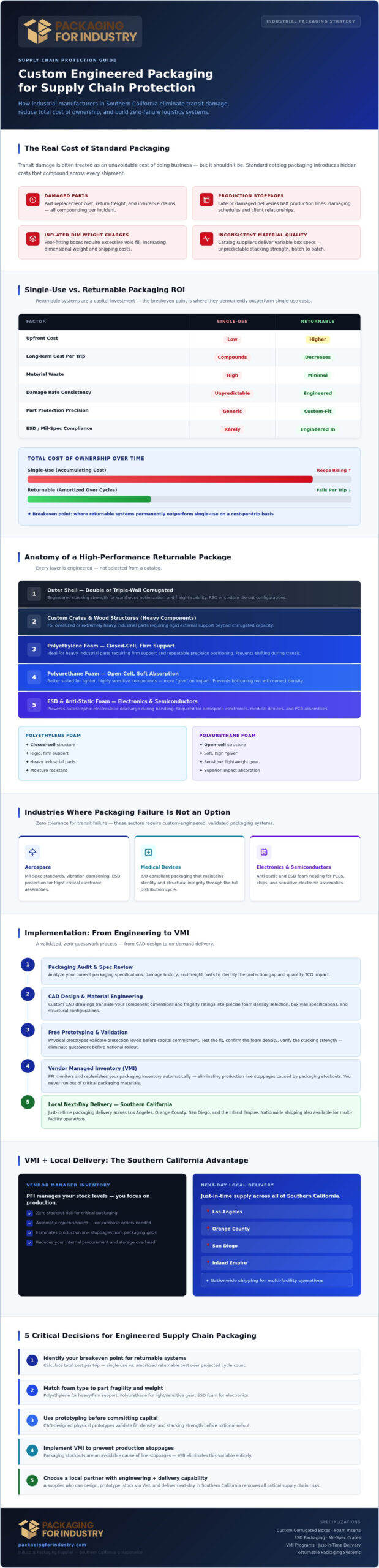
Packaging is often viewed as a consumable expense, but for high-value industrial operations, it is a critical financial instrument. Custom engineered packaging for supply chain protection represents a system-level approach where every material, from the outer heavy-duty corrugated box to the internal polyethylene foam inserts, is selected based on the specific fragility of the part. This methodology moves beyond the “box and bubble wrap” mentality to address the Total Cost of Ownership (TCO). When a sensitive component arrives damaged, the loss isn’t just the cost of the part. It includes the administrative burden of claims, the freight cost of the return, and the potential for production line stoppages that damage your reputation.
Why ‘Standard’ Packaging is a Supply Chain Risk
Relying on off-the-shelf catalog solutions introduces unnecessary variables into your logistics. Standard sizes rarely match industrial components perfectly, which leads to excessive void fill. This doesn’t just waste material; it increases dimensional weight (DIM) charges, causing your shipping costs to climb. More importantly, catalog materials often lack the precision required for shock absorption. Inconsistent material quality from high-volume suppliers means you might receive a batch of double-wall boxes that don’t meet the stacking strength of the previous order, leading to unpredictable failure rates in the warehouse.
The Protection Gap: Aerospace, Medical, and Electronics
In sectors like aerospace and medical device manufacturing, there is zero tolerance for transit failure. These industries require custom design packaging that meets rigorous Mil-Spec or ISO standards. A standard RSC box cannot provide the electrostatic discharge (ESD) protection or the vibration dampening needed for sensitive electronics. This gap in protection often results in “hidden” costs that standard accounting overlooks.
Closing this gap requires custom engineered packaging for supply chain protection validated through prototyping. By testing a physical model before a national rollout, you ensure the fit is exact and the protection is absolute. This proactive engineering eliminates the guesswork. If you’re looking to lower packaging costs through better engineering, you can request a packaging quote to begin an audit of your current specifications. Choosing a partner that understands the intersection of engineering and economics ensures your supply chain remains stable and profitable.
The Anatomy of a High-Performance Returnable Packaging Solution
A successful returnable system depends on the synergy between different materials. While a single-use box relies on basic cushioning, high-performance custom engineered packaging for supply chain protection uses an integrated approach. This involves combining technical foams, heavy-duty corrugated board, and sometimes wood or plastic components into a single, durable unit. These systems are built to withstand the rigors of multiple transit cycles, shifting the focus from disposable to durable. Every component is selected to ensure the container maintains its structural integrity over dozens of trips through the logistics loop.
Protective Foam Inserts: Polyethylene vs. Polyurethane
Material selection starts with the internal cushioning. Polyethylene foam is closed-cell and rigid, making it ideal for heavy industrial parts that require firm support and repeatable positioning. In contrast, Polyurethane is open-cell and softer, better suited for lighter, highly sensitive gear that needs more “give” during impact. Utilizing custom foam packaging allows for precision die-cutting, ensuring parts are nested securely to eliminate vibration damage. For electronics or semiconductor components, we integrate ESD and anti-static foam varieties to prevent catastrophic static discharge during handling. Choosing the correct foam density is a critical step in preventing the “bottoming out” that occurs with standard, non-engineered materials.
Heavy-Duty Corrugated and Custom Crates
The outer shell must provide the stacking strength necessary for warehouse optimization and freight stability. We often utilize double-wall or triple-wall corrugated board to ensure containers don’t collapse under pressure in a stacked environment. For exceptionally heavy or oversized loads, moving from a corrugated box to a custom-engineered wood crate is the most responsible choice for long-term durability. We also incorporate corner and edge protection to stabilize loads and prevent impact damage to the container’s structural integrity. This layered defense is a hallmark of effective custom engineered packaging for supply chain protection.
Effective returnable packaging must also be designed for the “Return Loop.” This means engineering the units to be easily collapsible or nestable when empty. Reducing the volume of the return shipment directly lowers your freight costs and improves the overall ROI of the system. If you aren’t sure which material combination fits your specific logistics cycle, you can request a packaging quote to have our team evaluate your current setup. Our goal is to provide a solution where the outer shell and inner cushioning work in tandem to guarantee part safety and logistical efficiency.
Returnable vs. Single-Use: Supply Chain ROI Guide
Choosing between returnable and single-use systems is a decision rooted in financial analysis rather than just material preference. While single-use packaging is often seen as a lower upfront cost, it carries significant hidden expenses that accumulate over time. For high-volume manufacturers in Southern California, implementing custom engineered packaging for supply chain protection often reveals a clear breakeven point where the initial capital investment in durable containers pays for itself through the elimination of recurring material costs and disposal fees. This shift transforms packaging from a consumable drain into a reusable asset.
A returnable system typically becomes profitable when it completes a specific number of trips, often between five and ten cycles depending on the complexity of the design. Southern California manufacturers who manage closed-loop logistics between local assembly plants and distributors find that these systems don’t just save on materials; they also align with corporate sustainability goals by drastically reducing the volume of waste sent to landfills. Consider a medical device manufacturer in Orange County shipping sensitive monitors to a sterilization facility in the Inland Empire. By switching from single-use foam to a returnable system with custom inserts, they can eliminate the daily labor of box assembly and the cost of purchasing new materials for every shipment.
Calculating Your Total Cost of Ownership (TCO)
To accurately lower packaging costs, you must look beyond the invoice price of the container. A comprehensive TCO analysis includes several critical factors:
- Labor Efficiency: Returnable inserts with precision-fit foam often require significantly less assembly time than folding and taping standard boxes.
- Cost of Failure: This includes the price of replacing high-value components damaged in transit and the administrative cost of processing insurance claims.
- Freight Optimization: Custom sizing reduces dimensional weight (DIM) charges, ensuring you don’t pay to ship empty space.
When to Stick with Custom Single-Use
There are scenarios where a return loop isn’t feasible, such as one-way international shipping or low-frequency deliveries to remote locations. In these instances, the best strategy is to utilize heavy-duty corrugated boxes engineered for maximum protection. These single-use solutions still benefit from custom engineered packaging for supply chain protection by using specific board grades and internal cushioning designed for the exact duration of the transit. This ensures you aren’t over-packaging for a short trip or under-protecting for a long-haul voyage. If you need to compare packaging pricing for both returnable and single-use options, our team can provide a side-by-side ROI analysis tailored to your logistics network.
Implementing Engineered Protection: From Prototyping to VMI
Transitioning from a standard box to a high-performance returnable system requires a methodical implementation process. This isn’t just about ordering a different SKU; it’s about building a sustainable logistics loop. The first step is an engineering audit to analyze your current damage rates and freight spend. This data provides the baseline for measuring future ROI. Once we understand the specific stresses your parts face, we transition to CAD design and physical prototyping. This ensures that your custom engineered packaging for supply chain protection is validated before you commit to a full production run.
After the design is finalized, we recommend a pilot run. This phase validates the returnable loop in a real-world environment, allowing your team to test the ease of assembly and the durability of the materials during actual transit. Only after the pilot run proves successful do we move to full-scale deployment. This structured approach eliminates the guesswork and ensures that your capital investment delivers the protection and cost savings you expect.
The Power of Free Prototyping
Free prototyping is a core part of our design process. By using CAD/CAM support, we create exact-fit samples that match the specific geometry of your industrial products. This eliminates the risk of “unfit” packaging that fails in the field or causes internal shifting during transit. When you consult with a packaging manufacturer early in the development phase, you can refine designs to optimize both shock absorption and dimensional weight. This proactive testing is essential for custom engineered packaging for supply chain protection, especially when dealing with high-value aerospace or medical components.
Vendor Managed Inventory (VMI) for Custom Solutions
The biggest challenge with custom solutions is lead time. Custom foam inserts and crates can take longer to produce than stock boxes, which creates a risk of stockouts. Our VMI program solves this by managing your packaging inventory for you. We stock your custom items in our Anaheim facility and provide just-in-time (JIT) delivery to your locations in Los Angeles, Orange County, or San Diego. This frees up valuable warehouse floor space and ensures zero production stops due to packaging shortages. By integrating VMI, you gain the benefits of custom engineering with the reliability of a stock supply.
PFI: Your Southern California Partner for Engineered Supply Chain Protection
PFI operates as a dedicated extension of your logistics team, bridging the gap between high-level engineering and warehouse execution. While national catalog suppliers provide generic, one-size-fits-all boxes, we focus on the intersection of engineering and economics. Our strategic headquarters in Anaheim allows us to provide rapid response times to manufacturers throughout Orange County and Los Angeles. This proximity is a critical advantage when you need custom engineered packaging for supply chain protection without the long lead times associated with distant, non-specialized vendors. While we maintain nationwide shipping capabilities through strategic distribution partners, our local roots allow us to offer next-day delivery for many Southern California operations.
Large commodity suppliers often force you into standard sizes that increase your dimensional weight charges and offer inadequate protection for sensitive gear. PFI provides a cost-saving alternative by designing packaging that fits your product perfectly, reducing material waste and minimizing the risk of transit damage. By choosing a local partner, you also eliminate the high freight costs and carbon footprint of shipping empty boxes from distant distribution centers. We understand the specific logistical pressures of the Port of Los Angeles and the high-volume distribution centers in the Inland Empire, allowing us to anticipate your needs before they become bottlenecks.
Serving the SoCal Industrial Corridor
Industrial hubs like Irvine, Brea, and Long Beach require specialized support that understands the local manufacturing landscape. Our team provides localized expertise for manufacturing and warehouse operations that demand absolute reliability. Whether you’re moving aerospace components through Torrance or medical devices through Santa Fe Springs, our local next-day delivery ensures your production lines never stop. We don’t just deliver boxes; we provide a managed system of protection that integrates seamlessly with your existing workflow and VMI requirements.
Request Your Custom Packaging Quote
Getting started with a comprehensive packaging review is a straightforward process. We begin by identifying areas where you can lower packaging costs through better design and material selection. You can request a quote today to see how our custom engineered packaging for supply chain protection compares to your current spend. Our goal is to provide a clear path toward zero-damage shipping and a reduced total cost of ownership. Leveraging PFI’s expertise allows you to focus on your core business while we handle the complexities of logistical protection and inventory management.
Optimize Your Industrial Logistics with Engineered Protection
Shifting your supply chain from a disposable model to a durable, returnable system is a decision that impacts both your operational stability and your bottom line. You’ve learned how integrating high-performance materials like precision-cut foam and heavy-duty corrugated board creates a layered defense against transit damage. By focusing on the Total Cost of Ownership rather than just the initial price of a box, you can eliminate the hidden costs of waste, disposal fees, and production delays. This strategic approach ensures your high-value components arrive ready for the assembly line every time.
PFI is ready to help you implement custom engineered packaging for supply chain protection through our free CAD/CAM prototyping and specialized aerospace and medical expertise. Our local next-day delivery in Southern California ensures you have the reliable support needed to maintain a lean, efficient warehouse. We don’t just provide materials; we provide a managed inventory system that scales with your production demands.
Let’s build a more resilient and cost-effective future for your distribution network together.
Frequently Asked Questions
What is returnable packaging and how does it protect my supply chain?
Returnable packaging is a durable, multi-trip system designed for repeated use in closed-loop logistics. It protects your operations by using high-strength materials like heavy-duty corrugated and precision foam that don’t degrade after a single trip. This ensures consistent structural integrity throughout the shipping cycle. Implementing custom engineered packaging for supply chain protection minimizes variables and prevents the fatigue failures common in standard, single-use boxes.
How much can I save by switching from single-use to returnable engineered packaging?
Total savings depend on your cycle count and the fragility of your parts. You lower packaging costs by eliminating recurring material purchases and high disposal fees. Many manufacturers find that returnable systems pay for themselves after five to ten trips. You also reduce the administrative and replacement costs associated with transit damage claims, which are frequent when using standard catalog supplies for high-value goods.
Does PFI provide custom foam inserts for sensitive aerospace components?
Yes, we specialize in protective foam packaging for the aerospace and aviation sectors. We offer polyethylene and polyurethane options in various densities to match the specific fragility and weight of your components. Our capabilities include ESD and anti-static foam to protect sensitive avionics from static discharge. We use CAD/CAM technology to ensure a precision fit that eliminates internal shifting during high-vibration transit environments.
What industries benefit most from custom engineered packaging solutions?
High-value sectors like aerospace, medical device manufacturing, and electronics benefit most from these systems. These industries often have zero-tolerance for damage and require specific protection standards like Mil-Spec or ISO. Any operation with a closed-loop supply chain, such as shipping between local assembly plants and distributors, can gain significant efficiencies and cost reductions by moving away from generic, one-size-fits-all shipping materials.
How does a Vendor Managed Inventory (VMI) program work for custom boxes?
PFI manages your inventory levels so you don’t have to. We stock your custom boxes, foam inserts, and crates in our Anaheim facility based on your historical usage data. This prevents stockouts of long-lead-time custom items and frees up floor space in your warehouse. We provide just-in-time delivery to your Southern California locations, ensuring you always have the necessary supplies without tying up capital in excess inventory.
Can PFI help reduce my FedEx and UPS dimensional weight surcharges?
Yes, our engineering team designs packaging to minimize exterior dimensions without sacrificing protection. Standard boxes often contain excessive void fill, which triggers higher dimensional weight (DIM) charges from carriers. By utilizing custom engineered packaging for supply chain protection, we ensure the container is as compact as possible. This precision-fit approach helps you lower freight costs by ensuring you aren’t paying to ship empty air.
Do you offer local next-day delivery in Orange County and Los Angeles?
PFI provides local next-day delivery for our Southern California customers from our Anaheim headquarters. This service covers major industrial hubs in Orange County, Los Angeles, San Diego, and the Inland Empire. Our proximity allows us to respond quickly to production spikes or urgent inventory needs. For clients outside Southern California, we maintain nationwide shipping capabilities through a network of strategic distribution partners to ensure reliable delivery.
What is the process for getting a custom packaging prototype from PFI?
The process begins with an engineering audit of your current damage rates and component specifications. Our design team uses CAD software to create a digital model, followed by physical prototyping in our facility. We provide these samples so you can test the fit and protection levels before committing to a full production run. This pre-production validation ensures the final design meets your specific logistical requirements and protection standards.