
The lowest per-unit price for a shipping box is often the most expensive choice your operations team can make. While a standard catalog container seems cost-effective on a purchase order, it frequently hides the mounting expenses of shipping damage, excessive DIM weight surcharges, and sluggish packing lines. You likely already know that “good enough” packaging is costing you more than you’d like to admit in returns and wasted freight spend. Successfully calculating the ROI of a custom engineered packaging solution requires looking beyond the invoice and analyzing how precision-fit corrugated and custom foam inserts protect your bottom line.
This guide provides a pragmatic framework for quantifying the financial impact of optimized logistics. We’ll show you how to measure the reduction in “hidden” costs like the 139 DIM divisor penalties and the labor savings found in streamlined kitting processes. We’ll also explore how vendor-managed inventory (VMI) and just-in-time delivery can improve warehouse flow. By the end of this article, you’ll have the data-driven insights needed to present a compelling case to stakeholders for transitioning from stock supplies to a high-performance, custom-tailored system.
Key Takeaways
- Understand why the per-unit cost of a box is a misleading metric and how Total Cost of Ownership (TCO) reveals the true expense of shipping damage and excessive dimensional weight.
- Learn a structured framework for calculating the ROI of a custom engineered packaging solution by quantifying damage reduction, freight optimization, and labor efficiency.
- Identify how precision-fit corrugated and custom foam inserts mitigate carrier surcharges by optimizing package volume for the 139 DIM divisor.
- Discover how Vendor Managed Inventory (VMI) and Just-in-Time programs reduce your warehouse footprint and improve operational flow in high-cost regions like Los Angeles and Orange County.
- Gain a clear, data-driven formula for presenting a business case to stakeholders that balances material costs against long-term logistical savings.
Beyond Unit Price: Total Cost of Ownership in Packaging
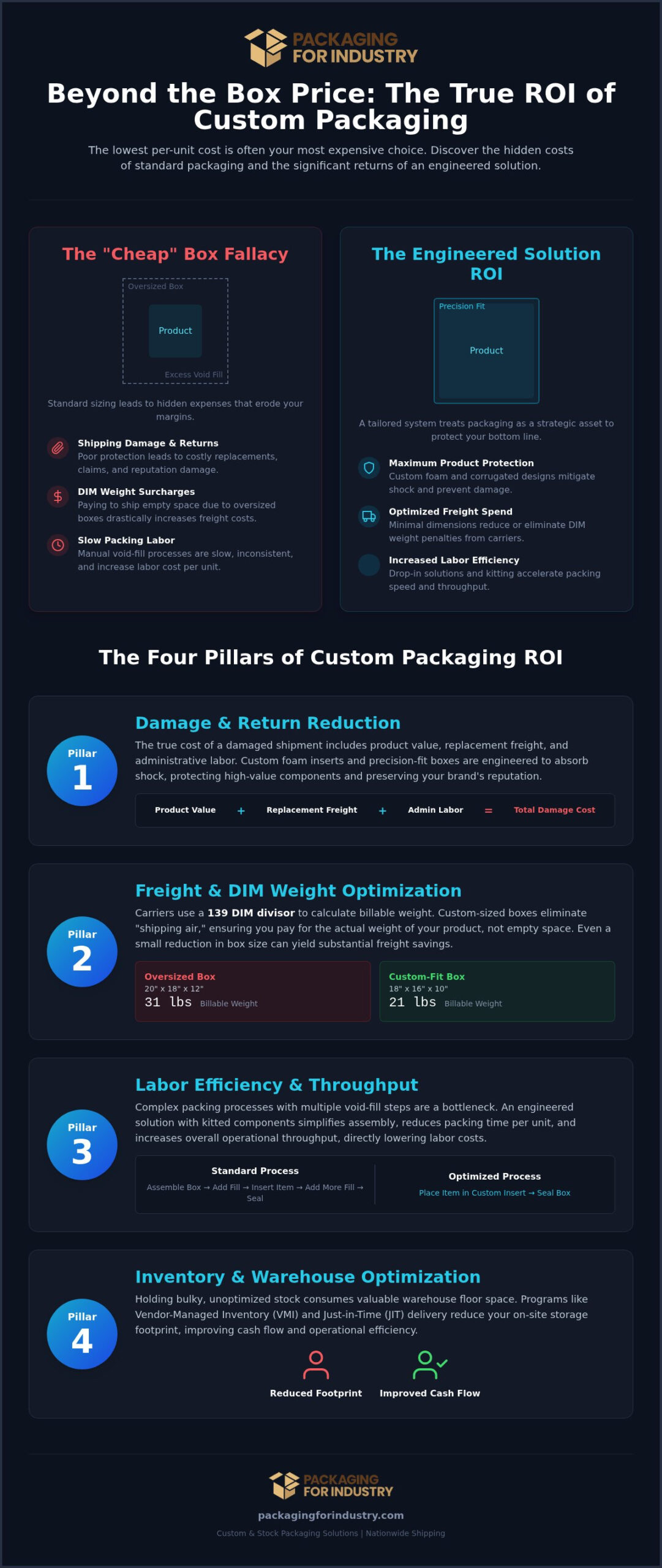
Many procurement departments prioritize the unit price of a box above all else. This approach often leads to purchasing standard catalog containers that seem inexpensive on paper but create financial leaks elsewhere in the supply chain. When you shift your focus to Total Cost of Ownership (TCO), you begin to see that the initial purchase price is only a fraction of the actual expense. Calculating the ROI of a custom engineered packaging solution requires a deep look at how materials interact with labor, freight carriers, and the product itself.
The Procurement View treats packaging as a disposable commodity. In contrast, the Operations View recognizes it as a system efficiency tool. If a box is too large, you pay for air; if it’s too weak, you pay for damage. By treating packaging as a strategic asset, you eliminate the hidden costs that erode your margins. These hidden costs typically include:
- Damage claims and return logistics for high-value industrial components.
- Excessive freight charges due to Dimensional (DIM) weight penalties.
- Increased packing labor from complex, manual void-fill processes.
- Warehouse congestion caused by bulky, unoptimized stock.
The Fallacy of Catalog Sizing
Standard catalog boxes are designed for general use, not for your specific product dimensions. This one-size-fits-none approach forces your team to use excessive void fill, which adds material cost and slows down production lines. More importantly, oversized boxes are a primary trigger for carrier surcharges. Major carriers like UPS and FedEx utilize a 139 DIM divisor for domestic shipments. If your box is unnecessarily large, you’re billed for the cubic volume rather than the actual weight. For packages exceeding 10,368 cubic inches, Additional Handling Charges apply, significantly increasing your landed cost. Custom sizes eliminate this “shipped air” tax and ensure you don’t pay for empty space.
Engineering as a Cost-Reduction Tool
True cost reduction starts at the design phase. By utilizing CAD/CAM design and precision prototyping, engineers create a fit that minimizes material waste while maximizing protection. This is especially critical for specialized sectors like aerospace or medical electronics that require custom foam assemblies. Professional prototyping ensures that your packaging is optimized for the rigors of the supply chain before you commit to a full production run. It’s a proactive way of calculating the ROI of a custom engineered packaging solution by preventing failures before they happen. Learn more about PFI’s custom design packaging services to see how precision engineering protects your bottom line.
The Four Pillars of Custom Packaging ROI
A comprehensive business case for custom packaging looks far beyond the material invoice. To accurately perform the task of calculating the ROI of a custom engineered packaging solution, you must analyze four specific operational pillars: damage reduction, freight optimization, labor efficiency, and inventory management. Each pillar contributes to a cumulative return that grows with every shipment. For manufacturers in aerospace and electronics, where components are fragile and high-value, these returns are often realized immediately through the elimination of a single catastrophic failure.
Pillar 1: Damage and Return Reduction
The cost of a single damaged shipment involves more than just the product value. It includes replacement freight, administrative labor for claims, and potential damage to your brand reputation. While bubble wrap or loose-fill peanuts might seem cheaper, custom foam inserts provide engineered shock absorption tailored to your product’s specific G-force sensitivity. In the pursuit of a “Zero-Damage” goal, precision foam ensures that sensitive electronics arrive calibrated and ready for use. You can quantify this by comparing your current damage rate against the projected reduction provided by an engineered solution.
Pillar 2: Freight and DIM Weight Optimization
Shipping air is a significant drain on profitability. Carriers now use a 139 DIM divisor to determine billable weight. This means a lightweight product in an oversized catalog box is billed as if it were much heavier. Custom-sized corrugated boxes allow you to minimize the exterior dimensions of your package. Reducing a box size by just two inches can save thousands in annual freight costs by avoiding Additional Handling Surcharges for packages over 10,368 cubic inches. This shift is a core component of managing the Total Cost of Ownership within your logistics network.
Pillar 3: Labor Efficiency and Kitting
Your packing line speed directly impacts your operational overhead. Engineered designs that utilize packaging kitting eliminate the need for complex manual wrapping or taping. When all protective components are delivered in one ready-to-use set, “seconds per pack” decrease significantly. This efficiency allows your team to handle higher volumes without increasing headcount. If you’re struggling with rising labor costs, you might request a packaging quote to see how an engineered design can simplify your workflow.
Pillar 4: Inventory and Warehouse Flow
The final pillar involves the cost of space. In regions like Orange County and Los Angeles, warehouse square footage is at a premium. Transitioning to a Vendor Managed Inventory (VMI) or Just-in-Time (JIT) program reduces the amount of packaging material you need to store on-site. By optimizing your inventory levels, you free up floor space for production while ensuring you never run out of critical supplies. This holistic view is essential when calculating the ROI of a custom engineered packaging solution for a modern manufacturing facility.
Step-by-Step: How to Calculate Your Packaging ROI
Moving from anecdotal evidence to a data-driven business case is essential for any operational shift. Calculating the ROI of a custom engineered packaging solution requires you to move beyond the per-unit price of materials and look at the broader logistical ecosystem. By following a structured calculation process, you can demonstrate exactly how much capital is currently leaking through inefficient shipping practices and how a custom solution will plug those gaps. This financial clarity is what ultimately secures stakeholder approval for custom projects.
Step 1: Auditing Your Current Baseline
You can’t measure improvement without a firm starting point. Begin by gathering SKU-level data on your current logistics performance. This audit should focus on three primary areas of waste:
- Damage Rates: Track the total cost of returns, including replacement product value, administrative labor for claims, and secondary freight spend.
- Freight Spend: Analyze your carrier invoices for “Dimensional Weight” surcharges and Additional Handling fees. Identify how often you’re paying for air because of oversized catalog boxes.
- Labor Throughput: Measure the “seconds per pack” for your current line. Note how much time is wasted on manual kitting, taping, and applying excessive void fill.
Step 2: Calculating the ‘Savings Delta’
Once you have your baseline, compare it against the projected performance of an engineered solution. The Savings Delta is the net reduction in total shipping spend achieved by comparing your current baseline logistics costs against the projected expenses of an optimized custom system. When performing this calculation, remember that PFI provides free prototyping and CAD/CAM design support to ensure a perfect fit. Because these engineering services are included, your initial “Investment” figure is significantly lower than it would be with a firm that charges for design hours. This improves your ROI immediately by reducing the upfront capital required to launch a new packaging program.
Step 3: Determining the ROI Percentage
With your savings and investment numbers in hand, apply the standard ROI formula: [(Total Savings – Investment) / Investment] x 100. This percentage provides a clear metric for your finance team. However, the math is only half the battle. You must also present the “Cost of Inaction” to upper management. Every day you continue using standard catalog materials, you’re essentially choosing to pay for shipping damage and carrier surcharges. This ongoing loss often far exceeds the cost of transitioning to a custom-tailored system. To get started on your audit, you can request a professional packaging review for damage reduction to identify where your biggest savings opportunities are hidden.
Operational ROI: The Financial Benefit of VMI and JIT
The physical footprint of your packaging supplies is a major factor in your total operational expense. In Southern California markets like Anaheim, Irvine, and San Diego, industrial real estate costs are among the highest in the nation. Storing months of bulky corrugated boxes or large stacks of pallets ties up valuable floor space that could be used for revenue-generating production lines. When calculating the ROI of a custom engineered packaging solution, you must account for these carrying costs. Transitioning to a leaner inventory model allows you to lower packaging costs by optimizing your facility’s layout and improving your overall cash flow.
Freeing Up Warehouse Capital with VMI
Many manufacturers struggle with the “bulk buy” trap, where they purchase massive quantities of stock boxes to get a lower unit price but lose those savings to high storage costs. Vendor Managed Inventory (VMI) solves this by shifting the burden of inventory management to the supplier. With a VMI program, we monitor your usage levels and replenish supplies as they are consumed. This prevents expensive stockouts and the need for emergency rush orders that disrupt your production schedule in Los Angeles or Orange County. By paying for materials as you use them, you free up working capital that was previously sitting on a shelf in the form of unused inventory.
Lead-Time Mitigation for Custom Crates and Foam
The reliability of your supply chain is a critical component of ROI. While catalog items are easily sourced, they don’t provide the specialized protection required for high-precision components. If your supply of mil-spec packaging, custom foam inserts, or heavy-duty crates fails, your entire shipping line grinds to a halt. Maintaining a local supply chain in the Inland Empire and San Diego provides a significant logistical advantage. A local partner can offer next-day delivery and rapid prototyping for new RSC boxes, reducing the risk of production downtime. This proximity ensures that your high-value components are never waiting on a delayed shipment from a distant catalog retailer.
Just-In-Time (JIT) delivery programs further enhance this efficiency by synchronizing material arrival with your daily production schedule. By receiving exactly what you need for the day’s kitting, you eliminate warehouse congestion and simplify your internal logistics. This steady, predictable flow of materials allows your team to focus on manufacturing rather than searching for the right box size in a crowded warehouse. Calculating the ROI of a custom engineered packaging solution must include these gains in warehouse throughput and the elimination of “hidden” storage expenses.
Engineering Your Bottom Line: Why PFI is the ROI Choice
PFI combines technical material expertise with rigorous economic analysis to ensure your packaging is a profit-driver rather than a sunk cost. Unlike generic catalog retailers that focus on transactional volume, we evaluate how your protective materials impact your entire logistical flow. When you compare packaging pricing across the industry, it’s vital to look past the unit cost and consider the long-term reliability of an industrial-focused supplier that understands the complexities of your specific manufacturing line. Calculating the ROI of a custom engineered packaging solution becomes a straightforward exercise when you partner with a supplier that prioritizes precision over catalog sales.
Our ability to integrate diverse materials into a single, ROI-positive solution sets us apart. Whether you require heavy-duty RSC boxes, precision-cut polyethylene foam, or specialized crates, we ensure every component works in harmony to provide maximum protection with minimal volume. With a wide variety of custom sizes available, we eliminate the one-size-fits-none approach that leads to shipping air and carrier penalties. This integrated material strategy ensures that your high-value components are protected by a system designed specifically for their dimensions and fragility.
The PFI Advantage: From Prototype to Production
We remove the financial risk of custom engineering by providing free prototyping and CAD/CAM support for product fit. This allows your team to verify performance before full-scale production, which is essential for meeting the strict compliance standards of the aerospace and medical sectors. From our facility in Anaheim, we offer local next-day delivery throughout Southern California, ensuring your operations in Orange County or Los Angeles are never delayed by supply chain gaps. This local support is a critical component in maintaining a lean, responsive manufacturing environment.
Start Your Cost-Reduction Analysis Today
Optimizing your spend begins with a transparent assessment of your current baseline. We invite you to gather your internal data on damage rates and freight surcharges to see the true cost of your current system. Our consultants are ready to conduct a comprehensive packaging review to help you transition from stock materials to a high-performance system designed for durability and logistical flow. By identifying the specific points where your current packaging fails, we can engineer a solution that protects your products and your margins.
Contact Packaging For Industry to calculate your custom ROI
Optimize Your Industrial Logistics Strategy
Precision-engineered packaging is a strategic investment that pays dividends across your entire supply chain. You’ve seen how shifting from standard catalog boxes to custom solutions eliminates the hidden drains of DIM weight surcharges and product damage. By calculating the ROI of a custom engineered packaging solution, your operations team can move from reactive damage control to proactive cost management. This approach turns your packaging from a commodity expense into a driver of system efficiency.
PFI supports this transition with technical expertise and logistical reliability. As specialists in aerospace and industrial protection, we provide free prototyping and CAD design to ensure a perfect fit before production begins. Our local presence in Southern California allows for next-day delivery across Orange County, Los Angeles, and the Inland Empire. This proximity keeps your production lines moving without the need for excessive on-site inventory or bulky warehouse storage.
Take the first step toward a leaner, more profitable warehouse by auditing your current freight and damage data. We’re ready to help you build a more resilient and efficient logistics network that protects your products and your bottom line.
Frequently Asked Questions
How long does it take to see a return on investment for custom packaging?
Most industrial manufacturers realize a return on investment within the first few shipping cycles, particularly if they are currently experiencing high damage rates. For high-value components, preventing just one catastrophic failure often covers the entire cost of the custom project. Beyond immediate protection, the long-term reduction in repetitive shipping surcharges and labor inefficiencies provides a continuous return that improves your quarterly bottom line.
Is custom-engineered packaging only for high-value items like aerospace parts?
No, custom engineering is effective for any high-volume operation where small inefficiencies compound over time. While high-value aerospace components often require mil-spec packaging to ensure compliance and protection, custom solutions are equally valuable for standard industrial goods. Reducing box dimensions by just an inch or two across thousands of units can result in massive freight savings by avoiding carrier surcharges and optimizing pallet density.
What is the biggest hidden cost in standard catalog packaging?
The most significant hidden cost is Dimensional (DIM) weight surcharges. Carriers like UPS and FedEx use a 139 DIM divisor to bill based on volume rather than actual weight. Using a standard catalog box that is slightly too large often triggers Additional Handling Charges for packages exceeding 10,368 cubic inches. These fees frequently exceed the material price of the box, making “cheap” stock packaging much more expensive than a precision-fit container.
Can custom packaging really reduce my freight costs?
Custom packaging reduces freight costs by ensuring your exterior dimensions are as compact as possible. Since carriers bill based on whichever is greater, actual weight or DIM weight, oversized boxes lead to unnecessary spending on “shipped air.” Custom engineering allows you to lower packaging costs by designing containers that stay under specific surcharge thresholds, directly mitigating the impact of rising fuel surcharges and carrier rate increases.
How does Vendor Managed Inventory (VMI) improve my packaging ROI?
Vendor Managed Inventory (VMI) improves ROI by eliminating the carrying costs associated with large material stockpiles. Instead of tying up capital in bulk purchases of boxes and stretch film, you pay for supplies as they are consumed. This frees up expensive warehouse floor space in Southern California for revenue-generating production. VMI also prevents stockouts and emergency rush orders that can stall your packing lines and increase operational overhead.
What data do I need to accurately calculate my packaging ROI?
To accurately perform the task of calculating the ROI of a custom engineered packaging solution, you need three primary datasets. First, track your current damage rates and the total cost of return logistics. Second, analyze your carrier invoices for DIM weight surcharges and Additional Handling fees. Finally, measure your current “seconds per pack” labor time. Comparing this baseline against the performance of a custom-engineered prototype reveals your potential savings delta.
Does Packaging For Industry offer free design and prototyping?
Yes, Packaging For Industry (PFI) provides free prototyping and CAD/CAM design support for our clients. This service removes the upfront financial barrier to custom engineering and allows you to verify product fit before committing to mass production. By offering these expert engineering services without a separate design fee, we improve the overall ROI of your project. This ensures your custom foam inserts and mil-spec packaging are perfectly calibrated from day one.
How do custom foam inserts compare to bubble wrap in terms of ROI?
Custom foam inserts typically offer a higher ROI than bubble wrap for fragile industrial components. While bubble wrap has a lower material cost, it requires significantly more manual labor to apply and provides inconsistent protection. Engineered foam assemblies provide superior shock absorption and ensure a repeatable, standardized packing process. This reduces labor time and virtually eliminates shipping damage, making it the more fiscally responsible choice for aerospace and electronics manufacturers.