
By January 1, 2027, the state mandates a 10% weight reduction in single-use plastic packaging under the strict requirements of SB 54. For industrial manufacturers in Los Angeles and Orange County, finding sustainable alternatives to polyethylene foam in California is no longer just an ethical choice; it’s a legal necessity. You shouldn’t have to risk expensive product damage or regulatory non-compliance while trying to navigate these shifting environmental standards.
We understand that maintaining 100% product protection for high-value aerospace and medical components is your primary objective. This guide provides a technical roadmap to discovering high-performance, compliant materials that reduce your environmental impact without sacrificing industrial-grade security. We will examine engineered fiber solutions, bio-based cushioning, and the custom prototyping processes that ensure your Southern California operations remain efficient, protected, and fully compliant with upcoming state deadlines.
Key Takeaways
- Understand the mandatory requirements of SB 54 and how California’s plastic reduction deadlines impact your industrial shipping operations.
- Identify high-performance sustainable alternatives to polyethylene foam in California like custom corrugated inserts and mushroom packaging that meet strict environmental standards.
- Compare the shock absorption and vibration dampening capabilities of eco-friendly materials to ensure your aerospace and medical components remain fully protected.
- Learn how to use free prototyping and drop-testing to eliminate the risk of product damage when transitioning to new packaging materials.
- Utilize Vendor Managed Inventory (VMI) to prevent stockouts and manage the shifting lead times associated with the new sustainable material market.
Navigating California’s Packaging Regulations: SB 54 and Polyethylene Foam
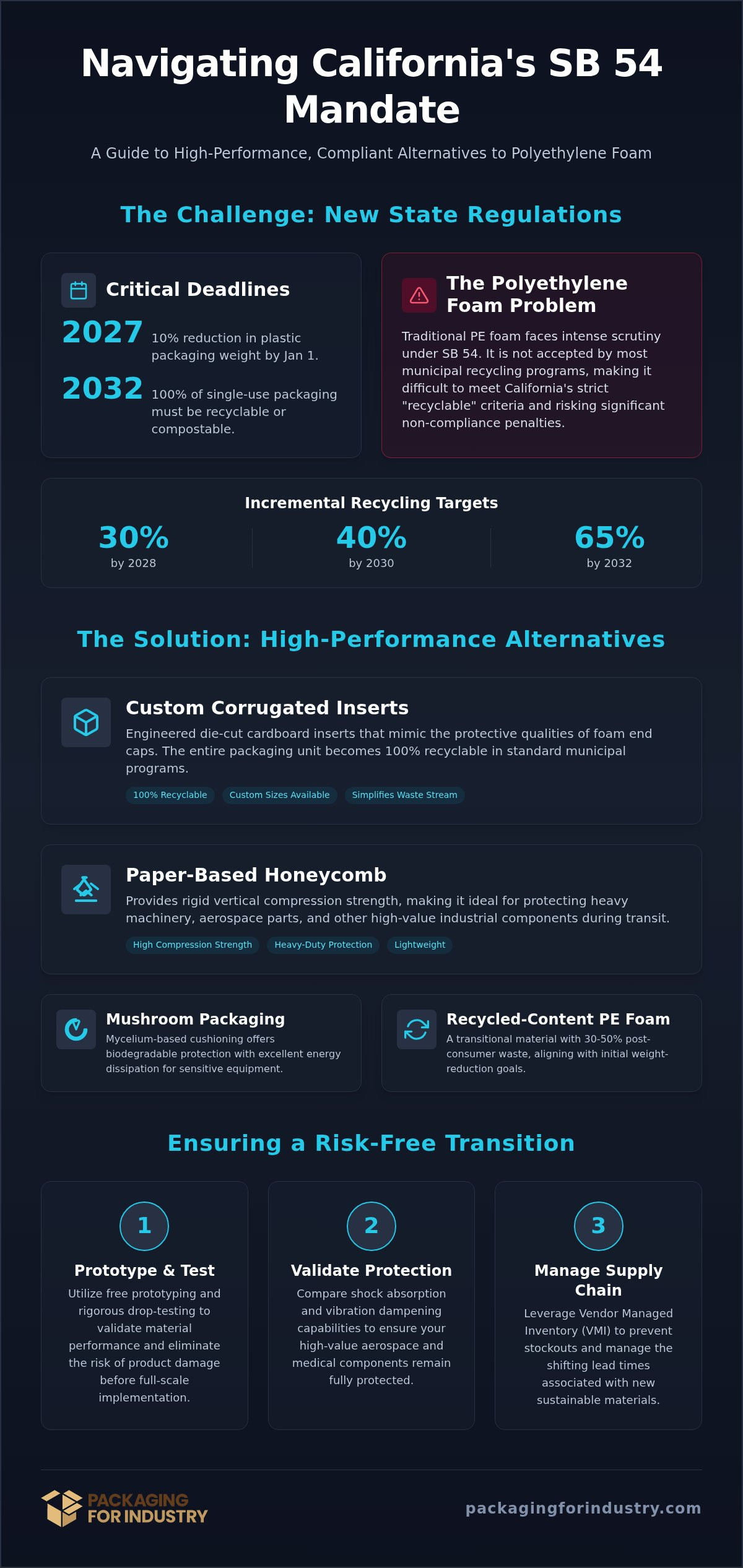
California’s SB 54, known as the Plastic Pollution Prevention and Packaging Producer Responsibility Act, represents a fundamental shift in how industrial waste is managed. It moves the financial burden of recycling from taxpayers to the companies producing the packaging. If your operation relies heavily on traditional plastic cushioning, finding sustainable alternatives to polyethylene foam in California isn’t just an environmental goal; it’s a legal necessity. The state now requires a 10% reduction in plastic packaging weight by January 1, 2027, with the ultimate mandate that all single-use packaging be 100% recyclable or compostable by 2032.
While Polyethylene (PE) foam offers excellent cushioning for high-value electronics and medical devices, it faces intense scrutiny under these new rules. Most municipal programs don’t accept PE foam, making it difficult to meet the state’s strict “recyclable” criteria. Industrial producers who fail to transition to more circular systems risk significant penalties and increased oversight as the state enforces incremental recycling targets of 30% by 2028 and 40% by 2030.
Understanding the Impact on Southern California Manufacturing
Manufacturers in hubs like Anaheim and Irvine are already feeling the effects of Extended Producer Responsibility (EPR). This framework requires businesses to join a Producer Responsibility Organization (PRO) to help fund the state’s recycling infrastructure. In California, a material is only “recyclable” if it’s actually processed by local facilities at scale, a higher bar than many other states set. This means Southern California operations must audit their current foam packaging usage now to avoid supply chain bottlenecks later.
Compliance Risks for Unprepared Supply Chains
Producers who don’t proactively seek sustainable alternatives to polyethylene foam in California face more than just regulatory fines. Non-compliant materials may soon trigger surcharges that drive up total landed costs. To protect your margins, you should document every step of your material transition, keeping records of prototyping and testing for audit purposes. Within the context of SB 54, circular packaging refers to materials designed to remain within a closed-loop system through reuse, high-rate recycling, or industrial composting, effectively eliminating permanent waste.
Top Sustainable Alternatives to Polyethylene Foam for Industrial Use
Replacing traditional cushioning requires a deep understanding of material density and structural load. While standard plastics were once the default for protection, several sustainable alternatives to polyethylene foam in California have emerged that meet the rigorous demands of industrial logistics. These solutions aren’t just environmentally responsible; they’re engineered to provide high-performance shock absorption for manufacturers in Orange County and the Inland Empire who must now comply with SB 54 mandates.
Paper-based honeycomb and mushroom packaging (mycelium) are leading the shift. Honeycomb structures provide rigid vertical compression strength, making them ideal for heavy machinery and aerospace parts. Mycelium-based cushioning offers biodegradable protection with excellent energy dissipation for sensitive equipment. For operations that require the tactile properties of foam, recycled-content PE foam containing 30% to 50% post-consumer waste serves as a transitional material that aligns with the state’s weight-reduction goals for 2027.
Custom Corrugated Inserts as a Primary Alternative
One of the most effective strategies for replacing foam is the use of custom corrugated boxes with integrated die-cut inserts. By engineering the tension and folds of the cardboard, we can mimic the protective qualities of foam end caps. This approach simplifies the recycling stream for your customers, as the entire unit is 100% recyclable in municipal programs. We maintain custom sizes available for every industrial application, ensuring that your specific components fit securely without the need for additional void fill. If you are looking to streamline your material variety, you can compare packaging pricing for these integrated systems.
Advanced Bio-Based and Recycled Foam Options
Bio-based materials are closing the performance gap for high-spec industries. Starch-based foams offer water-soluble protection for lighter electronics, leaving zero permanent waste behind. We also evaluate the utility of bio-PE, which is derived from renewable sources like sugarcane but maintains the technical specifications required for medical and defense contracts. When selecting these sustainable alternatives to polyethylene foam in California, it’s important to differentiate between cross-linked and non-cross-linked options. Non-cross-linked foams are generally easier to recycle, making them a safer long-term bet for meeting the 2032 goal of 100% recyclability.
Performance Comparison: Sustainable Materials vs. Traditional PE Foam
Industrial protection is measured in G-force and vibration cycles, not just environmental certifications. While traditional PE foam is prized for its resilience and multi-drop protection, sustainable alternatives to polyethylene foam in California are closing the performance gap through superior engineering. For many Southern California manufacturers, the decision to switch hinges on whether a corrugated insert or bio-foam can truly prevent damage to high-value electronics or aerospace parts during long-haul freight.
Shock absorption remains the primary concern. PE foam’s closed-cell structure excels at recovering after impact. Conversely, paper-based alternatives like honeycomb or heavy-duty corrugated rely on structural crush zones to dissipate energy. While these are often single-use for shock absorption, they provide excellent rigid support for heavy machinery. Vibration dampening is another critical metric; sensitive medical devices require materials that can absorb high-frequency tremors without transferring the energy to the component. Moisture resistance is where traditional foam usually wins, as paper-based alternatives can lose structural integrity in high humidity. To solve this, we often integrate moisture-resistant coatings or use high-performance stretch film to create a barrier. Density also plays a role in your bottom line, as material weight directly influences freight costs and DIM weight surcharges across Southern California logistics routes.
The Engineering Gap: Can Paper Protect Like Foam?
Structural design is what makes paper-based materials viable. We use CAD/CAM support to engineer precise die-cuts and folds that mimic the spring-back effect of foam end caps. In many heavy-duty applications, a multi-material system involving wood crates and corrugated inserts provides better protection than pure foam blocks. This hybrid approach ensures structural integrity while remaining 100% compliant with California’s recycling mandates. We offer free prototyping to verify these protection levels, allowing you to see exactly how your product handles a drop test before committing to a full production run.
Environmental Impact vs. Operational Utility
Calculating the true cost of packaging involves more than the price per unit. You must weigh the material cost against potential regulatory surcharges and damage rates. Interestingly, custom foam packaging is evolving to include circular options like recycled-content PE and bio-based polymers that maintain technical specs while reducing carbon footprints. You should also consider the storage requirements of these new materials. Bio-based foams and starches are sensitive to humidity and have different shelf-life considerations than traditional waterproof PE foam. This requires a more managed approach to inventory to prevent material degradation before it even reaches the packing line.
Supply Chain Transition for California Manufacturers
Implementing sustainable alternatives to polyethylene foam in California requires a phased, strategic approach to avoid supply chain disruptions. The first step involves a comprehensive audit of your current material usage. Identify “low-hanging fruit” products that don’t require high-spec cushioning and can be immediately switched to corrugated or paper-based solutions. This allows you to meet early SB 54 reduction targets without overhauling your entire production line at once.
The second stage focuses on high-value or sensitive goods. For aerospace and medical components, you must utilize free prototyping and rigorous drop-testing to ensure zero damage. Once the design is finalized, managing the inventory shift is the third priority. You need to phase out traditional PE foam while simultaneously onboarding new compliant materials. Finally, communicate your transition to stakeholders and customers. Highlighting your adherence to sustainable alternatives to polyethylene foam in California and the January 1, 2027 mandates demonstrates a proactive commitment to regulatory compliance and environmental responsibility.
Leveraging Vendor Managed Inventory (VMI) for New Materials
Adopting new materials often introduces volatility in lead times and warehouse requirements. VMI programs are designed to stabilize these variables. Sustainable inserts, particularly bulkier corrugated designs, can consume significant floor space compared to dense foam blocks. By using VMI, Packaging For Industry handles the storage and monitoring of your stock levels. We deliver materials just-in-time to your facility, preventing stockouts and ensuring you always have the custom eco-friendly inserts you need for daily production.
Local Logistics and Southern California Support
Partnering with a local Anaheim packaging supplier provides a distinct advantage during the testing and rollout phases. Manufacturers in Los Angeles, Orange County, and the Inland Empire benefit from rapid prototyping cycles and next-day delivery. This proximity allows for immediate adjustments to custom sizes and designs based on real-world shipping feedback. Additionally, sourcing locally significantly reduces the carbon footprint of your own supply chain, reinforcing the sustainability goals that drive the move away from traditional plastics.
Custom Sustainable Packaging Solutions from Packaging For Industry
Packaging For Industry takes a pragmatic approach to engineering sustainable alternatives to polyethylene foam in California. We don’t just provide materials; we design entire protective systems from our Anaheim headquarters. Our process often involves transitioning complex industrial parts into RSC boxes featuring custom-designed fiber inserts. Through our kitting services, we deliver pre-assembled packaging sets directly to your floor, which reduces labor time and ensures every shipment is packed to exact specifications. This level of precision is what allows manufacturers to move away from foam without increasing their damage rates. We specialize in precision.
Integrated Solutions for Aerospace and Electronics
High-stakes industries like aerospace and medical manufacturing require specialized oversight. We design mil-spec packaging that adheres to defense standards while utilizing recyclable components. For heavy or sensitive loads, our engineers frequently combine corner boards with corner and edge protection to reinforce the structural integrity of the pallet. This integration is vital for protecting against the side-impact forces common during truck and rail transit across Southern California. We also provide ESD-safe sustainable options for the semiconductor sector, ensuring that static-sensitive components are shielded without relying on non-recyclable plastic coatings. Protection is non-negotiable.
Lowering Costs While Meeting California Standards
The most significant way to lower packaging costs is to eliminate waste through better engineering. Standard catalog boxes often result in excessive void fill and higher shipping rates due to inefficient sizing. By moving to custom-engineered wholesale units, you gain access to custom sizes available that are tailored to your specific product dimensions. This optimization reduces the dimensional weight of your shipments, which directly lowers the surcharges applied by carriers like UPS and FedEx. Our team provides a comprehensive cost-reduction analysis, reviewing your current material spend and logistics flow to identify where sustainable alternatives to polyethylene foam in California can actually improve your bottom line.
Frequently Asked Questions
What is the most cost-effective alternative to polyethylene foam in California?
Custom-engineered corrugated inserts are currently the most cost-effective solution for industrial shipping. Unlike bulk plastic foam, corrugated materials are widely accepted by municipal recycling programs, avoiding the surcharges associated with non-compliant plastics. By choosing custom-sized inserts over generic catalog options, you reduce material waste and lower freight costs. These sustainable alternatives to polyethylene foam in California allow you to maintain protection while adhering to strict local environmental standards.
Does SB 54 ban the use of all polyethylene foam in industrial packaging?
SB 54 doesn’t implement an immediate ban on polyethylene foam, but it sets aggressive recycling and reduction targets. By January 1, 2027, producers must achieve a 10% reduction in plastic packaging weight. By 2032, all single-use packaging sold or distributed in the state must be 100% recyclable or compostable. Transitioning now helps your operation avoid the regulatory penalties and supply chain bottlenecks that will occur as these deadlines approach.
Can sustainable packaging materials provide the same G-force protection as foam?
Engineered paper-based materials like honeycomb and heavy-duty corrugated can match the G-force protection of foam when designed correctly. These structures use controlled crush zones to absorb impact energy during a drop. We use CAD/CAM technology to create precise structural supports that mimic the performance of traditional cushioning. This ensures your high-value aerospace or medical components remain undamaged while you adopt sustainable alternatives to polyethylene foam in California for your daily shipping operations.
How do I ensure my custom paper-based inserts are moisture resistant?
You can protect paper-based inserts from moisture by applying specialized water-resistant coatings or using integrated barrier films. While traditional PE foam is naturally waterproof, corrugated materials can be treated to withstand high humidity environments. We also recommend using high-performance stretch film to seal pallets, providing an extra layer of protection against the elements. This approach ensures your sustainable packaging maintains its structural integrity from the warehouse to the final delivery destination.
Are there biodegradable alternatives to anti-static (ESD) foam for electronics?
Starch-based foams and treated corrugated inserts are effective biodegradable alternatives to traditional anti-static (ESD) foam. These materials are engineered with dissipative properties to protect sensitive semiconductor components from static discharge. Many of these bio-based solutions are water-soluble or fully compostable, meeting the strictest legal definitions of “recyclable” in California. They provide a safe, compliant way to ship electronics without relying on petroleum-based plastics that are difficult to process in local facilities.
How can a VMI program help my business transition to sustainable packaging?
A Vendor Managed Inventory (VMI) program stabilizes your supply chain by allowing us to monitor and replenish your stock of new materials automatically. Transitioning to sustainable inserts often requires more warehouse space due to different material densities. Our VMI service ensures you have the exact quantities of custom sizes needed for your production lines without overstocking. This prevents stockouts during the critical phase when you are phasing out traditional foam and onboarding compliant alternatives.
Does Packaging For Industry offer local delivery for sustainable packaging in Orange County?
Yes, Packaging For Industry provides local next-day delivery for all sustainable packaging solutions from our Anaheim headquarters. We serve manufacturers and distributors throughout Orange County, Los Angeles, and the Inland Empire. Sourcing your materials locally doesn’t just improve your turnaround time; it also reduces the carbon footprint associated with long-distance freight. This local support is essential for businesses that need to react quickly to changing production schedules or regulatory updates.
Can I get a prototype of a sustainable insert before ordering in bulk?
Packaging For Industry provides free prototyping to ensure your sustainable inserts fit your products perfectly before you commit to a bulk order. We believe that testing is the only way to eliminate the risk of product damage when switching to new materials. Our engineering team creates physical samples that you can use for internal drop tests and vibration checks. This consultative process guarantees that your new packaging meets all industrial performance and compliance standards.