
Compliance with California SB 54 isn’t just about environmental stewardship anymore; it’s a mandatory operational shift that dictates your plant’s bottom line. For many facility managers, reducing packaging waste in a manufacturing plant SoCal has become a race against the clock as the January 2027 full implementation deadline approaches. You’re likely dealing with soaring disposal fees for excess corrugated materials and the constant headache of transit damage caused by poorly fitted standard boxes. It’s frustrating to watch your margins shrink because of inefficient, one-size-fits-all packaging that doesn’t meet strict state mandates.
This guide will show you how to transform these challenges into a competitive advantage by using custom engineering and smarter inventory management to lower your total cost of ownership. We’ll explore specific strategies for source reduction, vendor-managed inventory, and precision-fit designs that ensure compliance while streamlining your warehouse operations. By the end of this article, you’ll have a clear roadmap to optimize your Southern California facility for both regulatory success and fiscal efficiency. Identifying these waste-heavy areas now is the first step toward a more resilient and profitable supply chain.
Key Takeaways
- Understand the specific SB 54 compliance milestones for 2026 and 2027 to avoid regulatory penalties and reduce your plant’s material footprint.
- Identify high-volume waste streams by conducting a structured audit of excess corrugated, stretch film, and void fill across your production lines.
- Learn how custom-engineered boxes help in reducing packaging waste in a manufacturing plant SoCal by eliminating the need for oversized containers and excessive protective materials.
- Implement Vendor Managed Inventory (VMI) and kitting strategies to eliminate obsolete stock waste and optimize valuable warehouse floor space.
- Partner with a local Southern California supplier to leverage just-in-time delivery and reduce the carbon footprint of your industrial supply chain.
Navigating California’s SB 54 and the Logistics of Waste Reduction
California’s Senate Bill 54 (SB 54), the Plastic Pollution Prevention and Packaging Producer Responsibility Act, has fundamentally changed the regulatory environment for manufacturers. As of May 1, 2026, the regulations are officially in effect. This legislation shifts the financial burden of Packaging waste management from municipalities to the producers themselves through Extended Producer Responsibility (EPR). For facility managers, reducing packaging waste in a manufacturing plant SoCal is no longer optional. It’s a legal requirement that demands a shift from a disposable mindset to a logistical optimization framework.
Understanding SB 54 Compliance for Manufacturers
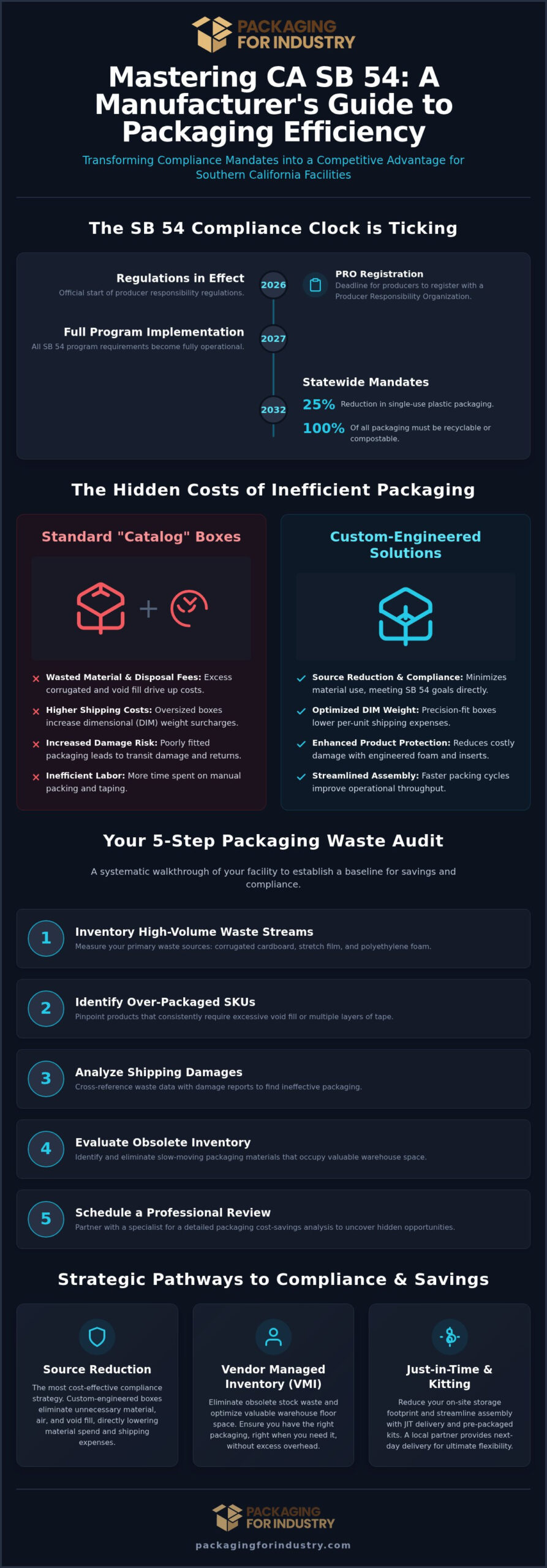
The current 2026 regulations target single-use packaging and plastic food serviceware. Regulatory pressure is mounting. Producers were required to register with a Producer Responsibility Organization (PRO) by June 1, 2026. By 2032, the state mandates a 25% reduction in single-use plastic packaging and requires 100% of packaging to be recyclable or compostable. Reducing packaging waste in a manufacturing plant SoCal starts at the engineering level. When you address source reduction during the design phase, you prevent downstream waste before it ever enters the supply chain. This proactive approach ensures your facility stays ahead of the full program implementation scheduled for January 1, 2027.
The Economic Case for Reducing Packaging Material
Standard catalog boxes often lead to hidden operational costs that erode your margins. Waste is an expense. When products don’t fit their containers perfectly, plants rely on excessive void fill and tape to prevent damage. This increases the dimensional weight (DIM) of your shipments, triggering significant freight surcharges from carriers. By transitioning to custom corrugated boxes, you eliminate unnecessary air and material. Source reduction is the most cost-effective compliance strategy because it simultaneously lowers material spend and shipping expenses.
- Lower per-unit shipping costs through optimized DIM weight.
- Reduced spend on secondary materials like bubble wrap or foam peanuts.
- Streamlined assembly lines that require less manual packing time.
- Enhanced brand reputation by meeting state-mandated sustainability targets.
Manufacturers in Orange County and Los Angeles face some of the highest logistics costs in the country. Efficiency pays dividends. Integrating waste reduction into your procurement strategy isn’t just about avoiding penalties. It’s about building a leaner, more efficient operation. You can request a packaging quote to see how engineered solutions compare to your current standard spend.
How to Conduct a Packaging Waste Audit in Your SoCal Facility
Reducing packaging waste in a manufacturing plant SoCal requires a systematic walkthrough of the production floor. You can’t manage what you don’t measure. Establishing a baseline is the first step toward achieving SB 54 compliance and lowering operational costs. Follow these five steps to evaluate your current efficiency:
- Inventory high-volume waste streams: Focus on corrugated cardboard, stretch film, and polyethylene foam.
- Identify over-packaged SKUs: Look for items that consistently require excessive void fill or multiple layers of tape.
- Analyze shipping damages: Cross-reference your waste with damage reports; using heavy materials doesn’t always mean better protection.
- Evaluate obsolete inventory: Identify slow-moving packaging materials that take up valuable warehouse space and eventually become waste.
- Schedule a professional review: Partner with a specialist for a detailed packaging cost-savings analysis to find engineering gaps.
Mapping Inbound vs. Outbound Waste
Your audit must account for dunnage arriving from Tier 1 suppliers. If you’re paying to dispose of their excess pallets or plastic wrap, it’s an invisible operational cost that adds up quickly. Standardizing your outbound box sizes helps eliminate the need for dozens of different SKUs, which simplifies purchasing for facilities from Anaheim to the Inland Empire. This also addresses “motion waste” by ensuring packers have the correct materials within reach, preventing them from spending time searching for rare box sizes.
Spotting the Red Flags of Over-Packaging
Over-packaging usually happens when a facility relies on stock catalog items rather than engineered solutions. You might be using heavy-duty double-wall boxes where a single-wall box with custom foam inserts would offer superior protection at a lower weight. Adhering to the principles of Sustainable Packaging involves using the right amount of material for the job, not just adding layers. Look at your pallet stabilization as well. Excessive stretch film usage often masks poor tensioning or a lack of corner boards. If you find these red flags on your line, you can request a packaging quote to see how custom sizes can reduce your total material usage.
A thorough audit often reveals that the most expensive packaging is the kind that ends up in the trash. By identifying these inefficiencies, you can begin the transition toward a leaner, more compliant operation that prioritizes both protection and fiscal responsibility.
Engineering Custom Solutions to Minimize Material Footprint
Standard catalog boxes are often the primary driver of excess material use in the warehouse. When you rely on a limited selection of stock sizes, you’re forced to ship air, which you then have to fill with expensive dunnage. Transitioning to custom corrugated boxes is a fundamental strategy for reducing packaging waste in a manufacturing plant SoCal. Right-sizing means designing the container around the specific dimensions of your product rather than trying to fit your goods into a shipping carrier’s standard footprint.
Integrating multiple materials into a single, cohesive design often results in the highest material efficiency. For example, a custom-engineered crate or box that utilizes internal bracing can eliminate the need for hundreds of cubic feet of loose-fill peanuts or bubble wrap over a single production run. This multi-material approach ensures that every gram of corrugated or foam serves a protective purpose, directly lowering your material spend and disposal costs.
- Material Reduction: Eliminate void fill by using precision-cut corrugated and foam.
- Freight Optimization: Reduce outer dimensions to lower DIM weight charges.
- Labor Efficiency: Simplify assembly with kitted components that don’t require manual taping of loose dunnage.
- Damage Control: Secure high-value parts in tailored cavities to prevent shifting during transit.
Precision Protection with Custom Foam Inserts
Aerospace components and medical devices require exact density foam to meet rigorous safety and vibration standards. By using CAD/CAM support, we engineer custom foam inserts that provide maximum deceleration with minimal bulk. This precision allows you to reduce the outer box dimensions significantly because the internal cushioning is optimized for the specific weight and fragility of the part. Precision foam reduces both material waste and transit damage by securing items in a tailored cavity that absorbs shock without the need for excessive secondary wrapping.
The Role of Prototyping in Waste Prevention
You shouldn’t commit to a full production rollout without validating the design first. Free prototyping is a critical step in waste prevention because it allows your team to test for “fit” in a real-world environment. This ensures that no unnecessary air is being shipped and that the assembly process is as lean as possible. Collaborating with custom design packaging experts in Anaheim provides your facility with the engineering resources needed to refine designs before they hit the production line. This iterative process catches potential inefficiencies early, preventing the manufacturing of thousands of units of sub-optimal, waste-heavy packaging.
Operational Efficiency: VMI and Kitting Strategies
Physical scrap isn’t the only form of waste in a high-volume facility. Inefficient procurement and storage often lead to “inventory waste,” where slow-moving or obsolete materials consume valuable square footage. For those focused on reducing packaging waste in a manufacturing plant SoCal, operational efficiency must include a strategy for managing the supply chain itself. Integrating Vendor Managed Inventory (VMI) ensures your packaging levels are always aligned with your real-time production needs, preventing the accumulation of excess stock that often leads to damage or disposal.
Just-in-Time (JIT) delivery is particularly critical for manufacturers in Los Angeles and Orange County. Real estate prices in these regions make every square foot of warehouse space an expensive asset. By shifting to a JIT model, you free up floor space for production equipment rather than storing stacks of empty corrugated boxes. Regional proximity allows for local next-day delivery, which is the backbone of a successful JIT strategy. This responsiveness means your facility can react to sudden spikes in demand without maintaining a massive, waste-prone safety stock.
Preventing Inventory Obsolescence
One of the most significant hidden costs in manufacturing is the disposal of packaging that no longer fits updated product designs. When you over-order stock sizes to get a volume discount, you risk being left with thousands of unusable units if the product specs change. VMI solves this by establishing strict min/max levels based on your actual consumption rates. This approach improves cash flow by reducing tied-up capital and ensures you only pay for the material you actually ship. It’s a pragmatic way to lower your total cost of ownership while maintaining 100% supply reliability through engineering-minded oversight.
Streamlining Assembly with Kitting
Process waste occurs when your team spends excessive time searching for, sorting, or pre-assembling various packaging components. Utilizing packaging kitting allows you to receive all necessary elements, such as custom foam inserts, RSC boxes, and corner boards, as a single, ready-to-use unit. This is especially beneficial for complex aerospace components that require specialized protective layers. Kitting reduces the footprint of your packing stations and eliminates the “scraps” that typically accumulate when components are sourced and stored separately. By reducing the physical footprint of the packing station, you create a safer and more ergonomic environment for your warehouse staff.
Choosing a Local SoCal Partner for Sustainable Growth
Selecting a regional packaging partner is a strategic decision that impacts both your environmental footprint and your operational agility. When you work with a supplier located in your own backyard, you significantly reduce the carbon footprint associated with long-haul freight. This proximity allows for local, next-day delivery across Orange County and Los Angeles, ensuring your production lines never stall due to a lack of materials. Reducing packaging waste in a manufacturing plant SoCal is far more manageable when your inventory is replenished in real-time by a partner who understands the specific logistical challenges of the region.
Transitioning from plastic-heavy designs to recyclable corrugated and paper-based solutions is a primary goal for many facilities looking to meet state mandates. Local expertise allows for a more collaborative approach to material selection. We help you move away from single-use plastics and toward heavy-duty, weather-resistant corrugated options that offer comparable protection without the regulatory burden. This regional focus ensures that your supply chain is resilient, cost-effective, and fully aligned with the evolving expectations of the California market.
Recyclability and the 2026 SB 54 Milestones
The regulatory landscape is moving quickly. With the SB 54 regulations having taken effect on May 1, 2026, and full program implementation scheduled for January 1, 2027, manufacturers must act now to ensure their materials meet new recyclability standards. It’s essential to document your source reduction efforts for potential state compliance audits. Using heavy-duty corrugated as a plastic alternative isn’t just about being “green.” It’s about ensuring your packaging is legally compliant and easy for end-users to recycle within the existing California infrastructure. We provide the technical specifications and material data you need to prove your facility is meeting its source reduction obligations.
The PFI Advantage: Local Expertise, National Reach
We support major industrial hubs throughout the region, providing specialized services to manufacturers in Irvine and Santa Fe Springs. Our approach combines the precision of custom engineering with the wholesale pricing typically reserved for national catalog suppliers. This allows you to get a perfect fit for your high-value components without the premium cost of “boutique” design firms. Whether you’re operating out of Anaheim or the Inland Empire, our team is ready to help you optimize your material usage and lower your total cost of ownership. Reducing packaging waste in a manufacturing plant SoCal requires a partner who can scale with your growth while maintaining the responsiveness of a local provider.
Ready to optimize? Request a custom packaging quote
Future-Proof Your SoCal Manufacturing Operations
Achieving SB 54 compliance while maintaining profitability requires a shift toward precision engineering. By conducting a thorough waste audit and transitioning to custom-designed solutions, you can eliminate the hidden costs of oversized boxes and excessive void fill. Reducing packaging waste in a manufacturing plant SoCal is an economic necessity that protects your margins from rising freight surcharges and disposal fees. It’s a pragmatic shift that turns regulatory requirements into logistical advantages.
Our team specializes in helping aerospace, medical, and electronics manufacturers streamline their logistics through vendor-managed inventory and kitting. We offer free prototyping for custom designs and local next-day delivery across Southern California to ensure your production lines stay efficient. Partnering with a specialist in SB 54 compliance and industrial cost-reduction gives you the peace of mind to focus on your core business goals.
Implementing these strategies today ensures your facility remains competitive and resilient in an evolving regulatory environment. We’re ready to help you build a leaner, more profitable operation.
Frequently Asked Questions
How does SB 54 affect manufacturing plants in Southern California?
SB 54 requires producers to take responsibility for the entire lifecycle of their packaging. As of May 1, 2026, regulations are active, demanding that all single-use packaging be recyclable or compostable by 2032. For manufacturers in the region, reducing packaging waste in a manufacturing plant SoCal is now a legal mandate. Failure to join a Producer Responsibility Organization or meet source reduction targets can lead to significant state penalties and increased operational fees.
What is the best way to reduce corrugated waste on a production line?
The most effective strategy involves transitioning from stock RSC boxes to custom-engineered corrugated solutions. Standard boxes often leave excessive air gaps that require void fill, leading to higher material consumption. By right-sizing your containers, you eliminate the need for secondary dunnage and reduce the total volume of cardboard used per shipment. This approach directly lowers your material spend while simplifying the packing process for your warehouse staff and improving overall line efficiency.
Can custom-sized boxes actually save my company money?
Yes, custom-sized boxes lower your total cost of ownership by reducing dimensional weight (DIM) and material usage. When you use boxes tailored to your product, you spend less on tape, stretch film, and cushioning materials. Additionally, smaller footprints allow for more units per pallet, which optimizes freight costs. You can request a packaging quote to compare the pricing of engineered boxes against the hidden costs of standard catalog sizes and freight surcharges.
What is right-sizing in industrial packaging?
Right-sizing is the engineering process of designing packaging that matches the exact dimensions and protection requirements of a specific product. Instead of using a one-size-fits-all shipping container, right-sizing utilizes CAD/CAM prototyping to create a perfect fit. This technique is a cornerstone of reducing packaging waste in a manufacturing plant SoCal because it removes unnecessary air and material. It ensures maximum protection with the minimum amount of corrugated or foam required for safe transit.
How does Vendor Managed Inventory (VMI) help reduce packaging waste?
VMI reduces waste by ensuring your packaging supply matches your actual production output in real-time. By setting strict min/max levels, a specialist manages your stock to prevent over-ordering and inventory obsolescence. This prevents piles of outdated boxes from taking up warehouse space or ending up in landfills when product designs change. VMI also protects your materials from environmental damage or degradation that can occur during long-term storage in an unoptimized facility.
Are there recyclable alternatives to protective foam packaging?
Many manufacturers are switching to paper-based cushioning, honeycomb corrugated, or recyclable polyethylene foam to meet new standards. These materials provide high-performance shock absorption for aerospace or medical gear while remaining compliant with SB 54 recyclability goals. Transitioning to these alternatives often requires custom engineering to ensure the protective qualities match traditional expanded polystyrene. We help you identify the right materials that balance product safety with environmental and regulatory requirements without compromising on durability.
How do I start a packaging waste audit for my facility?
Begin by walking your production floor to identify where the most scrap is generated on a daily basis. Look for overflowing bins of corrugated cut-offs, excessive use of stretch film, and oversized boxes that require heavy void fill. You should also analyze your freight bills for DIM weight surcharges, as these often indicate “air” waste. For a more comprehensive review, we offer a professional waste reduction analysis to identify specific engineering gaps in your current packaging line.
What are the benefits of choosing a local SoCal packaging supplier?
A local partner provides just-in-time (JIT) delivery and expert knowledge of California’s unique regulatory environment. Suppliers in areas like Orange County or Los Angeles offer local next-day delivery, which frees up your warehouse floor space and reduces the carbon footprint of your supply chain. Regional proximity also allows for faster prototyping and on-site consultations, ensuring your packaging engineering is always aligned with your production needs. This local responsiveness is critical for maintaining high supply reliability.