
What if the most expensive component of your surgical kit isn’t the precision engineering, but the packaging that fails to protect it during transit? You already know that even a microscopic scratch or a compromised sterile barrier leads to immediate rejection, high replacement costs, and friction with healthcare providers. Finding reliable protective packaging for surgical instruments San Diego manufacturers can trust is now a regulatory necessity. Since the FDA’s Quality Management System Regulation (QMSR) took effect in February 2026, your packaging must align perfectly with ISO 13485:2016 standards to ensure total compliance.
This guide explains how to secure your precision tools using custom-engineered foam and corrugated solutions designed for zero-damage shipping. We’ll show you how to eliminate warehouse clutter and shorten lead times through local logistical support and just-in-time delivery. You’ll discover how to streamline your procurement process while maintaining the aseptic presentation required by ISO 11607. By integrating engineering with economics, you can protect your bottom line as effectively as you protect your instruments.
Key Takeaways
- Learn how to implement multi-layer systems that provide puncture resistance while maintaining the sterile barrier integrity required for medical compliance.
- Discover why custom-engineered die-cut foam is the most effective protective packaging for surgical instruments San Diego manufacturers use to eliminate transit damage.
- Understand the specific advantages of double-wall RSC corrugated boxes for protecting delicate tools from the physical hazards and humidity of regional shipping.
- See how local Vendor Managed Inventory (VMI) programs solve the space constraints of San Diego industrial zones by ensuring you never face packaging stockouts.
- Identify how free CAD prototyping and industrial engineering support can significantly lower packaging costs while improving your overall supply chain reliability.
Critical Requirements for Surgical Instrument Protective Packaging
Effective protective packaging for surgical instruments San Diego medical device firms utilize is much more than a standard shipping container. It’s a multi-layer system engineered to prevent mechanical damage, maintain sterility, and resist puncture throughout the supply chain. Precision tools often feature microscopic tolerances; even minor impacts can render a device useless or dangerous. High-quality packaging serves as the final line of defense between your manufacturing floor and the operating room.
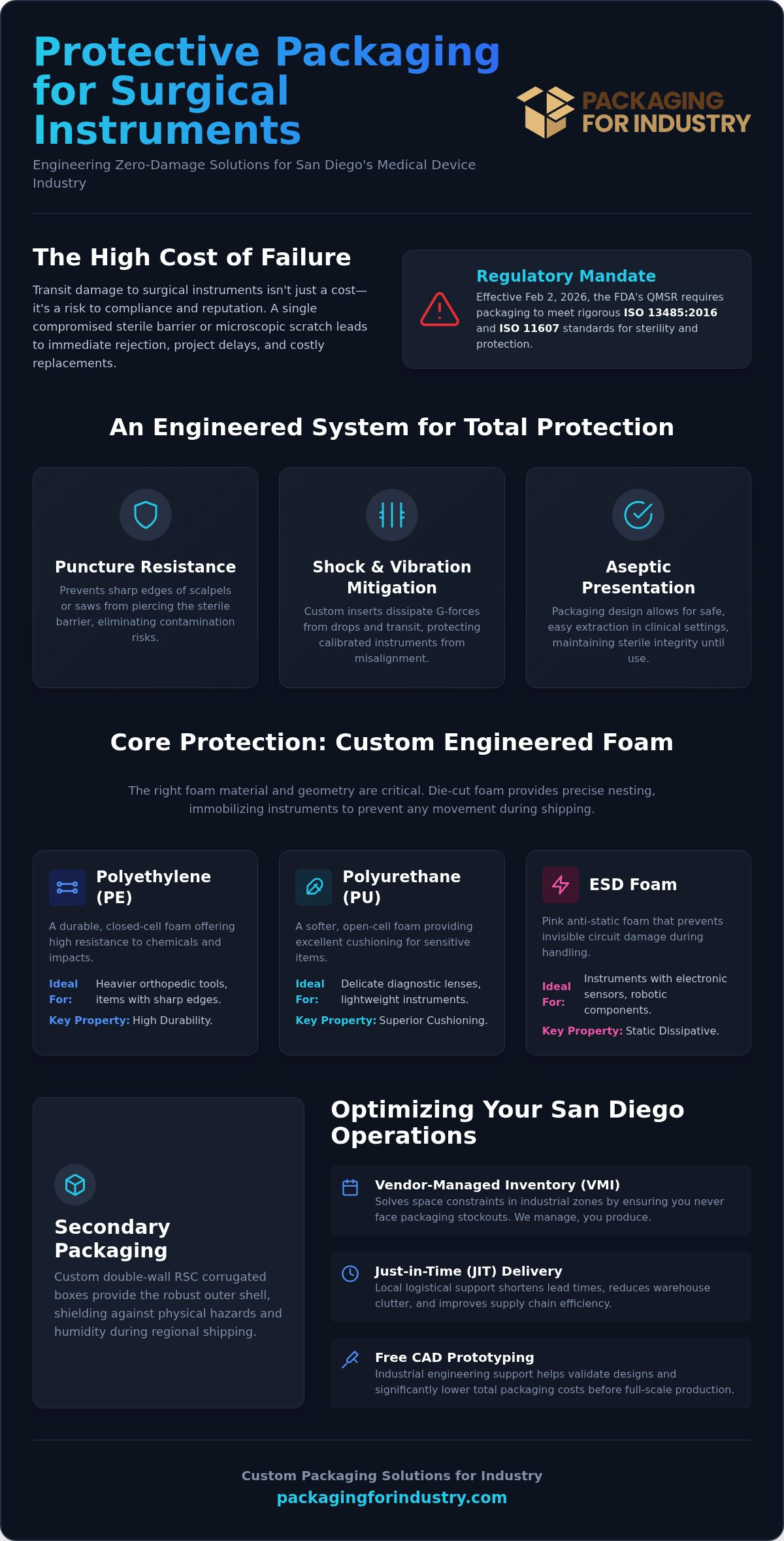
Transit damage carries a high price tag. Beyond the direct cost of the tool, you face project delays, re-sterilization expenses, and potential regulatory scrutiny. Standard off-the-shelf boxes lack the structural integrity to protect high-value assets. This is why secondary packaging must be designed to support the primary sterile barrier according to ISO 11607 standards. Because of the FDA’s Quality Management System Regulation (QMSR) effective as of February 2, 2026, manufacturers must ensure their packaging processes meet rigorous ISO 13485:2016 standards. This includes verifying that packaging supports various sterilization methods for surgical instruments without compromising the device’s integrity.
Protecting Sharp Edges and Delicate Tips
Puncture resistance is the top priority when shipping scalpels, bone saws, or fine-tipped scissors. If a sharp edge pierces the primary sterile barrier, the instrument is contaminated. We use specialized protective foam packaging and rigid inserts to prevent “break-through” during high-vibration transit. The design must also balance security with ease of extraction. Healthcare professionals need to remove the tool quickly and safely in a clinical setting without risking a needle-stick injury or compromising aseptic presentation. Precision die-cut foam ensures the tool remains stationary, even if the outer box is mishandled.
Shock and Vibration Mitigation
Calibrated surgical instruments are sensitive to G-forces. Dropping a carton or enduring the constant vibration of a long-haul flight can knock a tool out of alignment. Custom inserts are engineered to dissipate this energy before it reaches the instrument. At Packaging For Industry, our custom design packaging services utilize CAD/CAM support to create geometries that cradle the tool at its strongest points. These containers are often validated through ASTM or ISTA testing protocols to ensure they withstand the specific hazards of the medical device supply chain. This engineering approach reduces the risk of costly returns and maintains the precision of your surgical instruments.
Engineering Custom Foam Inserts for Maximum Protection
Selecting the right geometry for your instrument is the first step in engineering a secure shipping solution. Die-cut foam provides the exact nesting required for surgical tools, whereas convoluted foam is often too generic for precision instrumentation. For high-value medical shipments, the geometry must match the tool’s center of gravity to prevent shifting during transit. This level of detail is why specialized custom foam packaging has become the standard for the San Diego medical hub.
Material selection depends on the tool’s weight and fragility. Polyethylene is a closed-cell material that offers high durability and resistance to chemicals, making it ideal for heavier orthopedic tools or items with sharp edges. In contrast, Polyurethane is a softer, open-cell foam suited for delicate diagnostic lenses or light instruments. When building complex tool kits, we often engineer custom foam assemblies that combine multiple densities. This approach provides rigid support at the base and soft cushioning at the point of contact, ensuring your protective packaging for surgical instruments San Diego remains effective through every stage of distribution.
Many modern surgical tools include electronic sensors or robotic components. These instruments require Electrostatic Discharge (ESD) foam to prevent invisible circuit damage during handling. Using pink anti-static foam ensures that your protective packaging for surgical instruments San Diego meets the technical requirements of high-tech medical manufacturing. It’s a proactive step that eliminates the risk of “dead on arrival” electronics due to static buildup.
Precision Die-Cutting and CAD Design
PFI utilizes in-house CAD/CAM support to engineer instrument cavities with zero-tolerance precision. This process eliminates the guesswork of manual pack-outs and ensures every tool sits perfectly in its cradle. We offer free prototyping so you can test the fit and function of your inserts before committing to a full production run. This ensures a consistent, secure fit for high-volume surgical kit assembly lines, which reduces labor time and increases overall throughput.
Cleanroom and ESD Foam Options
For sterile-ready environments, we provide cleanroom-compatible poly bags and low-particulate foam options. These materials are processed to minimize outgassing and debris, ensuring the instrument remains uncontaminated before it reaches the sterilization phase. Standardizing on anti-static foam for robotic surgical components protects sensitive hardware from discharge. If you need to request a packaging quote for custom foam solutions, our team can provide technical specifications tailored to your cleanroom requirements.
Secondary Packaging: Custom Corrugated Boxes and Shippers
The outer shipper is the structural hull that protects your precision tools from the rigors of the global logistics network. While custom foam provides internal stability, the secondary container must withstand stacking pressures, humidity, and rough handling. For many manufacturers, standard boxes aren’t sufficient. This is where high-performance protective packaging for surgical instruments San Diego businesses rely on provides a critical advantage. We engineer these shippers to serve as a durable shell for the delicate contents inside.
When shipping heavy orthopedic trays or multi-instrument kits, upgrading to double-wall or triple-wall RSC (Regular Slotted Container) boxes is often necessary. These heavy-duty options provide the burst strength required to prevent box failure during palletization. San Diego manufacturers must also consider coastal humidity, which can soften standard corrugated fibers and lead to collapsed stacks. We provide weather-resistant corrugated options that maintain structural integrity even in high-moisture environments.
One of the most effective ways to lower packaging costs is through precision sizing. Oversized boxes require excessive void fill and trigger expensive FedEx or UPS dimensional weight (DIM) surcharges. By using custom-sized boxes, you eliminate wasted space and ensure a snug fit for your foam inserts. PFI also offers integrated solutions, such as shipping boxes pre-lined with protective foam, which streamlines your assembly process and reduces labor costs on the production line.
Custom Box Design for Medical Kits
Slim surgical instrument sets often benefit from die-cut corrugated folders rather than deep boxes. These folders provide a professional presentation and reduce the overall shipping footprint. For more complex kits, we use custom partitions and dividers to organize multiple instruments within a single shipper. This prevents tool-to-tool contact and simplifies the inventory count for the end user. You can explore our custom corrugated boxes to find the right strength for your specific medical application.
Branding and Compliance Labeling
Your secondary packaging is a reflection of your brand’s commitment to quality. We offer printed corrugated boxes that maintain a professional appearance while providing the necessary space for thermal transfer labels and regulatory markings. For larger, palletized surgical equipment, we integrate corner and edge protection to prevent strap damage during transit. This comprehensive approach ensures your protective packaging for surgical instruments San Diego shipments arrive in pristine condition, ready for the clinical environment.
How to Choose a San Diego Packaging Supplier for Medical Devices
Selecting a partner for protective packaging for surgical instruments San Diego manufacturers depend on requires a methodical approach. It isn’t just about finding a vendor; it’s about securing a consultant who understands the intersection of engineering and logistics. To ensure your precision tools arrive safely while keeping operational costs low, follow these five evaluation steps.
- Step 1: Evaluate engineering capabilities. A reliable partner must offer in-house CAD design and prototyping to ensure your instruments fit perfectly in their cradles.
- Step 2: Check for industry-specific experience. Suppliers familiar with medical device and aerospace requirements understand the high stakes of compliance and damage prevention.
- Step 3: Analyze logistical support. Local San Diego firms that offer next-day delivery provide a significant advantage for maintaining a lean supply chain.
- Step 4: Review cost-reduction programs. Programs like Vendor Managed Inventory (VMI) and Just-in-Time (JIT) delivery are essential for optimizing warehouse space in expensive industrial zones.
- Step 5: Compare pricing against large catalog suppliers. Local partners often provide more competitive bulk rates and personalized service than generic national distributors.
The Importance of Local Prototyping
San Diego manufacturers benefit immensely from local design reviews. When you work with a regional partner, you can physically inspect prototypes and make real-time adjustments. This significantly reduces the feedback loop for custom-engineered surgical packaging. Instead of waiting days for a sample to arrive by mail, you can finalize designs in a fraction of the time. You can explore our custom design packaging services to see how this engineering-first approach improves your speed-to-market.
Assessing Supply Chain Reliability
Vetting a supplier for consistent material quality is critical for medical applications. Southern California-based manufacturing offers San Diego firms better oversight and shorter lead times compared to overseas or out-of-state sources. This proximity ensures that the corrugated and foam materials used in your kits meet strict quality standards every time. We recommend requesting a comprehensive packaging review to identify hidden damage risks in your current setup. This proactive step can reveal where your current system might be failing and where you can improve reliability.
Optimizing San Diego Operations with JIT and VMI Programs
San Diego’s industrial real estate market ranks among the most expensive in Southern California. For medical device manufacturers, every square foot used to store empty corrugated boxes or bulk foam inserts is a square foot not dedicated to production. This creates a challenging “space vs. supply” dilemma. If you under-order, you risk a production shutdown due to a packaging stockout. If you over-order, you clutter your facility and tie up vital capital in stagnant inventory.
Our Vendor Managed Inventory (VMI) and Just-In-Time (JIT) programs solve this conflict by shifting the inventory burden from your floor to ours. By utilizing local logistical support, you ensure that your protective packaging for surgical instruments San Diego is available exactly when the production line requires it. This transition from a reactive to a proactive supply chain model improves cash flow. It allows your team to focus on manufacturing rather than monitoring box counts. It’s a pragmatic solution for high-growth firms.
Implementing VMI for Recurring Packaging Needs
Effective VMI isn’t a one-size-fits-all service; it’s a methodical partnership. PFI manages the entire review cycle for our San Diego clients, conducting weekly or monthly inventory audits based on your specific throughput. We track your usage patterns for custom boxes and foam inserts, automatically triggering replenishment orders before you ever face a shortage. This automation eliminates the stress of manual ordering. It ensures that your Vendor Managed Inventory services are synchronized perfectly with your production schedule.
Lowering Total Cost of Ownership
The true cost of packaging includes more than just the unit price. It encompasses the labor required to manage it, the cost of the space it occupies, and the emergency fees paid when supplies run low. By implementing a JIT system, you eliminate expensive overnight shipping and emergency rush orders that often plague unoptimized supply chains. We also offer packaging kitting and assembly services to further reduce warehouse labor. Instead of your team spending hours assembling complex inserts, we deliver ready-to-use kits directly to your station. This saves time.
This integrated approach ensures that your protective packaging for surgical instruments San Diego remains cost-effective from procurement to final delivery. Reclaiming your warehouse space starts with a better logistical strategy. If you’re ready to streamline your operations, you can request a quote for a custom VMI assessment today. Our team will evaluate your current usage and design a plan that maximizes efficiency while minimizing waste.
Securing Your Surgical Instrument Supply Chain
Securing high-value medical tools requires a strategic balance of engineering precision and logistical reliability. By integrating custom-engineered foam inserts with heavy-duty corrugated shippers, you eliminate transit damage and ensure full compliance with current medical standards. Our specialized approach to protective packaging for surgical instruments San Diego helps you reclaim valuable warehouse space while maintaining a lean, responsive inventory through local support.
PFI specializes in San Diego medical device logistics. We provide free CAD prototyping for custom foam inserts and cost-saving VMI stocking programs. These integrated systems allow your team to focus on manufacturing excellence rather than inventory management. You don’t have to manage these complexities alone. You can effectively lower your total cost of ownership by partnering with a local expert that understands the technical and economic demands of your sector.
Our team is ready to help you optimize your supply chain and protect your precision instruments with confidence.
Frequently Asked Questions
What is the best foam for surgical instrument packaging?
Polyethylene foam is often the superior choice for surgical tools due to its closed-cell structure and high chemical resistance. It provides the rigid support needed for sharp edges while preventing particulate shedding. For highly delicate diagnostic instruments, we may recommend open-cell polyurethane for better shock absorption. Our engineering team selects the material based on the tool’s weight and fragility to ensure your protective packaging for surgical instruments San Diego meets all performance requirements.
Can you provide custom-size boxes for large surgical kits in San Diego?
Yes, we specialize in manufacturing custom-sized corrugated boxes that fit your specific surgical kits perfectly. By eliminating excessive void fill, you reduce the overall shipping footprint and avoid expensive dimensional weight surcharges from carriers. We offer these in various strengths, including double-wall and triple-wall RSC styles, to ensure your high-value medical shipments remain secure throughout the entire Southern California distribution network. Custom sizes available for any kit configuration.
How does VMI help medical device manufacturers save money?
Vendor Managed Inventory (VMI) saves money by reducing the capital you have tied up in excess packaging stock. We monitor your inventory levels and manage the replenishment process, which eliminates the risk of production shutdowns due to packaging stockouts. This program also frees up expensive warehouse space in San Diego’s industrial zones. You only pay for what you need, allowing you to lower packaging costs significantly over time through optimized supply reliability.
Do you offer anti-static or ESD-safe packaging for surgical electronics?
We provide a full range of anti-static and ESD-safe packaging solutions for surgical instruments with electronic sensors or robotic parts. This includes pink anti-static foam and specialized poly bags that prevent electrostatic discharge from damaging sensitive circuits. Using these materials ensures your high-tech medical devices remain functional upon arrival. It’s a critical requirement for manufacturers looking to compare packaging pricing for advanced surgical hardware while maintaining technical compliance.
What are the lead times for custom foam inserts in Southern California?
Our local manufacturing presence in Southern California allows us to offer significantly shorter lead times than national catalog distributors. Because we design and produce custom foam inserts regionally, we eliminate the long transit times associated with out-of-state suppliers. While specific durations depend on the complexity of the die-cut design, our proximity to San Diego ensures a faster feedback loop for revisions and final production runs. This speed helps you maintain a lean production schedule.
Can you help reduce shipping damage for fragile medical tools?
We reduce shipping damage by engineering custom-fit cavities that dissipate vibration and absorb impact energy. Standard boxes often allow instruments to shift, leading to surface scratches or compromised sterile barriers. Our protective packaging for surgical instruments San Diego utilizes CAD-designed inserts that cradle each tool at its strongest points. This proactive engineering approach ensures your precision instruments arrive in pristine condition, ready for immediate clinical use without the risk of expensive transit-related defects.
Do you provide free prototypes for custom medical packaging designs?
Yes, we offer free prototyping and CAD/CAM support for all custom medical packaging projects. This allows your team to test the physical fit and extraction ease of a design before committing to a bulk order. By reviewing a physical sample, you can identify potential issues early in the design phase and refine the layout for maximum efficiency. This service is essential for ensuring your surgical kits meet the rigorous handling requirements of the healthcare industry.
Is next-day delivery available for San Diego medical device companies?
Next-day delivery is available for San Diego medical device companies for stock items and recurring VMI orders. Our local Southern California fleet ensures that your packaging supplies arrive exactly when your production schedule demands them. This reliable logistical support helps you maintain a lean inventory model and reduces the stress of managing supply chain disruptions. You can request a packaging quote to see how our local delivery improves your operational flow and lowers overhead.