
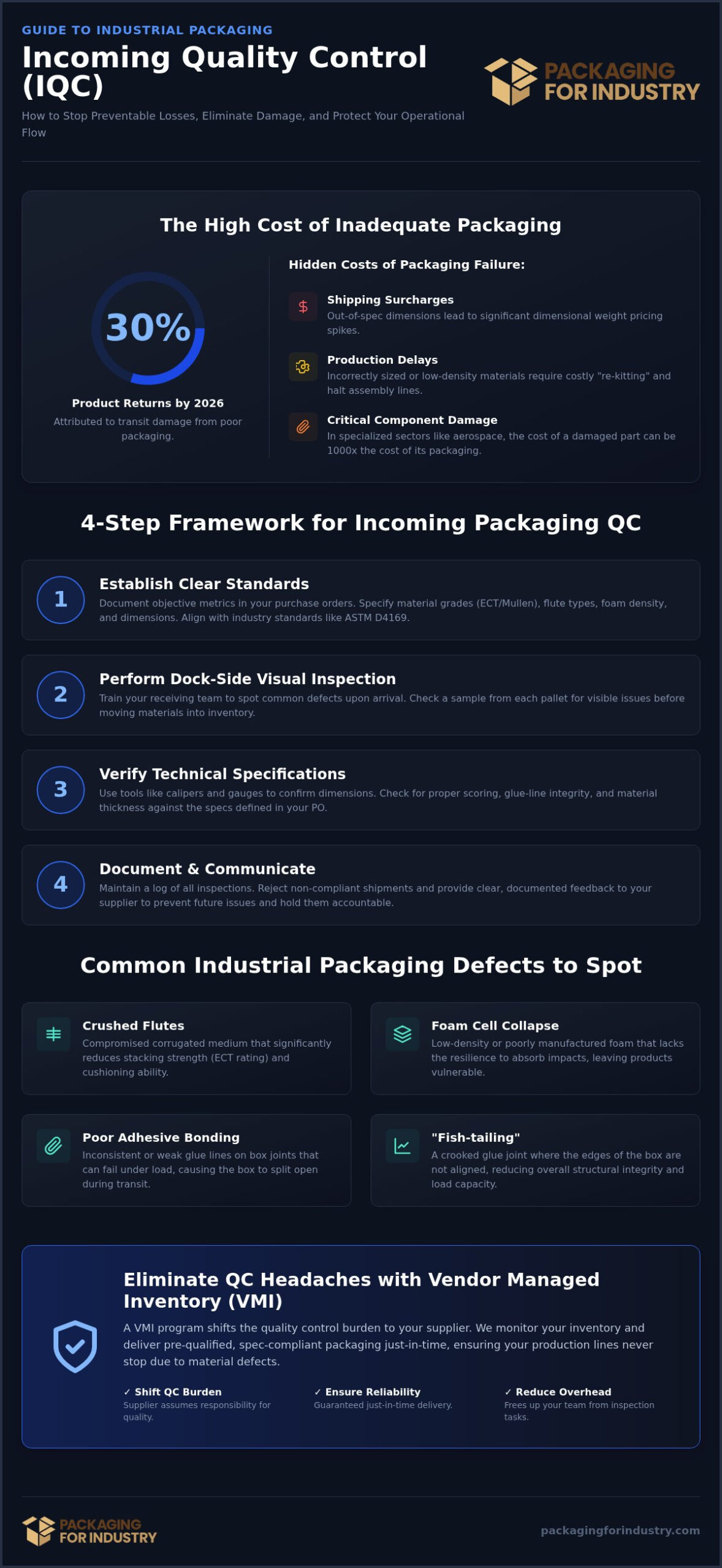
Nearly 30% of all product returns in 2026 are attributed to transit damage caused by inadequate or out-of-spec packaging. It’s a frustrating reality for manufacturing and warehouse managers who find their production lines halted by a batch of corrugated boxes that don’t meet their engineering specs. You’ve likely experienced the professional stress of a rejected shipping claim or a delayed delivery because a supplier’s material quality was inconsistent. Implementing a quality control process for incoming packaging is the most effective way to stop these preventable losses and protect your operational flow.
We know that your team needs pragmatic solutions, not more paperwork. Catching defects at the loading dock is significantly more cost-effective than managing product failures once they reach the customer. This guide will show you how to establish a robust incoming quality control process to eliminate damage, reduce waste, and lower your total packaging spend. We’ll provide a repeatable checklist for your warehouse staff and explore how the 2026 updates to ISTA testing standards can help you verify that every pallet and crate meets your requirements before they ever leave your facility.
Key Takeaways
- Learn why identifying packaging defects at the loading dock prevents the high costs of transit damage and shipping surcharges.
- Understand the critical technical specifications for corrugated boxes and protective foam, including burst strength and compression requirements.
- Follow a clear, 4-step framework for implementing a quality control process for incoming packaging to ensure every shipment meets your engineering standards.
- Discover how to spot common industrial defects like crushed flutes, fish-tailing, or foam cell collapse before they reach your production line.
- See how Vendor Managed Inventory (VMI) programs can shift the quality control burden to your supplier while ensuring just-in-time reliability.
Why Incoming Quality Control (IQC) for Packaging is Mission-Critical
IQC in industrial packaging is the systematic verification that every shipment of corrugated boxes, protective foam, and pallets meets engineering requirements before they enter your inventory. It’s a proactive filter. Without it, you’re essentially gambling that your suppliers’ manufacturing tolerances align with your own. For high-volume operations, a single batch of out-of-spec material can trigger a domino effect of operational failures.
Implementing a quality control process for incoming packaging is about more than just counting units. It’s about ensuring that a double-wall box actually provides the burst strength required for your heavy-duty components. When packaging fails, the costs are rarely limited to the price of the box. It impacts your bottom line and your professional reputation for reliability.
The Financial Impact of Packaging Failure
The most immediate hidden cost of poor packaging quality is the shipping surcharge. Major carriers like FedEx and UPS have strict dimensional weight pricing. If your incoming boxes are even half an inch wider than specified due to poor manufacturing, you’ll see a significant spike in freight costs. Beyond shipping, there’s the expense of “re-kitting.” If cushioning materials aren’t cut to the correct density, your assembly team must stop their work to swap out materials. In the aerospace sector, where precision is non-negotiable, the cost of a packaging failure can be a thousand times the cost of the packaging itself if a critical component is damaged.
Protecting Your Supply Chain Reliability
Reliability is the backbone of any lean manufacturing environment. Relying on inconsistent material quality from high-volume catalog suppliers often leads to emergency rush orders, which drive up your total cost of ownership. By implementing a quality control process for incoming packaging, you stabilize your internal logistics. You ensure that every item on your warehouse floor is ready for immediate use.
Standardized Package testing procedures allow your staff to identify issues like crushed flutes or poor adhesive bonding before the product is packed. This level of oversight is what separates a world-class operation from one that’s constantly fighting fires. At Packaging For Industry (PFI), we recommend integrating these checks into your standard operating procedures to maintain the professional reliability your customers expect. Catching a defect at the dock is a minor inconvenience; catching it after a customer receives a damaged product is a business-critical failure.
Establishing Standards for Your Incoming Packaging Quality Control
Setting rigid benchmarks is the first step in implementing a quality control process for incoming packaging. You can’t hold a supplier accountable for “poor quality” without objective metrics. These standards must be documented in your purchase orders to ensure your warehouse team knows exactly what to look for during receiving. We recommend aligning your internal standards with ASTM D4169, which provides a framework for evaluating how containers perform under real-world distribution hazards.
A proactive approach involves moving beyond generic descriptions. Instead of ordering “large boxes,” your specifications should include material grades, flute types, and weight capacities. This clarity eliminates the guesswork for your staff and sets a high bar for your vendors. When everyone is working from the same technical drawing, the risk of production line stoppages due to out-of-spec materials drops significantly.
Corrugated Specifications: More Than Just Dimensions
While size matters, structural integrity is what prevents product damage. Your standards should specify whether you require Edge Crush Test (ECT) ratings for stacking strength or Mullen Test ratings for puncture resistance. For high-volume industrial applications, verify that your RSC boxes feature clean scoring and consistent glue-line integrity. A crooked glue joint or “fish-tailing” reduces the box’s load-bearing capacity. If your components require double-wall protection, your QC checklist must confirm the flute profile matches your engineering drawings exactly.
Foam and Cushioning Standards
For sensitive equipment, protective foam packaging must meet precise density and compression set requirements. Polyethylene foam is often preferred for its durability in manufacturing environments, while polyurethane offers softer cushioning for delicate finishes. If you’re shipping electronics, verifying anti-static (ESD) properties is a non-negotiable step in your IQC. Your team should use a surface resistance meter to ensure the material provides the necessary protection. We often provide CAD prototypes to our clients so their staff can compare incoming die-cut inserts against a physical “gold standard” for fit and finish.
Specialized sectors like aerospace and defense often require adherence to strict mil-spec packaging standards. These regulations dictate everything from material thickness to chemical composition. Establishing tight tolerances for custom-engineered crates and pallets ensures that high-value components remain secure during transport. If you’re unsure which specifications are right for your application, you can compare packaging pricing and technical specs for various industrial materials with our engineering team.
A 4-Step Process for Implementing a Quality Control Process for Incoming Packaging
A successful transition to implementing a quality control process for incoming packaging requires a clear, boots-on-the-ground workflow. It’s not enough to have standards on paper; your warehouse team needs a repeatable sequence to follow the moment a trailer hits the dock. This four step framework ensures that every pallet of material is vetted for quantity, dimensions, and structural integrity before it’s accepted into your inventory. By catching errors at the receiving stage, you prevent the exponential costs of production downtime or transit damage later in the cycle.
Visual and Dimensional Verification
The process begins with a high level visual inspection. Before the driver leaves, your team should check for “shipping hangovers” where boxes or crates overhang the pallet edge. This is a primary cause of crushed corners and compromised stacking strength. Verify the packing slip against the physical count and check for moisture damage or punctured stretch wrap. When implementing a quality control process for incoming packaging, these initial visual cues are your first line of defense against supplier negligence.
Once the shipment is staged, move to dimensional testing. Use calibrated calipers and tape measures to verify that custom box sizes match your purchase order exactly. Even a quarter inch variance can lead to “box slap” or improper fit for your internal foam inserts. This level of scrutiny aligns with broader industrial best practices, such as FDA regulations on quality control, which emphasize the importance of inspecting containers to ensure they are clean and in good condition. Finally, compare any printing or labeling against approved artwork to maintain brand consistency and professional reliability.
Physical Material Testing
Step three involves verifying the technical specifications of the materials themselves. For corrugated supplies, your staff should check the board thickness and confirm the flute type (A, B, C, E, or F) matches what you’ve paid for. It’s common for lower tier suppliers to substitute lighter grades to save on their own costs. If you’re receiving stretch film, verify the gauge and perform a quick puncture resistance check to ensure it provides the necessary load containment for your specific pallet weights.
For protective foam, simple compression checks or “drop tests” with sample products can reveal if a batch is too soft or prone to cell collapse. The final step is documentation and disposition. If materials are non-conforming, they must be clearly tagged and moved to a designated quarantine area. Documenting these failures with photos and specific measurements allows your purchasing department to file accurate claims and hold suppliers accountable. This methodical approach ensures that your production line never stops because of a bad batch of boxes.
Common Packaging Defects and How to Spot Them
Identifying defects requires a trained eye and a clear understanding of material science. When implementing a quality control process for incoming packaging, your warehouse staff should be equipped with a visual guide of “red flags” that indicate structural instability. These defects aren’t just cosmetic; they’re early warning signs of a shipment failure waiting to happen. Catching these issues at the receiving dock prevents them from becoming costly damage claims later in the supply chain.
Corrugated and Cardboard Red Flags
One of the most common issues in high-volume corrugated supply is “fish-tailing” on the manufacturer’s joint. If the glue line isn’t perfectly square, the RSC boxes will assemble into a trapezoid rather than a rectangle. This misalignment drastically reduces stacking strength. Your team should also watch for delamination, where the linerboard peels away from the fluting. This is often a result of poor adhesive application during the manufacturing process and can lead to total box failure under heavy loads.
Crushed flutes are another critical failure to monitor. If the internal “waves” of the cardboard are flattened, the box loses the structural integrity required to meet its Edge Crush Test (ECT) rating. This often happens due to over-clamping during transit or improper handling by the supplier. In humid environments, be wary of “recycled content” failures. Boxes with high levels of short-fiber recycled material may look fine upon delivery but can collapse quickly if the warehouse moisture levels rise. These defects often disrupt packaging kitting operations where precision assembly is required.
Identifying Substandard Protective Materials
Protective inserts are only as good as their density and resilience. In low-quality foam, you might encounter “cell collapse,” where the material feels brittle or fails to spring back after compression. This leads to “bottoming out,” where the product’s weight eventually touches the outer box wall, bypassing the cushion entirely. It’s also vital to inspect corner boards for structural rigidity. If these components are soft or easily bent, they won’t provide the stacking reinforcement needed to protect your pallets during long-haul transit.
For operations using mailing tubes, check for consistent wall thickness. Any thin spots in the spiral winding will cause the tube to buckle under the weight of other parcels in a carrier’s network. Wood packaging, such as custom crates, requires a check for the ISPM-15 stamp to ensure proper heat treatment for international shipping. Finally, test your tapes and adhesives. Brittle backing or poor “tack” often indicates old stock that won’t hold up in fluctuating temperatures. By implementing a quality control process for incoming packaging that targets these specific defects, you ensure your operations remain lean and reliable.
Eliminating QC Headaches with Vendor Managed Inventory (VMI)
While implementing a quality control process for incoming packaging is essential for operational stability, it can consume significant internal resources. Managing a dedicated team to measure flutes and test foam densities adds overhead that many lean organizations prefer to avoid. VMI programs offer a strategic shift by moving the inspection and inventory management burden directly to the supplier. This proactive model ensures that only pre-vetted, high-quality materials reach your production floor. It effectively transforms your supplier into a quality gatekeeper rather than just a vendor.
Combining VMI with just-in-time (JIT) delivery further optimizes your warehouse logistics. You no longer need to store months of inventory that might hide latent manufacturing defects. Local Southern California partners provide a distinct advantage in this area. Proximity allows for more frequent design reviews and tighter oversight compared to distant high-volume catalog suppliers. If a quality issue is detected, a local partner can address it in person immediately. This prevents the professional stress of halted production lines and lengthy claims processes often associated with national distributors.
The PFI Approach to Quality Assurance
At Packaging For Industry (PFI), we integrate quality into the initial design phase to prevent issues before they reach production. We utilize advanced CAD/CAM technology and offer free prototyping for custom designs to ensure every RSC box and foam insert fits your product perfectly. For specialized sectors like aerospace, our internal inspection process for custom mil-spec packaging is exceptionally rigorous. We handle the technical verification and structural testing so your team doesn’t have to. Our local next-day delivery capabilities in Orange County and Los Angeles ensure that your supply chain remains fluid, predictable, and defect-free.
Lowering Total Packaging Costs through Reliability
Reliability is the ultimate driver of fiscal efficiency. By leveraging a trusted partnership, you significantly reduce the need for large internal QC teams dedicated solely to shipping supplies. This simplifies the workflow for your manufacturing and logistics managers, allowing them to focus on production throughput instead of measuring box dimensions. With a vast range of custom sizes available, we ensure your specific engineering tolerances are met before the shipment ever leaves our facility.
Implementing a quality control process for incoming packaging at the supplier level means you receive ready-to-use materials every time. It’s a pragmatic way to lower packaging costs by eliminating the “hidden” expenses of re-kitting and transit damage. To see how we can optimize your supply chain, request a packaging quote to compare our engineered solutions and VMI programs against your current supplier’s performance.
Securing Your Supply Chain Through Rigorous Quality Oversight
Establishing a repeatable framework for material integrity is the most direct path to reducing operational waste. By standardizing technical requirements and training warehouse staff to spot defects like crushed flutes or poor adhesive bonding, you protect your bottom line from the costs of product damage. Implementing a quality control process for incoming packaging ensures every corrugated box and foam insert is ready for real-world shipping stresses. It’s a proactive step toward long-term supply chain stability.
Packaging For Industry (PFI) supports these efforts through free prototyping for custom designs and specialized expertise in aerospace and medical device packaging. Our local teams in Anaheim, Irvine, and Los Angeles provide the responsive partnership needed to maintain high-precision standards without adding internal overhead. We’re here to help you optimize logistics and eliminate the professional stress of out-of-spec supplies.
Your operations deserve a supply chain built on reliability and engineering excellence. We look forward to helping you achieve zero production delays and lower your total cost of ownership.
Frequently Asked Questions
What is the most important test for incoming corrugated boxes?
The Edge Crush Test (ECT) is the most critical metric for modern warehouse stacking. It measures the top-to-bottom compression strength of a box, which is vital for palletized loads. While the Mullen test measures puncture resistance, ECT directly correlates to stacking performance. When implementing a quality control process for incoming packaging, your team should verify the ECT stamp on the bottom of the box against your purchase order specifications.
How can I verify the density of custom foam inserts?
Verifying foam density is done by calculating the mass per unit volume of a sample. You should weigh a specific die-cut insert on a calibrated scale and divide that weight by the total volume in cubic feet or inches. Compare this result to the density specified in your engineering CAD drawings. This ensures that protective foam packaging provides the necessary deceleration properties to prevent high-value components from bottoming out during transit.
What should I do if a batch of packaging arrives out of spec?
You should immediately quarantine the material and document the specific non-conformances with photographs and measurements. Move the rejected items to a designated “red tag” area to prevent them from entering your production line accidentally. Providing your supplier with a formal Non-Conformance Report (NCR) allows for a structured claims process. This documentation is a vital part of implementing a quality control process for incoming packaging to ensure you receive a credit or replacement.
Does my warehouse need specialized equipment for packaging quality control?
Most industrial facilities only require basic tools such as digital calipers, heavy-duty tape measures, and calibrated scales. For specialized sectors like electronics, you may also need a surface resistance meter to verify ESD properties. More complex testing, like the 2026 ISTA 3E revisions for unitized loads, is typically handled by your packaging partner during the design phase. Having these basic tools on hand allows for quick, reliable verification at the dock.
How do I ensure our custom crates meet international export standards?
Look for the official ISPM-15 certification mark branded onto the wood of the crate or pallet. This mark indicates the wood has been heat-treated to kill pests, which is a legal requirement for international shipping. You should also verify that the wood is free from large knots or bark edges that could compromise structural integrity. At PFI, we provide full compliance documentation for all custom engineered crates intended for global export to ensure smooth customs clearance.
Can Vendor Managed Inventory (VMI) actually improve my packaging quality?
Yes, VMI improves quality by shifting the burden of inspection to a trusted partner who specializes in material science. Under a VMI program, we perform the technical verification before the material ever reaches your facility. This reduces the risk of human error in your warehouse and ensures that only defect-free supplies are stocked. It’s a pragmatic way to lower packaging costs by eliminating the need for an internal quality control department and reducing waste.
What are the common signs of poor-quality stretch film?
Frequent tearing during the wrapping process and poor “cling” are the primary indicators of substandard stretch film. If the film is inconsistent in gauge, it won’t provide the necessary load containment to keep pallets stable. You can check for “gel” spots or fish-eyes in the film, which suggest poor resin quality. High-quality film should maintain its tension without snapping, ensuring your heavy-duty loads remain secure throughout the entire shipping cycle.
How often should I review our packaging quality control standards?
You should review your quality standards at least once per year or whenever you notice a trend in transit damage. Updates to carrier regulations or changes in your product’s weight and fragility may require tighter tolerances. Regular reviews help you compare packaging pricing against performance to ensure you aren’t over-specifying or under-protecting. Consistent refinement of these benchmarks is key to maintaining professional reliability and reducing your total cost of ownership over time.