
With Orange County’s medical device sector now employing over 24,000 professionals across hubs like Irvine and Anaheim, the margin for logistical error has never been thinner. You likely understand that a single shipment of compromised surgical tools or miscalibrated equipment does more than just hurt your bottom line; it threatens your reputation with healthcare providers. Many local manufacturers struggle with inconsistent foam densities or long lead times that disrupt production schedules. Securing precision-engineered custom foam inserts for medical devices Orange County is no longer just a packaging choice. It’s a critical component of your quality management system.
We agree that your packaging should be as precise as the technology it protects. This guide will show you how to select the ideal foam materials to eliminate shipping damage while maintaining compliance with the latest FDA Quality Management System Regulations. We’ll explore how local delivery and free prototyping can transform your supply chain into a competitive advantage. You’ll gain a clear roadmap for implementing professional, brand-aligned packaging that ensures your devices arrive ready for clinical use every time.
Key Takeaways
- Identify how precision-engineered custom foam inserts for medical devices Orange County prevent shipping damage and maintain device calibration during transit.
- Compare the technical benefits of polyethylene and polyurethane foams to select the right balance of impact resistance and delicate cushioning for your specific hardware.
- Learn how local next-day delivery and free prototyping reduce lead times and eliminate the logistical delays often found with national catalog suppliers.
- Explore how Vendor Managed Inventory (VMI) and integrated kitting services can lower your total packaging costs and prevent production line shutdowns.
- Understand the critical role of anti-static and ESD foam in protecting sensitive medical electronics from electrostatic discharge and environmental hazards.
Why Precision Matters: The Role of Custom Foam Inserts for Medical Devices
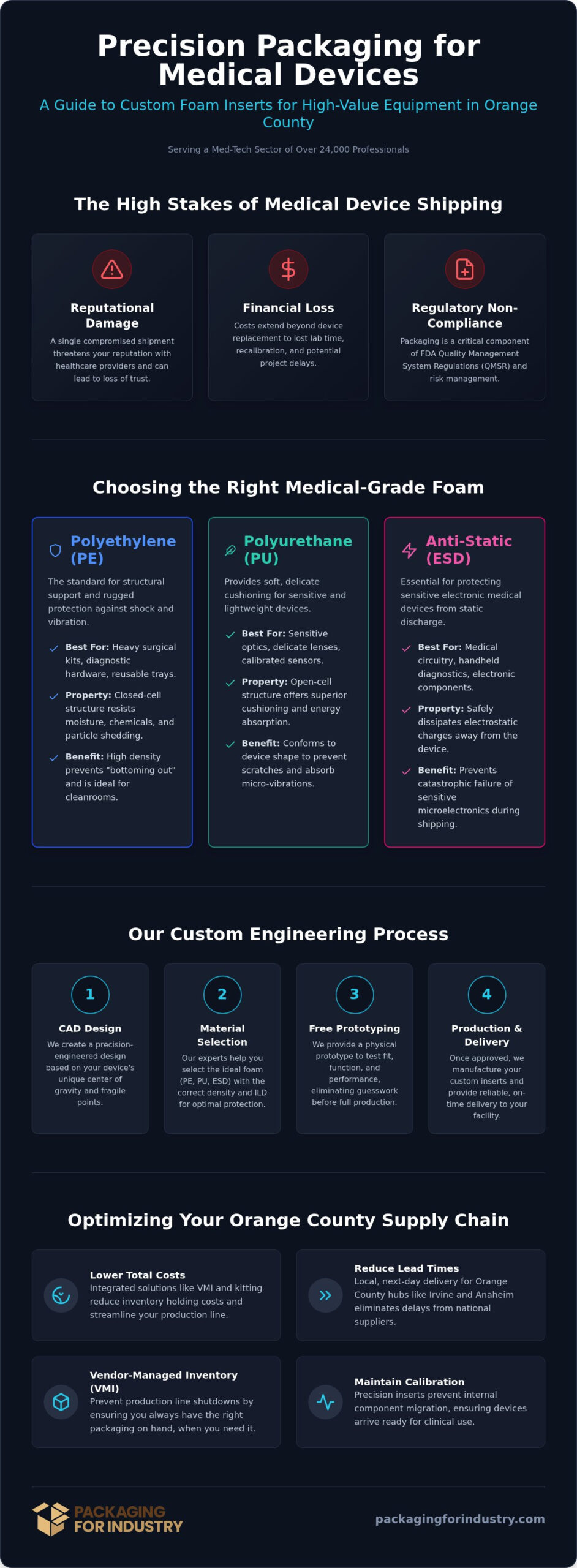
Shipping a medical device involves more than moving hardware from point A to point B. It’s about maintaining the integrity of a high stakes engineering project. When a device fails at its destination, the financial impact extends far beyond physical replacement. You face lost laboratory time, a damaged professional reputation, and potential regulatory non-compliance. Off the shelf packaging often fails sensitive optics and sensors because it lacks the specific load bearing properties needed for delicate electronics. Precision engineering ensures every void is filled and every fragile point is supported, effectively preventing internal component migration during LTL shipping.
Custom foam inserts for medical devices Orange County are designed to counteract the unpredictable shocks of the modern supply chain. While catalog suppliers offer generic shapes, a custom engineered solution accounts for your device’s unique center of gravity. This prevents the “bottoming out” effect where a heavy component compresses the foam entirely, leaving the device unprotected against the next impact. By choosing a tailored fit, you eliminate the guesswork that leads to high damage rates.
Protecting High-Value Diagnostic and Surgical Equipment
Sensitive medical optics and surgical lasers require precise vibration dampening. By utilizing specific types of medical-grade foam, engineers can create inserts that absorb kinetic energy before it reaches the device core. This is critical for heavy medical machinery shipped across long distances. Structural support must be rigid enough to maintain the device’s position but resilient enough to cushion it. This balance also protects sterile integrity. If a device shifts, it can puncture sterile barriers or damage sensitive connectors. Custom inserts lock the device in place, ensuring it arrives ready for immediate clinical use without the need for recalibration.
Meeting Orange County’s Med-Tech Standards
Orange County serves as a global headquarters for medical innovation. Manufacturers in Irvine and Anaheim must adhere to rigorous quality management standards, including the updated FDA QMSR that emphasizes risk management throughout the product lifecycle. Your packaging is the first thing a surgeon or technician sees; it should reflect the precision of the technology inside. Working with a local partner who understands these standards helps you maintain compliance while streamlining operations. We focus on the intersection of engineering and economics, ensuring your protection system is both effective and fiscally responsible for your production line.
Material Selection: Choosing the Right Medical-Grade Foam
Selecting the right material is a technical decision that impacts both device safety and total shipping costs. When designing custom foam inserts for medical devices Orange County manufacturers must align material properties with the ISO 11607-1 standard for terminally sterilized medical devices. The primary choice usually falls between Polyethylene (PE) and Polyurethane (PU). While PU offers soft, open-cell cushioning for delicate lenses, PE provides the rigid, closed-cell structure required for heavy surgical kits and high-value diagnostic hardware. The wrong choice can lead to “foam creep,” where the material loses its shape over time, eventually compromising the device’s protection.
Polyethylene (PE) Foam for Rugged Protection
PE is the industry standard for structural support and heavy equipment. Its closed-cell nature means it doesn’t absorb moisture or chemicals, making it ideal for cleanroom environments where particle shedding must be minimized. Engineering these inserts requires a deep understanding of Density and Indentation Load Deflection (ILD). Density measures the foam’s weight per cubic foot, while ILD determines the force needed to compress it. For heavy machinery, we use high-density PE to provide specific G-force protection. This ensures the device doesn’t “bottom out” and hit the outer corrugated wall during an impact. You can customize PE density to meet the exact weight requirements of your reusable surgical trays or heavy monitors.
ESD Foam for Sensitive Medical Circuitry
Electronic medical devices, such as handheld diagnostic sensors and portable monitors, are vulnerable to electrostatic discharge (ESD). A single static event can compromise a sensor’s calibration or destroy internal circuitry before it ever reaches the hospital. We provide specialized protective foam packaging options that include both anti-static and conductive materials.
- Anti-Static Foam (Pink): This material contains additives that prevent the generation of static charges caused by the device rubbing against the packaging.
- Conductive Foam (Black): This foam contains carbon to drain existing static charges away from the device, providing a higher level of protection for extremely sensitive components.
Choosing the wrong material leads to expensive damage or sterile barrier failures. If you’re comparing material specifications for a new product launch, you can request a quote to receive a professional material recommendation based on your specific device geometry and fragility levels.
The Engineering Process: From CAD to Medical-Grade Prototype
The engineering phase bridges the gap between a conceptual device and a market ready product. Adhering to FDA device packaging regulations requires a methodical approach to design that ensures total protection during processing, storage, and distribution. When developing custom foam inserts for medical devices Orange County, the process begins with a comprehensive technical assessment. We analyze the device’s weight distribution, center of gravity, and specific G-force fragility. Engineers then use CAD software to map out every contour, identifying fragile points like glass screens or delicate sensors that require specialized cushioning.
Following the digital design, the material selection phase focuses on vibration dampening and impact absorption. We match the physical requirements of the device to the density of the foam, ensuring the packaging can withstand the rigors of LTL shipping and repeated handling. The third step is rapid prototyping. This allows your team to physically verify the fit and protection levels before any large scale manufacturing begins. Finally, we move to production. This transition is managed with strict quality control to ensure the final product matches the approved prototype exactly, providing a reliable shield for your sensitive hardware.
Precision CNC Cutting vs. Traditional Die-Cutting
Precision CNC cutting is the preferred method for complex 3D geometries and low-volume production runs. It allows for intricate cutouts and multi-layered designs without the initial cost of a physical die. This flexibility is vital during the early stages of a product launch when design iterations are common. Conversely, traditional die-cutting offers superior cost-efficiency for high-volume recurring orders. This method ensures repeatable accuracy across thousands of units, which is essential for maintaining the tight tolerances required on medical device production lines. We help you compare the economics of both methods to find the best fit for your budget and volume requirements.
Free Prototyping: Eliminating Risk for OC Manufacturers
Eliminating risk is a priority for any procurement or operations manager. PFI provides free prototyping to ensure a zero-failure fit, allowing you to test the packaging with your actual hardware before committing to a purchase. This hands-on verification prevents the costly mistake of ordering bulk quantities of packaging that doesn’t properly secure the device. To begin, simply provide your device dimensions or a physical sample for our design team to analyze. You can Request a custom design and prototype today to see how our engineering process streamlines your path to market while lowering your total packaging costs.
Optimizing Your Orange County Medical Supply Chain
High precision engineering is only effective if your packaging arrives exactly when the production line starts. In the competitive Southern California med-tech corridor, supply chain reliability is just as critical as the material density or CAD accuracy discussed earlier. Many manufacturers lose thousands in operational efficiency due to long lead times from national catalog suppliers. By sourcing custom foam inserts for medical devices Orange County, you gain the tactical advantage of local next-day delivery in Orange County. This proximity supports just-in-time (JIT) delivery models, which maximize your high value cleanroom and warehouse space by eliminating the need for excessive on-site storage.
Lowering your total cost of ownership involves more than just comparing unit prices. It’s about removing the hidden costs of logistics, such as emergency shipping fees and production delays. Working with a local partner allows for a more responsive supply chain that can adapt to sudden shifts in market demand or production schedules. This logistical flow ensures that your sensitive diagnostic tools and surgical kits move from assembly to shipping without unnecessary downtime or inventory bottlenecks.
Vendor Managed Inventory (VMI) for Med-Tech
Vendor Managed Inventory (VMI) is a strategic solution for manufacturers looking to optimize their balance sheets. PFI monitors your foam and corrugated box inventory levels so your procurement team doesn’t have to manage manual counts. This system improves your cash flow by ensuring you only stock and pay for what you need for your immediate production cycles. You can explore our VMI programs for manufacturers to see how we prevent packaging stockouts that could otherwise halt a medical manufacturing line and delay critical shipments to healthcare providers.
Local Support for Southern California Operations
Local support offers tangible benefits for firms in Huntington Beach, Irvine, and Brea. When your packaging partner is Anaheim-based, you can implement rapid design changes or material adjustments in hours rather than weeks. This speed is vital when navigating the iterative process of medical device development or responding to updated regulatory requirements. While we provide specialized support for local operations, we also offer nationwide shipping capabilities to support medical firms with multiple manufacturing facilities. This ensures consistent packaging quality and protection standards regardless of where your devices are produced.
PFI: Your Partner for Integrated Medical Device Packaging
A comprehensive protection strategy requires more than just high quality foam. To achieve zero damage rates, your custom foam inserts for medical devices Orange County must be integrated into a total packaging system. This includes matching the foam’s shock absorption properties with the structural integrity of heavy-duty corrugated boxes. When these components are designed together, we can optimize the outer dimensions to lower UPS and FedEx dimensional weight (DIM) surcharges, directly improving your shipping margins. This holistic approach ensures that every layer of your packaging works in unison to shield your technology.
Industrial expertise beats a generic catalog because we focus on the total cost of ownership rather than just the unit price of a box. Catalog suppliers sell stock sizes that often require excessive void fill and tape to secure your device. This adds material cost and increases labor time. Precision engineered inserts reduce the need for secondary materials and allow for faster assembly. By using easy to insert foam designs, you can lower labor costs and ensure consistent packaging quality across every shift in your Huntington Beach or Irvine facility.
Total Protection: Foam, Boxes, and Crates
For high value medical imaging and laboratory equipment, corrugated boxes may not provide sufficient puncture resistance for international freight. In these cases, we engineer custom crates that provide a rigid exterior for heavy machinery. We also offer weather resistant and mil-spec options for sensitive medical exports that face extreme environmental conditions during transit. Our custom kitting services simplify your warehouse operations by delivering foam, boxes, and accessories as a single unit. This means your team receives packaging that is already assembled and ready for the device, eliminating the need to manage multiple SKUs for a single shipment.
Lowering Costs and Improving Reliability
Working with an Anaheim based partner allows you to move beyond the “one size fits all” limitations of large distributors. We design packaging systems that minimize the footprint of your shipments while maximizing protection. This precision reduces the amount of storage space required for your packaging materials and lowers the frequency of shipping damage claims. When you eliminate the risk of transit failure, you protect your professional reputation and ensure that healthcare providers receive critical equipment in perfect working order. Our goal is to provide a steady, dependable partnership that values long term reliability over flashy innovation.
Securing Your Medical Device Supply Chain
Orange County’s medical technology sector requires a packaging partner that understands the intersection of engineering and economics. You’ve learned how selecting the right density and material, such as specialized ESD or medical-grade foams, prevents transit damage and maintains compliance with the latest FDA regulations. Transitioning from generic catalog options to precision-engineered custom foam inserts for medical devices Orange County reduces the total cost of ownership by eliminating emergency shipping fees and minimizing warehouse labor.
Our Anaheim-based team provides the specialized expertise needed for complex diagnostic and surgical equipment. With free CAD design and prototyping for manufacturers, we remove the risk from your procurement process. By leveraging local Orange County next-day delivery and Vendor Managed Inventory programs, you can maintain a lean production line without the fear of stockouts. This integrated approach ensures your packaging is as advanced as the medical devices it protects.
Protecting your high-value hardware starts with a reliable, local partner. We look forward to helping you streamline your logistics and ensure every device arrives in perfect clinical condition.
Frequently Asked Questions
What is the best foam material for protecting fragile medical electronics?
Polyethylene (PE) is generally the superior choice for structural support and moisture resistance in medical environments. While Polyurethane (PU) provides soft cushioning for delicate optics; PE’s closed-cell structure prevents particle shedding, which is vital for cleanroom standards. We help you select the exact density to meet your G-force protection requirements. When you request a packaging quote, our engineers analyze your device geometry to ensure the material choice balances protection with fiscal responsibility.
Do you offer anti-static or ESD-safe foam for medical devices?
Yes, we provide specialized anti-static and conductive foam for medical devices to prevent electrostatic discharge (ESD) damage. Anti-static foam is typically pink and prevents charge generation, while black conductive foam drains existing charges away from diagnostic sensors and circuitry. These materials are essential for maintaining the calibration and integrity of sensitive medical electronics. Our team can help you compare packaging pricing for different ESD grades to find the most cost-effective level of protection.
Can you provide free prototypes for custom medical foam inserts?
We offer free CAD design and prototyping services to ensure a zero-failure fit for your hardware. This process allows you to verify the structural support and impact absorption of our custom foam inserts for medical devices Orange County before committing to a full production run. By eliminating the guesswork during the engineering phase, you avoid the high costs of transit damage and ensure your packaging reflects the high quality of the device inside.
What are the lead times for custom foam production in Orange County?
Lead times for custom foam production are significantly reduced due to our local manufacturing and design capabilities. While catalog suppliers often take weeks to ship; our Anaheim-based facility allows for rapid prototyping and local next-day delivery for established accounts. This speed is critical for medical device firms navigating tight product launch windows or sudden shifts in production demand. We prioritize efficiency to keep your supply chain moving without unnecessary logistical bottlenecks.
Do you have a Minimum Order Quantity (MOQ) for custom medical inserts?
We focus on industrial-scale production and recurring manufacturing needs, offering flexibility in order volumes for custom medical inserts. Whether you need a low-volume run of complex CNC-cut foam or high-volume die-cut inserts, we provide custom sizes available to meet your specific production targets. Our goal is to serve as a steady partner for your long-term logistical needs. Contact our sales team to discuss your volume requirements and request a packaging quote tailored to your business.
Can you integrate foam inserts into custom corrugated boxes?
Yes, we specialize in integrated packaging solutions that combine custom foam inserts with heavy-duty corrugated boxes. This ensures that every component of your packaging system works together to absorb shock and prevent internal movement. We also offer kitting and assembly services, delivering your foam and boxes as a single, ready-to-use unit. This integrated approach helps lower packaging costs by reducing the need for excess void fill and simplifying your warehouse operations.
How does a Vendor Managed Inventory (VMI) program work for medical packaging?
Our Vendor Managed Inventory (VMI) program involves PFI monitoring your packaging stock levels and replenishing them automatically based on your production schedule. This system ensures you always have the foam inserts and boxes you need without tying up excessive capital in warehouse inventory. It supports just-in-time delivery models, which is especially beneficial for firms in Irvine and Anaheim where warehouse space is at a premium. VMI effectively eliminates the risk of stockouts and production delays.
Do you offer local delivery to medical device firms in Irvine and Anaheim?
We provide local next-day delivery to medical device manufacturers throughout Orange County, including major hubs like Irvine, Anaheim, and Huntington Beach. This local presence allows for faster response times and lower shipping costs compared to national catalog distributors. By working with a Southern California partner, you can also schedule rapid design reviews or material adjustments at our facility. This logistical proximity is a key advantage for maintaining a reliable and efficient medical supply chain.