
What if the most expensive component of your laboratory instrument isn’t the internal sensor or the laser, but the six inches of air surrounding it during transit? For manufacturers from the Inland Empire to San Diego, securing reliable protective foam packaging for lab equipment Southern California is the only way to prevent a single hairline fracture from turning into a five-figure repair bill. You shouldn’t have to settle for inconsistent quality or bulky catalog stock that wastes valuable warehouse space while increasing your dimensional weight shipping costs.
We understand that precision instruments require a specialized engineering approach to survive the rigors of the modern supply chain. This guide outlines how to specify and procure custom-engineered foam inserts to ensure a zero-damage shipping record. You’ll learn how to optimize your packaging footprint to combat the 5.9% carrier rate increases seen in 2026 and how to partner with a local supplier for next-day delivery across Orange County and Los Angeles. We’ll cover everything from ESD-safe material selection to cost-effective bulk pricing strategies for recurring production runs.
Key Takeaways
- Compare the technical properties of Polyethylene and Polyurethane foams to match material density with the specific fragility of your scientific instruments.
- Discover how custom CAD/CAM engineering provides superior protective foam packaging for lab equipment Southern California, outperforming generic off-the-shelf catalog options.
- Learn to implement integrated kitting solutions that combine heavy-duty corrugated boxes with precision foam inserts for maximum transit security.
- Identify strategies to lower packaging costs by optimizing package dimensions to avoid 2026 carrier surcharges and dimensional weight penalties.
- Leverage local next-day delivery and vendor-managed inventory programs in Orange County, LA, and San Diego to maintain a lean, responsive supply chain.
The High Stakes of Lab Equipment Shipping in Southern California
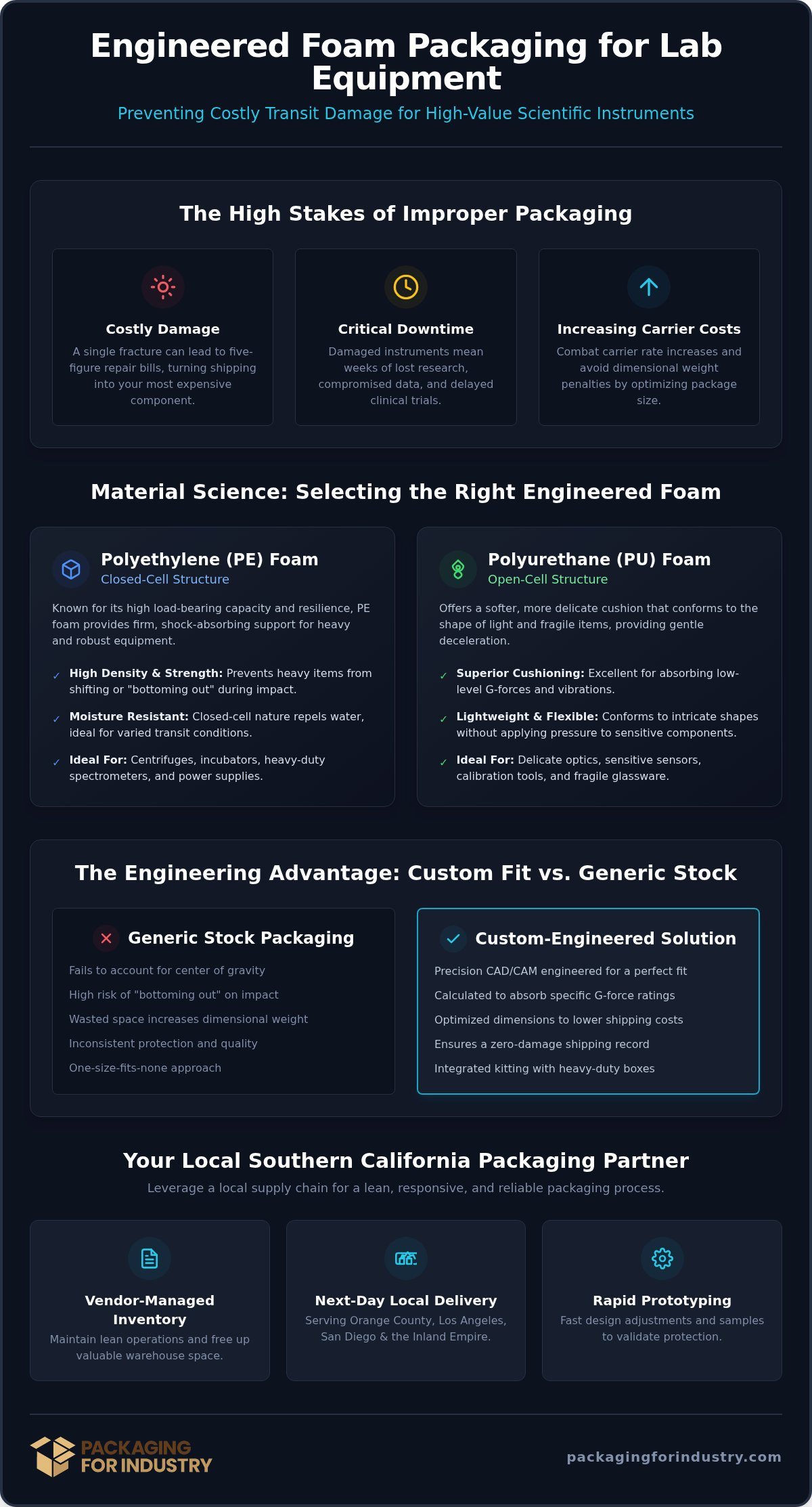
Standard catalog packaging is built for the average, not the exceptional. When shipping a high-value mass spectrometer or a delicate medical laser, relying on generic foam inserts is a gamble with your company’s bottom line. Most off-the-shelf options fail to account for the specific center of gravity or the fragility of internal optical sensors. This mismatch often results in “bottoming out,” where the instrument strikes the outer box during a drop, rendering the packaging useless. It’s a common failure point that leads to expensive claims and operational delays.
The true cost of transit damage extends far beyond the immediate repair bill. For laboratories in San Diego or Irvine, a damaged instrument means lost calibration, weeks of research downtime, and potentially compromised clinical trial data. We define high-performance protective foam packaging for lab equipment Southern California as a precision-engineered shock absorption system designed to negate these risks. It’s about protecting the integrity of the data just as much as the physical hardware. Professional logistics managers know that an instrument that arrives “looking” fine but requiring a full recalibration is still a failure of the packaging system.
Fragility Factors: Understanding G-Force and Vibration
Every instrument has a fragility rating, measured in G-forces, which indicates the maximum impact it can survive without damage. Effective Package cushioning must be calculated to keep impacts below this specific threshold. Vibration is equally dangerous. Constant high-frequency shaking during truck transit can loosen internal fasteners or knock sensitive alignments out of spec. Interestingly, over-packaging can be just as hazardous as under-packaging. If the foam is too stiff for the instrument’s weight, it won’t compress enough to absorb the shock, passing the full force of an impact directly into the equipment.
Southern California’s Biotech and Medical Hubs
Navigating the logistics landscape from the Sorrento Valley biotech cluster to Irvine’s medical device corridor requires a partner who understands local transit realities. Shipping through the 405 and 15 corridors involves constant stop-and-go movement and varying road surfaces that test the limits of your packaging. Our Anaheim headquarters provides a strategic advantage for these hubs. Being local allows for rapid prototyping and same-day design adjustments that catalog suppliers simply can’t match. When you request a packaging quote from a local expert, you’re investing in a supply chain that accounts for heat, humidity, and the specific multi-modal challenges of LAX and the Port of Long Beach.
Material Science: Selecting the Right Foam for Laboratory Gear
Selecting the correct polymer is a matter of engineering, not just cushioning. For sensitive laboratory gear, the choice between Polyethylene (PE) and Polyurethane (PU) depends on the instrument’s weight and fragility. Beyond shock absorption, you must consider material longevity. Low-quality foams can degrade over time or “dust,” releasing particulate matter that can ruin sensitive optical lenses or contaminate sterile samples. High-performance protective foam packaging for lab equipment Southern California utilizes high-grade materials that maintain their structural integrity throughout the equipment’s lifecycle.
Polyethylene (PE) Foam for Heavy-Duty Support
PE is a closed-cell foam known for its high load-bearing capacity and moisture resistance. This makes it the industry standard for heavier laboratory equipment like centrifuges, incubators, or heavy-duty spectrometers. Because the cells are sealed, the foam doesn’t compress as easily as open-cell varieties, providing a firm base that prevents heavy instruments from shifting. Custom-cut PE planks or pads are often used for base-loading to ensure the most weight-intensive parts of the gear remain stabilized during long-haul transit across the Inland Empire or down to San Diego.
Polyurethane (PU) and Convoluted Foam for Fragile Optics
PU is an open-cell foam that offers a much softer touch, ideal for delicate glassware, sensors, and lightweight calibration tools. It provides a gentle deceleration upon impact. Convoluted (egg-crate) PU foam is particularly versatile for kitting multiple small components within a single box. The primary engineering challenge with PU is balancing its softness with enough density to prevent “bottoming out.” If the foam is too soft, the instrument will push through the cushion and strike the outer box during a drop. You can request a packaging quote to have our engineers determine the exact density required for your specific fragility rating.
ESD and Anti-Static Foam for Electronic Lab Gear
Laboratory equipment often contains sensitive semiconductor components that are vulnerable to electrostatic discharge (ESD). Using standard foam can generate static through friction, potentially frying internal circuit boards. We provide specialized anti-static foams, typically identified by their pink or black additives, which dissipate static charges safely. For sterile medical environments, we also offer cleanroom-compatible foams that meet low-particulate requirements. This specialized protection is critical for manufacturers in Irvine and Sorrento Valley who must adhere to strict contamination and safety standards. Using the right anti-static material is an essential step in lowering packaging costs by eliminating the high price of electronic component failure.
The Engineering Process: Custom Foam Inserts and Prototyping
Moving from off-the-shelf cushioning to custom-designed packaging is a strategic shift that moves beyond simple protection. While catalog foam sheets might seem cheaper initially, they often lead to inconsistent packing results and higher labor costs on the assembly line. Our approach at PFI centers on precision engineering through CAD/CAM technology. We tailor every insert to the exact geometry of your instrument, ensuring that sensitive components never touch the outer walls of the container. This level of precision is the cornerstone of high-performance protective foam packaging for lab equipment Southern California, where transit across uneven coastal roads demands absolute stability.
CAD Design and Precision Die-Cutting
The engineering phase begins with your CAD files or a physical sample of the instrument. We use this data to create exact-fit cavities that distribute the equipment’s weight evenly across the foam surface. For high-volume recurring production, we typically utilize precision die-cutting to maintain consistency and lower packaging costs. For low-volume or highly complex geometries, water-jet cutting offers a tool-less alternative that maintains tight tolerances without the need for custom dies. Precision CAD design ensures that every cavity matches the instrument’s profile exactly, which eliminates the need for manual void fill and reduces the overall package size. This optimization also helps you avoid the cubic volume surcharges that carriers often apply to bulky, inefficient shipments.
Prototyping and Drop Testing
Theoretical protection is never enough for high-value lab gear. We provide free prototyping to ensure the product fit and foam density are correct before you commit to a full production rollout. This physical sample allows your team to verify the ease of packing and the security of the fit. We simulate real-world shipping conditions through iterative testing, which may include drop testing and vibration analysis to see how the foam performs under stress. If the initial test shows too much shock transfer, we refine the foam density or adjust the geometry. This consultative process ensures that your packaging kitting and assembly process is as efficient as possible. When you request a packaging quote, you aren’t just buying material; you’re securing a validated engineering process that guarantees your equipment arrives in factory-calibrated condition.
Integrated Solutions: Combining Foam, Corrugated, and Crates
Effective protective foam packaging for lab equipment Southern California doesn’t exist as a standalone component; it’s one part of an integrated system. For most high-value instruments, we utilize the “Box-in-Box” method. This involves nesting a precision foam insert within a primary heavy-duty corrugated box, which is then suspended within a larger outer container. This dual-layer approach provides redundant shock absorption and protects against the exterior punctures common in high-volume distribution centers.
This integration is where engineering meets economics. With the 2026 general rate increase averaging 5.9% for major carriers, optimizing your total package volume is critical to lower packaging costs. Carriers currently use a dimensional weight divisor of 139 for domestic shipments. If your foam is too thick or your box is unnecessarily large, you’ll pay for empty air. Packages exceeding 10,368 cubic inches now trigger Additional Handling surcharges, regardless of weight. We engineer our foam-and-box combinations to provide the smallest possible footprint that still guarantees a zero-damage record. See our guide on custom corrugated boxes to understand how we match box strength to your specific instrument weight.
Heavy-Duty Corrugated and Double-Wall Boxes
We match the Edge Crush Test rating of our containers to the specific weight and fragility of your lab gear. For equipment weighing over 50 lbs, which often triggers carrier “Additional Handling” surcharges, we typically recommend double-wall or even triple-wall corrugated. Triple-wall boxes offer a significant strength-to-weight advantage, often serving as a cost-effective alternative to wood crates for domestic transit. Custom sizes available for these heavy-duty boxes ensure that your instruments are snug, reducing the risk of internal shifting during transit through San Diego or the Inland Empire. We also offer custom printing to ensure your medical device delivery maintains a professional, branded appearance.
Custom Foam-Lined Crates for High-Value Transit
When instruments reach extreme weights or price points, such as mass spectrometers or robotic lab arms, we move from corrugated to custom wood crates. These crates are lined with precision-cut foam end caps, providing the highest grade of protective foam packaging for lab equipment Southern California available for heavy-duty industrial logistics. For international shipments departing from LAX or the Port of Long Beach, we use export-ready (ISPM-15) heat-treated wood. By engineering the crate and the foam as a single unit, we eliminate the guesswork often found when buying materials from separate vendors.
Why Southern California Manufacturers Choose PFI for Lab Packaging
Procurement and operations managers in the scientific sector require more than just a vendor; they need a strategic partner who understands the intersection of engineering and economics. We specialize in providing high-performance protective foam packaging for lab equipment Southern California by focusing on the specific logistical hurdles of the region. Our B2B approach centers on dedicated support that addresses the high replacement costs of damaged instruments and the operational stress of supply chain inconsistencies. By manufacturing locally, we eliminate the unnecessary markups and lengthy lead times associated with national catalog suppliers.
Anaheim-Based Support and Nationwide Shipping
The primary advantage of our Anaheim headquarters is the ability to provide hands-on, consultative support. We offer site visits to your facilities in Irvine, Carlsbad, or the Inland Empire to evaluate your current packing line and identify points of failure. This proximity allows for rapid design changes and immediate prototyping that keeps your production schedule on track. While we provide local next-day delivery across Orange County, Los Angeles, and San Diego, we also maintain nationwide distribution capabilities. This ensures that manufacturers with multiple facilities receive the same precision-engineered quality regardless of destination. To further streamline your operations, we offer Vendor Managed Inventory (VMI) services. We monitor your stock levels and replenish your packaging supplies automatically, which prevents stockouts and keeps your production line moving.
Cost-Reduction and Supply Chain Reliability
Smart engineering is the most effective way to lower packaging costs. Many companies unknowingly pay a premium for oversized catalog boxes and generic foam that doesn’t fit their equipment. We provide competitive pricing on custom and bulk orders by optimizing the material usage for every insert. Our Just-in-Time (JIT) delivery model allows you to free up valuable lab warehouse space that would otherwise be wasted on bulky foam stock. Instead of storing months of packaging on-site, you can rely on our local facility to deliver exactly what you need, when you need it. This pragmatic approach reduces your overhead and improves your overall supply chain reliability. You can request a packaging quote today to begin a comprehensive cost-reduction analysis. We’ll demonstrate how custom-engineered protective foam packaging for lab equipment Southern California can improve your shipping record while protecting your bottom line.
Optimize Your Laboratory Logistics Strategy
Securing high-value scientific instruments requires a shift from generic supplies to an engineered system. You’ve seen how custom CAD/CAM design eliminates the risks of bottoming out while helping you avoid costly dimensional weight surcharges. By utilizing specialized materials like anti-static and mil-spec foam, you protect the long-term calibration and functionality of your gear during the most rigorous transit cycles. It’s about protecting the integrity of your research data as much as the hardware itself.
Partnering with an Anaheim-based specialist ensures your production line never stops due to packaging shortages. We provide free CAD/CAM prototyping to validate every design before full production rollout. With local next-day delivery across Orange County, San Diego, and Los Angeles, your warehouse stays lean and your shipping record remains flawless. Investing in precision protective foam packaging for lab equipment Southern California is the most reliable way to safeguard your bottom line and your professional reputation.
We look forward to helping you streamline your supply chain and eliminate transit damage for good.
Frequently Asked Questions
What is the best foam density for shipping sensitive lab instruments?
The optimal foam density is determined by your equipment’s fragility rating and total weight. For heavy instruments like centrifuges, a 1.7 lb or 2.2 lb density polyethylene (PE) foam provides the necessary structural support to prevent bottoming out. Lighter, more delicate sensors often require softer polyurethane (PU) foam with a lower density to absorb high-frequency vibrations. We engineer protective foam packaging for lab equipment Southern California to ensure the density specifically matches your instrument’s G-force threshold.
Can you design custom foam inserts if I don’t have CAD files for my equipment?
Yes, our engineering team can design precision inserts even if you don’t have CAD files available. We frequently work with physical samples of the equipment to create exact-fit cavities through manual measurement and digitizing. This process ensures that the foam geometry accounts for every protrusion and sensitive port. Once we capture the dimensions, we generate a design file for future production runs, ensuring consistency across every shipment you send from your Southern California facility.
Do you offer anti-static or ESD-safe foam for electronics?
We provide a full range of anti-static (pink) and conductive (black) ESD-safe foams specifically for electronics-heavy laboratory gear. These materials prevent the buildup of static electricity that can damage sensitive internal circuit boards and semiconductor components during transit. Using ESD foam is a critical requirement for medical device manufacturers in Irvine who must comply with strict safety and performance standards. It’s a proactive step that helps you lower packaging costs by eliminating electronic failure claims.
How long does it take to get a prototype for a custom lab equipment insert?
You can typically expect a physical prototype for a custom lab equipment insert within 48 to 72 hours. Because we operate out of our Anaheim headquarters, we prioritize rapid prototyping to keep your production timeline moving. This physical sample allows your team to verify the fit and ease of assembly before you commit to a full production run. It’s an essential part of our consultative process, ensuring that the protective foam packaging for lab equipment Southern California meets your exact specs.
What is the minimum order quantity for custom-cut foam packaging?
We specialize in recurring production runs and bulk quantities for industrial manufacturers and distributors. While we don’t have a rigid one-size-fits-all minimum, our custom-cut foam services are optimized for businesses with ongoing packaging requirements rather than one-off residential needs. This focus allows us to offer competitive bulk pricing that helps you lower packaging costs across your entire supply chain. Request a packaging quote to discuss your specific volume requirements and recurring production schedules with our sales team.
How do I choose between a heavy-duty box and a custom wood crate for my equipment?
The choice between a heavy-duty corrugated box and a custom wood crate depends on the equipment’s weight and the shipping destination. For domestic transit of instruments under 100 lbs, a triple-wall corrugated box often provides sufficient protection at a lower freight cost. If you’re shipping heavy robotic arms or shipping internationally through the Port of Long Beach, a custom foam-lined wood crate is the safer choice. We engineer both solutions to ensure maximum transit security.
Do you provide local delivery to Sorrento Valley or the Irvine Spectrum?
We provide local next-day delivery to major biotech and medical hubs, including Sorrento Valley in San Diego and the Irvine Spectrum in Orange County. Our Anaheim location is strategically positioned to serve the 405 and 5 corridors, ensuring your warehouse stays stocked without the need for excessive on-site inventory. This local service is a key advantage for manufacturers who require just-in-time packaging delivery to keep their production lines running efficiently and avoid costly logistical delays.
Can PFI manage my packaging inventory to prevent production stops?
Our Vendor Managed Inventory (VMI) programs are designed specifically to prevent production stops by managing your packaging stock for you. We monitor your usage levels and automatically replenish your custom foam inserts and corrugated boxes before you run out. This service frees up your warehouse space and allows your procurement team to focus on other business-critical tasks. It’s a pragmatic solution for high-volume manufacturers who demand supply reliability and a streamlined, cost-effective logistical flow.