
A standard shipping label won’t protect a $50,000 industrial control panel from a denied insurance claim if your internal cushioning fails a basic carrier drop test. You already know that transit damage is more than just a repair bill; it’s a direct hit to your production schedule and client trust. Relying on generic catalog supplies often leads to inconsistent protection and wasted warehouse space. This guide explains how to select the right protective foam for industrial control panel shipping to ensure your high-value electronics arrive intact every time.
You will learn how to specify the exact foam densities and custom insert designs needed to achieve zero-damage shipping cycles. We will cover the technical requirements for high-performance polyethylene and anti-static materials that meet the ANSI/ESD S541-2026 standards. By optimizing your packaging footprint, you can lower freight costs while maintaining a reliable supply chain. This overview provides the logistical clarity required to move from reactive damage control to a proactive, engineered protection system.
Key Takeaways
- Identify the critical differences between Polyethylene (PE) and Polyurethane (PU) foam to match material density with your panel’s weight and surface sensitivity.
- Learn how custom-engineered protective foam for industrial control panel shipping eliminates transit damage by securing complex internal geometries that standard stock planks often miss.
- Understand the importance of a total packaging system that integrates custom foam inserts with heavy-duty double-wall or triple-wall corrugated boxes for maximum structural integrity.
- Explore how Vendor Managed Inventory (VMI) and local stocking programs in Southern California can solve lead time issues and prevent production shortages for recurring orders.
The Logistics of Shipping Industrial Control Panels
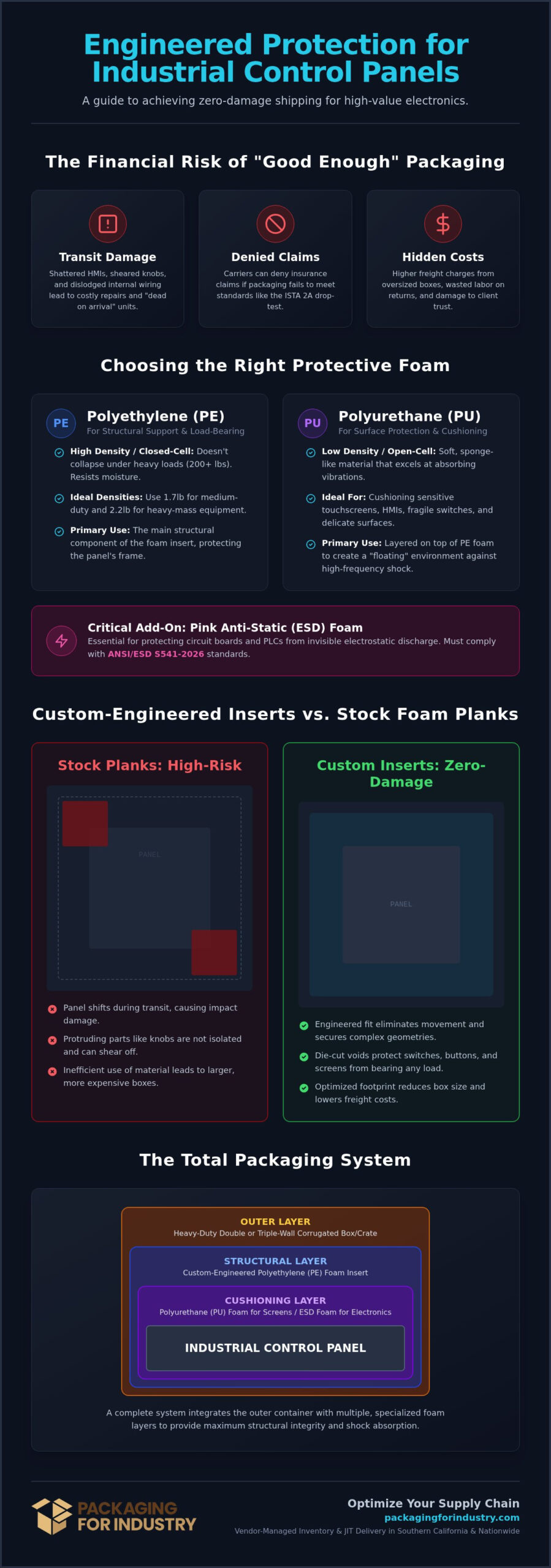
Shipping an industrial control panel is a logistical paradox. While the heavy steel or aluminum enclosure suggests durability, the internal electronics are often as sensitive as laboratory equipment. This weight-to-fragility ratio makes standard catalog supplies insufficient for high-value shipments. When you use inadequate protective foam for industrial control panel shipping, you risk more than just hardware replacement costs. You face the administrative burden of labor hours for repairs, the loss of client confidence, and the high probability of denied insurance claims from carriers like UPS or FedEx.
Common failure points identified in industrial environments include:
- Shattered HMIs and touchscreens: Mechanical vibrations during transit can cause micro-fractures or total screen failure.
- Knob and switch shear: Protruding elements often catch on loose packaging, snapping off during handling.
- Dislodged internal wiring: High-frequency vibrations can loosen terminal block connections, leading to “dead on arrival” units that require expensive field technician visits.
To secure a valid damage claim, your packaging must typically meet ISTA 2A drop-test standards. Effective Package cushioning acts as the primary defense against these mechanical shocks by decelerating the product over a controlled distance.
Identifying Your Panel’s Fragility Level
Engineering an effective solution begins with assessing the “G-factor,” which is the maximum acceleration a component can withstand before failure. Sensitive PLCs and circuit boards often have low G-ratings, requiring high-dampening foam. If your panel contains electrostatically sensitive items, your packaging must comply with the ANSI/ESD S541-2026 standard to prevent static discharge from destroying internal logic. Protruding elements like emergency stop buttons require specialized die-cut voids to ensure they don’t bear the load of the panel during a drop or tip-over event.
The Financial Impact of “Good Enough” Packaging
The hidden costs of transit damage extend far beyond the RMA process. In August 2026, diesel fuel prices averaged $5.454 per gallon, making return shipments and redeliveries more expensive than ever. “Good enough” packaging often uses excessive material to compensate for poor design, which artificially increases the dimensional weight of your corrugated boxes. By switching to custom-engineered protective foam for industrial control panel shipping, you can often reduce the overall box size. This optimization lowers your freight costs and eliminates the fiscal stress of recurring damage claims. You can request a packaging quote to see how an engineered approach provides better protection while streamlining your logistics budget.
Choosing the Right Material: PE, PU, and ESD Foam
Selecting the right material for protective foam for industrial control panel shipping isn’t just about padding. It’s about engineering a hybrid system that accounts for the panel’s heavy frame and its delicate electronic interfaces. Most industrial applications require a combination of materials to address different stress points within the crate or box. Using a single type of foam often leaves the shipment vulnerable to either structural collapse or surface damage.
Polyethylene vs. Polyurethane for Heavy Panels
Polyethylene (PE) foam is the industry standard for load-bearing protection. This closed-cell material doesn’t collapse under the weight of a 200-pound control cabinet. Selecting the correct density is vital. A 1.7lb PE foam works for most medium-duty panels, while 2.2lb density provides the necessary resistance for high-mass equipment. Because PE is a closed-cell foam, it also resists moisture and chemical exposure, which is critical during long-haul transit or warehouse storage.
In contrast, Polyurethane (PU) foam is an open-cell, softer material. It’s ineffective for supporting the panel’s weight but excels as a top-layer buffer. We use PU foam to cushion touchscreens, HMI displays, and fragile switches. By layering PU over PE, you create a “floating” environment that absorbs high-frequency vibrations. To verify these performance metrics, we rely on ASTM D1596 cushioning standards to measure shock absorption across different material thicknesses. This ensures the material won’t “bottom out” during a standard drop event.
Static Control: When to Use Pink Anti-Static Foam
Invisible damage from electrostatic discharge (ESD) can be more costly than a dented cabinet. If your panel houses Programmable Logic Controllers (PLCs) or sensitive circuit boards, you must integrate ESD-safe materials. Pink anti-static foam is treated with a topical agent to prevent static buildup on the foam surface itself. For components with extreme sensitivity, conductive or dissipative foams are often required to meet ANSI/ESD S541-2026 requirements.
Integrating these materials into a complete protective foam packaging strategy ensures that your electronics remain functional upon arrival. For panels with “Class-A” finishes or specialized powder-coated surfaces, Cross-Linked Polyethylene (XLPE) is often the best choice. It offers a smooth, non-abrasive surface that prevents scuffing while maintaining the structural benefits of standard PE. Selecting the wrong density can lead to hardware failure, but over-engineering leads to unnecessarily high costs. You can request a packaging quote to compare different material combinations tailored to your specific panel dimensions and weight.
Custom Foam Inserts vs. Stock Foam Planks
Deciding between stock foam planks and custom inserts requires a balance between upfront tooling costs and long-term labor efficiency. While stock planks offer a low-cost entry point for standard, square enclosures, they often require manual cutting and taping that drains warehouse productivity. For high-volume manufacturers, the labor saved by using pre-configured protective foam for industrial control panel shipping typically outweighs the initial engineering investment. Your production line speed depends on packaging simplicity; custom solutions allow workers to secure a panel in seconds rather than minutes.
Stock foam planks remain a pragmatic choice for uniform panels that fit snugly within standard RSC boxes. However, if your panel features complex geometries or protruding components, stock material often fails to provide uniform support. Custom die-cut foam creates a precise nest for the product, distributing the load across the strongest points of the cabinet frame. We often recommend foam end caps as a middle ground. These caps secure the top and bottom of the panel, providing a 2-inch or 3-inch “float” within the box without the need to wrap the entire unit in expensive material.
Engineering Custom Foam Assemblies
The transition to custom packaging begins with a technical assessment of your panel’s dimensions. At PFI, we utilize CAD/CAM support to ensure that every cutout aligns perfectly with your hardware. For small production runs or initial testing, CNC routing offers a tool-less way to create precise prototypes. Larger recurring orders typically move to die-cutting, which provides the lowest per-unit cost for high-volume protection. You can verify the fit of your design through our free prototyping services, ensuring the protective foam for industrial control panel shipping performs exactly as intended before you commit to a full production run.
Optimizing for the Unboxing Experience
The unboxing process is the first interaction your customer has with your engineering quality. Using specialized kitting and assembly techniques, we can design inserts that make it easy for the end-user to remove a heavy panel without damaging sensitive switches. If your equipment requires regular field servicing, we develop reusable foam designs that survive multiple shipping cycles. This approach reduces waste and provides your technicians with a reliable way to transport panels back for maintenance. Integrating these features into your Custom design packaging services ensures that your brand’s reputation for quality extends from the factory floor to the client’s facility.
The Total Solution: Integrating Foam with Boxes and Crates
High-performance protective foam for industrial control panel shipping is only effective if the outer container maintains its structural integrity. If the box buckles under the weight of stacked freight, the internal foam can’t distribute shock loads as designed. For most industrial control panels, standard single-wall boxes are insufficient. We recommend moving to heavy-duty corrugated boxes, specifically double-wall or triple-wall constructions, to provide the necessary stacking strength and puncture resistance.
Selecting the right outer shell depends on the panel’s weight and the shipping environment. Double-wall boxes, often rated at 48 or 51 ECT (Edge Crush Test), handle most standard industrial loads effectively. Triple-wall corrugated is the preferred choice for exceptionally heavy units that might otherwise require a full wood crate. For oversized cabinets or units exceeding 500 pounds, custom wood crates integrated with foam blocking provide the ultimate level of protection against the rigors of LTL freight. These crates prevent the racking or twisting that often occurs when heavy equipment is moved by a forklift.
Corrugated Box Selection for Industrial Equipment
Matching the box’s ECT rating to your foam-encased panel is a critical engineering step. A high-density foam insert in a weak box creates a punch-through risk during a drop. We also consider weather-resistant adhesives for corrugated materials used in international shipping to prevent moisture-induced structural failure during long-haul transit. To reinforce these loads, we utilize corner and edge protection. These rigid boards prevent box crush when pallets are stacked. They ensure the outer container stays square and the internal protective foam for industrial control panel shipping remains properly positioned to absorb impact.
Palletization and Load Stabilization
Once the panel is boxed, stabilization becomes the priority. A shifting load is a primary cause of denied insurance claims and warehouse accidents. We use high-performance stretch film with high puncture resistance to secure the boxed panel to the pallet. This prevents lateral movement during sudden stops or turns. For panels that are bottom-heavy or have an offset center of gravity, custom pallets or skids are engineered to provide a wider, more stable base. These Manufacturing packaging solutions create a unified system where the box, foam, and pallet work together to survive the modern supply chain’s stresses.
Optimizing Your Supply Chain with PFI in Southern California
Supply chain reliability is often the difference between meeting a shipping deadline and facing a production bottleneck. Relying on generic catalog distributors frequently leads to inconsistent material quality or unexpected stock outages that stall your high-value shipments. At PFI, we solve these disruptions through dedicated stocking programs for your protective foam for industrial control panel shipping. By maintaining local inventory at our facility, we act as a buffer against market volatility and prevent production shortages. This ensures that your assembly line stays active because the exact protective components you need are always staged and ready for dispatch.
Our logistical network is engineered to support the diverse industrial landscape of the region. We provide local next-day delivery to manufacturers in Anaheim, Orange County, and the Inland Empire. We also serve specialized sectors in San Diego and across Los Angeles County with the same level of speed and precision. For companies with multi-location operations, our nationwide shipping capabilities ensure that your engineering standards remain uniform at every site. This centralized control eliminates the variability that typically leads to transit damage when using different suppliers in disparate regions. It is a pragmatic logistical approach that prioritizes long-term stability over simple commodity sourcing.
The VMI Advantage for Custom Packaging
Implementing a Vendor Managed Inventory (VMI) program fundamentally changes how you manage warehouse overhead. Instead of dedicating valuable floor space to bulky foam orders, PFI manages the stock levels for you. We conduct scheduled inventory reviews to match your specific production cycles, ensuring you have the right volume without overstocking. This proactive system improves your cash flow by eliminating emergency rush orders and the high costs of expedited freight. It turns your packaging into a just-in-time asset that moves in sync with your production flow, allowing your team to focus on manufacturing rather than inventory tracking.
Request a Packaging Quote from Packaging For Industry
Starting a comprehensive packaging review is the most effective way to identify hidden inefficiencies in your current logistics. We provide a detailed cost-reduction analysis that compares our engineered solutions against standard catalog pricing. With custom sizes available for any control panel geometry, we eliminate the need for your warehouse staff to manually modify generic foam planks. This reduction in labor and material waste directly contributes to your bottom line. Contact our Anaheim headquarters to speak with a consultant about your specific requirements. You can request a packaging quote today to secure your supply chain with local expertise and reliable delivery schedules.
Securing Your High-Value Industrial Shipments
Selecting the correct protective foam for industrial control panel shipping is a strategic decision that impacts your operational bottom line. By moving away from generic catalog supplies and adopting engineered foam inserts, you eliminate the high costs of transit damage and the administrative burden of denied insurance claims. The right combination of high-density polyethylene and anti-static materials provides the structural support and electronic safety required for modern industrial logistics.
Packaging For Industry provides a comprehensive partnership that extends beyond material supply. We offer free prototyping for all custom designs to ensure a perfect fit before production begins. Our expertise in Aerospace and Electronics packaging allows us to solve complex fragility challenges while streamlining your warehouse operations. With local next-day delivery in Southern California, you can maintain lean inventory levels without risking production delays.
Our team is ready to help you lower packaging costs and improve shipping reliability. We look forward to engineering a solution that protects your hardware and your professional reputation.
Frequently Asked Questions
What is the best foam density for shipping heavy industrial control panels?
Polyethylene (PE) foam is the industry standard for securing heavy enclosures. For most medium-duty panels, a 1.7lb density provides the necessary shock absorption without collapsing. However, units exceeding 150 pounds often require 2.2lb density PE to maintain structural integrity during LTL transit. We select the specific density based on your panel’s mass and the sensitivity of internal PLCs, ensuring the material decelerates the load effectively during a drop or vibration event.
Do I need anti-static foam for all industrial control panels?
Anti-static or ESD foam is only required if your control panel contains logic-level electronics, semiconductors, or circuit boards. If your system relies on sensitive controllers, using pink anti-static foam is essential to comply with ANSI/ESD S541-2026 standards. This prevents electrostatic discharge from damaging internal components during handling. For purely mechanical or high-voltage panels without logic-level controllers, standard non-treated polyethylene is usually a sufficient and cost-effective choice.
How does custom die-cut foam compare to using foam planks for protection?
Custom die-cut foam is designed for production efficiency and precise fit, whereas stock planks are best for low-volume, uniform boxes. Using protective foam for industrial control panel shipping that is pre-cut to your cabinet’s dimensions significantly reduces labor hours on the packing line. While stock planks require manual fabrication by your warehouse team, custom inserts arrive ready for immediate assembly, providing consistent protection that stock materials cannot match for complex geometries.
Can I get a prototype of my custom foam insert before placing a bulk order?
Yes, PFI offers free prototyping for all custom-engineered designs to verify product fit and protection levels. We use CAD data to create precise samples via CNC routing or die-cutting before you commit to a production run. This allows you to perform drop tests and ensure that protruding elements, such as emergency stop buttons or HMIs, are properly protected. This engineering-first approach eliminates the risk of costly packaging failures after your units have shipped.
How do I lower my shipping costs when using bulky foam packaging?
The most effective way to lower packaging costs and freight fees is to optimize the dimensional weight of your container. Because we have custom sizes available for both foam and corrugated boxes, we can design a tighter packaging footprint that reduces the overall box volume. Eliminating just two inches of “dead space” can move your shipment into a lower freight class, significantly reducing the surcharges typically associated with oversized industrial equipment.
What are the benefits of a Vendor Managed Inventory (VMI) program for packaging?
A VMI program ensures you never face a production stoppage due to missing packaging supplies. We monitor your usage rates and maintain a dedicated stock of your custom foam inserts at our facility. This allows you to free up valuable warehouse floor space for manufacturing while ensuring a just-in-time supply of materials. It also improves fiscal stability by allowing you to compare packaging pricing and lock in rates for recurring production cycles.
Does PFI provide local delivery in Orange County, Los Angeles, and San Diego?
Yes, we provide local next-day delivery to manufacturers throughout Orange County, Los Angeles, and San Diego from our Anaheim headquarters. Our company-owned fleet also services the Inland Empire, ensuring reliable transit times that catalog distributors cannot guarantee. For customers with facilities outside of Southern California, we utilize our nationwide shipping capabilities to provide consistent protective foam for industrial control panel shipping at every location in your supply chain.
Can custom foam inserts be integrated into heavy-duty corrugated boxes?
Custom foam is most effective when integrated into a high-strength outer shell, such as double-wall or triple-wall corrugated boxes. This total system approach ensures that the outer container resists punctures and stacking pressure while the internal foam absorbs mechanical shock. We engineer these components to work together, often incorporating corner boards for palletized loads. This creates a unified protective barrier that meets carrier insurance requirements and ensures your high-value panels arrive in factory condition.