
The 2026 UPS and FedEx general rate increase of 5.9% is only the surface of a much deeper logistical challenge for manufacturers in Los Angeles and Orange County. With new cubic volume surcharges now penalizing bulky, lightweight packages, the true cost of inefficient packaging has reached a breaking point. You’ve likely realized that off-the-shelf solutions from national catalogs often lead to excessive warehouse clutter and high replacement costs. Sourcing custom foam inserts for industrial parts Southern California is no longer just about protection; it’s a critical strategy for controlling your total landed costs.
We understand the pressure to maintain a zero-damage shipping record while keeping your operations lean. This guide will help you master the process of specifying precision-engineered foam inserts that eliminate transit damage and improve professional presentation. You’ll learn how to navigate the 2026 California Assembly Bill 2026 regulations, select the optimal polyethylene or polyurethane grades for your components, and leverage just-in-time delivery to reclaim valuable floor space. We’ll outline a clear path toward logistical optimization that prioritizes both engineering precision and fiscal responsibility.
Key Takeaways
- Learn why generic packaging fails to protect heavy components from the unique vibration risks inherent in Southern California’s LTL hubs and port traffic.
- Identify the technical differences between Polyethylene and Polyurethane foam to select the most durable material for your specific industrial application.
- Discover how CAD/CAM engineering and free prototyping eliminate the risk of specification errors before you move to full-scale production.
- Streamline your local operations by sourcing custom foam inserts for industrial parts Southern California through specialized Vendor Managed Inventory (VMI) programs.
- Reduce your total landed costs by leveraging just-in-time delivery to reclaim valuable warehouse floor space and minimize bulk inventory overhead.
The Cost of Damage: Why Industrial Parts in SoCal Need Custom Foam
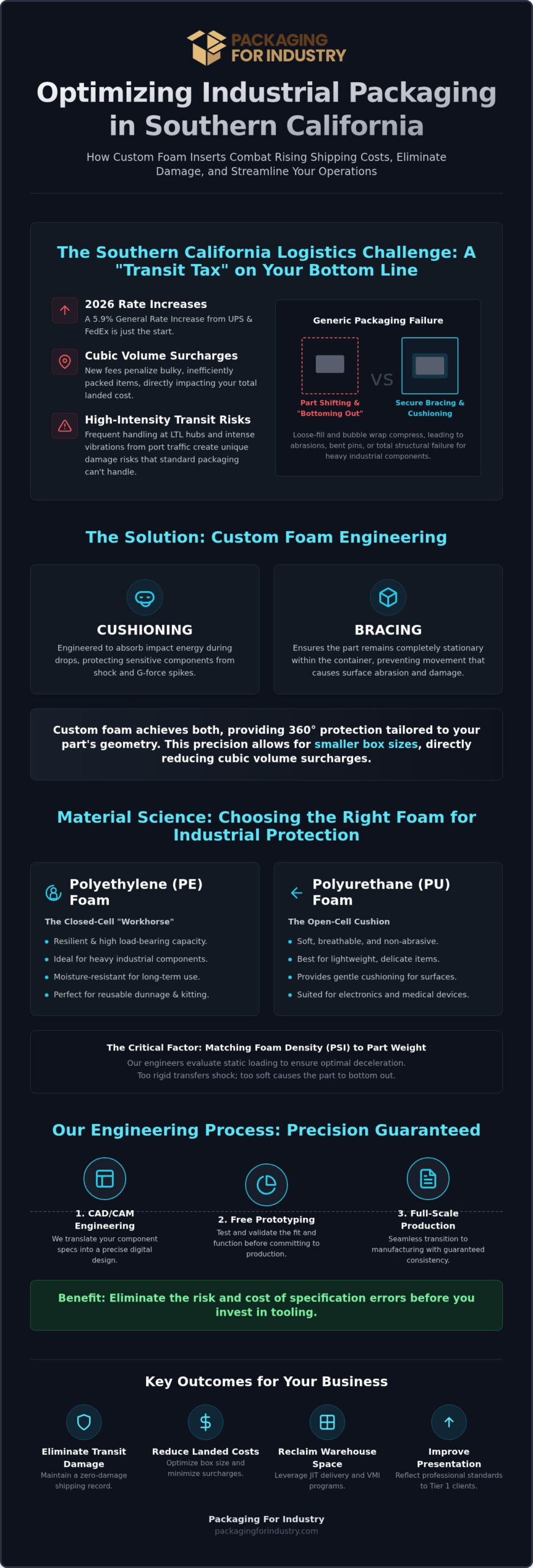
Shipping high-value components through the Southern California corridor involves more than just calculating mileage. It involves accounting for the “SoCal Transit Tax.” This refers to the cumulative physical stress caused by frequent handling at LTL hubs in the Inland Empire and the intense vibrations encountered near the Port of Los Angeles. Standard packaging often fails here because it wasn’t engineered for these specific, high-intensity logistical environments. When you invest in custom foam inserts for industrial parts Southern California, you’re not just buying material; you’re securing your bottom line against the volatility of the regional supply chain.
The Southern California Logistics Challenge
Navigating the “last mile” in Los Angeles and Orange County freight corridors presents unique risks. Parts moving through the Port of Long Beach or San Pedro are subject to heavy machinery handling that generic void-fill simply cannot withstand. While bubble wrap or loose-fill peanuts might suffice for lightweight consumer goods, they fail for heavy or high-value industrial components. These materials compress under weight, allowing parts to “bottom out” or shift violently during transit through high-traffic hubs in San Diego or the Inland Empire. This movement leads to surface abrasions, bent pins, or total structural failure before the product even reaches the customer.
The Difference Between Cushioning and Bracing
Professional packaging engineering distinguishes between cushioning and bracing. Cushioning is designed to absorb impact energy during a drop, while bracing ensures the part remains stationary within the box. Custom foam packaging achieves both by providing 360-degree protection tailored to the complex geometries of your parts. This precision engineering also allows for smaller box sizes. With the 2026 UPS and FedEx cubic volume surcharges now in effect, reducing your package footprint through custom design packaging is a direct way to lower packaging costs.
The financial impact of damage includes hidden costs like the administrative labor of filing freight claims and the loss of customer trust. For those in the aerospace or medical sectors, a damaged part can halt an entire production line. A custom-engineered insert ensures your components arrive in factory-perfect condition, reflecting the professional standards your Tier 1 clients expect. If you are ready to eliminate transit damage, you can request a packaging quote to see how precision inserts can optimize your operations.
Material Science: Choosing the Right Foam for Industrial Protection
Selecting the correct material for custom foam inserts for industrial parts Southern California requires a balance between engineering requirements and shipping economics. With the 2026 parcel rate increases focused on cubic volume and weight thresholds, the density of your foam choice directly impacts your total landed costs. You don’t just need protection; you need the lightest material capable of meeting your specific G-force requirements.
Comparing Closed-Cell vs. Open-Cell Industrial Foams
The primary distinction in industrial packaging is between closed-cell and open-cell structures. Polyethylene (PE) foam is a closed-cell “workhorse” designed for heavy components and reusable dunnage. It’s resilient, moisture-resistant, and possesses a high load-bearing capacity. In contrast, Polyurethane (PU) foam is an open-cell material that provides a soft, breathable cushion for lightweight, delicate items. Matching the foam’s PSI (pounds per square inch) to the part weight is critical. If the foam is too rigid, the shock of a drop is transferred directly to the part. If it’s too soft, the part will bottom out against the corrugated wall. Our engineers evaluate the static loading of your components to ensure the foam density provides optimal deceleration during transit.
Specialized Foams for Regulated Industries
Manufacturers in specialized sectors like aerospace and medical devices require foams with specific chemical and physical properties. Cross-linked Polyethylene (XLPE) is frequently specified for aerospace applications in Torrance and Long Beach due to its superior chemical resistance and fine cell structure, which prevents surface scratching on high-finish parts. For the defense sector, we provide Mil-Spec compliant foams that meet rigorous durability standards for field use.
- ESD and Anti-Static Foam: Essential for the Southern California semiconductor industry to prevent electrostatic discharge from damaging sensitive circuit boards.
- Medical-Grade Foam: Engineered for cleanroom compatibility, these foams are non-abrasive and resistant to particulate shedding.
- High-Density PE: Ideal for heavy industrial pumps or automotive components that require rigid bracing within a wooden crate or heavy-duty RSC box.
Understanding these material nuances helps prevent over-packaging, which is a common source of unnecessary expense. You can compare packaging pricing for various foam grades to determine which material offers the best protection-to-weight ratio for your specific application. By selecting the right density from the start, you avoid the hidden costs of transit damage and excessive shipping surcharges.
The PFI Engineering Process: From CAD Design to Free Prototyping
Procuring custom foam inserts for industrial parts Southern California requires a transition from material theory to physical application. At PFI, we follow a methodical four-step engineering process to ensure your packaging performs under real-world stress. This begins with an initial assessment where we evaluate your part’s weight, fragility ratings, and intended shipping method. We don’t just look at the part; we look at the entire logistics cycle to determine the necessary G-force protection. This data-driven approach prevents the common mistake of over-engineering, which adds unnecessary bulk and shipping weight.
CAD Design and Packaging Reviews
Once we define the protection requirements, we move into custom design packaging using CAD/CAM software. This technology allows us to engineer the insert for optimal material usage, ensuring every square inch of foam serves a functional purpose. During this phase, we often conduct packaging reviews to identify cost-reduction opportunities. For example, we might suggest packaging kitting, where multiple components are organized into a single secure insert. This reduces the number of boxes handled and lowers your total freight spend.
The Value of the Physical Prototype
While digital models are precise, they cannot replace a physical fit-test. PFI provides free prototyping because we believe fit-testing is mandatory for high-precision aerospace and medical parts. A physical sample allows your team to verify that the part seats correctly and that the foam provides the expected bracing. This step is critical for reducing the risk of bulk order errors. It’s much more cost-effective to adjust a prototype than to realize a thousand units don’t fit your production line’s assembly flow. This process significantly speeds up the design-to-production cycle for Southern California manufacturers.
The final step is precision fabrication. We utilize die-cutting for high-volume efficiency and CNC routing for complex, low-volume geometries. This ensures consistent industrial quality across every unit we deliver. If you’re ready to see how our engineering team can optimize your protection, you can request a packaging quote to start the prototyping process. Our goal is to move you from design to delivery with zero guesswork and maximum reliability.
Buying Guide: Specifying Custom Foam for Your Production Line
Specifying custom foam inserts for industrial parts Southern California requires a transition from engineering theory to purchasing reality. To ensure the highest level of precision, we recommend providing 3D CAD models or physical part samples during the design phase. This eliminates the risk of manual measurement errors and ensures the foam bracing fits the complex geometries of your components perfectly. Accuracy at this stage prevents costly production delays and ensures your assembly line doesn’t encounter fitment issues during the final packaging stage.
Managing volume requirements is equally critical for operational efficiency. While high-volume orders typically lower the unit price, they often create a different problem: excessive warehouse clutter. National catalog suppliers often require bulk purchases that take up valuable floor space for months. PFI solves this by leveraging our local Anaheim production facility to offer just-in-time inventory management. This approach allows you to balance cost-effectiveness with a lean warehouse footprint.
Key Questions for Your Packaging Supplier
When vetting a local partner, look beyond the price per unit. Consider these logistical factors that impact your total landed cost. Does the supplier offer next-day delivery in Orange County, Los Angeles, or the Inland Empire? Local shipping reduces lead times and minimizes the risk of damage during long-haul transit. You should also ask if they can manage Vendor Managed Inventory (VMI). This service ensures you never face a stockout on the production line. Finally, verify they are familiar with the specific cleanliness standards for medical devices or the durability requirements for aerospace packaging.
Integrated Packaging vs. Standalone Inserts
Efficiency improves when you view foam as part of a total system. Instead of sourcing inserts and containers separately, consider integrated solutions. For heavy machinery, foam-lined wood crates provide superior bracing and impact resistance. For smaller electronics, custom die-cut boxes with integrated foam end caps reduce the number of components your team needs to handle. These packaging kitting solutions significantly lower assembly time and reduce the likelihood of packing errors on the warehouse floor.
Why Southern California Manufacturers Choose Packaging For Industry
Manufacturers in Orange County and Los Angeles operate in one of the most expensive industrial real estate markets in the country. Sourcing custom foam inserts for industrial parts Southern California from an Anaheim-based supplier like PFI provides a distinct economic advantage. We don’t just ship products; we integrate our production into your supply chain. This local presence allows us to offer specialized support that national distributors cannot match, especially when dealing with the high-stakes requirements of the aerospace and medical sectors.
Local Service, Nationwide Support
Next-day delivery is a standard capability for our clients in Irvine, Santa Ana, and Huntington Beach. This proximity ensures that design changes or urgent replenishment orders don’t result in production downtime. While we maintain deep roots in Orange County, our network of manufacturing partners allows us to support your national distribution needs with the same level of precision and accountability. You gain direct access to industrial packaging consultants who can walk your warehouse floor and identify immediate packaging cost savings through better material selection and design.
Streamlining Procurement with VMI
Inventory management is often the overlooked variable in total landed cost. Our Vendor Managed Inventory (VMI) programs are engineered to eliminate packaging shortages while freeing up your valuable floor space. Instead of dedicating hundreds of square feet to bulk packaging inventory, you can utilize that space for revenue-generating production. PFI monitors your usage levels and manages scheduled replenishment; this improves your cash flow and ensures you never face a line-down situation due to a lack of protective materials.
Reliability in a fast-paced environment requires more than just a good product. It requires a just-in-time inventory management strategy that aligns with your specific manufacturing cycle. Whether you need heavy-duty corrugated boxes for industrial pumps or anti-static foam for sensitive electronics, PFI provides a comprehensive suite of solutions. By consolidating your procurement of crates, foam, and stretch film with a single local partner, you reduce administrative overhead and ensure a consistent standard of protection across your entire product line. Our goal is to provide the peace of mind that comes from a steady, predictable, and professionally managed supply chain.
Optimize Your Southern California Supply Chain
Managing high-value industrial shipments requires more than just standard padding. It demands a precision-engineered approach that balances material science with logistical reality. By integrating CAD design support and free prototyping into your procurement process, you eliminate the risk of transit damage while ensuring a professional presentation for your Tier 1 clients. This level of oversight is particularly critical for the aerospace and medical sectors where precision isn’t optional.
Choosing the right custom foam inserts for industrial parts Southern California is a strategic decision that directly impacts your operational efficiency. Moving to a local partner allows you to leverage next-day delivery and vendor-managed inventory, effectively reclaiming warehouse floor space and reducing total landed costs. You don’t have to choose between high-quality protection and lean operations.
Our team is ready to help you streamline your packaging workflow and protect your most critical components. We look forward to partnering with you to solve your most complex logistics challenges.
Frequently Asked Questions
How do I know which foam density is right for my industrial parts?
Determining the correct density involves calculating the static loading of your component and its specific G-force fragility rating. Our engineers match the foam’s pounds per square inch (PSI) to the weight and surface area of your part. If the density is too low, the part will bottom out; if it’s too high, the shock transfers directly to the product. We provide technical assessments to ensure your custom foam inserts for industrial parts Southern California provide optimal protection.
What is the lead time for custom foam inserts in Southern California?
Lead times for custom production are significantly shorter when you partner with an Anaheim-based supplier rather than a national catalog vendor. While national suppliers often deal with weeks of transit and bulk shipping delays, our local production facility allows for rapid turnaround on both prototypes and production runs. This proximity supports just-in-time delivery schedules throughout Orange County and Los Angeles, helping you maintain a lean inventory without risking production line stockouts or delays.
Do you offer free prototypes for custom foam designs?
Yes, we provide free physical prototypes to ensure a perfect fit before you commit to a high-volume production run. This fit-testing phase is a critical part of our CAD/CAM design support, especially for complex aerospace and medical components. By approving a physical sample, you eliminate the risk of bulk order errors and verify that the foam bracing meets your assembly line’s requirements. This consultative approach ensures total accountability from design to final delivery.
Can custom foam inserts help reduce my UPS or FedEx shipping costs?
The primary way custom foam reduces costs is through dimensional weight optimization. Since the 2026 carrier rate increases penalize cubic volume, using precision foam allows for smaller corrugated boxes. This prevents your shipments from triggering Additional Handling surcharges or Large Package fees. By right-sizing the package around the part, you minimize the “air” you’re paying to ship, which is a critical strategy for managing total landed costs in the current freight environment.
What is the difference between Polyethylene and Polyurethane foam for industrial use?
Polyethylene is a rigid, closed-cell material designed for heavy-duty bracing and structural support. It’s the standard for industrial components that require durability and moisture resistance. Polyurethane is an open-cell, flexible foam used for cushioning delicate or lightweight items that are sensitive to vibration. While polyethylene is a workhorse for heavy parts, polyurethane provides the soft touch needed for medical gear. The choice depends on the fragility and weight of your specific industrial components.
Do you provide ESD or anti-static foam for electronics manufacturers?
We specialize in providing anti-static (ESD) foam inserts for the Southern California semiconductor and electronics sectors. These materials are chemically treated to prevent the buildup of static electricity, which can destroy sensitive circuit boards and microchips during handling. Available in both polyethylene and polyurethane varieties, our ESD foams meet stringent industrial standards for surface resistivity. This specialized protection is essential for manufacturers in Irvine and the Inland Empire who ship high-value electronic components.
Can I get a custom foam insert that fits into my existing corrugated boxes?
Yes, we can engineer custom foam inserts to fit perfectly within your existing corrugated boxes or RSC containers. This is a cost-effective way to upgrade your protection without discarding your current inventory of shipping supplies. Our CAD team uses your box dimensions and part samples to design an insert that maximizes internal space while providing 360-degree bracing. This integrated approach ensures your custom foam inserts for industrial parts Southern California function as a cohesive protection system.
What industries do you specialize in for custom foam packaging in SoCal?
We provide specialized packaging support for the aerospace, medical device, and electronics sectors throughout the region. Our team is familiar with the strict mil-spec standards required by defense contractors in Torrance and the non-abrasive requirements for medical manufacturers in Irvine. We also serve the broader manufacturing market, including automotive and heavy machinery sectors. This local expertise ensures your packaging meets both industry-specific regulations and the physical demands of the Southern California freight corridor.