
A single micro-scratch or a layer of chemical residue from low-grade foam can instantly turn a high-precision optical component into expensive scrap. When you manage logistics for aerospace or medical hardware, the perceived savings found in generic catalog mailers often vanish the moment a shipment is rejected due to coating degradation. Securing reliable packaging for sensitive optical lenses Los Angeles manufacturers can trust requires moving beyond standard off-the-shelf supplies toward a precision-engineered protection system.
It’s frustrating to deal with the high costs of transit damage or the sting of chemical outgassing from cheap materials. This guide explains how to engineer a custom packaging system that eliminates these risks for high-precision optical components. We will cover how specialized materials like polyethylene foam and MIL-PRF-81705 ESD barriers work together with custom corrugated shells to ensure your products arrive in pristine condition. You will also learn how local vendor-managed inventory and just-in-time delivery can stabilize your supply chain and reduce operational stress.
Key Takeaways
- High-precision lens coatings require non-contact containment and specific material selection to prevent chemical outgassing and micro-abrasions during transit.
- Engineering an integrated system with primary PET-G containment and custom foam inserts provides the specialized shock absorption necessary for high-value components.
- Utilizing custom-sized corrugated boxes helps manufacturers lower packaging costs by significantly reducing dimensional weight (DIM) surcharges from carriers.
- Implementing the specialized packaging for sensitive optical lenses Los Angeles-based firms require ensures compliance with rigorous aerospace and medical standards.
- Local Vendor Managed Inventory (VMI) and next-day delivery programs eliminate supply chain bottlenecks and prevent critical production delays.
The Challenges of Shipping Sensitive Optical Lenses
High-precision optical components are among the most difficult items to transport within an industrial supply chain. Unlike standard manufactured parts, a lens is susceptible to failure from factors that are invisible to the naked eye. Effective packaging for sensitive optical lenses Los Angeles manufacturers rely on must address more than just basic impact protection; it has to mitigate microscopic environmental and chemical threats. While understanding optical lens basics helps in recognizing the inherent fragility of the glass and its coatings, the logistics professional must focus on the specific mechanical and atmospheric hazards of the transit cycle.
Understanding Surface Abrasion and Contact Damage
Surface degradation often occurs when the lens moves even slightly against its primary container. This movement creates resonance during transit, leading to a phenomenon known as “fretting.” These micro-abrasions can strip away specialized anti-reflective or hydrophobic coatings, rendering the component useless. Many operations mistakenly rely on glassine bags or cloth pouches, but these materials provide zero structural support and can actually trap abrasive particulates against the lens surface. Professional solutions prioritize non-contact suspension, ensuring that the critical optical faces never touch the packaging walls.
The Threat of Atmospheric and Chemical Contamination
Chemical outgassing is a silent killer for high-end optics. Standard polyurethane foams often release volatile organic compounds (VOCs) over time. When these gases are trapped inside a sealed shipping container, they can condense onto the lens, forming a cloudy film that’s nearly impossible to remove without damaging the coating. For this reason, custom foam packaging using chemically inert materials like polyethylene is mandatory for long-term storage or international freight. Preventing moisture and particulate ingress is equally vital, as humidity fluctuations can lead to fungal growth on internal elements.
Modern optics frequently feature integrated electronic sensors or actuators, introducing the risk of Electrostatic Discharge (ESD). A static shock that wouldn’t harm a mechanical part can fry the sensitive circuitry of a smart lens system. Engineering a system that addresses these multi-faceted risks is the only way to maintain a reliable supply chain. Without specialized packaging for sensitive optical lenses Los Angeles distributors face high replacement costs and damaged client relationships.
Engineering the Optimal Optical Packaging System
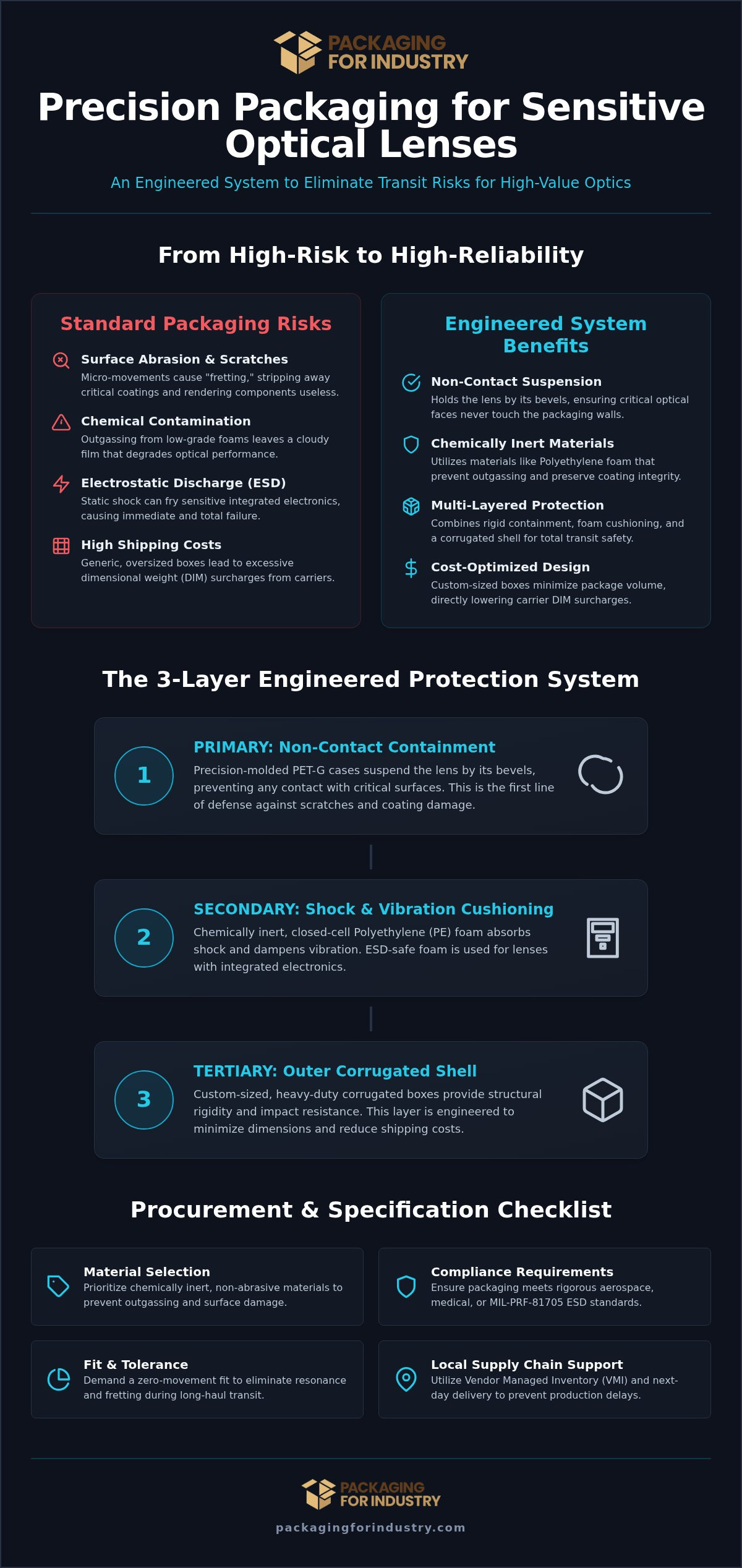
Protecting high-value optics requires a multi-layered engineering approach that extends far beyond the primary container. While a precision-molded jewel case might protect the lens surface, it does little to mitigate the structural shocks of the industrial supply chain. A robust system for packaging for sensitive optical lenses Los Angeles manufacturers can depend on involves three distinct layers: primary non-contact containment, secondary foam cushioning, and a tertiary corrugated outer shell. This integrated method ensures that delicate components survive both the acute impacts of drops and the chronic vibration of long-haul transit.
Primary containment utilizes precision-molded PET-G impact cases that suspend the lens by its bevels. This non-contact method is essential for preventing surface scratches and preserving coating integrity. By following established optical packaging standards, engineers select materials that are chemically inert, which prevents the outgassing issues discussed in previous sections. Once the lens is secured in its primary case, it must be nested within a secondary support structure to manage kinetic energy.
Selecting High-Performance Foam Materials
The choice of cushioning material is critical for shock absorption. Polyethylene (PE) is the industrial standard for optics because it’s a closed-cell foam that offers superior vibration damping compared to softer polyurethane. PE foam doesn’t shed particulates, making it ideal for cleanroom-compatible packaging. For lenses integrated with electronic sensors, we utilize ESD-safe foam to prevent electrostatic discharge. We design custom foam packaging using precision die-cutting to match the exact geometry of your primary containers, ensuring a zero-movement fit during shipment.
Corrugated Box Specifications for High-Value Optics
The tertiary layer is the outer corrugated box, which provides structural rigidity and stacking strength. For high-precision optics, standard single-wall boxes are rarely sufficient. We recommend heavy-duty double-wall RSC (Regular Slotted Carton) boxes to provide a rigid barrier against punctures and compression. In the Southern California climate, humidity can weaken standard fiberboard, so we offer weather-resistant corrugated options for maritime or long-term storage applications. These boxes can be custom-printed with handling instructions and fragile warnings to ensure visibility throughout the logistics chain.
To further improve operational efficiency, we offer integrated kitting services. This involves delivering pre-assembled packaging sets, including the custom box, foam inserts, and necessary labeling, directly to your production line. This approach helps Los Angeles manufacturers streamline their assembly process and reduce warehouse labor. If you need to optimize your current protection levels while controlling expenses, you can request a packaging quote for a custom-engineered system.
Custom vs. Stock Solutions for Los Angeles Manufacturers
Purchasing managers often face the choice between immediate catalog availability and engineered precision. For manufacturers focused on packaging for sensitive optical lenses Los Angeles, the decision impacts more than just the unit price of the box. Stock solutions from national vendors often lead to “over-packaging,” where oversized containers require excessive void fill to secure the component. This inefficiency triggers dimensional weight (DIM) surcharges from carriers like UPS and FedEx, which can inflate your logistics budget by rewarding volume over actual weight. With custom sizes available, you eliminate this wasted space and significantly lower packaging costs.
Transitioning from a catalog-based approach to a custom-engineered system allows you to optimize the entire shipping footprint. This is particularly critical when you compare packaging pricing across high-volume production runs. A box that is only two inches larger than necessary can result in thousands of dollars in annual freight overages. By matching the outer shell to the specific geometry of your internal foam inserts, you ensure every cubic inch of the shipment is serving a protective purpose.
When to Choose Stock Packaging Supplies
Stock supplies remain a pragmatic choice for non-critical or lower-value items. Standard mailing tubes are highly effective for transporting oversized optical blueprints, and stock RSC boxes can handle non-fragile ancillary hardware. However, the trade-off for this convenience is a lack of specialized surface protection. If the component has a precision-grade coating or integrated sensors, the risk of surface degradation from a poorly fitted stock container far outweighs the speed of a catalog order. We recommend stock items only when the “no-touch” zones mentioned in the previous sections are not a primary concern.
The Advantages of Engineered Custom Solutions
True protection for high-value optics requires custom design packaging that accounts for the specific weight and center of gravity of the assembly. Using precision CAD/CAM technology, we engineer foam inserts that isolate the lens from the outer walls of the box, preventing the fretting damage caused by transit resonance. This level of engineering is essential for aerospace optics, where components must often be shipped in integrated foam-lined crates to meet rigorous safety standards. Beyond individual protection, custom-sized boxes improve palletization and load stability, reducing the risk of warehouse damage during the kitting process.
Specifying Your Lens Packaging Requirements: A Procurement Checklist
Procurement professionals must move beyond basic dimensions when sourcing packaging for sensitive optical lenses Los Angeles. A successful specification process requires detailed data on the component’s geometry and its eventual journey through the supply chain. Before requesting a quote, identify the exact “no-touch” zones where contact will ruin the lens coating. You’ll also need to account for the total weight of the assembly, as this dictates the necessary foam density to prevent “bottoming out” during a drop.
The transit environment is the next critical variable. Air freight involves significant pressure changes and rapid temperature fluctuations. Sea freight requires moisture-resistant barriers to prevent salt-air corrosion. Local Los Angeles delivery, while shorter in duration, still involves the high-vibration environment of Southern California’s freeway system. Consulting with a packaging engineer early in the design phase ensures that your materials are optimized for these specific stresses.
Technical Specifications for Quote Requests
When you compare packaging pricing, you’ll need to specify the strength of your corrugated boxes. Use the Mullen test (burst strength) if your lenses are heavy and risk puncturing the box wall. Opt for the Edge Crush Test (ECT) if you plan on high-stacking pallets in a warehouse, as ECT measures top-to-bottom compression strength. For high-precision optics, clearly state requirements for low-outgassing or anti-static materials. If you have a consistent production schedule, you can leverage bulk packaging pricing to lower packaging costs over time.
Evaluating Supplier Reliability in Southern California
Proximity matters for both cost and speed. Assessing a supplier’s local delivery capabilities for Los Angeles County and Orange County can reveal opportunities for freight savings. A reliable partner should offer Vendor Managed Inventory (VMI) to eliminate stockouts and ensure you don’t halt production due to a lack of supplies. Prototyping is not optional. You should always request a physical prototype to verify the fit and performance of the foam and box before committing to a bulk order. This step prevents expensive errors and ensures the system meets your protection standards.
Local Support for Los Angeles Optical Manufacturers
Southern California’s dominance in the optics sector requires a logistics partner that understands the local pace of production. Our headquarters in Anaheim allows us to serve manufacturers in Los Angeles, Torrance, and Carson with next-day delivery on stock items and scheduled releases for custom designs. While we specialize in securing the packaging for sensitive optical lenses Los Angeles firms depend on, we also maintain robust nationwide shipping capabilities to support your distribution centers across the country. Whether you’re shipping across the 405 or to a facility on the East Coast, our logistics network ensures your precision components remain protected.
Serving the Los Angeles Aerospace and Medical Hubs
We provide custom solutions for manufacturers across Santa Fe Springs, Long Beach, and San Diego. These regions, along with the Inland Empire, are primary hubs for aerospace and medical innovation where compliance with military and defense standards is mandatory. In Irvine and Orange County, we support high-tech clusters with specialized foam that meets the strict particulate requirements of cleanroom environments. Our team understands the nuances of mil-spec packaging, ensuring your precision components are protected during every stage of the transit cycle.
Why Partner with Packaging For Industry (PFI)?
We don’t just sell products; we engineer outcomes. Unlike catalog vendors that force you to adapt your high-precision hardware to their stock sizes, we design the solution around your specific lens geometry. When providing the specialized packaging for sensitive optical lenses Los Angeles manufacturers require, we ensure custom sizes available for every component of the system. This precision fit reduces material waste. By combining all your needs into a single order, including stretch film, pallets, and labels, we help you significantly lower packaging costs and streamline your entire procurement process.
Streamlining Operations with VMI and JIT
Reclaiming warehouse space is a top priority for Southern California businesses facing high real estate costs. Our Just-In-Time (JIT) delivery model ensures that bulky supplies arrive exactly when your production line needs them, not weeks in advance. For total supply chain stability, our Vendor Managed Inventory (VMI) program provides a hands-off solution where we monitor and manage your stock levels on your behalf. This proactive approach prevents the costly production delays associated with unexpected packaging shortages or stockouts, giving you peace of mind and more room to grow.
We look forward to helping you optimize your protective systems and streamline your Southern California logistics. Your precision components deserve a protection strategy as engineered as the products themselves.
Frequently Asked Questions
What is the best foam for shipping sensitive optical lenses?
Polyethylene (PE) is the superior choice for high-precision optics because it’s a closed-cell material that won’t shed particulates. Unlike softer polyurethane, PE foam provides the high-density support needed to prevent delicate components from bottoming out during transit. For lenses with integrated electronics, we provide ESD-safe versions of this foam to prevent static damage. This material is a core component when engineering the reliable packaging for sensitive optical lenses Los Angeles manufacturers require.
How can I prevent outgassing in my optical packaging?
You can prevent outgassing by selecting chemically inert materials like polyethylene foam and avoiding low-grade polyurethane foams that release volatile organic compounds (VOCs). These VOCs can condense onto lens surfaces, creating a cloudy film that ruins precision coatings. We recommend using non-contact primary containment paired with low-outgassing secondary materials. Professional engineering ensures your protection system won’t inadvertently damage your hardware during long-term storage or international freight cycles.
Do you offer custom foam inserts for optical lenses in Los Angeles?
Yes, we provide precision-engineered custom foam inserts from our local headquarters in Anaheim. We utilize CAD/CAM technology to design inserts that match your specific component geometry, ensuring a zero-movement fit within your outer corrugated boxes. This local support is essential for manufacturers in Los Angeles, Torrance, and Carson who need rapid turnarounds. You can request a packaging quote for custom-designed inserts that provide professional-grade protection for your high-value optics.
What are the benefits of VMI for a lens manufacturer?
Vendor Managed Inventory (VMI) allows you to eliminate stockouts by shifting the responsibility of inventory monitoring to your supplier. For a lens manufacturer, this means you’ll never have to halt production because you ran out of custom boxes or foam inserts. This program also frees up valuable warehouse floor space in high-cost areas like Orange County. It streamlines your procurement process, allowing your operations team to focus on manufacturing rather than tracking supplies.
Can custom packaging help reduce my UPS/FedEx shipping surcharges?
Custom packaging can significantly lower packaging costs by reducing dimensional weight (DIM) surcharges from UPS and FedEx. When you use “one-size-fits-all” stock boxes, you often pay to ship empty space or excessive void fill. By engineering a box that fits your specific lens assembly, you reduce the overall volume of the shipment. This optimization ensures you only pay for the space your product actually requires while improving load stability on the pallet.
Do you provide mil-spec packaging for aerospace optics?
We provide full support for mil-spec and aerospace compliance, including expertise in standards like MIL-STD-2073-1 for preservation and MIL-PRF-81705 for ESD protection. Our team understands that defense contractors in Southern California require rigorous documentation and specific material certifications. We offer heavy-duty double-wall corrugated boxes and custom foam solutions that meet these demanding requirements. This ensures your aerospace optics arrive in pristine condition while remaining fully compliant with all contractual obligations.
Is next-day delivery available for packaging supplies in Los Angeles?
We provide local next-day delivery for stock items throughout Los Angeles, Orange County, and the Inland Empire. For custom-engineered orders, we offer scheduled releases that align with your production timelines. Our proximity in Anaheim allows us to respond faster than national catalog vendors, which is critical for maintaining a steady supply chain. This local service ensures that manufacturers in Santa Fe Springs and Torrance have the materials they need without maintaining excessive on-site inventory.
Can you create a prototype for my specific lens geometry?
We offer free prototyping and CAD/CAM support to verify the fit and performance of your packaging before you commit to a bulk order. This step is vital for packaging for sensitive optical lenses Los Angeles manufacturers produce, as it allows us to identify and resolve any potential “no-touch” zone issues. Once you approve the physical prototype, we can move directly into high-volume production. This ensures your final protection system is perfectly optimized for your specific hardware.