
How much of your annual logistics budget is currently being wasted on the empty space inside oversized boxes or the replacement costs for parts damaged in transit? If you’re managing complex industrial components, you know that even a few millimeters of movement in a foam insert can lead to catastrophic failure during shipping. Partnering with a packaging supplier that offers 3D CAD models of designs isn’t just a convenience; it’s a critical requirement for professional procurement. When your packaging partner speaks the same language as your engineering team, you close the communication gap that often leads to costly fitment errors and production delays.
We understand that waiting weeks for physical prototypes is no longer a viable option in a just-in-time manufacturing environment. You need a partner who can integrate directly with your workflow using modern standards like AP242 to ensure seamless data exchange between SOLIDWORKS 2026 and production. This guide explores how 3D modeling eliminates the guesswork in protective design, reduces your freight costs through optimized box sizing, and provides the zero-defect reliability your customers expect. From custom corrugated solutions to mil-spec foam, discover how CAD-driven packaging transforms your logistics from a recurring stressor into a streamlined, cost-effective system.
Key Takeaways
- Learn how 3D modeling ensures zero-defect fitment for complex parts, effectively closing the communication gap between your engineering and procurement teams.
- Discover why selecting a packaging supplier that offers 3D CAD models of designs is essential for simulating protection and reducing shipping damage before bulk production begins.
- Understand how precision engineering through CAD software optimizes box sizing to lower packaging costs and reduce total freight expenses for high-volume shipments.
- See how integrating CAD data into your Vendor Managed Inventory (VMI) program can streamline kitting, assembly, and recurring industrial supply logistics.
- Explore the advantages of free prototyping and CAD/CAM support for specialized sectors, including aerospace, medical, and electronics manufacturing in Southern California.
The Strategic Value of 3D CAD Models in Industrial Packaging
In the context of industrial logistics, Computer-Aided Design (CAD) is the use of computer systems to assist in the creation, modification, and analysis of a design. For a packaging supplier that offers 3D CAD models of designs, this means more than just drawing a box; it involves creating a precise digital twin of your product and its protective environment. Traditional 2D technical drawings often fail to account for the complex spatial relationships in modern manufacturing. This is particularly true when dealing with multi-material solutions like custom foam inserts nested inside heavy-duty corrugated boxes. Digital modeling allows designers to identify potential interference points before a single piece of material is cut.
Static blueprints cannot simulate how a part sits within a custom-cut foam cavity or how weight is distributed across a pallet. By utilizing 3D models, Packaging For Industry can perform virtual fitment testing. This is essential for industries like aerospace and medical devices where tolerances are exceptionally tight. Adherence to standards like MIL-STD-2073 is mandatory for military packaging, and a CAD-driven approach ensures that every dimension of a custom crate or foam insert meets these rigid specifications. This precision effectively removes the expensive “trial and error” phase that typically slows down the prototyping process.
Bridging the Gap Between Engineering and Procurement
Product engineering teams and packaging procurement teams often operate in silos. This leads to communication gaps where the final packaging does not match the latest product revision. When you work with a packaging supplier that offers 3D CAD models of designs, you can align packaging specs directly with your product’s existing CAD files. This integration allows purchasing managers to provide manufacturing teams with a visual, 3D proof of concept. Securing internal stakeholder approval becomes much faster. You can demonstrate fitment through a digital model rather than waiting days for a physical sample to arrive at your facility. This transparency is a cornerstone of custom design packaging that works from day one.
The Impact on Sustainability and Material Waste
Efficiency and economics are inextricably linked in the warehouse. Precise digital measurements allow designers to optimize material usage, ensuring you are not paying for excess foam or oversized corrugated sheets. This “right-sized” packaging approach supports corporate sustainability goals by reducing your carbon footprint. It also helps lower packaging costs by reducing total freight expenses. By eliminating physical waste from rejected prototype iterations, you save money and speed up your time-to-market. Digital modeling ensures that the first physical prototype you receive is already optimized for both protection and cost-effectiveness.
Engineering Precision: How 3D Modeling Eliminates Shipping Damage
Shipping damage isn’t just a logistical headache; it’s a direct hit to your bottom line. While some firms use 3D renders for retail aesthetics, a packaging supplier that offers 3D CAD models of designs uses these tools for structural engineering. We simulate impact and vibration protection within a digital environment to identify failure points before they occur. This level of precision is vital when moving high-value industrial equipment that can’t afford a single scratch.
Integrating multi-material solutions into a single model is a key advantage. We visualize how a custom foam insert sits inside a triple-wall corrugated box, which is then secured within a heavy-duty crate. This holistic view ensures that every component works in harmony to absorb shock. The benefits of additive manufacturing and 3D modeling include the ability to iterate rapidly, ensuring the final design is optimized for the rigors of your specific supply chain.
Custom Foam Packaging and Protective Inserts
Complex geometries require more than a standard foam block. We design custom foam packaging with millimeter precision using die-cut paths derived directly from your product’s CAD data. For the electronics and medical sectors, we also consider static dissipation (ESD) in the modeling phase. This ensures that the foam’s protective properties don’t interfere with sensitive circuitry while maintaining a perfect fit.
Heavy-Duty Corrugated and Structural Integrity
Stackability is a major concern in high-density warehouses. We model industrial corrugated boxes using double-wall and triple-wall specifications to verify their crush resistance. By integrating CAD-designed corner and edge protection, we prevent the structural failures that often lead to damaged goods. If you’re currently dealing with high damage rates, you might want to compare packaging pricing for a custom-engineered solution that prioritizes durability.
3D CAD vs. Catalog Vendors: Evaluating Your Packaging Partner
Buying from a catalog is easy until your product doesn’t fit a standard RSC box. Catalog vendors offer convenience for generic items but fail when precision is required for specialized manufacturing. A packaging supplier that offers 3D CAD models of designs provides a level of agility that stock vendors simply cannot match. For manufacturers in Orange County and the Inland Empire, working with a local design partner means you aren’t forced to compromise on protection or pay for excessive void fill. If a supplier can’t provide a STEP file or a 3D PDF of your design, they aren’t an engineering partner; they’re just a middleman selling cardboard.
Beyond the Catalog: When to Choose Custom Engineering
When dealing with high-value gear, “close enough” fitment is a liability. Stock boxes often require significant amounts of bubble wrap or packing peanuts to stabilize a product. This increases your material costs and labor time. Custom-engineered solutions, modeled in 3D, ensure that the packaging is an exact extension of the product. This precision helps lower packaging costs by reducing the total footprint of the shipment. Optimized dimensions lead to higher pallet density and lower freight charges. When you select a packaging supplier that offers 3D CAD models of designs, you’re investing in a long-term reduction of damaged goods. Choosing a partner with an Anaheim-based design team allows for faster iterations and face-to-face consultations that catalog vendors can’t provide.
The Importance of Free Prototyping and Samples
A digital model is a powerful tool, but industrial procurement requires physical proof before committing to a bulk order. This is why Packaging For Industry provides free prototyping and samples for fitment verification. It’s the final sanity check for any 3D design. By testing a physical sample, you eliminate the risk of bulk order errors. You can verify that the multi-material integrated solution, perhaps a combination of a crate and die-cut foam, performs exactly as simulated. Red flags in a supplier include a lack of CAD/CAM capabilities or an unwillingness to provide rapid physical samples. These gaps indicate a supplier that may struggle with the complex geometries common in the aerospace and medical sectors. A reliable partner should bridge the gap between digital design and warehouse reality seamlessly.
Streamlining Procurement: From 3D Prototype to Full Production
The transition from a digital prototype to a full production run is where many industrial projects lose momentum. A 3D model shouldn’t be a static asset; instead, it serves as the digital master file that guarantees consistency across thousands of recurring orders. When you partner with a packaging supplier that offers 3D CAD models of designs, you’re creating a blueprint that eliminates the “specification drift” often seen with traditional manufacturers. This digital-first approach ensures that whether you’re ordering a single custom crate in Anaheim or bulk quantities for nationwide distribution, the dimensions remain identical to the original engineering spec. Efficiency drives profit.
Implementing Vendor Managed Inventory (VMI)
Inventory management is often a difficult balance between having enough stock and wasting valuable warehouse space. By integrating CAD data into a Vendor Managed Inventory program, Packaging For Industry helps you maintain precise stocking levels. We use the exact volume measurements from your 3D models to calculate the most efficient pallet configurations and storage requirements. This allows for just-in-time delivery schedules that free up your floor space for manufacturing rather than storage. It’s a proactive way to lower packaging costs while improving your operational flow.
Integration with VMI provides several tangible benefits:
- Automated replenishment based on real-time usage data.
- Reduction in “dead stock” through precise CAD-based volume planning.
- Consolidated invoicing for recurring industrial supply needs.
- Local next-day delivery options for Southern California manufacturers.
Kitting and Assembly Efficiency
Labor costs on the production line are a significant factor in your total cost of ownership. We use 3D modeling to design packaging that simplifies the assembly process for your warehouse team. Through packaging kitting services, we provide pre-sorted sets that are intuitive to pack. CAD-optimized designs ensure that foam inserts only fit one way and boxes fold without resistance. This reduces training time and prevents packing errors that lead to shipping damage. By streamlining the physical workflow through better digital design, you can significantly improve your throughput and reduce labor hours per unit.
Packaging For Industry: Your Custom Solution Partner
Manufacturers in Southern California require more than just a vendor; they need a partner that understands the high-stakes nature of industrial logistics. Based in Anaheim, Packaging For Industry (PFI) serves the specific needs of businesses across Orange County, Los Angeles, and the Inland Empire. We don’t just provide standard containers. Our team specializes in high-precision sectors like aerospace, medical devices, and electronics, where fitment errors can lead to catastrophic shipping damage or production delays. By integrating engineering expertise with a pragmatic business approach, we help you reduce shipping shortages and lower your total packaging costs.
Our comprehensive material range allows us to design holistic, multi-material solutions. Whether you need heavy-duty triple-wall corrugated boxes, custom polyethylene foam inserts, or mil-spec crates and pallets, we manage the entire design and manufacturing process in-house. This centralized oversight ensures that every component of your packaging system is optimized for both durability and fiscal efficiency. We focus on the intersection of engineering and economics, ensuring your high-value equipment is protected without the waste of oversized “catalog” solutions.
Local Service, Nationwide Capability
Working with a local packaging supplier that offers 3D CAD models of designs provides a distinct logistical advantage. For manufacturers in the Southern California region, we offer next-day delivery for recurring programs, ensuring your production line never stops due to a lack of supply. While our design team is based in Anaheim, we maintain the capability to support your operations nationwide through strategic manufacturing partnerships. This local-first approach means you have direct access to packaging experts who understand your warehouse floor, while still benefiting from the scale required for national distribution. We’re here to solve your logistical “pain points” with steady, dependable service.
Request a Packaging Quote Today
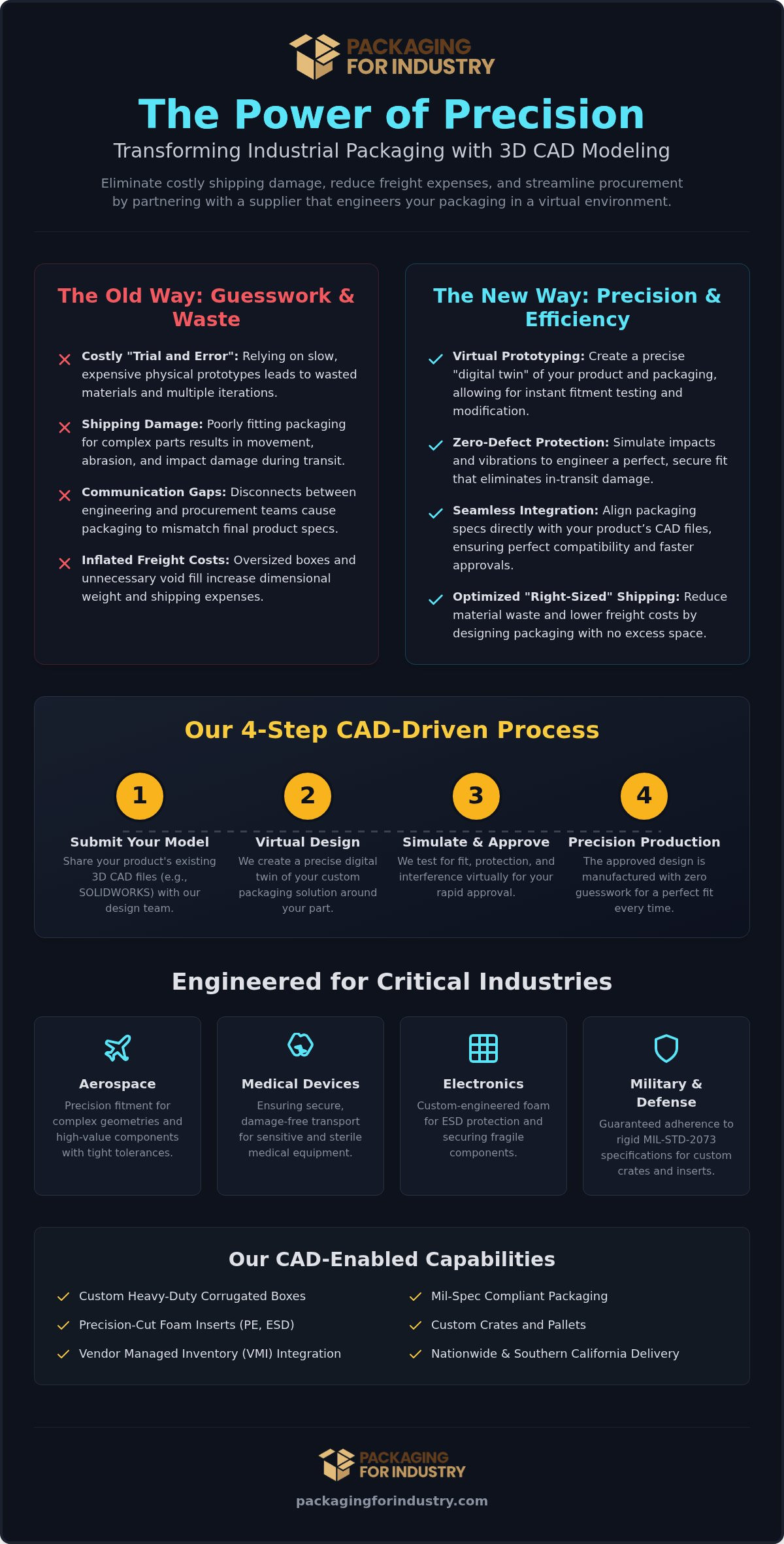
The transition to a more efficient packaging system begins with a thorough assessment of your current needs. Our process is designed to be straightforward and results-oriented. You can submit your product dimensions or existing CAD files directly to our engineering team for review. We then move through a methodical four-step process: assessment of your shipping environment, custom digital design, free prototyping for fitment verification, and finally, full-scale production and delivery. This eliminates the guesswork and ensures that your bulk order performs exactly as expected from day one. If you’re ready to improve your supply reliability and eliminate shipping damage, it’s time to request a packaging quote and see the difference that CAD-driven precision makes for your bottom line.
Optimize Your Industrial Logistics with Precision Engineering
Industrial packaging is a precision component of your supply chain, not just a commodity box. Transitioning to a packaging supplier that offers 3D CAD models of designs allows your procurement team to align perfectly with engineering specifications. This approach effectively eliminates fitment errors, reduces transit damage for high-value parts, and supports more efficient warehouse kitting. By utilizing digital master files, you ensure consistent quality across every recurring order while reducing unnecessary material waste and freight costs.
Packaging For Industry provides the technical expertise required for high-stakes sectors like aerospace and medical manufacturing. We offer free prototyping for fitment verification and provide local next-day delivery across Southern California. It’s our mission to serve as a dependable partner that understands the intersection of engineering precision and fiscal responsibility. We’re ready to help you solve your most complex logistics challenges.
We look forward to helping you streamline your procurement process and protect your most valuable industrial equipment.
Frequently Asked Questions
Does Packaging For Industry charge for 3D CAD modeling?
Packaging For Industry integrates 3D CAD modeling into the design phase of custom projects as a standard part of our engineering service. We don’t view engineering as an add-on but as a fundamental requirement for providing a reliable industrial solution. For clients moving toward a production run, this CAD/CAM support is often included to ensure fitment before manufacturing. You can request a packaging quote to see how our engineering services align with your specific volume.
Can I provide my own product CAD files to help design the packaging?
Yes, we encourage you to provide your product CAD files to ensure the highest level of precision. By choosing a packaging supplier that offers 3D CAD models of designs that utilize your existing STEP or SOLIDWORKS files, we eliminate manual measurement errors. This collaborative approach ensures that custom foam inserts and corrugated boxes provide the exact clearances required for sensitive components. It significantly speeds up the design and prototyping phases.
What industries benefit most from 3D CAD packaging designs?
Industries with high-value, fragile, or complex parts see the greatest return on investment from digital modeling. This includes aerospace manufacturers shipping engine components and medical device companies moving sensitive diagnostic equipment. Electronics firms also benefit from precise ESD-safe foam modeling. Any sector where shipping damage results in high replacement costs requires the precision of a packaging supplier that offers 3D CAD models of designs for their heavy-duty corrugated boxes and crates.
How long does it take to move from a 3D model to a physical prototype?
The transition from a digital design to a physical sample is typically rapid because our CAD files drive the CAM machinery directly. For most custom foam or corrugated projects, we can produce a prototype for fitment verification within a few business days. This speed is a primary benefit of our Anaheim-based design team. It allows Southern California manufacturers to test physical samples and make adjustments before committing to a full-scale production run.
Can 3D modeling help reduce my UPS or FedEx shipping surcharges?
Yes, 3D modeling is an effective tool for lowering packaging costs associated with dimensional weight surcharges. We use CAD software to minimize the exterior footprint of your boxes while maintaining necessary internal protection. By reducing just an inch from a box’s dimensions, you can often drop into a lower pricing tier for major carriers. This “right-sizing” ensures you don’t pay to ship empty space or pay for excessive void fill materials.
Is 3D design available for simple corrugated boxes or just complex foam?
We utilize 3D modeling for both simple corrugated boxes and complex multi-material systems. While foam inserts require the highest precision, even a standard RSC box benefits from CAD-driven sizing to ensure it fits your pallets perfectly. Modeling the box allows us to verify stackability and structural integrity under load. This ensures that even “simple” packaging is engineered for the realities of a high-density warehouse or long-haul distribution environment.
Does PFI offer 3D models for military-spec (mil-spec) packaging compliance?
Yes, we provide full CAD support to ensure compliance with rigid military standards like MIL-STD-2073. Military packaging often requires complex, multi-layered protection that must be documented precisely for government review. Our 3D models serve as the digital record for these designs, ensuring that every recurring order meets the exact performance specifications required. This precision is vital for specialized foam inserts and heavy-duty crates used in defense and aerospace applications.
Can I get a 3D model for a custom shipping crate?
We model custom shipping crates in 3D to visualize internal bracing, cushioning, and hardware placement. This is especially important for oversized or top-heavy industrial machinery. By modeling the crate first, we can identify center-of-gravity issues and ensure the design includes necessary features like forklift pockets or ramp doors. This engineering-first approach prevents the structural failures that often occur with guesswork crate construction. It provides peace of mind for your most valuable shipments.