
A generic shipping container is often the most expensive part of your logistics chain. This isn’t due to the material cost, but rather the hidden expenses of transit damage and carrier dimensional weight surcharges. If you’re tired of settling for catalog sizes that leave your high-value components vulnerable, you aren’t alone. Most operations managers realize that “close enough” packaging is a liability that erodes profit margins every time a truck leaves the warehouse.
By partnering with a fast packaging prototyping service Los Angeles engineering teams can access immediately, you transform these risks into predictable savings. We’ll show you how rapid industrial prototyping validates protection for aerospace and medical electronics while eliminating wasted space that triggers UPS or FedEx penalties. You’ll discover how local CAD/CAM support gets your products to market faster and ensures every physical sample fits your product perfectly. This guide outlines how optimized design and local Southern California expertise will accelerate your supply chain efficiency throughout 2026.
Key Takeaways
- Learn why functional engineering samples are critical for preventing production line bottlenecks and accelerating your speed to market in 2026.
- Understand the technical transition from CAD/CAM designs to physical “fit tests” that ensure your high-value components remain secure during transit.
- Discover how a fast packaging prototyping service Los Angeles manufacturers can access locally helps eliminate expensive dimensional weight surcharges from carriers like UPS and FedEx.
- Identify the specific data points, such as G-force tolerance and shipping environment, needed to engineer a prototype that maximizes protection while lowering overall packaging spend.
- Explore how PFI’s free prototyping for custom industrial projects serves as a risk-free entry point for optimizing your long-term logistics and inventory management.
Why Fast Packaging Prototyping is Business-Critical for Los Angeles Manufacturers
In industrial logistics, an effective packaging prototype is a functional engineering sample built for durability rather than aesthetics. For manufacturers in Los Angeles, this distinction is vital. High-value sectors like aerospace and medical device production require validated protection that standard catalog boxes cannot provide. Rapid prototyping allows your team to verify that a design will withstand the rigors of LTL freight or international export before you commit to a full production run. In 2026, speed is the primary competitive advantage. If your packaging design process lags, it creates a production line bottleneck that delays market entry and impacts your bottom line. It’s no longer enough to have a product ready; you must have the delivery system ready simultaneously.
By utilizing a fast packaging prototyping service Los Angeles operations teams can trust, you ensure that custom solutions are ready the moment the product is finished. This proactive approach mitigates the risk of shipping damage, which remains a primary driver of professional stress for logistics managers. Our Anaheim-based design team works as an extension of your engineering department to solve these challenges before they reach the warehouse floor.
The ROI of Rapid Prototyping in Southern California
Calculating the return on investment for custom packaging starts with comparing the cost of a single damaged shipment to the cost of an engineered solution. “Good enough” stock boxes are often the leading cause of logistics-related financial loss because they lack the precision fit required for heavy-duty industrial components. By working with a local partner, you also eliminate the long lead times and high carbon footprint associated with overseas sampling. Whether you’re in Torrance or Santa Fe Springs, local prototyping provides the agility needed to pivot designs quickly based on real-world feedback.
Solving the “Dimensional Weight” Problem
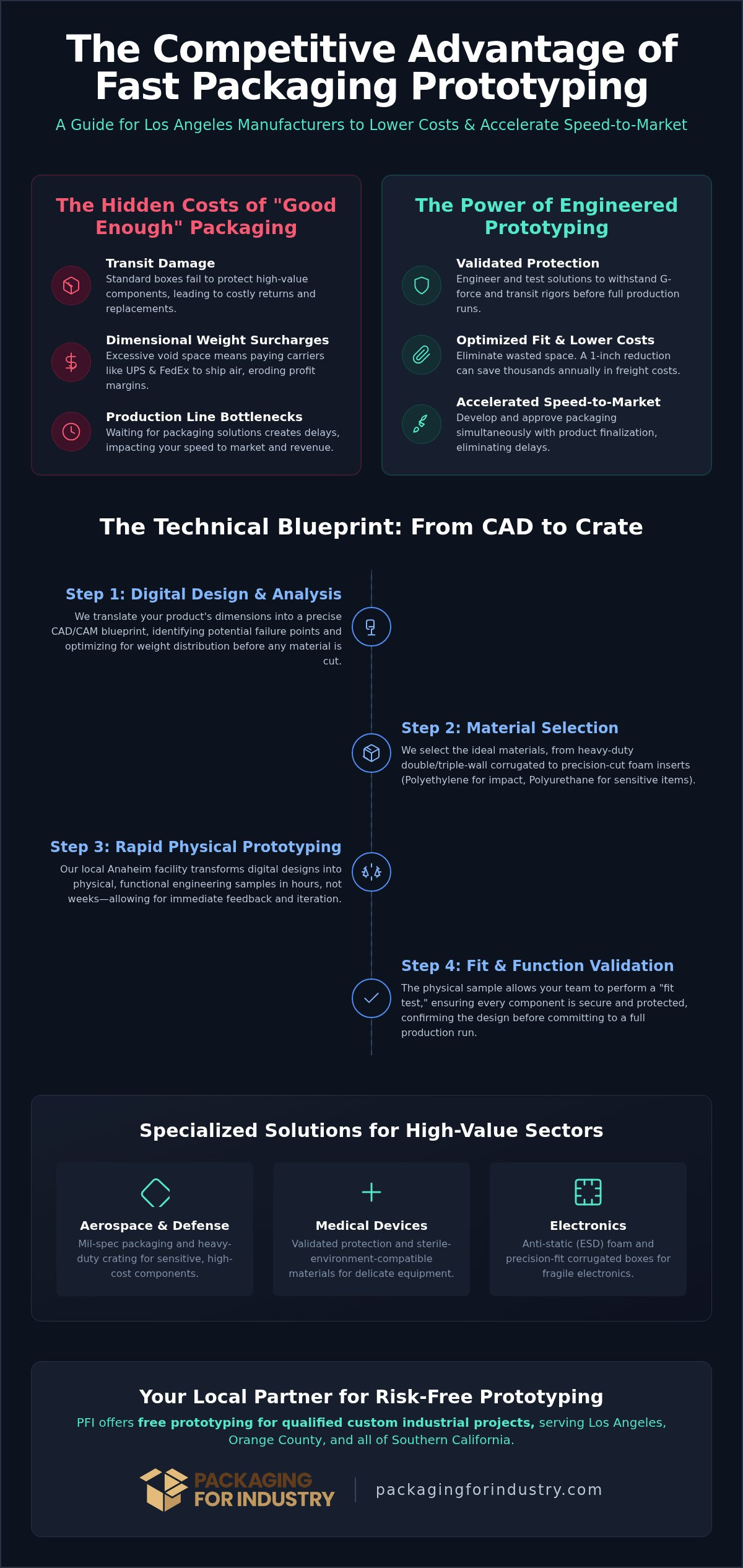
Carriers like UPS and FedEx have aggressive dimensional weight pricing models that penalize inefficient packaging. If your custom corrugated boxes contain excessive void space, you are essentially paying to ship air. We use advanced CAD/CAM support to shave unnecessary inches off your packaging dimensions while maintaining the required cushioning for your product. A single-inch reduction in box size can save thousands in annual freight costs for high-volume manufacturers. This level of precision optimization is only possible when you have a physical prototype to validate the fit and protection levels before the final rollout.
The Technical Blueprint: How Industrial Packaging Prototypes are Engineered
Engineering a prototype begins with precise data. We use CAD/CAM software to translate physical product dimensions into digital blueprints that account for every angle and weight distribution point. This digital phase is where we identify potential failure points before a single piece of material is cut. For manufacturers, utilizing a fast packaging prototyping service Los Angeles based means these digital designs become physical realities in hours, not weeks. This rapid transition is essential for maintaining production schedules and ensuring that the packaging is as refined as the product it protects.
Material selection is the foundation of this process. We evaluate the trade-offs between standard custom corrugated boxes and heavy-duty double-wall or triple-wall options. For industrial components, the structural integrity of the outer shell must match the internal bracing. We often integrate precision foam packaging to provide a custom-contoured fit. This involves selecting between polyethylene, which offers superior impact absorption for heavy loads, and polyurethane for lighter, sensitive items. The business benefits of rapid prototyping become evident here, as we can test the interaction between these materials in real-time.
Advanced Foam and Corrugated Integration
Designing die-cut foam inserts is a precise science. These inserts must lock products in place to neutralize high-vibration transit environments. For electronics and semiconductor manufacturers across the Inland Empire and Los Angeles, we frequently incorporate anti-static (ESD) foam to prevent latent electrical damage. By using a fast packaging prototyping service Los Angeles firms can access locally, you can physically test these foam densities before committing to a bulk order. Material density is the most critical factor; we select the specific density required to ensure the product doesn’t “bottom out” during a drop while avoiding a foam that is too rigid to absorb shock.
Engineering for Heavy Equipment and Aerospace
When weight or fragility exceeds the limits of corrugated material, we transition to custom wood crates. These solutions often feature foam-lined interiors to protect sensitive aerospace components from both impact and surface abrasion. Every prototype designed for international export is engineered with ISPM-15 compliance in mind, ensuring your shipments don’t face rejection at customs. By kitting foam, corrugated, and wood together, we create a comprehensive protection system that standard catalog suppliers simply cannot offer. If you need to validate a multi-material design, you can request a custom packaging quote to start the engineering process.
Comparing Prototyping Methods: Speed, Accuracy, and Material Integrity
Digital proofs provide a necessary visual baseline, but a screen-based design cannot replace a physical “fit test.” In industrial logistics, the interaction between your product and its packaging must be physically validated to ensure structural integrity. Using a fast packaging prototyping service Los Angeles manufacturers can rely on allows for the creation of samples that use actual production materials rather than 3D-printed substitutes. While some competitors promote 3D prototyping, those models often lack the specific crush strength and flex of industrial corrugated or foam. PFI prioritizes using the exact material grades intended for your final run to ensure that the prototype’s performance matches the production reality.
Our Anaheim facility utilizes rapid cutting tables, similar to ESKO-style technology, which enables same-day sample production without the need for expensive steel-rule dies. This speed allows your team to perform a “Fit and Function” test immediately. You can verify that warehouse teams can assemble the packaging efficiently and that the product remains secure during handling. This pragmatic approach identifies potential failures in the design phase, preventing costly delays during full-scale production. It’s a proactive way to ensure your supply chain remains fluid and your products remain protected.
Rapid Cutting vs. Die-Cutting
The transition from a prototype to high-volume production typically involves moving from a digital cutting table to a die-cut process. Prototyping saves money by catching design flaws before expensive steel-rule dies are manufactured. A physical prototype is the only way to verify the crush strength of a specific material grade in a real-world configuration. If a design fails at the prototype stage, we simply adjust the CAD file and cut a new sample. If it fails after the dies are made, the financial impact and timeline delays are significant. This step is essential for any business looking to compare packaging pricing and lower overall costs.
Testing Protocols for Industrial Validation
Validation requires more than just a visual check. We perform internal drop testing and vibration simulation to replicate the stresses of the Southern California transit corridor. During these tests, we evaluate corner and edge protection under high-stacking pressure to ensure pallet stability. “Kitting” tests are also vital for complex assemblies, ensuring that all components, foam inserts, and corrugated shells work together as a unified system. This methodical testing ensures that your final packaging solution is both fiscally responsible and operationally sound before it ever reaches a carrier.
A Professional’s Checklist: Preparing for Your Rapid Packaging Prototype
To maximize the value of a fast packaging prototyping service Los Angeles engineering teams must provide a comprehensive technical profile of their product. High-level protection isn’t a result of guesswork; it’s the outcome of precise data points translated into physical geometry. Before requesting a sample, your team should follow this systematic checklist to ensure the resulting prototype meets both logistical and financial goals.
- Step 1: Product Specifications. Provide exact weight, dimensions, and the fragility rating or G-force tolerance. This data determines the thickness and density of protective materials.
- Step 2: Shipping Environment. Identify if the product travels via LTL freight, parcel carriers, or international export. Each environment presents different vibration and impact risks.
- Step 3: Regulatory Requirements. Define if the project requires anti-static (ESD) protection for electronics or specific mil-spec compliance for defense contracts.
- Step 4: Design Assets. Submit a physical sample or STEP/CAD files. Digital files allow our Anaheim design team to engineer a precise fit within hours.
- Step 5: Operational Review. Evaluate the prototype for pack-out speed. A design that protects but takes too long to assemble will increase your labor costs.
Critical Data for Packaging Engineers
Precision requires data. Knowing your required “Drop Height” is essential for foam design; a medical device shipping via parcel needs different cushioning than a heavy component on a pallet. Stacking requirements are equally vital for warehouse optimization. If your packaging can’t support the weight of four stacked pallets, you’re losing valuable vertical square footage. For sensitive electronics, we also address temperature or humidity concerns that might necessitate specialized barriers or desiccants within the custom-engineered shell.
Evaluating the Sample for Operational Flow
A successful prototype must perform on the warehouse floor. When testing your sample, assess the ease of closure. Determine if the design requires stretch film, industrial tape, or if a self-locking RSC box is more efficient. We also ensure the prototype fits standard pallet dimensions to maximize truck space and eliminate wasted freight spend. By utilizing a fast packaging prototyping service Los Angeles manufacturers can trust, you can physically validate the unboxing experience for your B2B clients, ensuring your brand projects the same quality as the industrial components inside.
Packaging For Industry: Your Local Partner for Fast Prototyping in Southern California
PFI operates out of a strategic Anaheim facility, placing our design and engineering teams in the heart of the Southern California industrial corridor. This location is critical for providing a fast packaging prototyping service Los Angeles manufacturers need to stay competitive. We understand that in the LA and Inland Empire traffic zones, proximity equals speed. Navigating the logistics of the 405 and 91 corridors requires a partner who understands that a two-hour delay can disrupt an entire production shift. Our team eliminates the typical friction of custom design by offering free prototyping for custom industrial projects. This approach removes the financial barrier to entry, allowing you to validate protection levels before making a capital commitment.
Our engineering experts don’t just hand you a sample and walk away; we work as a dedicated consultant to lower packaging costs. We help you identify where oversized catalog packaging is draining your budget and replace it with precision-engineered alternatives. Once a prototype is validated through the fit and function tests mentioned previously, we facilitate a seamless transition into Vendor Managed Inventory (VMI). This ensures your warehouse never faces a stockout of custom sizes, maintaining your supply chain reliability even during peak demand cycles. You get direct access to specialists who understand the local manufacturing landscape and the specific requirements of aerospace and medical sectors.
Local Service, Nationwide Capabilities
While our roots are firmly planted in Southern California, our reach is nationwide through established manufacturing partners. However, for local manufacturers in Carson, Torrance, and Santa Fe Springs, we offer the distinct advantage of local next-day delivery. Being a single-source supplier for corrugated boxes, foam inserts, and custom crates simplifies your procurement process significantly. Instead of managing three different vendors, you deal with one partner that understands the holistic needs of your logistical flow. This integration is why many firms choose PFI to compare packaging pricing and request a packaging quote to streamline their operations.
Request Your Custom Packaging Quote and Prototype
Starting the design process is straightforward and begins with a comprehensive PFI packaging review. We analyze your current damage rates, shipping environment, and freight spend to find optimization opportunities. Our commitment is to reduce your total cost of ownership through engineered efficiency, not just lower the price per box. We utilize our local fleet to ensure your samples arrive when your engineering team needs them, avoiding the long lead times of out-of-state suppliers. Take the first step toward a more resilient supply chain by reaching out to our Anaheim design team today.
Optimize Your Industrial Logistics for 2026
Efficient supply chains depend on the precision of their smallest components, including the protective shells that move your products. We’ve explored how rapid industrial prototyping converts logistical risks into predictable savings by eliminating transit damage and dimensional surcharges. By partnering with a fast packaging prototyping service Los Angeles operations can rely on, you gain the agility needed to meet strict production deadlines.
Our Anaheim-based team provides custom CAD/CAM engineering specifically for high-value aerospace and medical sectors. We prioritize proven cost-reduction strategies that improve reliability for high-volume manufacturers. With local next-day delivery available across Los Angeles and Orange County, your team can validate designs and move to production without delay.
We’re ready to help you solve your most complex packaging challenges and streamline your distribution network with engineered reliability.
Frequently Asked Questions
How fast can I get a packaging prototype in Los Angeles?
You can typically receive a functional packaging prototype within 24 to 48 hours after providing your product specifications. Our Anaheim facility utilizes advanced rapid cutting tables that bypass the need for traditional tooling, which significantly accelerates the design cycle. This speed allows Southern California manufacturers to validate protection levels without delaying their production schedules. For urgent industrial projects, our local proximity allows for immediate hand-delivery or next-day courier service throughout the region.
What materials can be used for a packaging prototype?
We utilize the exact production-grade materials intended for your final run, including heavy-duty double-wall or triple-wall corrugated board. Our prototyping capabilities also extend to specialized foam packaging such as polyethylene and anti-static (ESD) polyurethane for sensitive electronics. For heavy industrial equipment, we can prototype custom wood crates and kitting solutions. Using actual materials ensures the prototype’s performance accurately reflects how the finished product will handle real-world transit stresses during the shipping process.
Is there a cost for the packaging prototyping service?
Packaging For Industry provides free prototyping as part of our custom design and engineering services for industrial projects. This approach eliminates the financial risk often associated with developing bespoke protection systems for aerospace or medical components. By offering this service at no initial cost, we help you lower packaging costs by identifying the most efficient design before you commit to a bulk purchase. This process ensures your budget is spent on validated solutions rather than trial and error.
Do I need to provide a physical product for prototyping?
You don’t always need to provide a physical product if you have accurate CAD or STEP files that our engineering team can use. While digital files allow us to begin the blueprinting process immediately, having a physical sample is the best way to ensure a perfect fit-test. A physical product allows us to verify weight distribution and fragility points more accurately. If the product is oversized or high-value, we can often work from detailed technical drawings and measurements.
Can you prototype military-spec (mil-spec) packaging?
Yes, we specialize in prototyping military-spec and aerospace packaging that adheres to strict government and industry standards. Our team understands the complexities of mil-spec requirements, including specific material densities and preservation methods. By utilizing a fast packaging prototyping service Los Angeles defense contractors can trust, you ensure that your specialized crates and foam inserts meet all contractual obligations. We focus on durability and regulatory compliance to prevent rejection at receiving docks or during international export.
What is the difference between a prototype and a production sample?
A prototype is an engineering sample created on a digital cutting table to validate fit and function without the expense of steel-rule dies. A production sample is a finished unit taken from the actual high-volume manufacturing run after the final tooling is complete. Prototyping allows for rapid design iterations and flaw detection at minimal cost. Once you approve the prototype, we move to the production phase where the final units are manufactured with consistent precision using permanent dies.
How does prototyping help reduce UPS and FedEx shipping costs?
Prototyping allows our engineers to shave unnecessary inches off your box dimensions to minimize dimensional weight surcharges. Carriers like UPS and FedEx base their pricing on the volume of the package rather than just the actual weight. By using a fast packaging prototyping service Los Angeles logistics managers can optimize their freight spend by ensuring there is no wasted void space. A precisely fitted box reduces the need for excessive dunnage, which further lowers your overall cost per shipment.
Can you prototype custom foam inserts for existing boxes?
We can design and prototype custom foam inserts tailored to fit your existing corrugated boxes or RSC containers. This is an effective way to upgrade the protection level of a standard size without re-engineering the entire outer shell. We test different foam densities, such as polyethylene or polyurethane, to ensure your product is locked in place. This kitting approach is ideal for manufacturers looking to improve reliability while utilizing their current box inventory to maintain supply chain consistency.