
Over 57% of electronics manufacturers are currently transitioning away from cobalt chloride-based indicators to meet modern REACH and RoHS 3 safety standards. For engineering and procurement teams in Southern California, this shift isn’t just about environmental compliance; it’s about protecting high-value components from the invisible threat of moisture ingress. You understand that even a minor breach in a moisture barrier bag can lead to catastrophic failures during the reflow process, resulting in expensive scrap and missed delivery deadlines.
We’ve developed this guide to help you source the specific humidity indicator cards for electronics packaging San Diego firms require to ensure full J-STD-033D compliance. You’ll learn how to identify the correct indicator spots for your moisture sensitivity levels and how to integrate these cards into a robust dry-pack system. We’ll also examine how partnering with a local industrial supplier can eliminate supply chain delays and ensure your production line remains fully stocked with compliant materials.
Key Takeaways
- Identify the specific J-STD-033D requirements for monitoring moisture-sensitive devices to prevent catastrophic component failures during the reflow process.
- Source the correct humidity indicator cards for electronics packaging San Diego businesses need to ensure full regulatory compliance and eliminate moisture-related returns.
- Transition to cobalt-free and RoHS-compliant indicators to meet international shipping standards and REACH environmental regulations for high-tech exports.
- Build a comprehensive protection strategy by integrating indicator cards into a complete dry-pack system with moisture barrier bags and calculated desiccant units.
- Lower packaging costs and improve supply reliability by utilizing local vendor-managed inventory (VMI) and next-day delivery throughout Southern California.
The Critical Role of Humidity Indicator Cards in Electronics Packaging
A Humidity indicator card (HIC) is an essential diagnostic tool for any facility handling moisture-sensitive devices (MSDs). These cards consist of chemically impregnated paper that changes color as ambient relative humidity (RH) levels rise or fall. While desiccant packs and barrier bags provide the physical defense, the HIC serves as the visual record of the environment inside the package. It’s the only way to confirm that the internal atmosphere remained within safe limits throughout the entire shipping and storage cycle. Without this visual history, you’re essentially guessing about the integrity of your moisture barrier.
For manufacturers in the region, using high-quality humidity indicator cards for electronics packaging San Diego facilities rely on is a standard protocol to prevent “popcorning.” This phenomenon occurs during the high-heat reflow soldering process. If an electronic component has absorbed moisture from the air, that water turns to steam and expands violently, cracking the package from the inside out. By monitoring RH levels with precision, you ensure that components are baked or dry-packed correctly before they ever reach the assembly line. This proactive approach eliminates the risk of internal delamination and latent field failures.
Why Visual Moisture Monitoring is Non-Negotiable
Even the most robust moisture barrier bags can fail due to micro-perforations, improper heat sealing, or rough handling during transit. Relying solely on the presence of desiccant is a risk that most aerospace and defense contractors can’t afford to take. The HIC acts as a critical fail-safe for quality control teams. It provides an immediate, low-cost verification that the protective environment is intact. This level of oversight is vital for reducing warranty claims and maintaining the high reliability standards expected in mission-critical manufacturing.
San Diego’s High-Tech Climate Considerations
San Diego’s unique geography presents specific logistical challenges for electronics firms. Coastal humidity levels in hubs like Sorrento Valley and Otay Mesa often fluctuate, creating an environment where moisture ingress is a constant threat. Local transit times also play a role. When components move between local warehouses and assembly houses, they’re often exposed to varying temperatures and humidity spikes in non-climate-controlled vehicles. Utilizing a local supplier for these components through vendor-managed inventory (VMI) ensures that your packaging supplies are always compliant and ready for quick-turn production schedules. It’s about maintaining a seamless flow of protected materials without the overhead of bulk storage.
Selecting the Right HIC: Standards, Spots, and Sensitivity
Selecting the correct humidity indicator cards for electronics packaging San Diego operations depends entirely on the Moisture Sensitivity Level (MSL) of your components. These cards aren’t one-size-fits-all tools. They range from 3-spot configurations, which are standard for high-volume surface mount devices, to 6-spot cards that offer a wider monitoring spectrum from 10% to 60% relative humidity. The 5% spot is particularly critical for the most sensitive components. If that spot changes color, it indicates that the desiccant is nearing exhaustion and the barrier integrity might be compromised. This early warning allows your team to intervene before moisture reaches the 10% threshold where damage becomes likely.
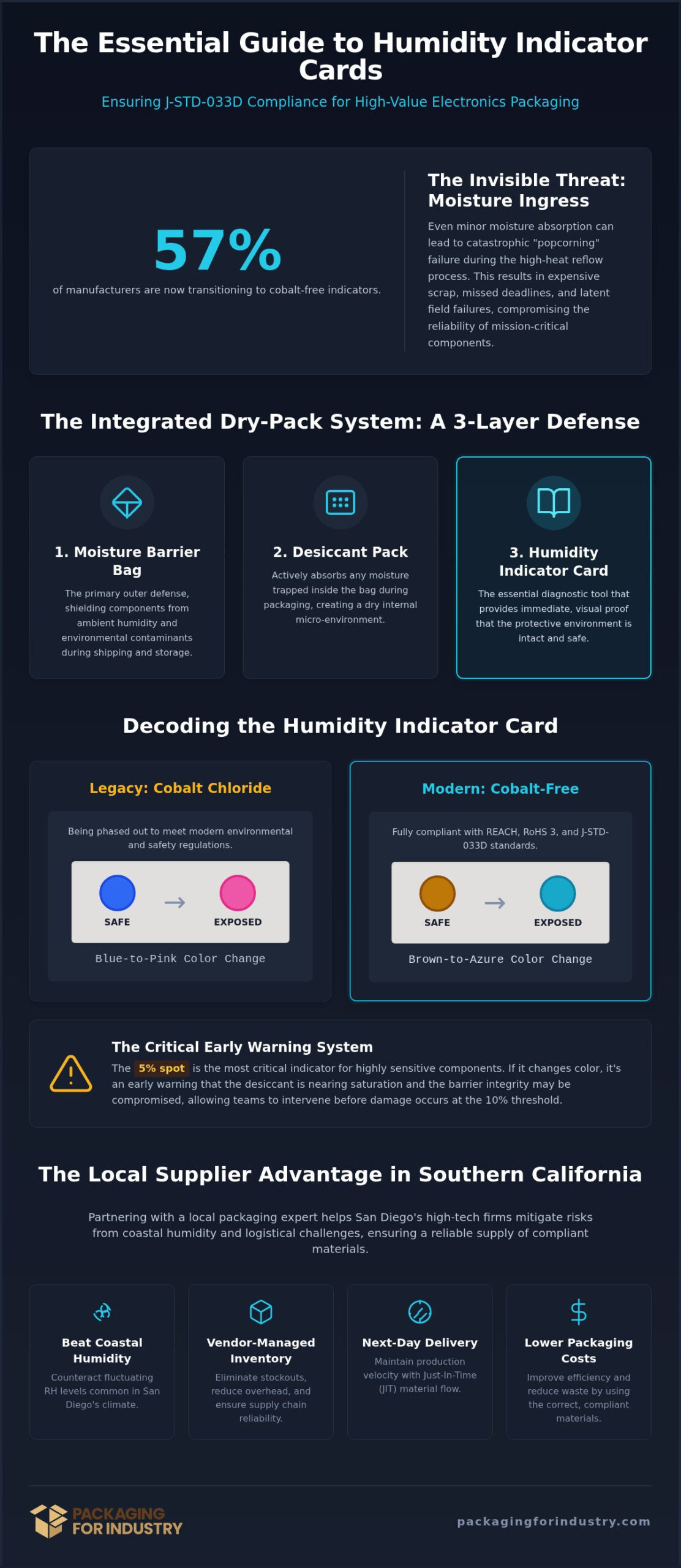
You also need to consider the chemistry of the indicator. Traditional blue-to-pink cards use cobalt chloride, but many modern San Diego facilities are switching to cobalt-free brown-to-azure alternatives. These newer cards provide the same precision while ensuring your shipments remain compliant with evolving environmental regulations. Matching the card’s sensitivity to the specific MSL rating of your hardware prevents unnecessary baking cycles. This is a pragmatic way to avoid degrading component leads and increasing your overall production costs.
Understanding J-STD-033 and IPC Compliance
The J-STD-033 standard is the industry benchmark for handling and packing moisture-sensitive electronics. It specifies exactly which humidity levels must be monitored to maintain component integrity. For military-grade and aerospace applications, the standard typically requires cards with 5%, 10%, and 60% indicators. Accurate card interpretation is a vital skill for your warehouse team. If the 10% spot has turned pink (or azure on cobalt-free cards), the components are deemed to have been exposed to excessive moisture. At this point, “baking” the components is mandatory to drive out moisture before they hit the assembly line. This process is time-consuming and energy-intensive. By choosing the right humidity indicator cards for electronics packaging San Diego manufacturers can avoid the financial hit of unnecessary baking while ensuring only dry components move forward to assembly.
Standard vs. Heavy-Duty Packaging Integration
The packaging environment dictates how you integrate these indicators. In standard corrugated boxes, HICs are typically placed inside the moisture barrier bag right on top of the components. However, for high-value gear shipped in custom foam packaging or heavy-duty wood crates, the placement must ensure the card is visible immediately upon opening the seal. For long-term storage in a warehouse, you might opt for a more comprehensive 6-spot card to monitor gradual moisture buildup over months. Rapid transit applications might only require a 3-spot card focused on the most critical thresholds. If you’re unsure which configuration fits your current project, you can always request a packaging quote to get expert guidance on a tailored solution.
Regulatory Compliance: Cobalt-Free and RoHS Requirements
Compliance is no longer an optional feature for San Diego’s high-tech exporters. REACH and RoHS 3 directives have fundamentally changed how moisture control components are sourced and deployed. If you’re shipping to the European Union or other international markets, your choice of humidity indicator cards for electronics packaging San Diego could be the difference between a successful delivery and a shipment stuck at customs. Cobalt dichloride, the active chemical in traditional cards, is classified as a Substance of Very High Concern (SVHC) under REACH regulations. While its use is managed via occupational exposure limits, the market shift toward cobalt-free alternatives is the only pragmatic way to future-proof your supply chain and avoid customs rejections.
International environmental standards are becoming stricter as of 2026. Non-compliant packaging materials can lead to significant delays and potential fines. By utilizing compliant humidity indicator cards for electronics packaging San Diego firms ensure their products meet the rigorous safety and environmental expectations of global partners. This isn’t just about following rules; it’s about maintaining the logistical flow of high-value components without regulatory interference.
Cobalt-Chloride vs. Cobalt-Free: A Comparison
Traditional blue-to-pink cards have served the industry for decades. They’re inexpensive and provide a clear visual change that technicians find easy to read. However, their chemical makeup makes them a liability for companies focused on sustainability and worker safety. In contrast, cobalt-free humidity indicator cards typically transition from brown to azure. These eco-friendly cards meet the same 5%, 10%, and 60% RH sensitivity requirements defined in J-STD-033D. While there was once a perception that cobalt-free options were less accurate, modern formulations provide equivalent precision. For high-volume manufacturing, the slight cost difference of cobalt-free cards is far lower than the financial impact of a rejected international shipment.
Compliance Documentation for San Diego Exporters
For companies involved in aerospace packaging, a clean supply chain is a non-negotiable requirement. Procurement teams must maintain rigorous records to prove that every component, including the HIC, meets current 2026 standards. We ensure all moisture control products are fully documented to satisfy these needs. You can request certificates of compliance (CoCs) for your procurement records to simplify audits and satisfy your tier-one customers. This proactive approach to documentation reduces administrative stress and ensures your operations remain focused on production rather than compliance fire drills. It’s a steady way to build trust with international clients who demand total accountability.
The Integrated Dry-Pack System: Beyond the Card
A humidity indicator card is a diagnostic tool, not a preventative one. It provides the data you need to verify safety, but it doesn’t offer physical protection against moisture ingress. To truly safeguard sensitive components, you must integrate these cards into a comprehensive dry-pack system. This architecture consists of three primary elements: the indicator card, the desiccant, and the moisture barrier bag. When implementing humidity indicator cards for electronics packaging San Diego assembly lines must view the card as just one component of a larger protective architecture designed to maintain an internal environment below 10% relative humidity.
The integration process follows a strict engineering logic to ensure maximum reliability. First, select a Moisture Barrier Bag (MBB) based on the required Water Vapor Transmission Rate (WVTR). Second, calculate the desiccant requirements in “Units” as defined by MIL-D-3464, ensuring the volume of desiccant matches the interior surface area of the bag. Third, place the HIC in a position of maximum visibility so it’s the first thing a technician sees when the seal is broken. Finally, use industrial-grade heat sealers to create a vacuum-tight environment. This methodical approach ensures that your moisture sensitivity monitoring is supported by a robust physical defense.
HICs and Moisture Barrier Bags
An HIC is essentially useless if the surrounding barrier is compromised or inadequate. Many procurement teams confuse standard anti-static poly bags with true moisture barrier bags. While anti-static bags prevent electrostatic discharge, they offer almost no protection against water vapor. High-quality MBBs utilize multiple layers of nylon, foil, and polyethylene to create a dense shield. Sourcing the right moisture barrier solutions is the only way to ensure the desiccant isn’t overwhelmed by the ambient coastal humidity found in Southern California hubs. Without a high-integrity barrier, even the most sensitive HIC will indicate a failure within days of packaging.
Desiccant Integration and Kitting
Desiccants and HICs work in tandem to maintain an “Ultra-Dry” environment for moisture-sensitive devices. The desiccant actively pulls moisture from the air, while the HIC monitors the desiccant’s performance. For high-volume production, managing these individual components can create logistical bottlenecks. Many local manufacturers utilize packaging kitting services to streamline their operations. By sourcing pre-validated humidity indicator cards for electronics packaging San Diego firms can ensure every shipment leaves the warehouse with a guaranteed moisture-free history. Pre-kitted sets reduce assembly time and eliminate the risk of missing a critical component during the final pack-out process.
Sourcing HICs in San Diego: Bulk Procurement and VMI
Large catalog suppliers often complicate logistics with high freight costs and standardized inventory that doesn’t account for specific regional needs. For high-tech hubs in Sorrento Valley, Otay Mesa, or Carlsbad, relying on a Southern California-based industrial partner is a more efficient alternative. By sourcing humidity indicator cards for electronics packaging San Diego manufacturers can avoid the hidden expenses of long-distance shipping and rigid pricing models. We provide a localized approach that prioritizes your specific production cycles and regulatory requirements, ensuring that your moisture control supplies are as precise as the components they protect.
Our infrastructure is built for the speed of the local electronics industry. We provide local next-day delivery to San Diego, Carlsbad, and Chula Vista, allowing your team to maintain lean inventory levels without the risk of a line shutdown. This proximity eliminates the lead time uncertainty associated with national distributors. It’s a pragmatic solution for operations that require a steady flow of J-STD-033 compliant materials to meet aggressive shipping deadlines.
Vendor Managed Inventory (VMI) for Electronics Manufacturers
Stockouts of critical ESD supplies or HICs can halt an entire production line, leading to expensive downtime and missed customer commitments. Our VMI services are designed to eliminate these bottlenecks by placing the responsibility of inventory management on our team. We conduct scheduled inventory reviews to match your recurring electronics production needs, ensuring you never run out of compliant moisture control materials. This system also frees up valuable warehouse space in expensive San Diego real estate. Instead of storing months of bulk inventory, you receive exactly what you need through a just-in-time delivery model tailored to your facility’s footprint.
Requesting a Quote for Bulk Humidity Indicators
Procurement managers can significantly lower packaging costs by moving away from one-size-fits-all catalog orders. Bulk pricing for HICs is influenced by volume, but the real savings come from consolidation. You can combine your humidity indicator cards for electronics packaging San Diego orders with corrugated boxes, stretch film, and custom foam inserts to secure better aggregate rates. This holistic approach to procurement streamlines your vendor list and reduces administrative overhead.
When you request a packaging quote, we analyze your entire usage pattern to identify cost-saving opportunities that large national suppliers typically overlook. Our goal is to provide a steady, dependable supply chain that supports your bottom line while maintaining full regulatory compliance. By aligning your procurement with a local specialist, you gain a partner who understands the specific logistical challenges of the Southern California manufacturing landscape.
Optimizing Your Moisture Protection Strategy
Protecting sensitive electronic components requires more than just a barrier bag; it demands a compliant, data-driven monitoring system. By selecting the correct indicator configurations and adhering to J-STD-033D standards, you eliminate the risk of moisture-related damage during reflow. Transitioning to cobalt-free technology ensures your shipments navigate international customs without regulatory delays.
Partnering with Southern California’s custom packaging experts allows you to streamline these processes. You can lower packaging costs and improve supply reliability through dedicated vendor-managed inventory programs. Ensuring you have the correct humidity indicator cards for electronics packaging San Diego facilities require is the final step in securing your high-value production line. It’s the most pragmatic way to maintain quality while optimizing your logistical flow.
We look forward to helping you achieve zero moisture-related returns with our local next-day delivery and expert technical support.
Frequently Asked Questions
What is the standard humidity indicator card for electronics?
The industry standard for electronics is defined by J-STD-033D. This guideline requires cards with specific indicator spots, typically at 5%, 10%, and 60% relative humidity. These thresholds are designed to monitor moisture-sensitive devices during storage and transit. Using compliant cards ensures your packaging meets the rigorous quality requirements of the aerospace and defense sectors found throughout Southern California’s high-tech manufacturing landscape.
How do I read a 3-spot humidity indicator card?
You read a 3-spot card by comparing the color of the indicator spots to the reference key provided on the card. In traditional cards, a change from blue to pink indicates moisture exposure. For cobalt-free versions, the color shifts from brown to azure. If the 10% spot has transitioned, it’s an indication that the components may require baking before assembly. It’s a simple visual check for immediate feedback.
Are humidity indicator cards reusable after they change color?
Most humidity indicator cards are reversible, meaning they return to their original color once the environment dries out. However, J-STD-033D regulations state that if the 60% spot has changed color, the card shouldn’t be reused. This indicates a severe moisture event that could compromise the card’s future accuracy. Always replace cards that have been exposed to high humidity to maintain the reliability of your quality control process.
What is the difference between cobalt-free and traditional HICs?
The primary difference is the chemical composition and regulatory compliance. Traditional HICs use cobalt chloride, which is a substance of very high concern under REACH regulations. Cobalt-free cards use safer alternatives and change from brown to azure. When sourcing humidity indicator cards for electronics packaging San Diego firms often choose cobalt-free options to ensure their products meet RoHS 3 standards for international export and avoid customs delays.
Do I need a humidity indicator card if I use a desiccant?
Yes, a humidity indicator card is essential even when using a desiccant. While the desiccant actively removes moisture from the sealed environment, the HIC provides the only visual proof that the desiccant is still functioning. Without a card, you don’t have a way of knowing if a seal has failed or if the desiccant has reached its maximum absorption capacity. The card acts as the diagnostic monitor.
How many HIC cards should I use per moisture barrier bag?
You only need one humidity indicator card per moisture barrier bag. It should be placed inside the bag on top of the moisture-sensitive components, ensuring it’s clearly visible when the bag is opened. For larger bulk shipments or custom crates, you might use multiple cards in different sections to monitor for localized moisture pockets. However, for standard electronics packaging, a single, well-placed card is the industry-accepted method for verification.
Where can I buy humidity indicator cards in bulk in San Diego?
You can source humidity indicator cards for electronics packaging San Diego through local industrial suppliers that offer bulk quantities and vendor-managed inventory. Local sourcing is the most efficient way to lower packaging costs while ensuring next-day delivery to hubs like Carlsbad or Sorrento Valley. We provide J-STD-033 compliant cards alongside moisture barrier bags and desiccants, allowing you to manage your entire moisture-protection supply chain through one partner.
What are the storage requirements for unused HICs?
Unused HICs must be stored in their original, airtight containers with a fresh desiccant pack to prevent premature color change. Keep the containers in a cool, dry area away from direct sunlight or extreme temperature fluctuations. If a container is opened, it should be resealed immediately to protect the remaining cards from ambient humidity. Proper storage ensures the indicators remain accurate and ready for use when your production line requires them.