
Every shattered component returned to your warehouse is more than just a lost product; it’s a direct hit to your profit margins and operational schedule. You’re likely already aware that relying on generic cushioning or excessive bubble wrap often leads to inconsistent protection and wasted storage space. It’s frustrating to watch packing teams struggle with inefficient multi-part shipments that still result in transit damage. This article explains how to protect high-value components and reduce shipping damage using custom-engineered heavy-duty corrugated partitions for fragile parts. We’ll explore how these structural dividers provide 360-degree impact protection while significantly lowering your overall packaging volume. You’ll discover how PFI’s specialized double-wall and triple-wall designs help manufacturers in Southern California achieve zero-damage shipping goals. We will also cover how a reliable, local supply chain partner can streamline your inventory through just-in-time delivery and vendor-managed programs. By the end, you’ll have a clear strategy for optimizing your logistics and reducing the total cost of ownership for your industrial packaging.
Key Takeaways
- Understand how interlocking dividers create a structural grid that prevents part-on-part contact and maximizes vertical stacking strength during transit.
- Discover how specifying custom heavy-duty corrugated partitions for fragile parts allows you to replace bulky void fill with precision-engineered, multi-wall protection.
- Learn to identify when to use double-wall versus triple-wall materials to balance shipping weight with maximum impact absorption for high-value components.
- Explore how features like V-notches and lead-in chamfers can be integrated into your partition design to support high-speed, automated kitting lines.
- Find out how local vendor-managed inventory (VMI) and next-day delivery in Southern California can reduce your warehouse footprint and lower packaging costs.
What are Heavy-Duty Corrugated Partitions for Fragile Parts?
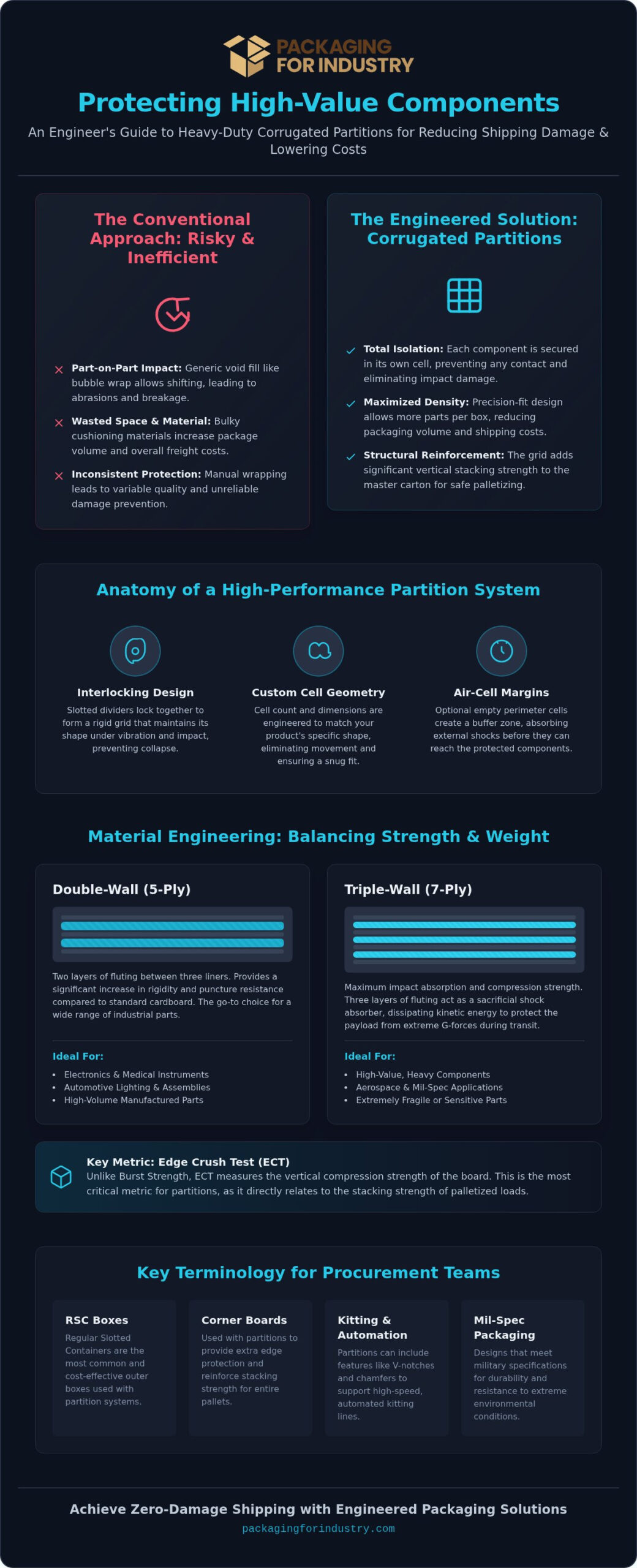
In industrial logistics, heavy-duty corrugated partitions for fragile parts are specialized interlocking dividers engineered from high-test fiberboard. These systems create a grid of individual cells within a larger master container, ensuring that each component remains isolated and secure. Unlike standard cardboard dividers, these partitions utilize corrugated fiberboard with double-wall or triple-wall construction to provide the rigidity needed for high-density items. Their primary function is two-fold: they prevent part-on-part impact damage while simultaneously increasing the vertical stacking strength of the entire master carton. This structural reinforcement is critical for high-value sectors where even minor surface abrasions can lead to total product rejection.
For specialized sectors like aerospace and defense, these dividers are often designed to meet mil-spec packaging standards. This ensures that the material can withstand extreme environmental conditions and rigorous handling protocols. Whether you’re shipping precision medical instruments or complex automotive assemblies, these partitions integrate naturally with RSC boxes to create a unified protective system. By isolating each unit, manufacturers move away from disorganized bulk shipments toward a more methodical, engineered approach that protects the bottom line.
Anatomy of a Partition System
A high-performance partition relies on a slotted interlocking design. This mechanical connection ensures the grid maintains its shape even under the intense vibration of long-haul transit. We customize the cell count and dimensions to match the specific geometry of your product, which eliminates shifting during handling. For exceptionally sensitive components, we often engineer air-cell margins. These are empty perimeter cells that create a dedicated buffer zone between the product and the outer box wall, absorbing external shocks before they reach the payload.
Key Terminology for Procurement Teams
Understanding technical specifications helps you lower packaging costs by selecting the right material for the job. Key terms include:
- RSC boxes vs. Die-cut: Standard RSC boxes are the most common outer containers for partitions, while die-cut designs are used for specialized kitting requirements.
- Corner boards: These are often used in conjunction with partitions to provide extra edge protection and stacking strength for palletized loads.
- ECT vs. Burst Strength: While Burst strength measures puncture resistance, the Edge Crush Test (ECT) is the metric that matters for partitions. It measures the ability of the board to withstand vertical pressure, which is vital for palletized stacking.
By specifying the correct heavy-duty corrugated partitions for fragile parts, you ensure that your logistics chain remains efficient and your damage rates stay near zero. This technical approach to protection replaces the guesswork of manual wrapping with a repeatable, engineered solution. It’s a pragmatic way to stabilize your supply chain while protecting your operations from the costs of replacement and re-shipping.
Material Engineering: Double-Wall vs. Triple-Wall Strength
Protecting industrial components requires a technical understanding of how materials manage kinetic energy. When a pallet shifts during transit or a container experiences a sudden impact, the resulting force must be dissipated before it reaches the product. This is where the engineering of heavy-duty corrugated partitions for fragile parts becomes essential. By utilizing multiple layers of fluting, these dividers act as a sacrificial shock absorber. Each layer of the corrugated medium collapses slightly under extreme pressure, which drastically reduces the G-force transmitted to the internal components. Selecting the right wall thickness isn’t just about durability; it’s about optimizing the balance between protection and freight costs.
Double-Wall Corrugated (5-Ply)
Double-wall construction consists of two layers of fluting sandwiched between three liners. This 5-ply configuration provides a significant increase in puncture resistance and stacking strength compared to standard single-wall board. It’s the ideal choice for electronics, medical instruments, and automotive lighting systems. For high-volume manufacturing, double-wall board offers an excellent cost-to-benefit ratio. It provides industrial-grade protection without adding excessive weight to your shipping volume, helping you maintain lean logistics without compromising part safety.
Triple-Wall Corrugated (7-Ply)
For the most demanding applications, triple-wall (7-ply) partitions serve as a viable crate replacement. This material is exceptionally rigid and can often replace heavy wood packaging, which helps you lower packaging costs while reducing overall shipment weight. It’s the primary choice for heavy machinery parts and sensitive aerospace gear that requires maximum impact mitigation. Triple-wall dividers provide extreme stacking strength, which is vital for maintaining structural integrity in high-bay warehouse environments where palletized loads are stacked multiple levels high.
Compliance with rigorous industrial standards, such as those outlined in the DLA Packaging and Marking Guide, often requires these heavy-duty materials to ensure long-term durability in global supply chains. For international shipping or long-haul routes, specialized weather-resistant coatings can be applied to either grade to resist moisture and humidity. If you’re looking to optimize your current setup, you can request a packaging quote to determine which material grade best fits your specific part geometry and weight requirements.
Why Corrugated Dividers Outperform Standard Void Fill
Loose fill materials like packing peanuts or crumpled paper often fail when tasked with protecting dense or sharp-edged industrial components. These materials shift during the vibration of transit, which allows parts to migrate toward each other or the container walls. In contrast, heavy-duty corrugated partitions for fragile parts create a rigid, fixed structure that prevents part-on-part contact entirely. Research into the mechanical properties of corrugated board highlights its superior compressive strength and bending stiffness; this translates to a more stable environment for your high-value payload. By locking each part in a dedicated cell, you eliminate the friction and impact that lead to surface damage.
Implementing a partition system also transforms your manufacturing floor’s efficiency. Wrapping individual items in bubble or foam is a labor-intensive process prone to human error. A pre-assembled corrugated grid allows packing teams to simply drop components into place, which significantly reduces the time spent per box. This standardization ensures that every shipment is packed identically, regardless of which shift is on the assembly line. It’s a pragmatic way to eliminate the variables that lead to shipping damage while streamlining your internal logistics.
Partitions vs. Foam Inserts
While custom foam packaging offers high-end aesthetics and shock absorption, corrugated partitions are often the more economical choice for bulk industrial shipments. Corrugated dividers provide sufficient protection for many high-value parts at a lower price point. For items with extremely sensitive finishes, we often recommend a hybrid solution. By combining corrugated dividers with thin foam pads or liners, you get the structural strength of fiberboard with the non-abrasive qualities of foam. Additionally, 100% corrugated systems are fully recyclable, which supports corporate sustainability goals without sacrificing performance.
Reducing Shipping Surcharges
Space optimization is a critical factor in lowering your logistics overhead. Engineered partitions allow you to maximize the number of parts per container by reducing the empty space required for loose void fill. This leads to a smaller overall box footprint, which helps you avoid costly dimensional weight (DIM) surcharges from carriers. Beyond the box, standardized dimensions improve pallet stability. When containers are uniform and rigid, applying stretch film becomes more effective, creating a unified load that resists shifting. Ultimately, the use of heavy-duty corrugated partitions for fragile parts reduces damage rates, which has a direct impact on your bottom line by cutting down on replacement costs and administrative strain.
Customizing Your Partitions for Maximum Part Protection
Standard packaging often fails because it isn’t designed for the specific center of gravity or surface sensitivity of a complex industrial part. Custom engineering transforms heavy-duty corrugated partitions for fragile parts from simple dividers into precision instruments. Our design process starts with CAD drawings that account for every millimeter of your component’s geometry. We often integrate features like V-notches and lead-in chamfers, which are essential for high-speed assembly lines and automated kitting. These tapered entries guide parts into their cells quickly; this prevents snagging and reduces the labor hours required for manual packing.
We also incorporate extended tabs that reach the full height of the outer corrugated boxes. This design choice provides significant vertical support, which prevents the outer container from buckling under the weight of a palletized stack. To ensure your facility remains lean, PFI offers kitting and pre-assembly services. We deliver your partitions already inserted into their master cartons, so your team can focus on production rather than folding cardboard. It’s a pragmatic approach that combines structural integrity with operational speed.
Step 1: Identifying Fragility and Weight
A successful design begins with a technical assessment of the part’s G-force tolerance. We calculate how much impact the component can withstand before internal damage occurs. This data determines the necessary wall thickness and flute profile. If your parts have polished or painted surfaces, we select a board finish with low friction coefficients to prevent abrasion during the micro-vibrations of transit. Matching the material to the part’s weight ensures the partition won’t collapse under its own payload.
Step 2: Prototyping and Fit Testing
PFI provides free prototyping for industrial clients to eliminate the risk of a full-scale rollout failure. We test the “drop-in” fit to ensure the design supports your operational speed. A tight fit is necessary for protection, but it shouldn’t slow down your packers. Finally, we validate every custom design against UPS and FedEx shipping standards. This ensures your high-value gear survives the rigors of the small-parcel network without requiring excessive secondary cushioning.
Sourcing Industrial Partitions in Southern California and Nationwide
Sourcing heavy-duty corrugated partitions for fragile parts requires a partner that understands the intersection of engineering and economics. Manufacturers often overlook the logistical burden of storing bulky dividers, which can quickly consume valuable warehouse floor space. PFI addresses this challenge by combining custom design with a sophisticated logistics network. For businesses in Southern California, we provide local next-day delivery to facilities in Anaheim, Irvine, and Carson, as well as across Orange County, Los Angeles, San Diego, and the Inland Empire. This proximity allows you to maintain lean operations without the risk of supply chain disruptions. Beyond the local region, our nationwide shipping capabilities ensure that multi-location organizations receive consistent packaging specifications across every facility.
The implementation of Vendor Managed Inventory (VMI) is a defining advantage that sets PFI apart from catalog suppliers. We manage your stock levels based on real-time production data, which eliminates the stress of packaging stockouts. When you’re ready to request a packaging quote, our team provides transparent data to help you compare packaging pricing against generic options. This proactive approach ensures your assembly lines never stop due to a lack of protective materials. Custom sizes available for any part geometry ensure that you aren’t paying for air or unnecessary material.
The PFI Difference: Just-In-Time Supply
Our just-in-time supply model is designed to optimize your fiscal responsibility. By stocking your custom partitions at our facilities, we free up your warehouse floor space for revenue-generating production. We provide scheduled replenishment based on your actual usage, which reduces the amount of capital tied up in excess inventory. This system transforms packaging into a seamless flow that supports your broader business goals. It’s a pragmatic solution for companies looking to maximize their operational efficiency while protecting high-value assets.
Streamlining Your Procurement Process
Consolidating your supply chain is a proven way to lower packaging costs. PFI allows you to source custom boxes, partitions, and corner protection from a single partner. This integration simplifies procurement and ensures that all components of your protective system work together perfectly. For complex projects, you have direct access to our packaging engineers for damage reduction reviews. We don’t just sell products; we provide a comprehensive system of protection and logistical optimization for your most sensitive components.
Optimize Your Industrial Protection Strategy
Implementing heavy-duty corrugated partitions for fragile parts is a strategic investment in your supply chain’s long-term reliability. By transitioning from generic void fill to engineered double-wall or triple-wall dividers, you protect your bottom line from the high costs of transit damage and product replacements. These systems don’t just shield your components; they also streamline your packing labor and maximize container density to avoid shipping surcharges. Every cell is a calculated layer of defense against the rigors of industrial logistics.
PFI specializes in high-value sectors like aerospace and medical device manufacturing, providing the precision required for sensitive gear. We offer free industrial packaging prototyping to ensure a perfect fit before your full rollout. With local next-day delivery across Southern California and comprehensive VMI programs, we help you eliminate stockouts and reclaim valuable warehouse floor space. Our team is ready to help you lower packaging costs while improving the safety and efficiency of every shipment you send.
We look forward to partnering with you to solve your most complex logistical challenges and stabilize your supply chain.
Frequently Asked Questions
What is the difference between chipboard and corrugated partitions?
Chipboard is a solid, non-fluted paperboard typically used for lightweight items like cosmetics or small glass vials. Corrugated partitions feature a fluted medium between liners, which provides superior shock absorption and structural strength. For industrial applications involving high-value components, corrugated is the standard because it manages kinetic energy better. Utilizing heavy-duty corrugated partitions for fragile parts ensures the dividers can handle significant weight that would crush standard chipboard systems.
Can heavy-duty corrugated partitions be used for aerospace components?
These partitions are a staple in the aerospace sector for protecting turbine blades, sensors, and machined fittings. They provide the rigid isolation necessary to prevent surface scratches and structural deformation during transit. We often engineer these with custom coatings or foam liners to meet stringent flight-spec requirements. This approach ensures that high-precision parts arrive at the assembly line in ready-to-install condition without the risk of part-on-part impact damage.
How do I determine the right cell size for my fragile parts?
The ideal cell size is determined by the part’s maximum dimensions plus a small allowance for ease of loading. A fit that’s too loose allows the part to vibrate and gain momentum, while a fit that’s too tight can cause abrasion or slow down the packing line. Our engineers use CAD software to calculate the precise clearance needed for your specific geometry. We recommend testing a physical prototype to validate the drop-in speed for your workers.
Are custom corrugated partitions more expensive than bubble wrap?
While the unit price of a partition may be higher than a roll of bubble wrap, the total cost of ownership is often lower. Partitions eliminate the labor-intensive process of manual wrapping and reduce the amount of secondary void fill needed. They also allow for higher container density, which reduces shipping volume and carrier surcharges. When you utilize heavy-duty corrugated partitions for fragile parts to compare packaging pricing holistically, the efficiency gains usually outweigh the material cost.
What is the lead time for custom-size corrugated dividers?
Standard lead times for custom die-cut partitions vary based on design complexity and current production volume. For businesses in Southern California, PFI offers expedited prototyping to speed up the approval process. Once the design is finalized, we coordinate production to meet your specific assembly schedule. We suggest contacting our team directly to confirm the current 2026 lead times for your specific volume and material requirements to ensure your production timeline remains on track.
Can partitions be treated with anti-static (ESD) coatings for electronics?
We provide specialized corrugated materials with ESD-safe coatings or liners to protect sensitive electronic components from electrostatic discharge. These treatments prevent the buildup of static electricity that can fry circuit boards or sensors during handling and transit. Combining heavy-duty structural strength with ESD protection creates a comprehensive solution for high-value electronics. This eliminates the need for individual anti-static bags in many bulk shipping scenarios, which helps you lower packaging costs and reduce waste.
Do you offer pre-assembled partitions for high-volume manufacturing?
We provide pre-assembled partitions that are ready to be dropped into master cartons immediately. This service is essential for high-volume manufacturing environments where assembly speed is critical. By receiving pre-assembled grids, your team avoids the labor costs and floor space requirements associated with manual partition folding. This approach streamlines your kitting process and ensures that your packing station keeps pace with your production output without creating a bottleneck on the warehouse floor.
How do heavy-duty partitions improve box stacking strength?
Heavy-duty partitions act as internal vertical columns that support the weight of stacked pallets. While a standard box relies mostly on its outer walls, a partition grid transfers the load through the entire container. This prevents the outer corrugated box from buckling or crowning when stacked in high-bay warehouses. Using triple-wall materials for these dividers can significantly increase the total stacking strength of your packaging system, allowing for taller and more stable pallet loads.