
A single broken reagent vial doesn’t just waste a kit; it can stall a clinical trial or delay a critical patient diagnosis. For medical device manufacturers in Orange County, packaging isn’t just a container. It’s a precision instrument. You already know that managing sensitive glass components and electronics requires a level of protection that standard national catalog suppliers often fail to provide. Dealing with inconsistent lead times and damaged shipments shouldn’t be the standard cost of doing business.
In this guide, you’ll learn how to engineer and procure high-precision custom corrugated trays for medical diagnostic kits in Anaheim that eliminate transit damage while optimizing your local supply chain. We’ll examine how localized, just-in-time delivery and custom-engineered inserts can lower your per-unit costs and reclaim valuable warehouse space. We’re going to cover the technical requirements for zero-damage shipping and the logistical benefits of partnering with a local specialist who understands the demands of the Anaheim medical corridor.
Key Takeaways
- Identify how specific material choices, such as E-flute and B-flute corrugated, provide the necessary burst strength to protect delicate reagents during high-volume shipping.
- Compare structural designs like Sleeve-and-Tray and Roll-End Tuck-Top to determine which configuration offers the best accessibility and component security for your end-users.
- Learn the critical steps for documenting G-factor fragility and distribution environments to ensure your procurement specifications lead to zero-damage outcomes.
- Discover the logistical advantages of sourcing custom corrugated trays for medical diagnostic kits Anaheim, including local next-day delivery and reduced warehouse overhead.
- Explore how Vendor Managed Inventory programs can streamline your recurring production cycles and eliminate the risk of packaging stockouts.
Why Custom Corrugated Trays are Essential for Medical Diagnostic Kits
Custom corrugated trays are precision die-cut inserts designed to immobilize every specific component within a medical kit. These aren’t just simple dividers; they’re engineered structures that prevent movement, which is the primary cause of damage for glass vials, sensitive reagents, and delicate electronic sensors. By utilizing specific corrugated fiberboard material properties, these trays provide a high strength-to-weight ratio that maintains its shape even under the compression of stacked inventory. Standard off-the-shelf boxes fail in these environments because they lack the tight tolerances required to keep a 5ml vial or a plastic swab holder from shifting during transit.
The role of a tray extends beyond simple protection. It acts as a preventative measure against cross-contamination. If a reagent bottle leaks due to poor stabilization, the fluid can ruin the sensors or instructions in the rest of the kit. For clinical professionals, the unboxing experience is a matter of operational safety. A logical, organized layout allows a technician to identify missing components at a glance and perform tests with a predictable workflow. When you specify custom corrugated trays for medical diagnostic kits Anaheim, you’re investing in a design that prioritizes both product safety and the end-user’s efficiency.
The Logistical Advantage for Anaheim Manufacturers
Locating your packaging supplier near Anaheim’s medical corridor provides a significant competitive edge. Proximity allows for rapid custom design packaging cycles where physical kit components can be fit-tested in hours rather than weeks. This local loop eliminates the long lead times associated with national catalog suppliers. Sourcing locally also reduces the carbon footprint of your supply chain by cutting down on long-haul freight for bulky, empty packaging. It’s a pragmatic approach that combines environmental responsibility with fiscal efficiency.
Secondary vs. Distribution Packaging Roles
A corrugated tray typically serves as secondary packaging, sitting inside a primary kit box which is then placed in a master shipper. Its job is to absorb the “last mile” vibration that occurs during clinical delivery. While the master shipper handles bulk transit, the tray ensures the individual kit remains intact during the final leg of the journey. These trays also offer a prime surface for branding or instructional printing. Using high-quality corrugated boxes and trays ensures that your kits arrive at the laboratory looking professional and ready for immediate use.
Engineering Precision: Material Specs for Diagnostic Kit Trays
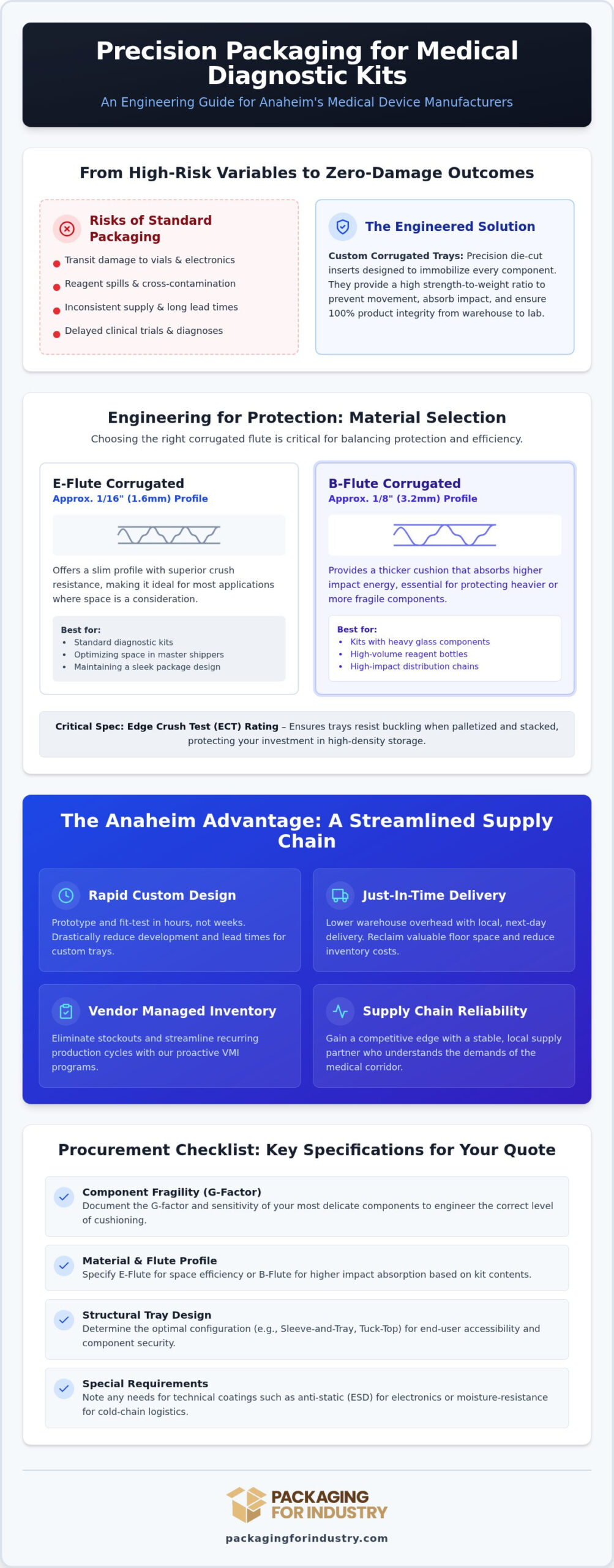
Selecting the appropriate material for diagnostic kit trays requires a balance between structural cushioning and spatial efficiency. While some suppliers push thin 18pt SBS paperboard for its print quality, it lacks the vertical stacking strength needed for industrial distribution. For most applications, E-flute corrugated is the industry standard. It offers a slim profile of approximately 1/16 of an inch while providing superior crush resistance. If your kit contains heavier glass components or high-volume reagents, B-flute provides a thicker 1/8-inch cushion that absorbs higher impact energy during transit. When sourcing custom corrugated trays for medical diagnostic kits Anaheim, engineers must prioritize the Edge Crush Test (ECT) rating to ensure trays don’t buckle when palletized in high-density warehouse environments.
Performance validation is critical for regulatory compliance. Material specifications should align with FDA-recognized packaging standards to ensure that the primary barrier remains protected. Beyond basic strength, specialized environments demand technical coatings. Kits moving through cold-chain logistics require moisture-resistant barriers to prevent the corrugated fibers from softening due to condensation. Additionally, if your diagnostic tool includes sensitive electronic sensors or PCBs, we offer anti-static (ESD) corrugated options that dissipate electrical charges. If you are unsure which flute size or ECT rating fits your specific distribution model, you can request a packaging quote to consult with our engineering team.
Die-Cutting and Tolerances
Modern CAD/CAM integration allows us to achieve zero-clearance precision for vials, swabs, and cassettes. These tight tolerances ensure that components remain stationary without the need for expensive secondary void fill like bubble wrap or foam peanuts. In 2026, the die-cutting process for corrugated fiberboard utilizes high-speed, automated rotary or flatbed presses to strike precision steel-rule dies into the material, creating complex geometries with repeatable accuracy. This level of precision reduces assembly time on your production line because every component snaps into its designated slot with consistent friction.
Sustainability in Medical Packaging
California’s SB 54 regulations have shifted the focus toward high-recycled content and total recyclability. High-grade fiberboard is often a more sustainable and cost-effective alternative to plastic thermoformed trays, which are increasingly difficult to process in hospital waste streams. By choosing localized Southern California manufacturing, you reduce the total carbon footprint of your supply chain while meeting corporate ESG goals. Our trays utilize high-recycled content without sacrificing the structural integrity required for medical-grade protection, ensuring your kits remain compliant and environmentally responsible.
Design Optimization: Comparing Tray Structures for Medical Components
The structural design of a tray determines how effectively it balances assembly speed with component security. Sleeve-and-Tray designs allow for fast, slide-in access, making them ideal for high-throughput production environments where automated equipment handles the final pack-out. Conversely, Roll-End Tuck-Top (RETT) configurations provide a secure, locking lid that eliminates the need for tape or additional adhesives. For kits with high component counts, such as multi-target PCR or antigen tests, multi-tiered trays are the most efficient solution. These designs organize swabs, test strips, and reagents into logical layers, ensuring that the most critical items are presented first to the clinician.
When engineering custom corrugated trays for medical diagnostic kits Anaheim, manufacturers must also account for glass-on-glass contact. Die-cut partitions and interlocking dividers create isolated cells for each vial, preventing friction-induced breakage and label scuffing. This structural integrity is a core requirement of ASTM medical packaging standards, which guide the industry in maintaining sterile barrier integrity throughout the supply chain. In cases where diagnostic hardware or electronic readers are involved, integrating custom foam inserts directly into the corrugated structure provides the necessary shock absorption for ultra-fragile equipment.
Integrated Foam and Corrugated Solutions
Hybrid packaging solutions combine the rigid support of corrugated with the dampening properties of polyethylene or ESD foam. This is particularly useful for kitting heavy diagnostic hardware alongside lightweight plastic reagents. It’s a strategy that prevents heavier items from crushing lighter components during a drop event. Pre-assembling these tray and foam combinations at our facility significantly reduces your facility’s pack-out time. This approach transforms a complex kitting process into a single, streamlined motion for your warehouse staff.
User Experience and Clinical Efficiency
The tray’s layout directly impacts the speed and accuracy of a lab technician. We incorporate ergonomic features like finger notches, which allow for the easy removal of small vials without disturbing the rest of the kit contents. Visual cues and printed instructions on tray flaps can further guide the diagnostic process for point-of-care testing. This attention to detail reduces the risk of user error in high-pressure clinical settings. When your packaging is intuitive, it doesn’t just protect the product; it supports the professional performing the test.
Procurement Checklist: Specifying Your Custom Corrugated Order
Precision procurement starts with data. When preparing your procurement specifications for custom corrugated trays for medical diagnostic kits Anaheim, precision in the initial data phase prevents costly manufacturing delays. You must first document all component dimensions, weights, and fragility levels, often referred to as the G-factor. This data dictates the necessary flute size and internal structural support. Secondly, determine your distribution environment. Parcel shipping through carriers like UPS or FedEx is significantly more aggressive than LTL (Less-Than-Truckload) freight, requiring higher ECT ratings to withstand repetitive drops and sorting belt impacts. If your kits involve cold-chain logistics, you must account for moisture-resistant barriers to maintain structural integrity.
Volume forecasting is the next critical step. Defining your recurring order frequency allows for effective VMI planning, which ensures you never face a production halt due to packaging shortages. Once the design is set, always request a physical prototype. This allows your team to verify the fit and function of every vial and swab holder before full-scale production begins. Finally, review regional compliance and labeling requirements. Ensuring your trays accommodate necessary barcodes and safety symbols is a prerequisite for medical device shipping in the Southern California corridor.
Avoiding Common Ordering Mistakes
Over-packaging is a common logistical error that leads to unnecessary dimensional weight surcharges. If your tray is even half an inch larger than necessary, your shipping costs can climb significantly over a high-volume production run. You should also pay close attention to flute direction; orienting the flutes incorrectly can reduce the stacking strength of your trays by as much as 30 percent. To avoid out-of-stock crises, many Anaheim manufacturers utilize local just-in-time programs. These programs allow you to pull inventory as needed, which saves valuable warehouse floor space for your core diagnostic manufacturing operations.
Prototyping and Testing Protocols
CAD samples play a vital role in the diagnostic kit qualification process. These samples allow you to perform rigorous drop tests and vibration simulations that mimic the actual stresses of the medical supply chain. By testing a custom tray prototype with live components, you can identify if a vial is prone to rotating or if a sensor is susceptible to impact. Prototyping is the most critical step in medical packaging design because it allows you to identify and resolve structural vulnerabilities before they impact your regulatory validation or patient safety.
Why Anaheim Manufacturers Choose PFI for Medical Packaging Solutions
PFI positions itself as a specialized extension of your engineering and procurement teams. We bring deep expertise in custom design packaging for the medical and aerospace sectors, where tolerances are non-negotiable. Large catalog suppliers often provide generic solutions that lead to wasted space and higher shipping costs. By contrast, PFI focuses on engineered efficiency. For firms requiring custom corrugated trays for medical diagnostic kits Anaheim, we provide a localized response that prioritizes structural integrity and fiscal responsibility. Our Anaheim headquarters allows for immediate support and local next-day delivery, ensuring your production line never waits for critical supplies.
Operational reliability is a core pillar of our service model. PFI’s Vendor Managed Inventory (VMI) programs effectively eliminate the stress of packaging shortages. We monitor your usage rates and maintain buffer stocks at our facility, allowing you to reclaim warehouse space for your core manufacturing activities. This just-in-time approach reduces your overhead while guaranteeing that every kit component has a high-precision tray ready for assembly. It’s a pragmatic solution for manufacturers who need to balance lean inventory with 100 percent supply reliability.
Local Service, Nationwide Capability
While we provide personalized attention to Anaheim-based companies, we maintain the infrastructure to support national distribution needs. You benefit from a dedicated account manager who understands the Southern California industrial landscape and can coordinate logistics across multiple satellite locations. We recently partnered with a local diagnostic firm that was struggling with high breakage rates on glass vials using standard catalog boxes. By engineering a custom E-flute tray with integrated dividers, we helped them achieve zero transit damage while simultaneously lowering their per-unit packaging costs through better dimensional weight optimization.
Request Your Custom Packaging Quote
We invite you to request a quote for your next diagnostic kit project. PFI offers free initial assessments to identify specific packaging cost-reduction opportunities in your current supply chain. If you prefer a hands-on approach, local buyers can visit our Anaheim facility for a design consultation with our engineering team. We’ll show you how a precision-engineered tray can transform your logistics from a cost center into a competitive advantage. Contact us today to start the prototyping process and secure your medical supply chain.
Secure Your Medical Supply Chain with Precision Engineering
Securing your diagnostic kits requires more than just a box; it demands a precision-engineered ecosystem of protection. We’ve discussed how selecting the correct ECT ratings and flute profiles directly prevents reagent breakage and cross-contamination. By implementing custom corrugated trays for medical diagnostic kits Anaheim, you effectively eliminate the transit damage that often plagues kits sourced from generic national suppliers. This targeted approach ensures that every sensitive component remains immobilized and functional upon arrival at the clinical laboratory.
Transitioning to a localized, just-in-time model allows your operations team to focus on diagnostic innovation rather than warehouse management. Our free prototyping and CAD design services ensure a zero-clearance fit for every vial and sensor. With specialized VMI stocking programs and local next-day delivery throughout Southern California, you can maintain lean inventory levels while ensuring 100 percent supply reliability. Partnering with a local specialist gives you the stability and technical precision required for medical-grade logistics.
Professional packaging is a critical component of your product’s success and regulatory compliance. We’re ready to help you optimize your logistics and lower your overall per-unit costs. Contact our Anaheim team today to begin your design consultation.
Frequently Asked Questions
What is the best corrugated flute for medical diagnostic trays?
E-flute and B-flute are the industry standards for diagnostic packaging. E-flute is approximately 1/16 of an inch thick and offers excellent space efficiency and a smooth surface for high-resolution printing. B-flute is 1/8 of an inch thick and provides superior cushioning for heavier glass vials or reagents. The choice depends on your kit’s total weight and the fragility of internal sensors. We help you compare packaging pricing for different flute options to ensure maximum protection.
Can PFI provide custom corrugated trays for small-volume diagnostic kits?
Yes, PFI supports both high-volume production and small-volume specialized diagnostic kits. We provide custom sizes available for localized pilot programs or clinical trials. Our Anaheim facility is equipped to handle smaller runs without the prohibitive setup costs often associated with national catalog suppliers. This flexibility allows you to iterate on your kit design before committing to large-scale manufacturing runs. We prioritize helping local firms scale their operations with minimal initial overhead.
How do custom trays help reduce UPS and FedEx shipping surcharges?
Custom trays reduce surcharges by optimizing the exterior dimensions of your kit to minimize dimensional weight. UPS and FedEx calculate costs based on package volume rather than just actual weight. If your internal components aren’t tightly organized, you pay for shipping empty air. By using custom corrugated trays for medical diagnostic kits Anaheim, we ensure the smallest possible footprint while meeting all safety requirements. This strategy is a proven way to lower packaging costs.
Does PFI offer medical-grade or cleanroom-compatible corrugated options?
We offer specialized corrugated materials that meet strict industrial standards for low-dust and particulate control. While traditional corrugated is inherently fibrous, we provide coated or treated options suitable for secondary packaging in controlled environments. If your diagnostic kit requires a higher level of cleanliness, we can integrate polyethylene foam inserts. These inserts are non-abrasive and particulate-free, ensuring that your delicate diagnostic components remain uncontaminated throughout the entire distribution cycle.
What is the typical lead time for a custom die-cut tray prototype in Anaheim?
The typical lead time for a custom die-cut tray prototype at our Anaheim facility is approximately 48 to 72 hours. Because we are local, you don’t have to wait for cross-country shipping to verify a fit. We provide free prototyping for product fit, allowing your engineering team to physically test the layout of vials and sensors immediately. This rapid iteration cycle significantly accelerates your overall time-to-market for new diagnostic kit releases and clinical updates.
Can you integrate foam inserts directly into the corrugated tray design?
Yes, we specialize in kitting and assembly that integrates custom foam inserts directly into corrugated trays. This hybrid approach is ideal for kits containing both heavy reagents and ultra-fragile electronic readers. The foam provides high-level shock absorption while the corrugated tray maintains the structural integrity of the outer kit. This dual-protection strategy is a standard requirement for high-value diagnostic equipment that must withstand the constant vibration of parcel shipping environments.
How does a Vendor Managed Inventory (VMI) program work for medical packaging?
Our Vendor Managed Inventory (VMI) program involves PFI monitoring your stock levels and automatically replenishing packaging inventory based on your production schedule. This eliminates the risk of stockouts and production halts. We store the bulk inventory at our local facility and provide next-day delivery as you pull stock. This system allows you to lower packaging costs by purchasing in bulk without wasting your own valuable warehouse space for empty box inventory.
Are your corrugated trays compliant with international shipping standards for medical devices?
Our trays are engineered to meet ASTM and ISO industrial standards for the distribution of medical devices. We design for the rigors of international transit, ensuring that your custom corrugated trays for medical diagnostic kits Anaheim withstand the vibration and compression of air and ocean freight. We verify that all materials comply with necessary international standards, providing you with the documentation required to clear customs and ensure total global supply chain integrity.