
How much does a single failed delivery actually cost your operation when you factor in DoD contractual penalties and the loss of a precision-engineered aerospace component? In the high-stakes Southern California defense corridor, “good enough” packaging doesn’t exist. You’re dealing with strict MIL-STD-2073 requirements where even a minor oversight in material selection can lead to rejected shipments or damaged high-value parts. Finding reliable mil-spec packaging for aerospace parts Southern California manufacturers can trust is the difference between a seamless supply chain and a logistical nightmare.
We understand that precision parts require precision protection that balances engineering requirements with fiscal responsibility. This guide will show you how to select the exact MIL-SPEC compliant shock-absorbing foam required to protect your assets while meeting the rigorous standards of modern defense contracts. We’ll examine the specific performance characteristics of polyethylene and polyurethane foams, compare local procurement advantages over national catalogs, and outline how to achieve zero-damage shipping for your most sensitive assemblies.
Key Takeaways
- Identify the performance differences between Polyethylene and Polyurethane foams to match material density with specific part fragility.
- Ensure full compliance with active standards like MIL-STD-2073 and MIL-PRF-26514G to eliminate transit damage and avoid contractual penalties.
- Streamline your procurement process by sourcing mil-spec packaging for aerospace parts Southern California from a local partner offering next-day delivery.
- Leverage Vendor Managed Inventory (VMI) and custom kitting to lower total packaging costs while maintaining a just-in-time production schedule.
- Utilize free prototyping and CAD/CAM design support to verify the fit and protection of custom foam inserts before moving to full-scale production.
The High Stakes of Aerospace Shipping: Why Shock Absorption Matters
Shipping high-value aerospace components across Southern California involves more than just moving boxes. It’s about protecting mission-critical assets from vibration and impact. Transit damage can lead to catastrophic financial losses. A single damaged sensor or avionics board doesn’t just represent the cost of the hardware; it triggers expensive re-certification processes and halts production lines in Anaheim or Irvine. Proper shock absorption is the first line of defense against these operational risks.
The Cost of Damage in Aerospace Logistics
Hidden costs often outweigh the price of the part itself. When a precision component arrives with hairline fractures or misaligned optics, the manufacturer faces production delays that ripple through the entire supply chain. Custom-engineered foam inserts are designed to manage Cushioning principles, effectively reducing the G-force impact during handling and transit. By dampening these kinetic energies, aerospace packaging solutions ensure that sensitive electronics remain within their calibrated tolerances. This proactive approach eliminates the need for emergency re-testing and keeps defense contracts on schedule.
MIL-SPEC vs. Commercial Standards
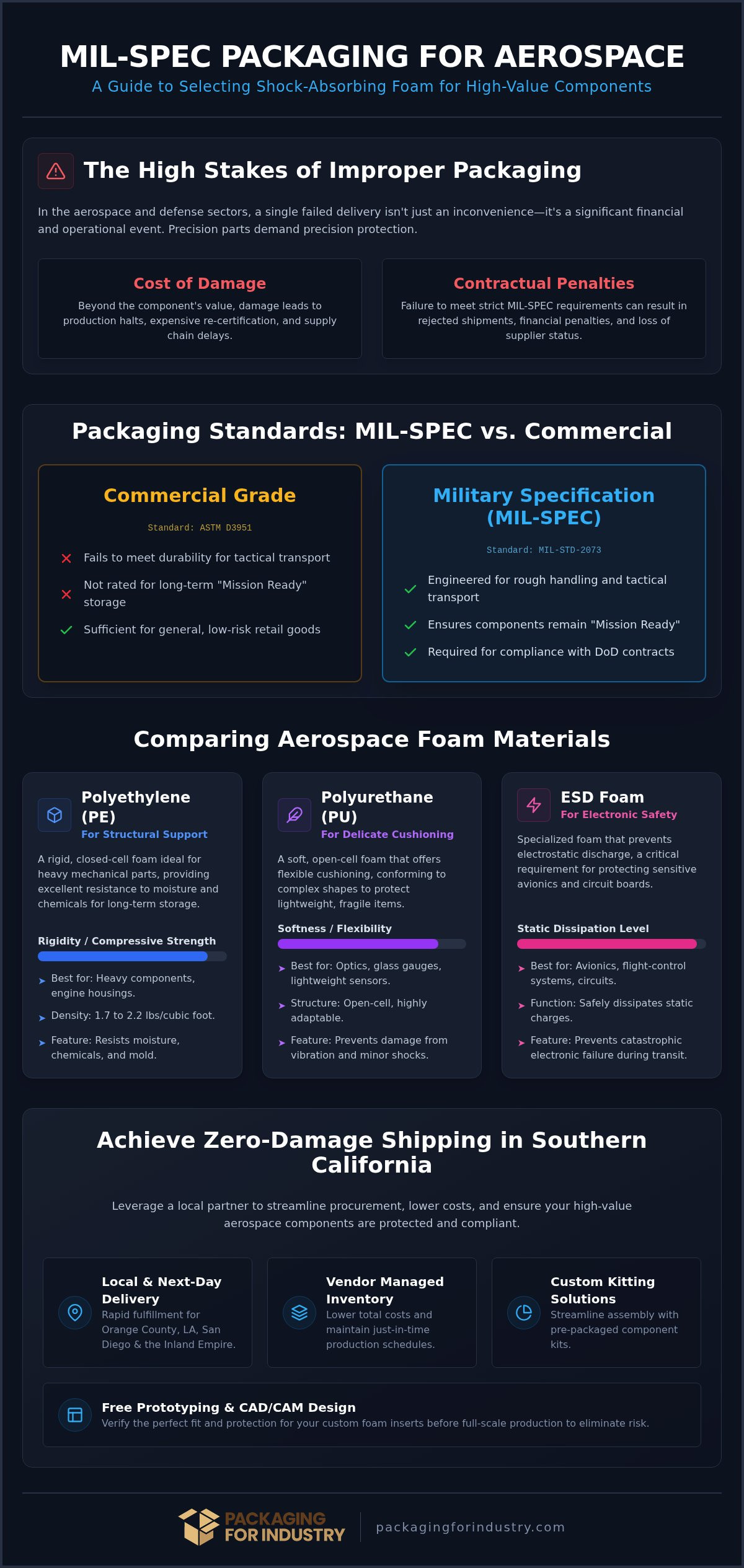
There’s a wide gap between commercial-grade packaging and the requirements for defense contracts. Most standard industrial supplies follow ASTM D3951. This is sufficient for general retail goods but fails to provide the durability required for military logistics. In contrast, MIL-STD-2073 dictates specific packaging methods that ensure items remain “Mission Ready” even after long-term storage or rough tactical transport. Selecting the right mil-spec packaging for aerospace parts Southern California vendors provide is essential for compliance. While commercial boxes might save a few cents upfront, they often lead to rejected shipments and contractual penalties. Heavy-duty protection isn’t an option; it’s a requirement for maintaining your status as a reliable tier-one or tier-two supplier.
Speed is a priority in the Southern California aerospace corridor. However, speed shouldn’t come at the expense of protection. Local manufacturers need a partner who understands the balance between rapid fulfillment and technical compliance. Whether you’re shipping between San Diego and Los Angeles or sending parts to a national distribution center, your foam inserts must be engineered for the specific fragility of the part. This ensures that even under tight deadlines, your shipments arrive intact and fully compliant.
Comparing Aerospace Foam Materials: PE vs. PU vs. ESD
Selecting the correct cushioning material is a technical decision that balances the fragility of the component with the weight of the assembly. In the Southern California aerospace sector, engineers often consult the Aviation Suppliers Association packaging guide to determine which material properties align with specific ATA or DoD requirements. Using the wrong foam density can lead to “bottoming out” during transit, which effectively negates the protection of your outer RSC boxes or crates.
Polyethylene (PE) for Structural Support
Polyethylene is the industrial workhorse for heavy-duty protection. It features a closed-cell structure that resists moisture, chemicals, and mold, making it ideal for long-term storage in varying warehouse environments. Because it’s a rigid foam, it provides excellent structural support for heavy mechanical parts like landing gear components or engine housings. Standard aerospace PE foam typically ranges from 1.7 to 2.2 pounds per cubic foot to provide the necessary compressive strength for heavy mechanical assemblies. This material is frequently used for custom-lined crates and heavy-duty kitting projects where durability is a primary concern.
When your parts are lightweight or exceptionally fragile, Polyurethane (PU) foam is the better alternative. PU is an open-cell foam that offers a softer, more flexible cushion. It’s the preferred choice for protecting delicate optics, glass gauges, and lightweight sensors. While it doesn’t offer the same moisture resistance as PE, its ability to wrap around complex geometries makes it indispensable for intricate aerospace assemblies.
Specialized ESD Foam for Avionics
Avionics and flight-control systems face a unique threat: Electrostatic Discharge (ESD). Standard foams can generate static electricity during handling, which can fry sensitive circuits before the part even reaches the hangar. To prevent this, manufacturers must use specialized foam packaging products designed for conductivity or dissipation. Pink anti-static foam is treated with a topical agent to prevent static buildup, while black conductive foam contains carbon to actively bleed off charges. Specifying the right ESD material is a critical step in securing mil-spec packaging for aerospace parts Southern California defense contractors require for compliance.
For cleanroom environments or applications where outgassing is a concern, cross-linked polyethylene (XLPE) offers the highest level of performance. It provides the durability of standard PE but with a much finer cell structure that won’t scratch highly polished surfaces. This material is often specified for satellite components and high-precision mirrors where even microscopic debris can cause mission failure. If you’re unsure which material meets your current contract specifications, you can request a packaging quote to have our engineers analyze your part’s fragility and weight requirements.
Navigating MIL-SPEC Standards for Aerospace Foam
Compliance is the bedrock of defense manufacturing. When you’re providing mil-spec packaging for aerospace parts Southern California contracts require, you’re following a precise technical roadmap. MIL-STD-2073 is the active standard practice, last updated on June 27, 2024. It defines the processes for developing and documenting military packaging. It’s important to distinguish this “standard practice” from material specifications like MIL-PRF-26514G, which dictates the performance requirements for polyurethane foam, or MIL-PRF-81705 for ESD-shielding materials. Understanding how these regulations interact ensures your shipments meet every contractual obligation.
Understanding MIL-STD-2073 Requirements
DoD contracts use a string of alphanumeric codes to define packaging requirements. These codes dictate the levels of protection, ranging from Level A (maximum protection for severe environments) to Level B (moderate protection). A key element for foam selection is “Method 50,” which specifically governs cushioning. This method ensures that the foam density and thickness are sufficient to prevent part movement and absorb kinetic energy. While preservation focuses on preventing corrosion, packing focuses on physical protection. Your foam inserts must bridge both needs, providing structural support while remaining chemically neutral to the part’s surface. We ensure our custom designs meet these specific kitting requirements to prevent stockouts and rejected shipments.
Compliance Documentation and Labeling
Physical protection is only half of the requirement. MIL-STD-129 governs the marking and labeling of every shipment. Without the correct barcodes and labeling, even perfectly cushioned parts can be rejected at the Defense Logistics Agency (DLA) or by Prime Contractors. Certified material test reports (MTRs) are often mandatory for aerospace applications. These documents prove the foam meets the specific specifications cited in your contract, such as A-A-59136 for polyethylene or MIL-PRF-26514G for polyurethane. Maintaining this paper trail is vital for re-certification and audit purposes. Working with a local partner who understands these administrative hurdles reduces the risk of shipment rejection and ensures your mission-critical parts are accepted without delay.
Reading a DoD contract code can be complex. Each digit in the packaging requirement string represents a specific variable, from the type of preservative used to the specific cushioning material required. If your contract specifies a code you aren’t familiar with, our team can help decode the requirements. This precision prevents over-packaging, which lowers packaging costs, while ensuring you don’t under-package and risk part damage. In the Southern California aerospace corridor, this level of technical oversight is a requirement for long-term supply chain reliability.
Buying Guide: How to Specify Custom Foam Inserts
Specifying the right foam insert starts with a comprehensive part analysis. You must evaluate the component’s weight, fragility (G-factor), and surface sensitivity. For example, a heavy engine component requires high-density polyethylene, while a delicate circuit board needs anti-static polyurethane. Once the part is analyzed, the next step is selecting the outer container. Standard RSC boxes work for many applications, but larger or heavier assemblies often require custom-engineered crates to ensure full protection during long-distance transit.
Prototyping for Precision Fit
Precision is non-negotiable in aerospace logistics. We use advanced CAD/CAM design to create inserts that match the exact geometry of your components. This is where custom design packaging services provide the most value. PFI offers free prototyping to ensure a perfect fit before mass production begins. By testing the prototype, you can verify that the cushioning prevents movement and absorbs vibration. This phase is critical for complex, multi-material kitting solutions where several components are housed in a single container.
Step four involves rigorous testing for real-world conditions. Your packaging must withstand shock and vibration, but it also needs to handle environmental factors like humidity and temperature fluctuations. In Southern California, parts may move from a temperature-controlled lab to a hot warehouse or a pressurized cargo hold. Testing ensures the material properties of the foam won’t degrade or outgas under these conditions. This level of technical oversight is essential for securing mil-spec packaging for aerospace parts Southern California defense contractors need to maintain their supply chain integrity.
Optimizing for Logistics Efficiency
Engineering isn’t just about protection; it’s also about economics. Over-designed packaging leads to excessive box sizes, which increases shipping costs through UPS or FedEx dimensional weight surcharges. Our designers focus on minimizing the footprint of the package without sacrificing safety. For recurring shipments, we often recommend reusable cushioning systems, such as Fast Packs, which lower long-term packaging costs. Balancing material price with labor efficiency during kitting and assembly is the final step in a successful procurement strategy. This proactive approach ensures your precision parts remain safe while your operational costs stay under control.
The PFI Advantage: Local SoCal Support for Aerospace
Choosing a packaging partner in the Southern California aerospace corridor requires more than just looking at a price list. National catalog suppliers often lack the technical depth and local presence needed to navigate complex defense requirements. PFI provides specialized mil-spec packaging for aerospace parts Southern California manufacturers rely on to maintain their standing with major primes like Boeing, Northrop Grumman, and SpaceX. Based in Anaheim, we offer a level of responsiveness that national distributors simply cannot match. Whether your facility is in Long Beach, Irvine, or San Diego, our local presence ensures your production lines never stall due to packaging shortages.
Just-in-Time Inventory for SoCal Manufacturers
Warehouse space in the Inland Empire and Orange County is a significant operational expense. Storing large quantities of custom foam inserts and heavy-duty corrugated boxes ties up both capital and square footage. Our vendor managed inventory services solve this by housing your custom stock in our facility and delivering it exactly when you need it. This just-in-time approach prevents stockouts of mission-critical MIL-SPEC materials and allows you to repurpose warehouse space for production. We also provide kitting and assembly services, delivering ready-to-use packaging sets directly to your floor to streamline your final assembly process.
Local Engineering and Prototyping
Aerospace projects evolve rapidly, often requiring quick adjustments to packaging designs as part geometries change. Working with our Anaheim-based engineering team means you don’t have to wait weeks for a prototype to arrive from a cross-country facility. We provide free prototyping and CAD/CAM design support with a focus on immediate turnaround. This local expertise is vital when securing mil-spec packaging for aerospace parts Southern California defense contractors need to meet tight launch or delivery windows. If a design needs a modification to improve shock absorption or reduce dimensional weight, our team can implement those changes and deliver a new prototype the next day.
Our commitment to the Southern California manufacturing community goes beyond simple delivery. We act as a seasoned industrial consultant, helping you lower packaging costs while ensuring 100% compliance with MIL-STD-2073 and other critical regulations. From the initial design phase to final delivery in San Diego or Carson, we provide a holistic system of protection. This end-to-end oversight ensures your high-value components arrive zero-damage every time. You can request a custom packaging quote today to see how our local expertise can optimize your logistics flow.
Securing Your Aerospace Supply Chain with Precision Protection
Protecting high-value aerospace components requires a disciplined approach to material selection and regulatory compliance. You’ve learned that the choice between polyethylene and polyurethane isn’t just about cushioning; it’s about meeting specific MIL-STD-2073 requirements while optimizing your logistical costs. By prioritizing engineering-driven solutions, you eliminate the risk of transit damage and ensure your shipments are mission-ready.
Partnering with a local expert for mil-spec packaging for aerospace parts Southern California manufacturers trust provides a distinct competitive advantage. Our Anaheim-based custom engineering team is ready to support your production line with free prototyping for aerospace components and local next-day delivery. This proximity allows for rapid design adjustments and reliable vendor-managed inventory programs that national catalog suppliers simply can’t provide.
We’re here to help you streamline your procurement and protect your most sensitive assets. Let’s build a more resilient and efficient supply chain together.
Frequently Asked Questions
What is the difference between MIL-STD-2073 and ASTM D3951?
MIL-STD-2073 is the mandatory standard for military packaging, requiring specific methods to ensure parts remain mission-ready after long-term storage or tactical transport. ASTM D3951 is the standard for commercial shipping, which lacks the rigorous preservation and packing requirements of defense contracts. Choosing the military standard is essential for DoD compliance and protecting parts against the severe handling environments typical in defense logistics chains.
Do you provide ESD-safe foam for aerospace electronics in Southern California?
Yes, we specialize in providing mil-spec packaging for aerospace parts Southern California electronics firms require to prevent static damage. We offer both pink anti-static foam and black conductive materials that meet MIL-PRF-81705 requirements. Our Anaheim engineering team helps you select the correct ESD-shielding material to protect sensitive avionics, flight-control systems, and circuit boards during transit between facilities in Irvine or San Diego.
How do I determine the right foam density for my aerospace part?
Density selection depends on the part’s weight, surface area, and G-force fragility. Heavy mechanical components like landing gear require high-density polyethylene to prevent bottoming out, while delicate sensors need soft polyurethane for better shock absorption. We analyze these variables during the design phase to ensure the foam provides maximum protection without unnecessary bulk. This technical approach helps you lower packaging costs while eliminating shipping damage.
Can PFI help with CAD design for custom foam inserts?
Yes, our in-house engineering team utilizes CAD/CAM design support to create inserts that match your part’s exact geometry. We provide free prototyping to ensure a precision fit before you move to full-scale production. This is particularly beneficial for complex kitting projects where multiple components must be secured within a single RSC box. Our custom designs focus on both physical protection and logistical efficiency to reduce your total spend.
What is the typical lead time for custom MIL-SPEC foam in SoCal?
Lead times depend on the complexity of the design, but our local Anaheim facility allows for much faster turnarounds than national catalog suppliers. We prioritize responsiveness for the Southern California aerospace corridor to keep your production moving. For recurring orders, our Vendor Managed Inventory (VMI) programs ensure your custom foam inserts are always in stock. This proactive management allows for just-in-time delivery to your facility, preventing stockouts.
Do you offer local next-day delivery for aerospace contractors in Orange County?
Yes, we offer local next-day delivery for aerospace contractors throughout Orange County, Los Angeles, and the Inland Empire. Our delivery fleet regularly services manufacturers in Anaheim, Long Beach, and Irvine. This local support eliminates the long lead times associated with national suppliers and improves your supply chain reliability. You can request a packaging quote to verify delivery schedules and compare packaging pricing for your specific location.
Can you provide the necessary MIL-SPEC certification for the foam materials?
Yes, we provide all required compliance documentation, including Certified Material Test Reports (MTRs), for our foam products. These documents prove that the materials meet specific standards like A-A-59136 or MIL-PRF-26514G. Providing this paperwork is a standard part of our mil-spec packaging for aerospace parts Southern California service. It ensures your shipments meet DoD requirements and prevents rejection at the DLA or Prime Contractor level during the receiving process.
What is a “Fast Pack” and is it suitable for aerospace components?
A Fast Pack is a standardized, reusable cushioning system that integrates foam inserts directly into a corrugated box. These systems are highly suitable for aerospace components, especially sensitive electronics and instruments that require frequent shipping. They offer excellent shock protection while significantly reducing the labor time required for kitting and assembly. Using Fast Packs is an effective way to maintain high protection standards while improving your overall warehouse efficiency.