
A single missing stamp on your shipping crate can result in your entire international cargo being quarantined or destroyed at the port of entry. For manufacturers in Los Angeles and Orange County, the stakes of international logistics are too high to leave packaging to chance. You’ve likely felt the pressure of tight export deadlines and the constant worry that a technical oversight in your wood packaging will trigger a costly customs delay. Securing ISPM-15 certified wood crates Southern California manufacturers rely on is about more than just checking a box. It’s a strategic move to protect your bottom line and ensure the logistical flow of your global supply chain.
We understand that the technical distinctions between Heat Treatment (HT) and Kiln Dried (KD) markings often create unnecessary confusion during the procurement process. This article provides the exact steps you need to secure compliant wood crates and pallets that meet international standards. You’ll learn how to distinguish between solid and processed wood requirements while managing lead times for custom-sized packaging. We’ll also provide a clear checklist to help you find a reliable local partner for your recurring certified supply needs. By the end of this guide, you’ll possess a clear roadmap to ensure your shipments move through the ports of LA and Long Beach with total confidence.
Key Takeaways
- Understand why the ISPM-15 “bug stamp” is a non-negotiable requirement for international shipping and how it prevents costly cargo quarantines.
- Learn the streamlined five-step process to secure ISPM-15 certified wood crates Southern California exporters need to clear customs without delays.
- Identify when to utilize heat-treated solid wood versus exempt processed materials like plywood to optimize your packaging durability and cost.
- Navigate high-volume inspection environments at the Port of Los Angeles and Port of Long Beach with compliant documentation and markings.
- Discover how to lower packaging costs and reduce lead times through custom engineering, free prototyping, and vendor-managed inventory programs.
What is ISPM-15 and Why is the “Bug Stamp” Mandatory for Export?
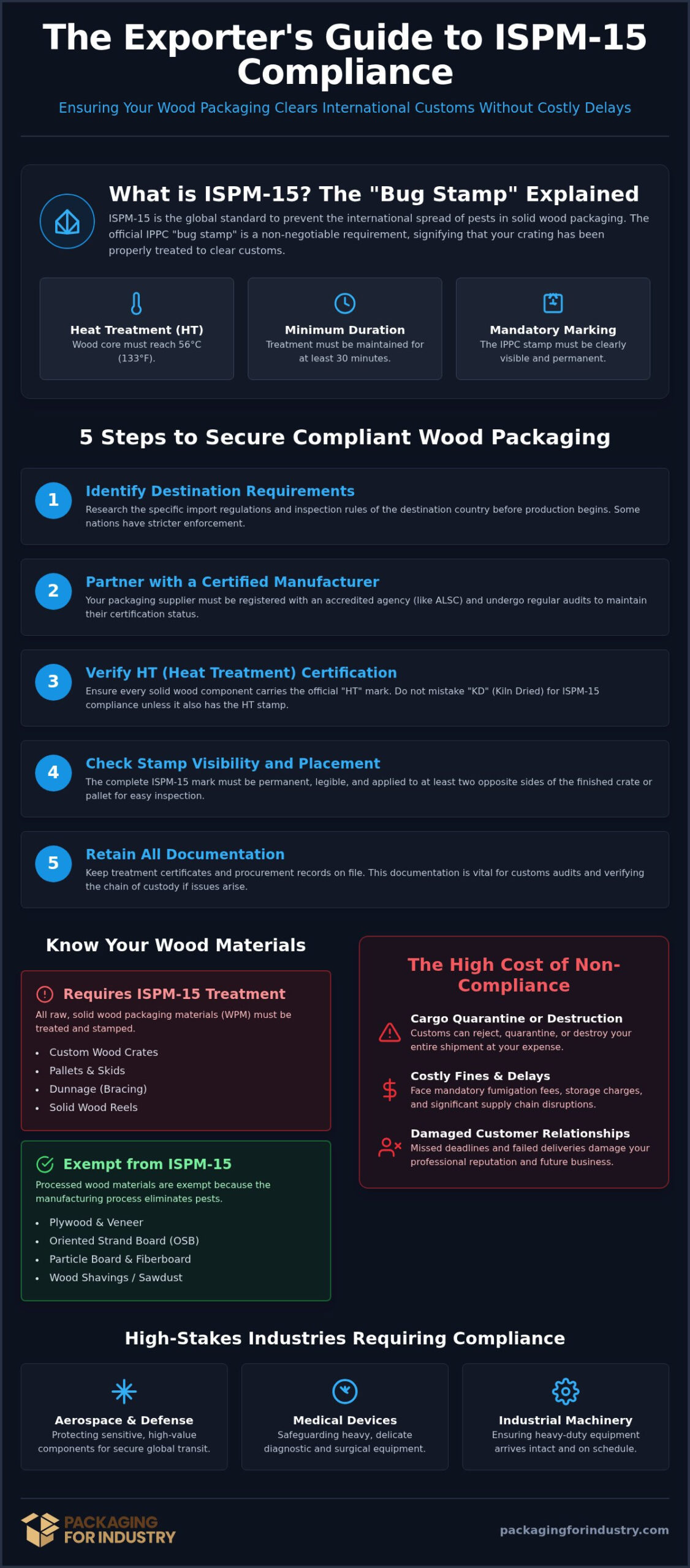
ISPM-15, or the International Standards for Phytosanitary Measures No. 15, is a global regulation established by the International Plant Protection Convention (IPPC). Its primary purpose is to prevent the international spread of pests that could devastate local ecosystems. When you’re shipping goods internationally, the “Bug Stamp” is the universal mark that tells customs officials your wood packaging has been properly treated. For businesses sourcing ISPM-15 certified wood crates Southern California, this stamp is the difference between a smooth delivery and a logistical nightmare.
The consequences of ignoring these standards are severe. If a shipment arrives at a foreign port without the proper IPPC mark, customs agents can deny entry. This often leads to mandatory fumigation at the exporter’s expense, or worse, the total destruction of high-value cargo to prevent potential infestation. These delays don’t just cost money in fines; they damage your reputation with international clients and disrupt your entire supply chain. Any packaging made of raw, solid wood requires this certification. This includes pallets, crates, dunnage, and skids. If the wood hasn’t been processed into a composite material like plywood or OSB, it must be treated and stamped.
The Core Requirements for Wood Packaging Materials (WPM)
To meet compliance, wood must be debarked and heat-treated so that its core reaches a temperature of 56°C for at least 30 minutes. Once treated, the wood is marked with the IPPC stamp. This mark includes a specific country code, a unique manufacturer ID, and the treatment type, which is typically “HT” for Heat Treated. It’s a common mistake to assume that “Kiln Dried” (KD) lumber is automatically compliant. While kiln drying removes moisture, it doesn’t always meet the specific temperature duration required for ISPM-15 unless it carries the official HT mark.
Industries Most Affected by Export Compliance
Certain sectors face higher scrutiny due to the nature of their cargo. Aerospace and defense companies shipping sensitive components through Southern California ports must ensure their custom crating is fully compliant to avoid security-sensitive delays. Similarly, medical device manufacturers moving heavy diagnostic equipment and industrial machinery suppliers in the Inland Empire and Orange County rely on ISPM-15 certified wood crates Southern California to protect their investments during long-haul transit. Reliable compliance is a prerequisite for these high-stakes industries where precision and reliability are paramount.
5 Steps to Secure ISPM-15 Certification for Your Wood Packaging
Securing compliance for international shipping requires a methodical approach to procurement. It’s not enough to simply ask for “treated wood.” You need a verified process that satisfies both US export laws and the destination country’s import regulations. When sourcing ISPM-15 certified wood crates Southern California manufacturers must follow these five critical steps to avoid port rejection.
- Identify destination requirements: Some countries enforce stricter inspections or have specific dunnage rules. Research these before starting production.
- Partner with a certified manufacturer: Your supplier must be registered with an accredited agency like the American Lumber Standard Committee (ALSC) and undergo regular audits.
- Verify HT certification: Ensure every solid wood component used in the build carries the HT (Heat Treatment) mark to prove it reached the required core temperature.
- Check stamp visibility: The ISPM-15 mark must be permanent and clearly applied to at least two opposite sides of the finished crate.
- Retain documentation: Keep all treatment logs and certification records on file. These are vital for customs audits and verifying the chain of custody.
Choosing a Certified Southern California Supplier
Selecting a local partner involves more than checking a price list. You need to verify that your supplier undergoes regular third-party inspections to maintain their certification status. Ask about their ability to handle custom crate design for oversized or high-value equipment. A reliable partner ensures that the IPPC markings are legible and won’t smudge or fade during long sea voyages from the Port of Los Angeles. If you’re looking to streamline your supply chain, you can compare packaging pricing for certified solutions today.
Documenting Compliance for International Freight
Clear documentation is the final hurdle in the compliance process. You should include specific ISPM-15 details directly on your commercial invoice and packing list. This transparency helps freight forwarders at the Port of Long Beach pre-clear your wood packaging, reducing the likelihood of a “red flag” inspection. Common pitfalls include missing manufacturer IDs on paperwork or failing to specify the treatment type. By providing consistent data across all shipping documents, you minimize the risk of your cargo being held for manual inspection. This proactive approach ensures your logistics move with the speed your business demands.
Choosing Between Heat-Treated Solid Wood and Processed Wood Materials
Selecting the right material for your export packaging is a balance between engineering requirements and regulatory speed. While raw timber must meet strict heat treatment standards, many manufacturers overlook the inherent benefits of processed wood. Materials such as plywood, OSB, and particleboard are naturally exempt from ISPM-15 regulations. The manufacturing of these materials involves high heat and pressure, which effectively eliminates pests, making them “pre-treated” by default. A hybrid approach using solid wood frames with processed wood panels is a common design for ISPM-15 certified wood crates Southern California manufacturers produce to balance cost and compliance.
Structural integrity is the primary driver when choosing solid wood. If you’re shipping industrial machinery exceeding 5,000 lbs, solid wood skids are non-negotiable. They provide the necessary compression strength and fastener-holding power that processed materials often lack. However, for lighter e-commerce shipments or delicate electronics, processed wood is the superior choice. It streamlines the customs process by removing the need for a “bug stamp” on the panels, reducing the risk of administrative delays at the port.
The Pros and Cons of Heat-Treated (HT) Solid Wood
Solid wood is the industry standard for maximum weight capacity and durability. It’s the preferred material for aerospace engines and heavy manufacturing equipment that requires custom-engineered support during transit. The primary benefit is structural; it handles extreme stacking pressures better than any other organic material. The drawback is that every piece of raw timber must carry a legible HT mark. This subjects the shipment to more rigorous port inspections, as customs officials must verify the stamp’s authenticity on every component. Despite this, the durability of solid wood remains essential for high-value gear shipped in ISPM-15 certified wood crates Southern California exporters rely on for protection.
The Advantages of Plywood and OSB in Export Crating
Processed materials offer a significant logistical advantage: they bypass ISPM-15 certification entirely because they aren’t considered “raw wood.” This simplifies the export process and eliminates the risk of a single missing stamp holding up your cargo. Additionally, plywood is significantly lighter than solid oak or pine. This weight reduction can drastically lower air freight costs, which is a major factor for time-sensitive electronics. The trade-off is impact resistance. While plywood is excellent for protecting against punctures, it doesn’t offer the same structural rigidity as a heavy-duty solid wood frame when subjected to extreme vertical loads.
Navigating Southern California Export Logistics and Compliance
The Port of Los Angeles and the Port of Long Beach represent the heaviest concentration of container traffic in the United States, but for many regional manufacturers, the Port of San Diego also serves as a critical gateway for specialized cargo. This high-volume environment creates a rigorous inspection landscape where Customs and Border Protection (CBP) officers prioritize wood packaging audits. If you are sourcing ISPM-15 certified wood crates Southern California manufacturers must ensure that every unit is marked with industrial-grade, permanent ink. The salt-heavy air at these ports can degrade poor-quality markings, leading to illegible stamps that trigger manual inspections and costly terminal storage fees. We verify that our IPPC markings are applied to withstand these environmental conditions, protecting your cargo from administrative holds.
PFI supports the entire regional manufacturing base with dedicated logistical support. We provide local next-day delivery to facilities in Anaheim, Irvine, and the Inland Empire through our Ontario operations. Our delivery network extends through San Diego and Los Angeles, ensuring that your warehouse always has a compliant supply of crates ready for the next outgoing shipment. For companies with multiple US-based manufacturing hubs, we offer nationwide shipping to maintain a unified standard of compliance across your entire organization.
Shipping to Mexico and Canada via Southern California
Cross-border land logistics under the USMCA require strict adherence to phytosanitary standards. San Diego is a primary hub for this trade, specifically through the Otay Mesa land port, which sees thousands of commercial crossings daily. While trade agreements simplify tariffs, they don’t waive the requirement for the ISPM-15 “bug stamp.” CBP and Mexican customs officials frequently audit shipments destined for Mexican maquiladoras to prevent the spread of wood-borne pests. We design our export crates to handle the unique stresses of trailer transfers and border inspections. This ensures your high-value freight moves through San Diego and into international territory without being flagged for non-compliant dunnage.
Port Inspections and Customs Clearance in SoCal
Customs officials at Southern California ports have the authority to refuse any shipment that lacks a verified IPPC mark. If your crate is flagged at the Port of Long Beach, you face the immediate risk of mandatory fumigation or the total rejection of the cargo. These events create a massive financial liability, including demurrage and the high cost of emergency repacking. To mitigate these operational risks, many manufacturers utilize vendor-managed inventory (VMI). VMI provides a safety net by ensuring you never run out of ISPM-15 certified wood crates Southern California exporters need for time-sensitive shipments. This integrated approach to supply reliability allows your team to focus on production while we manage the complexities of your certified crate stock.
Optimizing Your Export Strategy with PFI’s Custom Crating and VMI
Optimizing your export strategy goes beyond simple compliance; it requires an integrated approach to engineering and inventory management. By sourcing ISPM-15 certified wood crates Southern California manufacturers can leverage advanced kitting services to streamline their assembly lines. We don’t just provide the outer shell. We engineer internal custom foam packaging and use CAD/CAM support to ensure every component fits perfectly. Our free prototyping service allows you to test the structural integrity and ISPM-15 compliance of your design before committing to a full production run.
Achieving lower packaging costs is a primary focus of our consultative process. With custom sizes available, you don’t pay for excess material or wasted shipping volume. We analyze your recurring needs to determine when to use heavy-duty solid wood and when exempt materials like plywood provide a better economic balance. To further improve reliability, our Vendor Managed Inventory (VMI) programs work alongside just-in-time packaging schedules. This ensures that you never miss a critical export deadline due to a stockout of certified materials.
Custom-Engineered Protection for High-Value Exports
Sensitive electronics and aerospace gear require reinforced protection during international transit. We utilize heavy-duty corner boards to ensure crate integrity during forklift handling and stacking. Our corner and edge protection solutions are specifically designed to work with mil-spec and aerospace-grade crates. This creates a multi-layered defense system that prevents impact damage while maintaining full compliance for your ISPM-15 certified wood crates Southern California shipments. By integrating these materials at the engineering phase, we reduce transit risks and the associated costs of shipping damage.
Request a Quote for ISPM-15 Certified Wood Packaging
Providing accurate specs for your custom crate is the first step toward a more reliable supply chain. When you request a packaging quote, please include dimensions, cargo weight, and destination. PFI is committed to providing Southern California manufacturers with industrial-grade solutions that safeguard their products and reputation. Our local next-day delivery and nationwide shipping capabilities ensure your facility remains productive and compliant regardless of your volume requirements.
Secure Your International Supply Chain Today
Successfully navigating the complexities of international logistics requires a partner who understands the specific demands of the Port of Los Angeles and Port of Long Beach. By implementing a rigorous five-step certification process and choosing the right material mix, you can eliminate the risk of cargo being rejected or destroyed at the border. PFI stands as a certified manufacturer of ISPM-15 certified wood crates Southern California businesses rely on for total compliance and structural integrity.
Our team provides free prototyping and CAD design to ensure every custom crate meets your exact specifications before production begins. With local next-day delivery available across the region, we ensure your operations remain agile and responsive to global demand. We specialize in identifying the intersection of engineering efficiency and fiscal responsibility, helping you lower packaging costs while maintaining the highest level of protection for your high-value gear.
Protecting your exports is a strategic investment in your company’s global reputation. We are dedicated to helping you streamline your procurement and safeguard every shipment that leaves your facility. Let’s work together to build a more reliable and cost-effective logistical future for your business.
Frequently Asked Questions
How do I know if my wood crate is ISPM-15 certified?
You can identify a compliant crate by the official IPPC mark, commonly known as the “bug stamp,” permanently applied to the wood. This mark must include the IPPC symbol, the ISO country code, a unique manufacturer registration number, and the treatment code, such as HT for heat treatment. When sourcing ISPM-15 certified wood crates Southern California suppliers provide, ensure these stamps are legible on at least two opposite sides to satisfy international port inspectors.
Can I use standard pallets for international shipping?
No, standard domestic pallets typically lack the required heat treatment and certification markings needed for export. Most domestic pallets are made from raw lumber that hasn’t reached the mandatory core temperature of 56°C for 30 minutes. Using non-compliant pallets can lead to your entire shipment being rejected at the Port of Long Beach. You must specifically request heat-treated pallets that carry the official IPPC stamp to ensure they meet international phytosanitary standards.
Does plywood require an ISPM-15 bug stamp for export?
Plywood is considered a processed wood product and is naturally exempt from ISPM-15 regulations. The manufacturing process for plywood, OSB, and particleboard involves high heat and pressure that effectively eliminates any deep-seated pests. This makes processed wood an excellent choice for manufacturers looking to lower packaging costs and simplify the customs process. However, if a plywood crate uses solid wood internal framing, those specific solid wood components must still carry the HT stamp.
What happens if my shipment arrives at a foreign port without the IPPC stamp?
Your cargo will likely be quarantined, denied entry, or ordered for immediate destruction by foreign customs authorities. The exporter is typically responsible for all resulting costs, including mandatory fumigation fees, storage charges, and the expense of repacking the goods into compliant crates. In some cases, the entire shipment may be sent back to the United States at your expense. This administrative failure can cause weeks of delays and damage your international business relationships.
Is there a difference between heat-treated (HT) and kiln-dried (KD) wood?
Yes, heat-treated wood is processed specifically to kill pests, while kiln-drying is primarily used to reduce moisture content. While many kilns can reach the temperatures required for ISPM-15 compliance, the wood is only considered certified if it undergoes a verified HT process and receives the official stamp. You shouldn’t assume that KD lumber is export-ready. Always verify that your supplier provides wood marked with the HT stamp to ensure it meets IPPC requirements for international transit.
How much does it cost to get ISPM-15 certified wood crates in Southern California?
Pricing for certified crates depends on several factors, including the exterior dimensions, weight capacity, and current lumber market rates. While the heat treatment process adds a small premium over standard domestic crates, the cost is significantly lower than the potential fines for non-compliance. To get an accurate price, you should request a packaging quote based on your specific specs. PFI offers competitive rates for custom sizes and provides local delivery to help manage logistics expenses.
How long is an ISPM-15 certification valid for a used crate?
An ISPM-15 certification remains valid as long as the wood packaging has not been repaired or altered. If you replace any part of a certified crate with new, uncertified wood, the entire structure loses its compliance status. You must have the crate re-certified and re-marked by an accredited agency if any structural changes occur. Many manufacturers find it more cost-effective to procure new ISPM-15 certified wood crates Southern California suppliers offer rather than managing the liability of re-certifying old units.
Do I need ISPM-15 certification for shipments to Mexico or Canada?
Yes, ISPM-15 compliance is mandatory for wood packaging moving between the United States, Mexico, and Canada under USMCA rules. While these countries share a trade agreement, they maintain strict phytosanitary borders to prevent the cross-border movement of invasive species. Customs agents at land-border crossings frequently inspect trailers for the IPPC stamp. Failing to use certified pallets or crates for shipments to Mexican maquiladoras can result in significant delays and costly trailer transfers at the border.