
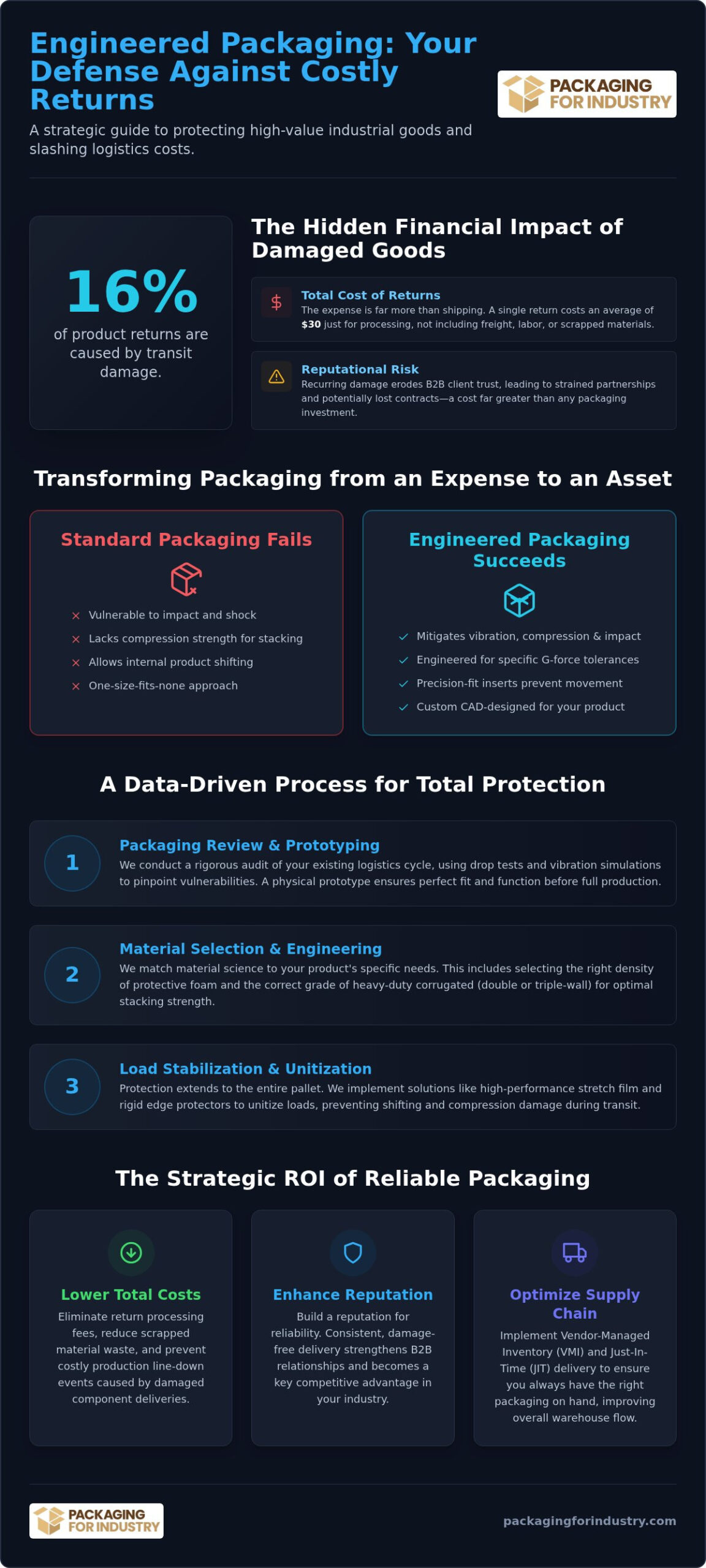
When 16% of product returns are caused by transit damage, the financial impact extends far beyond a lost sale. For industrial operations, the cost of processing a single return can reach $30, and that doesn’t account for the damage to your reputation with B2B clients. You’ve likely realized that standard shipping supplies aren’t sufficient for high-value components. Relying on generic solutions often leads to high reverse logistics costs and operational stress that your team doesn’t need. Engineering specialized packaging that reduces product returns is a technical challenge that requires a focus on both durability and fiscal responsibility.
We understand that your goal is a reliable supply chain where every shipment arrives intact. In this article, you’ll learn the exact engineering and material strategies that top-tier manufacturers use to eliminate transit damage and slash return rates. We’ll examine how custom CAD-designed foam, heavy-duty corrugated boxes, and precision-fit inserts work together to protect your bottom line. From optimizing for Southern California logistics to implementing vendor-managed inventory, this guide provides a roadmap for total logistical optimization. You’ll gain the insights needed to transform your packaging from a simple overhead cost into a strategic asset for your business.
Key Takeaways
- Identify the total cost of returns by accounting for labor, reverse freight, and scrapped materials rather than just the initial shipping fee.
- Discover how CAD/CAM design and prototyping lead to precision packaging that reduces product returns for high-value industrial components.
- Match the specific protection levels of double-wall or triple-wall corrugated boxes and specialized foam densities to your product sensitivity.
- Implement load stabilization techniques using high-performance stretch film and edge protectors to prevent shifting and unitize pallet loads.
- Improve operational flow through vendor-managed inventory (VMI) and just-in-time delivery to ensure a reliable supply of packaging materials.
The Financial Impact: Why Reducing Product Returns Starts with Packaging
The financial burden of product damage is often underestimated by procurement teams focusing solely on per-unit material costs. To truly understand the impact, you must calculate the Total Cost of Returns. This calculation includes administrative labor to process claims, the high cost of reverse freight, and the potential scrap value of high-value components. Implementing packaging that reduces product returns is a strategic move to preserve capital and maintain operational efficiency. For industrial manufacturers, packaging serves as the final safeguard against the rigors of the supply chain. Packaging engineering focuses on mitigating the three primary causes of transit failure: vibration, compression, and impact. While a standard box might seem cost-effective on a spreadsheet, the cost of a single industrial return frequently exceeds the annual investment in premium custom packaging.
The Hidden Costs of Damaged Industrial Goods
In sectors like aerospace and medical manufacturing, the stakes are exceptionally high. A damaged shipment can trigger a line-down event at a Tier 1 or Tier 2 supplier facility. These delays ripple through the supply chain, disrupting production schedules and warehouse flow. Data from 2026 indicates that 16% of product returns occur because the item arrived damaged. Recurring damage also creates significant reputational risk. Reliable delivery is the cornerstone of B2B relationships; poor packaging choices can lead to lost contracts and strained partnerships that are far more expensive than any shipping container.
Calculating Your ROI on Protective Packaging
Transitioning to packaging that reduces product returns requires viewing containers as insurance rather than a commodity. A thorough cost-reduction packaging analysis evaluates exactly where your current system fails. Switching from a standard RSC to heavy-duty corrugated boxes provides the vertical compression strength needed for industrial stacking. When you request a packaging quote, our team analyzes the intersection of material science and economics. We help you determine if custom-engineered protection will yield a higher ROI by eliminating the $20 to $30 average processing fee per returned item. By identifying failure points during the design phase, you avoid the compounding costs of scrapped parts and emergency re-shipments.
Step 1: Conducting a Professional Packaging Review and Prototyping
Developing packaging that reduces product returns starts with a rigorous audit of your existing logistics cycle. We examine where your current containers fail, whether it is crushed corners on corrugated boxes or components shifting inside a crate. This review identifies if the damage stems from insufficient stacking strength or inadequate internal cushioning. By simulating the entire transit journey, we pinpoint specific vulnerabilities before they become costly liabilities. It’s a pragmatic approach that replaces guesswork with data-driven design, ensuring your goods are protected from the moment they leave the warehouse.
Engineering reliability requires more than just selecting a box from a catalog. We utilize industry standards for drop tests and vibration simulations to ensure your shipments withstand the shocks of heavy freight handling. This process allows us to refine designs during the free prototyping phase. You can verify fit and function with a physical sample before committing to high-volume production. If you are currently facing high damage rates, you can request a packaging quote to begin a professional design review and eliminate operational stress.
Engineering for Fragility and Weight
Industrial components often have sensitive G-force tolerances that standard packaging can’t accommodate. We calculate these limits to determine the exact level of deceleration required during an impact. For heavy machinery or delicate aerospace parts, we develop custom design packaging solutions like reinforced wooden crates or heavy-duty triple-wall corrugated containers. Integrating sustainable packaging principles during this phase ensures we use only the necessary amount of material to achieve maximum protection, which helps you lower packaging costs while maintaining high standards of durability.
The Role of CAD/CAM in Damage Prevention
Precision is critical when shipping complex electronics or medical devices. Our CAD/CAM support enables the creation of custom foam end caps and die-cut inserts that mirror the geometry of your product. This level of accuracy eliminates “void space,” a primary driver of UPS and FedEx dimensional weight surcharges. Precision engineering ensures every repeat order maintains consistent tolerances, providing a reliable shield for your shipments. By right-sizing your containers through CAD design, you reduce material waste and optimize the flow of goods through your distribution network. This methodical oversight ensures that your packaging that reduces product returns also contributes to a more efficient and fiscally responsible operation.
Step 2: Selecting the Right Materials for Industrial Protection
Material selection is where engineering precision meets economic reality. Choosing the correct substrate is the most effective way to implement packaging that reduces product returns because it addresses the physical limitations of standard shipping supplies. While a basic single-wall box might suffice for lightweight consumer goods, industrial components require materials that withstand high-stacking pressures and repetitive shocks. We evaluate your product’s weight, fragility, and environmental exposure to determine the optimal combination of corrugated fiberboard and internal cushioning. This methodical approach ensures you aren’t over-spending on unnecessary materials while providing a robust shield for your high-value assets.
Specialized sectors like electronics and semiconductors require protection beyond mere physical cushioning. Static discharge can destroy sensitive circuits without showing any external signs of damage. We integrate ESD and anti-static materials to neutralize these risks during transit and handling. For long-term storage or international shipping, we utilize weather-resistant corrugated and mil-spec materials. These specialized solutions prevent moisture ingress and corrosion, ensuring that parts remain in peak condition regardless of the duration of the supply chain journey. By matching the material to the specific environmental threats, you create a reliable system that protects your brand reputation with B2B clients.
Heavy-Duty Corrugated Solutions
Standard RSC cartons often fail when subjected to the compression forces of a loaded pallet. We help you determine when it’s time to move to heavy-duty double-wall or triple-wall corrugated boxes. Triple-wall containers offer a viable, lightweight alternative to wooden crates for many industrial applications, providing exceptional puncture resistance and vertical strength. We also design custom partitions and dividers for multi-part kits. These inserts prevent parts from colliding during transit, which is a common cause of surface abrasion and mechanical failure. Using the right wall thickness is a fundamental step in designing packaging that reduces product returns while managing total shipping weight.
Precision Foam Packaging Inserts
Cushioning is about more than just filling space; it’s about managing energy. We match foam densities to your product’s sensitivity, typically choosing between Polyethylene (PE) for heavy items and Polyurethane (PU) for lighter, more delicate gear. Precision-cut foam packaging inserts, created via die-cutting or CNC routing, provide a secure nest for complex aerospace and medical devices. We often utilize foam end caps to suspend products within the carton, creating a protective buffer that prevents the item from ever touching the outer walls. This suspension technique is highly effective at absorbing high-impact shocks that would otherwise result in a damaged component and a costly return process.
Step 3: Optimizing Load Stabilization and Edge Protection
Even the most precisely engineered internal cushioning fails if the entire pallet shifts during transit. Load instability is a primary driver of secondary damage, where individual boxes crush one another due to movement inside the trailer. Effective packaging that reduces product returns must account for the forces of momentum and vibration at the pallet level. We focus on unitizing your loads to ensure that every component stays exactly where it was placed during the kitting process. This involves a combination of high-performance films, rigid edge protection, and heavy-duty skids tailored to your specific weight distribution requirements.
For specialized goods like textiles, roll materials, or architectural blueprints, standard boxes aren’t the solution. We provide heavy-duty mailing tubes and cores that offer superior crush resistance for cylindrical items. These specialized containers prevent the creasing and structural failure that often occur when roll goods are stacked horizontally. By addressing these unique form factors with purpose-built protection, you eliminate the common failure points that lead to B2B return claims. Selecting the right pallet or skid is equally vital; we ensure your base can support the total weight without bowing, which is a common cause of stack failure in long-haul freight.
The Power of Corner and Edge Guarding
Vertical compression is a constant threat in high-volume warehouses where pallets are frequently double-stacked. Applying corner and edge protection significantly increases the stacking strength of your shipments. These rigid corner boards distribute weight evenly across the pallet, preventing the bottom layer of corrugated boxes from buckling under pressure. Additionally, edge guards protect your products from “strap burn” caused by high-tension plastic or steel banding. For manufacturers of high-value equipment with sensitive finishes, we utilize non-abrasive corner boards to ensure that the protection itself doesn’t cause surface marring during the vibration of transport.
Load Stabilization Techniques
Selecting the correct gauge of stretch film is a technical decision that impacts both safety and cost. We analyze your load profile to determine if high-performance machine film or reinforced hand film is appropriate for your application. Using a film with insufficient containment force leads to pallet “leaning,” which is a major red flag for receivers and often results in rejected shipments. Our kitting and assembly services further streamline this process by unitizing multiple parts into a single, stable package before they ever reach the pallet. This reduction in manual handling errors is a proven method for maintaining packaging that reduces product returns while optimizing your warehouse labor efficiency.
Implementing a Reliable Supply Chain with PFI in Southern California
Engineering packaging that reduces product returns is only effective if the correct materials are consistently available on your production line. A breakdown in the supply chain often forces warehouse teams to use substitute packaging that doesn’t meet the original engineering specifications. These compromises lead to increased damage rates and higher return costs. By partnering with a local supplier like PFI, manufacturers in Southern California can secure a reliable flow of custom corrugated boxes and foam inserts. We focus on total accountability, ensuring that the protective systems we design are always in stock when your production schedule demands them. This reliability eliminates the operational stress of stockouts and keeps your shipping department running at peak efficiency.
Inventory Management as a Quality Control Tool
Operational downtime and packaging shortages are significant hidden costs in industrial manufacturing. Our vendor managed inventory (VMI) programs eliminate these risks by placing the responsibility of stock levels on our team. VMI serves as a critical quality control tool; it prevents the use of wrong-sized or inferior substitute packaging that often happens during a crisis. When your team has immediate access to the exact die-cut foam or double-wall boxes designed for your product, the integrity of your shipping process remains intact. This consistency is vital for maintaining packaging that reduces product returns over long production cycles and recurring orders.
Why Local Southern California Expertise Matters
Proximity is a strategic advantage for manufacturers in Anaheim, Irvine, and Torrance. We provide on-site packaging reviews to identify failure points in real-time, offering a level of service that large national catalog suppliers can’t match. Leveraging just-in-time delivery allows you to reduce warehouse clutter in Orange County, freeing up valuable floor space for production rather than bulk material storage. PFI offers local next-day delivery across Los Angeles and San Diego, providing the responsiveness needed for high-velocity distribution centers. While we are a local leader, our nationwide shipping capabilities ensure that multi-location manufacturers receive the same high-quality protective solutions across all their facilities.
Secure Your Supply Chain with Engineered Protection
Engineering a resilient logistics strategy requires a transition from reactive shipping to proactive protection. By integrating CAD-designed foam inserts, heavy-duty corrugated materials, and rigorous load stabilization, you address the specific technical failure points that lead to damaged goods. Implementing packaging that reduces product returns is more than a material choice; it’s a pragmatic financial strategy to eliminate reverse logistics costs and protect your reputation with B2B clients. Consistency in your supply chain depends on using the right materials every time, from the initial design phase to the final pallet wrap.
PFI serves as a dedicated partner for high-stakes sectors like aerospace and industrial manufacturing. We provide the technical expertise required to solve complex logistical challenges through free prototyping and precision CAD design services. For businesses operating throughout Orange County, Los Angeles, and San Diego, our local next-day delivery ensures your production line remains active and efficient. We combine engineering precision with logistical reliability to help you achieve a steady, damage-free flow of goods.
Take the first step toward a more efficient and fiscally responsible operation. Our team is ready to analyze your current failure points and deliver a custom solution that safeguards your bottom line.
Frequently Asked Questions
How does custom packaging specifically reduce my return rate?
Custom packaging reduces return rates by eliminating internal movement and providing targeted shock absorption for your specific product geometry. It’s engineered for the exact dimensions of your component, which prevents surface marring and mechanical failure during transit. Unlike generic boxes, custom design is the primary way to implement packaging that reduces product returns by addressing the specific fragility points identified during the prototyping phase.
What is the difference between double-wall and triple-wall corrugated boxes?
Double-wall boxes consist of two layers of fluting and three liners, providing high vertical compression strength for heavy industrial loads. Triple-wall corrugated adds a third fluted layer, offering puncture resistance and structural integrity comparable to wooden crates. We recommend triple-wall for the most demanding aerospace and machinery applications where maximum stacking strength is required to prevent bottom-layer collapse during long-haul freight or international transport. Both options are available in custom sizes.
Do you provide packaging for sensitive electronics or medical devices?
We specialize in high-precision protective solutions for both electronics and medical device manufacturing. Our team utilizes ESD foams and liners to protect semiconductors from invisible electrical damage during handling. For medical devices, we design custom-fit inserts that ensure sterile components remain secure and immobilized. Our CAD/CAM design process ensures that these sensitive parts are suspended or cushioned according to their specific G-force tolerances, reducing the risk of mechanical failure.
Can PFI help reduce UPS and FedEx shipping surcharges?
We help lower shipping costs by right-sizing your containers to eliminate excessive dimensional weight surcharges. Carriers like UPS and FedEx penalize oversized boxes that contain mostly air. By using custom-sized corrugated or Z-fold solutions, we minimize the exterior volume of your shipments. This precise engineering reduces the billable weight of your packages while maintaining superior protection for the contents inside. It’s an effective way to balance safety with fiscal responsibility.
What industries do you serve in Southern California?
PFI supports a wide range of B2B sectors across the Inland Empire, Orange County, and Los Angeles. We are primary suppliers for the aerospace, medical device manufacturing, and electronics industries in Southern California. Our team also provides warehouse and distribution supplies to large fulfillment centers. Because we are local, we offer next-day delivery to facilities in Anaheim, Irvine, and Torrance to support fast-paced production schedules and logistics.
Do you offer free prototypes for custom foam and box designs?
We provide free prototyping and CAD/CAM support to ensure your protective design is perfect before you commit to a full production run. This allows your team to perform physical test fits and drop simulations with your actual industrial components. Prototyping is a critical step in developing packaging that reduces product returns because it identifies potential failure points in a controlled environment before mass distribution starts.
How does Vendor Managed Inventory (VMI) help my operations?
Vendor Managed Inventory programs eliminate the risk of packaging stockouts by shifting inventory management to our expert team. We monitor your usage levels and replenish stock automatically, ensuring you never run out of critical shipping supplies. This prevents the costly mistake of using improper substitute packaging during a shortage. It also streamlines your warehouse operations and improves cash flow by reducing the amount of capital tied up in bulk inventory.
What are the benefits of using die-cut foam vs. standard void fill?
Die-cut foam provides superior immobilization and repeatable protection compared to loose void fill like paper or peanuts. It’s engineered to fit the specific contours of your product, which prevents shifting and absorbs impact energy more efficiently. While loose fill can settle during transit, leaving parts vulnerable to vibration, precision-cut foam ensures that high-value components remain suspended and protected throughout the entire shipping cycle. This reliability is essential for aerospace and medical gear.