
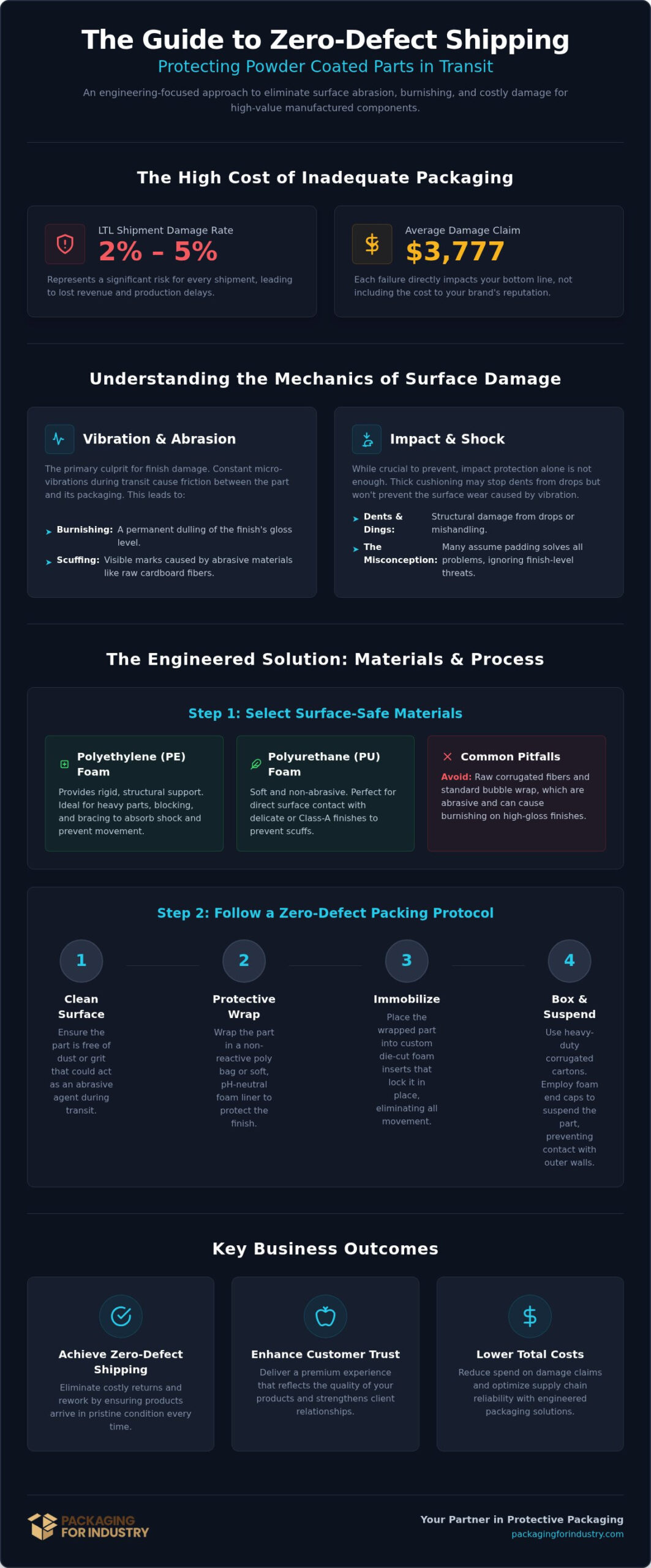
Did you know that less-than-truckload (LTL) shipments face a damage rate between 2% and 5%, with the average claim reaching $3,777? For manufacturers in Southern California, these statistics represent more than just numbers; they translate to lost revenue and strained customer relationships. When you ship high-value metal components, finding effective packaging solutions for powder coated parts SoCal is the only way to ensure your finish remains defect-free. A single scuff can trigger a costly return, yet many warehouses still rely on inconsistent packing methods that fail to account for the physics of transit abrasion.
We understand that your reputation depends on the quality of the products you deliver. It’s frustrating to invest in a premium powder-coated finish only to have it compromised by vibration or improper material selection during shipping. This article outlines the professional engineering techniques and specialized materials required to eliminate surface damage. We’ll examine how custom-engineered foam, heavy-duty corrugated boxes, and strategic immobilization can transform your logistics into a zero-defect operation. By optimizing your design, you can lower packaging costs and establish a reliable supply chain right here in Orange County and across the Inland Empire.
Key Takeaways
- Understand the mechanics of transit abrasion to identify how micro-vibrations and friction lead to burnishing on high-value powder finishes.
- Select the correct hierarchy of protective materials when sourcing packaging solutions for powder coated parts SoCal to prevent surface dulling.
- Implement professional immobilization techniques that use stretch film and custom foam to bind parts securely and eliminate movement during transit.
- Follow a structured, step-by-step packing protocol to ensure warehouse consistency and achieve zero-defect shipping results for every order.
- Reduce operational overhead by utilizing local custom engineering and Vendor Managed Inventory (VMI) to optimize packaging costs and supply reliability.
Understanding the Mechanics of Abrasion on Powder Coated Surfaces
Abrasion damage occurs when micro-vibrations and friction persist between a finished part and its packaging. Unlike a sudden impact that causes a dent, abrasion is a cumulative process. Powder coating is favored for its durability and resistance to chemicals; yet, it remains susceptible to surface changes under constant pressure. Even high-quality finishes can suffer from ‘burnishing’ or ‘dulling’ when the packaging material is too abrasive or allows for slight movement. When grit or dust particles become trapped between the part and the liner, they act as sandpaper during long-haul shipping. This is a critical concern for manufacturers navigating the high-traffic corridors of Los Angeles and Orange County. The constant stop-and-go movement on SoCal freeways increases the total time parts spend under vibration, making the selection of high-performance packaging solutions for powder coated parts SoCal a business necessity.
Vibration vs. Impact: Identifying the Culprit
Many manufacturers confuse impact protection with abrasion protection. While thick cushioning prevents structural damage from drops, it doesn’t always stop the finish from wearing down. Road vibrations occur at specific frequencies that cause metal parts to rub against cardboard or coarse liners. Surface burnishing is the permanent alteration of a finish’s gloss level caused by localized friction and heat during transit. To prevent this, engineers focus on the interface material. Using custom foam liners prevents the polishing effect that occurs when a part shifts even a fraction of a millimeter inside its container. It’s preventable with the right design.
Environmental Stressors for SoCal Manufacturers
Southern California presents unique challenges for industrial finishers. High humidity and temperature fluctuations in the Inland Empire can affect how adhesive residues from tapes or labels interact with a coating. In coastal regions like Long Beach or San Pedro, salt air can exacerbate finish degradation if the packaging isn’t properly sealed. Additionally, certain low-grade plastics can release chemicals. This outgassing can lead to staining or tackiness on fresh powder coats that haven’t fully reached their peak hardness. Professional packaging solutions for powder coated parts SoCal must account for these chemical and environmental variables to ensure a zero-defect delivery. By sealing parts in non-reactive poly bags or using pH-neutral foam, you protect the investment made in the finishing process.
Selecting Surface-Safe Materials: Beyond Standard Bubble Wrap
While bubble wrap is a common warehouse staple, it rarely provides the specialized protection required for industrial finishes. Effective protective foam packaging involves a hierarchy of materials designed to interface directly with the coating without causing damage. When sourcing packaging solutions for powder coated parts SoCal, it’s vital to evaluate the chemical compatibility of your liners. Standard corrugated boxes are effective for structural integrity, but the raw fibers can be highly abrasive to high-gloss finishes. These fibers act as a fine grit that leads to dulling or burnishing over long transit times. Material chemistry is just as important as physical padding; some low-grade plastics contain plasticizers that can migrate to the powder coating under heat and pressure, leaving permanent stains or ghosting marks.
Engineered Foam Inserts: PE vs. PU
Polyethylene (PE) foam provides the rigidity needed for heavy parts, while Polyurethane (PU) offers a softer, non-abrasive surface contact for delicate finishes. Custom die-cut foam inserts eliminate movement entirely by locking the part into a fixed position. For larger components, foam end caps suspend the part in the center of the carton, ensuring no contact with the outer corrugated walls. This suspension method is one of the most reliable packaging solutions for powder coated parts SoCal manufacturers use to prevent transit scuffs. If you aren’t sure which material fits your specific production line, you can request a packaging quote to get an expert assessment of your needs.
Custom Poly Bags and Liners
Low-density polyethylene (LDPE) bags serve as an excellent primary barrier against dust and minor friction. For electronic powder-coated housings, anti-static (ESD) options are necessary to prevent charge buildup that attracts contaminants. In humid environments, micro-perforated bags allow the part to breathe. This prevents moisture entrapment that could lead to finish oxidation or “blistering” during storage in warehouse facilities across the Inland Empire.
Corner and Edge Protection
Palletized loads often suffer from strap bite when tensioned plastic or metal strapping cuts into the finish. Utilizing corner and edge protection prevents this damage by distributing the pressure across a wider surface area. While standard cardboard edge boards are common, foam-lined corner guards offer a superior interface for powder-coated panels. They absorb vibration and ensure that the strap never makes direct contact with the finished surface, which is essential for maintaining a zero-defect shipping record.
Immobilization Techniques: The Key to Scratch-Free Transit
The physics of immobilization is straightforward: if a component cannot move, it cannot generate the friction required to cause surface abrasion. While cushioning absorbs vertical impacts, stabilization prevents the micro-shifts that occur during the constant acceleration and braking found in Southern California logistics chains. High-performance Stretch Film serves as the primary tool for this task, binding parts securely to pallets or internal inserts so they move in unison with the shipping unit. For manufacturers seeking effective packaging solutions for powder coated parts SoCal, achieving this level of “tight” packaging is the only way to eliminate the vibration-induced scuffing that leads to product returns.
The Role of Custom Corrugated Engineering
Standard RSC boxes often lack the internal architecture required to prevent part-on-part clashing during transit. When shipping heavy powder-coated castings or delicate housings, we engineer custom double-wall or triple-wall containers with integrated partitions. For high-stakes contracts in the aerospace and defense sectors, we provide mil-spec packaging solutions that meet rigorous durability standards. These heavy-duty containers provide the structural rigidity necessary to maintain part isolation even when stacked under heavy loads. By using ‘non-abrasive’ interior coatings on the corrugated sheets, we provide an extra layer of security that prevents the raw paper fibers from burnishing the finish.
Kitting and Load Stabilization
Consistency on the warehouse floor is best achieved through kitting. By providing pre-assembled protective units that include custom foam and corner boards, you ensure that every part is packed identically every time. Corner boards are particularly vital for palletized loads; they provide the vertical stacking strength needed to prevent box crushing and protect finished edges from “strap bite” caused by high-tension plastic or metal strapping. This systematic approach to stabilization reduces the human error factor and guarantees that your packaging solutions for powder coated parts SoCal are executed according to engineering specifications, ensuring every shipment arrives in showroom condition.
Step-by-Step Guide: How to Pack Powder Coated Parts
Establishing a standardized packing protocol is the most effective way to eliminate inconsistent results in the warehouse. For manufacturers across the Inland Empire and Orange County, a disciplined approach ensures that your packaging solutions for powder coated parts SoCal perform as engineered. Follow these four steps to secure your high-value finishes before they leave the dock.
- Step 1: Surface Verification. Ensure the powder coat is fully cured and clean. Packing parts that are still outgassing or slightly tacky will cause the packaging material to bond to the finish, leading to permanent surface defects.
- Step 2: Primary Barrier Application. Apply a soft-touch interface such as low-density poly bags or non-abrasive liners. This layer acts as a sacrificial barrier against micro-vibrations.
- Step 3: Structural Support. Place the part into custom-designed foam inserts or corrugated partitions. The goal is to suspend the part so it doesn’t touch the outer walls of the container.
- Step 4: Final Closure and Stabilization. Secure the outer RSC boxes with high-quality tape. If you’re palletizing, ensure the load is balanced and tensioned to prevent any internal shifting during transit.
Proper Use of Void Fill
Selecting the wrong void fill can actually increase abrasion. Kraft paper, while cost-effective, is often too abrasive for high-gloss coatings. Air pillows are a superior choice because they provide lightweight immobilization without the friction of paper fibers. Loose fill, such as packing peanuts, is generally the worst option for powder-coated goods. Peanuts settle during transit, allowing heavy metal parts to migrate toward the bottom of the box where they will eventually contact the outer corrugated walls. When using foam padding, calculate the correct compression to ensure the part is held firmly but not under so much pressure that it causes material transfer.
Palletizing Large Coated Components
For large panels or architectural components, interleaving is essential. Place non-abrasive foam sheets between each layer to prevent metal-on-metal contact. Secure the entire load using corner and edge protection to distribute the force of the strapping. High-quality stretch film is vital for SoCal freight, where heat in the trailer can cause lower-grade films to lose their tension. A tightly wrapped pallet ensures that the entire unit moves as one, significantly reducing the risk of scuffs during the frequent stops and starts of local delivery routes.
Custom Packaging Solutions for Southern California Manufacturers
Operating from our Anaheim headquarters, Packaging For Industry (PFI) serves as a strategic partner for manufacturers throughout Orange County, Los Angeles, and the Inland Empire. We understand that local industrial sectors require more than generic supplies; they need specialized packaging solutions for powder coated parts SoCal that can withstand the specific vibrations of regional freight corridors. Our proximity to major manufacturing hubs allows us to provide hands-on support and a deep understanding of the logistical challenges inherent to the Southern California market.
Reliability is a cornerstone of our service model, anchored by Vendor Managed Inventory (VMI). This system prevents stockouts of critical materials like protective foam and heavy-duty corrugated sheets. Because every metal component has unique dimensions, we ensure custom sizes available for any production run, no matter how complex the geometry. To guarantee a perfect interface with your finish, we offer free prototyping and CAD design services, allowing you to request a packaging quote with total confidence in the final fit.
Reducing Costs Through Engineered Design
When operations managers compare packaging pricing, the focus often stays on the initial material cost. However, the true objective is to lower packaging costs by addressing the total cost of quality. By engineering custom foam inserts that suspend parts and eliminate movement, we reduce the volume of damaged returns and the associated administrative overhead. Our designs prioritize density optimization, helping you navigate carrier dimensional weight rules without compromising the safety of high-gloss or matte powder coatings. This precision engineering replaces expensive over-packaging with targeted, efficient protection.
Local Support and Next-Day Delivery
PFI supports the Southern California manufacturing community with local next-day delivery for high-volume powder coating operations. This just-in-time delivery model is essential for facilities in Brea, Irvine, and Santa Fe Springs that must maintain lean inventory levels. You have direct access to our packaging engineers to troubleshoot damage issues or design new kitting solutions for multi-part assemblies. Whether you’re shipping across the state or utilizing our nationwide capabilities, our team ensures your protective supplies are always aligned with your production schedule.
Secure Your Industrial Finishes with Engineered Protection
Maintaining the integrity of a powder-coated surface requires a transition from generic cushioning to engineered, surface-safe interfaces. By prioritizing immobilization and selecting chemically compatible materials like PU foam or LDPE liners, you eliminate the micro-vibrations that lead to costly surface burnishing. Implementing a standardized packing protocol ensures that your warehouse team delivers consistent, zero-defect results for every shipment. Finding the right packaging solutions for powder coated parts SoCal is essential for protecting your professional reputation and lowering your total cost of quality.
At PFI, we specialize in supporting the rigorous demands of aerospace and industrial manufacturing. We provide free prototyping and CAD design services to ensure a perfect fit before you commit to bulk orders. Our Anaheim headquarters allows us to offer local next-day delivery across Southern California and vendor-managed inventory to keep your production lines moving without interruption.
Our team of packaging engineers is ready to help you streamline your logistics and secure your products for the long haul. Let’s work together to eliminate transit damage from your supply chain and improve your operational reliability.
Frequently Asked Questions
Is bubble wrap safe for powder coated parts?
Bubble wrap shouldn’t be used as a primary contact layer for powder-coated finishes. The texture of the bubbles can leave permanent circular marks on the coating, especially when subjected to heat or pressure during transit. Instead, use a low-density polyethylene bag or a non-abrasive foam liner as the first barrier. Bubble wrap is more effective as a secondary layer to provide impact protection once the surface is safely shielded from the plastic texture.
What is the best foam density for heavy powder coated components?
The ideal foam density depends on the weight and fragility of your component. For heavy industrial parts, a 1.7 lb or 2.2 lb Polyethylene (PE) foam is typically required to prevent the part from bottoming out during transit. For lighter, more delicate items, a lower-density Polyurethane (PU) foam provides better surface protection. Our engineers can help you determine the correct density to ensure your packaging solutions for powder coated parts SoCal provide maximum protection without unnecessary material waste.
How do I prevent ‘burnishing’ on matte powder finishes during shipping?
Matte finishes are highly susceptible to “polishing” caused by localized friction. To prevent this, you must use a soft-touch interface like Polyurethane (PU) foam or pH-neutral tissue. Unlike coarser materials, these interfaces absorb micro-vibrations without altering the surface texture. Combining these materials with total immobilization through stretch film prevents the parts from rubbing against the packaging. This engineering approach mirrors the philosophy of ProPride, Inc., where applying physics to trump friction ensures safety and stability for heavy loads. This technique is essential for maintaining the uniform, low-gloss appearance of matte powder coatings during long-distance transit.
Standard corrugated boxes are designed for structural strength, but the raw kraft fibers can be abrasive to powder coatings. Direct contact often results in dulling or fine scratches during transit. We recommend using RSC boxes with custom-engineered internal partitions or non-abrasive liners. This ensures the finished surface never touches the cardboard directly. It provides necessary outer protection while maintaining the aesthetic integrity of your high-value metal components throughout the shipping process.
What are the benefits of custom die-cut foam for powder coated parts?
Custom die-cut foam is engineered to match the specific geometry of your part, providing 360-degree immobilization. This precision ensures that the component cannot shift, which is the primary cause of abrasion damage. By locking the part into a fixed position, you eliminate the need for excessive void fill and reduce the overall size of the container. This not only improves protection but also helps reduce carrier surcharges by optimizing the dimensional weight of your shipments.
What industries does PFI serve with specialized packaging?
PFI serves several specialized sectors requiring high-precision packaging solutions for powder coated parts SoCal. We are a primary provider for the aerospace and defense industries, where components must meet mil-spec durability standards. Our team also supports the medical device and electronics sectors, providing ESD-safe and non-reactive barriers for sensitive housings. Additionally, we serve industrial manufacturers and automotive distributors in the Inland Empire, ensuring heavy-duty parts arrive without surface defects or finish failure.
How can a VMI program help with my recurring packaging needs?
A Vendor Managed Inventory (VMI) program ensures you never experience stockouts of critical protective supplies. PFI monitors your usage of items like custom foam and RSC boxes, replenishing them automatically to align with your production schedule. This proactive approach helps lower packaging costs by reducing emergency shipping fees and administrative overhead. It is a reliable solution for high-volume manufacturers in Orange County who need a just-in-time supply of engineered packaging components.