
What if your internal packaging is actually the reason your freight surcharges are climbing every time a carrier rounds up your box dimensions? It’s a common frustration for logistics managers who see warehouse floor space consumed by massive foam dunnage while still facing damage claims from heavy parts shifting in transit. You’ve likely felt the pressure of the 2026 carrier rate increases and the new cubic volume thresholds that penalize bulky shipments. Precision-engineered corrugated build-up blocks for internal bracing offer a structural solution that protects heavy industrial components without the unnecessary volume that triggers modern shipping penalties.
In this guide, you’ll learn how to reduce freight costs and eliminate transit damage by replacing bulky foam and wood with high-density corrugated alternatives. We’ll explore how these blocks function as structural columns to stabilize your products while meeting demanding ESG goals through recyclable materials. We’ll also break down the economic benefits of switching from expensive catalog suppliers to custom-engineered solutions, including how local Southern California supply chains can streamline your inventory through vendor-managed programs.
Key Takeaways
- Understand how precision packaging design helps you avoid the 2026 carrier surcharges and cubic volume penalties that drive up freight costs.
- Discover the “Column Effect” and how vertical flute orientation in corrugated build-up blocks for internal bracing provides the structural rigidity needed for heavy industrial parts.
- Compare the total cost of ownership between corrugated blocks and bulky foam to see how material recyclability and storage efficiency impact your bottom line.
- Learn how to specify custom internal pads for high-value sectors like aerospace and medical devices to ensure zero-shift protection during long-haul transit.
- Explore how Vendor Managed Inventory (VMI) and local next-day delivery in Southern California can eliminate warehouse congestion caused by bulky dunnage.
Why Internal Bracing Matters for Heavy-Duty Industrial Shipping
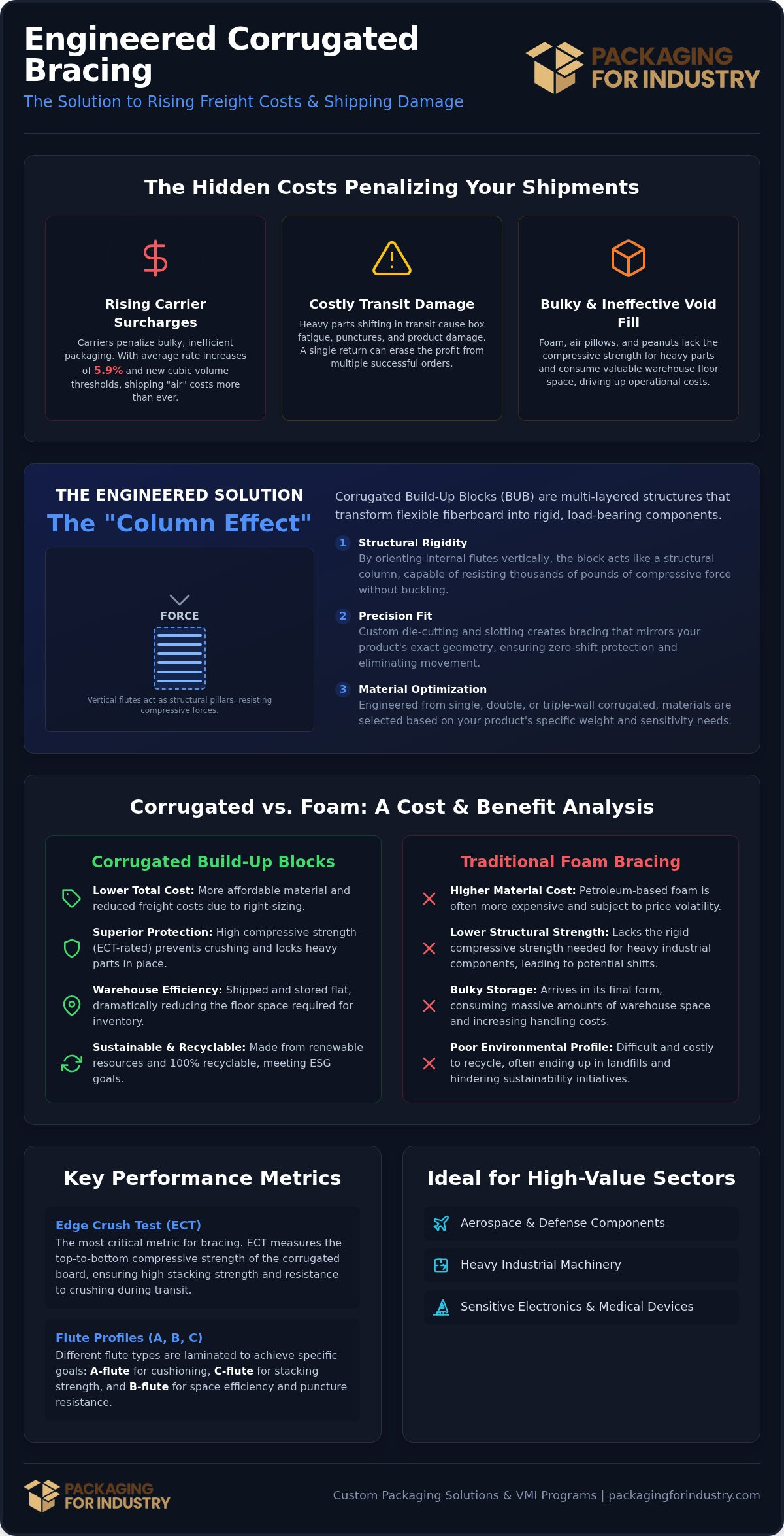
Shipping heavy industrial components requires more than just a sturdy outer box. When a high-value part shifts during transit, the momentum generated can puncture a double-wall container or crush the fluting of the Corrugated fiberboard. This phenomenon, known as box fatigue, occurs when the internal weight of the product gradually compromises the structural integrity of the packaging over long-haul freight journeys. Precision-engineered corrugated build-up blocks for internal bracing prevent this by transferring the load from the product to the strongest points of the container, maintaining the box’s shape even under stacking pressure.
Standard void fill like air pillows or loose-fill peanuts typically fails for heavy industrial components. These materials lack the compressive strength to keep a 50-pound part centered. As a result, the item often migrates to the bottom or side of the box, leading to direct impact damage. With the 2026 average rate increases of 5.9% from carriers like UPS and FedEx, the financial penalty for shipping “air” is higher than ever. Proper internal bracing allows for precise right-sizing. This is critical because carriers now round up every fractional inch before calculating dimensional weight and apply new surcharges for packages exceeding 10,368 cubic inches.
The Mechanics of Transit Damage
Identifying the difference between impact and vibration damage is essential for industrial logistics. While a drop causes immediate failure, constant vibration during truck or rail transport can lead to surface abrasions or internal component loosening. For sensitive electronics or medical devices, zero-movement is the engineering goal. Corrugated build-up blocks for internal bracing lock these components into a fixed position. This eliminates the kinetic energy that leads to damage, providing a level of security that thin pads or generic foam inserts cannot match.
Economic Impact of Bracing Failures
A single returned shipment often erases the profit margin of multiple successful orders. When a bracing system fails, you aren’t just paying for a replacement part; you’re absorbing costs for inspection labor, restocking, and potential line-down situations for your customer. Optimized bracing also improves pallet stackability. When boxes are reinforced internally, they can withstand higher vertical loads without buckling. This allows you to maximize truckload density, which is a primary driver for long-term packaging cost savings and improved logistics efficiency.
The Engineering Behind Corrugated Build-Up Blocks (BUB)
Corrugated build-up blocks are multi-layered structures created by laminating multiple sheets of corrugated fiberboard together. This process transforms flexible material into a rigid, load-bearing component. The primary engineering advantage lies in the strategic use of internal bracing to manage vertical and horizontal forces. By orienting the internal flutes vertically, we create a “Column Effect.” This alignment allows the block to act as a structural pillar, resisting thousands of pounds of compressive force without buckling during transit.
Material selection depends on the weight and sensitivity of your product. For lighter industrial parts, standard 200# test board provides a cost-effective base. When shipping heavy machinery or aerospace components, we utilize heavy-duty triple-wall layers. These blocks can be further customized with slotting, die-cutting, or multi-directional bracing to mirror the exact geometry of your part. This level of customization ensures the block provides equal support across all axes, preventing the item from rotating or sliding during sudden stops or rough handling. If you’re struggling with oversized boxes or complex part geometries, you can request a packaging quote for a tailored solution.
Crush Resistance and Stacking Strength
The performance of a build-up block is dictated by its flute profile. A-flute offers superior cushioning, while C-flute and B-flute provide a balance of strength and space efficiency. Through lamination, we combine these profiles to achieve specific Edge Crush Test (ECT) ratings. While the Mullen Burst Test measures puncture resistance, ECT is the more relevant metric for corrugated build-up blocks for internal bracing because it measures the block’s ability to withstand top-to-bottom pressure. This engineering focus ensures your packaging won’t collapse when pallets are stacked two or three high in a warehouse. Lamination essentially fuses the flexible properties of individual sheets into a solid mass that functions as a high-density structural unit.
The Role of CAD/CAM and Prototyping
Precision fit is non-negotiable when dealing with high-value industrial goods. Even a quarter-inch gap can allow a part to shift, leading to the transit damage discussed previously. We utilize CAD design to create digital models of the product and its bracing. This allows us to eliminate material waste and lower unit costs by using only the necessary amount of fiberboard. Our custom design packaging services include free prototyping to verify the fit before you commit to a bulk order. This proactive approach ensures that every block is optimized for both protection and logistical flow. By integrating precision engineering into your supply chain, you move beyond generic dunnage toward a system that guarantees stability and fiscal responsibility.
Corrugated vs. Foam Bracing: A Cost-Benefit Analysis
Selecting the right material for internal bracing requires a balance between engineering performance and fiscal responsibility. While foam is often the default choice for cushioning light, fragile items, corrugated build-up blocks for internal bracing provide a superior ROI for heavy industrial components. When adhering to ASTM Standard Practices for Packaging, engineers must account for the specific weight and fragility of the cargo. For high-density parts, corrugated blocks offer higher compressive strength at a lower material cost per square inch compared to polyethylene or polyurethane foams. Foam excels at vibration dampening, but it lacks the structural rigidity needed to prevent heavy parts from shifting and compromising the outer container.
The decision between these materials often comes down to the nature of the protection required. If your goal is to lock a 100-pound motor in place, corrugated is the smarter buy. It doesn’t compress as easily as foam under high loads, ensuring the product stays centered throughout the shipping cycle. By switching from expensive catalog foam inserts to precision-engineered corrugated blocks, manufacturers can significantly lower their cost per unit without sacrificing the safety of their products.
Freight and Warehouse Density
One of the most overlooked costs in packaging is the price of shipping and storing the dunnage itself. Foam is inherently bulky and cannot be compressed for transport, meaning you’re essentially paying to ship air from your supplier to your facility. In contrast, corrugated bracing is much denser in its inbound state. This allows for more units per pallet, reducing your inbound freight spend and freeing up valuable floor space for other warehouse packaging supplies. In a production environment where every square foot of rack space is calculated into overhead, the ability to stack corrugated components higher and tighter provides a clear operational advantage.
Environmental and Disposal Considerations
Modern corporate mandates often require a transition toward sustainable, 100% recyclable materials to meet ESG goals. Corrugated build-up blocks for internal bracing are made from cellulose fibers, making them easily recyclable through standard municipal and industrial streams. This is a significant benefit for your end-user, who can simply break down the bracing and toss it in the recycling bin rather than paying for specialized foam waste disposal. Defining BUB recyclability as a key decision factor in your procurement process helps align your logistics operations with broader sustainability initiatives. Using “green” dunnage reduces your overall carbon footprint while maintaining the durability required for heavy-duty industrial shipping.
Specifying Custom Build-Up Pads for Industrial Sectors
Industrial sectors with high-value or high-weight products can’t rely on generic, off-the-shelf dunnage. Custom-engineered corrugated build-up blocks for internal bracing are essential for sectors where precision is a requirement rather than an option. For industrial machinery, heavy castings and engines exert localized pressure that would crush standard void fill. We design these blocks to reinforce standard RSC boxes, ensuring the outer container maintains its shape even when housing 100-pound components. This internal support allows a standard fiberboard container to handle the stresses of LTL freight without the cost or weight of a full wood crate.
In the electronics sector, protection is a two-part challenge involving structural stability and electrostatic discharge (ESD) prevention. We solve this by combining high-density foam packaging with corrugated blocks. The foam provides the necessary vibration dampening and anti-static properties, while the corrugated blocks maintain the package’s outer dimensions. To prevent heavy internal components from migrating and puncturing the box walls, we often integrate corner boards into the bracing assembly. This adds a layer of vertical and horizontal reinforcement that protects both the product and the exterior packaging walls from internal impact.
Aerospace and Defense: Meeting Mil-Spec Standards
Aerospace components often feature irregular geometries, such as turbine blades or wing sections, that are impossible to secure with standard pads. We use precision die-cutting to create blocks that mirror these complex shapes, providing total surface contact and stability. These solutions are often designed to meet rigorous military packaging standards, ensuring compliance for defense contractors. For international transit, we utilize weather-resistant adhesives and liners to maintain structural strength in high-humidity environments. This specialized aerospace packaging approach guarantees that high-value assets arrive ready for deployment.
High-Volume Manufacturing and Kitting
Efficiency on the assembly line is a primary driver of profitability for large-scale manufacturers. High-volume operations can significantly reduce labor costs by using “drop-in” bracing designs that require no folding or taping by the packer. Packaging For Industry (PFI) delivers these components through our packaging kitting services, providing pre-assembled bracing sets directly to your production line. This streamlines the packaging process, allowing your team to focus on production rather than dunnage assembly. By eliminating manual assembly steps, you lower your total cost per unit and improve throughput during peak demand periods.
Optimizing Procurement with PFI’s VMI and Custom Programs
Many manufacturers hesitate to transition to corrugated build-up blocks for internal bracing because of the floor space required to store high-density dunnage. However, when you compare packaging pricing against the hidden costs of wasted warehouse square footage, the ROI of a managed system becomes clear. PFI’s Vendor Managed Inventory (VMI) program solves this storage dilemma by housing your inventory at our facility. With a wide range of custom sizes available, we monitor your usage and replenish stock automatically. This strategy ensures your production floor remains clear of excess bulk while maintaining 100% supply reliability for your most critical shipping lines.
Just-In-Time Delivery for Production Lines
Relying on JIT inventory management prevents the stockouts that often halt assembly lines during peak demand. Our system tracks your specific consumption patterns for corrugated build-up blocks for internal bracing, allowing us to deliver precise quantities right before they are needed. This approach significantly reduces the capital you have tied up in safety stock and simplifies the purchasing workflow. By moving away from large, infrequent orders toward a steady, managed flow, you stabilize your operational costs and improve overall warehouse efficiency without the stress of manual inventory counts.
Southern California Logistics Advantage
Our logistical footprint covers the entire industrial corridor, serving manufacturers from Anaheim and Irvine to San Diego and Los Angeles. This regional proximity is a major component of your total cost of ownership. Local supply means we provide next-day delivery and rapid prototyping for new industrial parts. When your engineering team needs to test a new bracing configuration, we can deliver a sample to your facility in 24 to 48 hours. This local agility is something national catalog suppliers simply can’t match, especially when you need custom-engineered protection for high-value components.
To see how we can lower packaging costs for your specific application, request a packaging quote for bulk build-up blocks. Whether you’re shipping sensitive electronics or heavy aerospace components, our custom programs ensure you have the protection you need without the inventory burden. We’re committed to helping you optimize your supply chain from the initial design phase to the final delivery at your customer’s dock.
Secure Your Logistics Chain with Precision Engineering
Transitioning to precision-engineered corrugated build-up blocks for internal bracing is a strategic move for manufacturers facing rising freight costs and warehouse space constraints. By utilizing the “Column Effect” of laminated fiberboard, you provide superior vertical strength for heavy industrial components while meeting critical corporate sustainability mandates. PFI supports your operations with free CAD/CAM prototyping to ensure a perfect fit for complex geometries, particularly in aerospace and medical sectors where zero-movement is non-negotiable. Our expertise in mil-spec packaging ensures your high-value assets remain stable throughout the entire global shipping cycle.
For businesses in Orange County and Los Angeles, our local next-day delivery and Vendor Managed Inventory (VMI) programs eliminate the logistical burden of storing bulky dunnage. You’ll gain the fiscal benefits of precision-engineered protection without the overhead of excess inventory. We’re ready to help you optimize your packaging flow and eliminate the professional stress of transit damage claims. We look forward to partnering with you to streamline your industrial logistics.
Frequently Asked Questions
What are corrugated build-up blocks used for in industrial shipping?
Build-up blocks are primarily used to block and brace heavy or high-value items within a shipping container to prevent load shifting. Unlike standard void fill, these blocks provide structural rigidity that absorbs impact and transfers the product’s weight to the strongest points of the box. They are essential for securing heavy machinery, aerospace components, and industrial parts where traditional cushioning would collapse under the weight.
How much weight can corrugated build-up blocks support?
The weight capacity of a build-up block depends on its flute profile and the number of laminated layers used in its construction. When engineered with a vertical flute orientation, these blocks leverage the “Column Effect” to support thousands of pounds of compressive force. We utilize Edge Crush Test (ECT) ratings to ensure each custom block meets the specific vertical load requirements of your heaviest industrial components.
Are build-up blocks cheaper than custom foam inserts?
Corrugated build-up blocks for internal bracing are typically more cost-effective than custom foam inserts for heavy industrial parts. While foam provides excellent vibration dampening for lightweight items, corrugated material offers higher compressive strength at a lower price point per square inch. You also save on inbound shipping and disposal costs, as these blocks are denser for transport and easily recyclable, leading to a better total cost of ownership.
Can build-up blocks be customized to fit irregular industrial parts?
Yes, we use precision die-cutting and CAD/CAM design to create blocks that mirror the exact geometry of your product. This ensures a zero-movement fit for irregular items like turbine blades, wing sections, or complex engine castings. Custom slots and multi-directional bracing options are available to provide comprehensive protection across all axes, ensuring your high-value assets remain stable throughout the entire shipping cycle.
Are corrugated build-up blocks recyclable?
Build-up blocks are 100% recyclable and manufactured from sustainable cellulose fibers. Unlike many foam alternatives that require specialized waste management, these blocks can be processed through standard municipal or industrial recycling streams. This helps manufacturers meet ESG goals and simplifies the disposal process for the recipient. Using recyclable materials reduces your overall carbon footprint while maintaining the durability required for heavy-duty industrial shipping.
How do build-up blocks help lower freight costs?
These blocks lower costs by allowing for “right-sized” packaging that avoids dimensional weight surcharges and cubic volume penalties. Because they provide superior structural support, you can often use a smaller outer container without risking damage. This is critical for staying below the 2026 carrier surcharge thresholds. Additionally, their high stacking strength allows for better pallet density, which reduces the total number of shipments required for your production runs.
Do you offer free prototypes for custom bracing designs?
PFI provides free CAD/CAM prototyping to ensure your internal bracing fits perfectly before you commit to a bulk order. Our engineering team works with you to design and test a solution that meets your specific protection and budget needs. This proactive approach eliminates the risk of transit damage and ensures that the final product is optimized for both safety and logistics efficiency on your assembly line.
What is the lead time for custom corrugated bracing in Southern California?
We provide local next-day delivery to manufacturers throughout Orange County, Los Angeles, and the Inland Empire. For custom-engineered projects, our Southern California presence allows us to move from the design phase to production much faster than national competitors. By utilizing our Vendor Managed Inventory (VMI) services, you can maintain a consistent supply of corrugated build-up blocks for internal bracing without dedicating your own warehouse space to bulky inventory storage.