
An unstable, irregular load is a ticking time bomb for your freight budget and damage claim rates. If you’re managing complex machinery or odd-shaped industrial parts, you’ve likely experienced the frustration of film punctures from sharp corners or the sting of a freight surcharge for an unstable pallet. Standard wrapping procedures often fail when the load doesn’t fit a perfect cube, leading to wasted material from over-wrapping that still doesn’t achieve true load containment. Using the right stretch film for securing irregular shaped loads is an engineering challenge that requires a technical approach rather than just more layers of plastic.
At Packaging For Industry (PFI), we help manufacturers across Orange County and the Inland Empire solve these logistical headaches through high-performance materials and custom sizes available for specialized applications. In this guide, you’ll learn how to stabilize complex loads while you lower packaging costs and reduce transit damage claims. We’ll examine the differences between blown and cast films, the role of integrated edge protection, and how to standardize wrapping for your most difficult shapes. Whether you need local next-day delivery in San Diego or nationwide shipping, our goal is to provide the precision tools your warehouse needs. You can request a packaging quote to compare packaging pricing for films designed to handle your specific footprint.
Key Takeaways
- Understand the technical differences between blown and cast film to ensure your material provides the puncture resistance required for sharp industrial corners.
- Master the roping technique to transform standard film into high-strength cables that provide critical structural support for uneven weight distributions.
- Learn how to apply stretch film for securing irregular shaped loads while integrating corner boards and foam to eliminate transit damage and freight surcharges.
- Standardize your wrapping procedures to reduce material waste and lower overall packaging costs through improved containment efficiency.
- Discover how PFI’s local next-day delivery and vendor-managed inventory programs maintain your supply of high-performance packaging materials.
The Logistics Challenge of Securing Irregular Shaped Loads
Irregular loads represent the most significant risk factor in industrial logistics. While uniform pallets follow predictable patterns, complex machinery and specialized components often feature non-standard footprints that defy basic wrapping methods. Using standard stretch wrap or stretch film application techniques on these loads often leads to failure. In B2B shipping, these loads account for the highest rates of transit damage because they don’t distribute stress evenly across the film. Achieving true stability with stretch film for securing irregular shaped loads requires a technical understanding of material properties and load dynamics. Securing these items isn’t just about protection; it’s about maintaining the integrity of the entire shipment through the rigors of the supply chain.
Identifying Load Hazards: Protrusions and Sharp Edges
Jagged industrial parts or heavy machinery components present unique physical hazards that standard packaging often can’t handle. Sharp protrusions can pierce the film, causing “zippering” where a single small hole quickly tears across the entire layer. This leads to catastrophic load failure during transit. Beyond sharp edges, you must assess the center of gravity. For industries like aerospace, parts often have offset weight distributions. Constant road vibration can loosen poorly secured freight, shifting the load off the pallet and endangering other cargo. Identifying these hazards early allows you to select the right stretch film for securing irregular shaped loads before the shipment leaves the dock.
The Financial Risk of Poor Containment
The cost of failure extends far beyond damaged products. LTL (Less-Than-Truckload) carriers in the Inland Empire and Orange County hubs are increasingly strict about pallet integrity. If a driver deems a load unstable, they may refuse the shipment or apply significant surcharges for re-stacking and re-wrapping. Insurance providers also frequently deny claims if the packaging doesn’t meet professional standards. Containment force is the total pressure applied to the load to keep it unified. Achieving this force requires moving from simply covering the freight to implementing an engineered containment strategy. By focusing on stability, you can lower packaging costs and avoid the administrative burden of refused freight and insurance disputes. PFI helps you manage these risks through technical film selection and custom-sized solutions that fit your specific footprint.
Selecting the Right Stretch Film for High-Performance Containment
Choosing the correct material is the foundation of industrial load stability. While many operations prioritize cost per roll, the true metric of success is the cost per secured pallet and the elimination of transit damage. To meet FMCSA cargo securement rules, your packaging must provide enough containment force to prevent any shifting during sudden braking or sharp turns. This is particularly difficult with non-standard freight. Selecting high-performance stretch film for securing irregular shaped loads requires you to understand the technical differences between blown and cast extrusion processes.
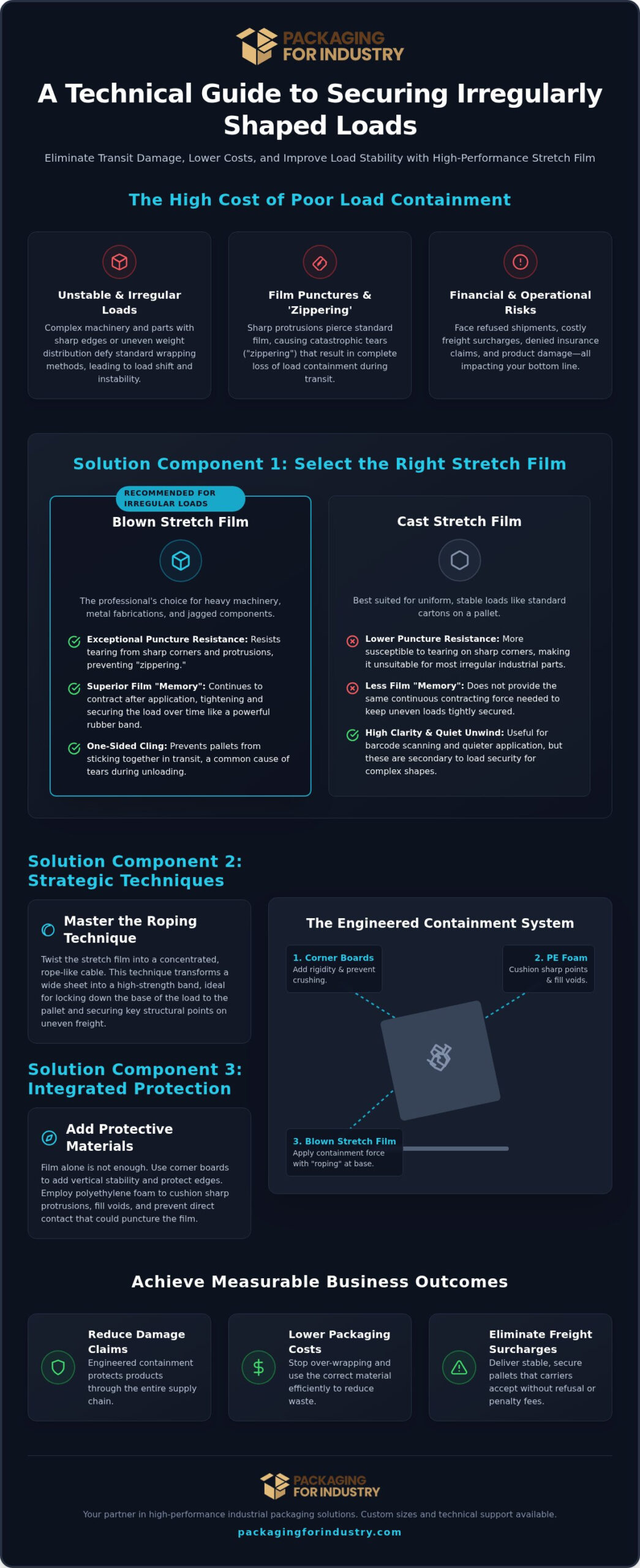
Blown Stretch Film: The Professional’s Choice for Irregular Edges
Blown film is the industry standard for challenging applications involving heavy machinery or metal fabrications. Unlike cast film, which is cooled quickly on rollers, blown film is cooled slowly by air, giving it superior “memory.” This means the film continues to contract after application, acting like a powerful rubber band that pulls the load together. It features exceptional puncture resistance, making it much less likely to unzip when stretched over sharp points or jagged aerospace components. Blown film also typically offers one-sided cling. This prevents pallets from sticking to one another in a crowded trailer, which is a common cause of film tearing during the unloading process.
Determining the Correct Gauge for Your Load
Matching the film thickness, or gauge, to your load weight is critical for both safety and fiscal responsibility. Using a gauge that’s too thin leads to over-wrapping and wasted material, while a gauge that’s too thick adds unnecessary cost without improving stability. You can generally categorize your needs based on the following standards:
- 60 to 70 Gauge: Best for lighter, irregular e-commerce shipments or small kitted parts.
- 80 Gauge: The industrial standard for most mid-weight pallets with minor irregularities.
- 100+ Gauge: Required for heavy-duty applications, such as raw metal castings or large crates with significant protrusions.
It’s a common misconception that more layers always equal more strength. In reality, achieving the proper containment force depends on the relationship between the film’s gauge and its stretch percentage. Pre-stretch films can be highly effective for lighter irregular loads, as they’re already elongated to their optimal point before application, ensuring consistent tension. For high-value goods, you might also consider specialty opaque films to prevent pilferage or anti-static (ESD) films for sensitive electronics. If you’re unsure which material fits your current operation, you can compare packaging pricing and technical specs through a custom consultation with our team.
Strategic Techniques for Wrapping Complex Geometries
Securing complex geometries requires more than just high-performance film; it demands a tactical approach to load preparation. High-volume operations often rely on semi-automatic wrappers to maintain consistent tension. However, for low-volume or highly variable industrial parts, manual wrapping remains a necessity. The goal is to transform a collection of protrusions into a stable unit using stretch film for securing irregular shaped loads. One of the most effective methods is the “Roping” technique. By twisting the film into a tight cord, you create a high-strength cable that can be used to pull heavy components toward the center of the pallet, providing structural support that flat film alone can’t achieve.
Integrating Protective Packaging for Load Leveling
Voids and deep recesses are the primary causes of film failure during transit. When you use custom foam packaging, you can fill these gaps to create a more uniform, wrap-friendly surface. This “leveling” process prevents the film from bridging across empty space, which often leads to punctures and loss of containment force. Additionally, heavy-duty corner and edge protection is essential for distributing film tension across fragile or sharp edges. By combining these materials, you can create a unified block from multiple irregular parts. This kitting strategy ensures that the containment force is applied to a solid structure rather than individual, loose components.
Manual Wrapping Best Practices for Low-Volume Odd Shapes
Manual wrapping presents ergonomic challenges that require specific training to prevent warehouse injuries. Workers should walk forward around the pallet rather than backward and use their legs to maintain tension. The most critical step in any manual wrap is the “Pallet Anchor.” This involves securing the film to the pallet base itself, ensuring the load is physically tied to the skid. Without a strong anchor, the entire load can slide off the pallet during sudden stops. Banding is a technique where the operator applies multiple overlapping layers of film to a specific high-stress area to reinforce a weak point in the load. When applying stretch film for securing irregular shaped loads, these targeted reinforcements prevent the shifting that leads to freight surcharges and refused shipments.
Step-by-Step: Securing an Irregular Load for Transit
Preparation is the foundation of any successful shipment. Before you apply a single layer of film, ensure the load surface is clean and free of oils that might compromise film cling. Apply primary edge protection to any sharp points identified during your hazard assessment. This step is vital when using stretch film for securing irregular shaped loads, as it prevents the initial layers from puncturing before you’ve established a base. Once the load is prepped, the goal shifts to creating a unified structure that moves as a single block with the pallet.
Phase 1: Base Layering and Anchoring
The first 3 to 4 wraps around the pallet base are the most critical part of the entire process. This is where you establish the Pallet Anchor, physically tying the freight to the wooden skid. Use the roping technique to thread the film through the pallet stringers and around heavy components. This creates a high-strength connection that prevents the load from sliding off during sudden braking or sharp turns. Ensure the film captures both the product and the pallet base. If the load is offset, add extra wraps to the heavier side to compensate for the uneven center of gravity.
Phase 2: Navigating Protrusions and Voids
As you move up the load, you’ll encounter protruding arms, pipes, or offset machinery parts. Don’t simply bridge these gaps with flat film, as air pockets create weak points that lead to shifting. Instead, use an X-wrapping pattern. This involves applying the film in diagonal passes to create multi-directional tension. This technique provides the diagonal stability required for loads with non-standard footprints. Maintain a consistent 50% overlap with each pass to ensure a weather-resistant and dust-proof seal. This overlap provides the necessary containment force to keep irregular parts from vibrating loose during long-haul transit.
The lock-down phase finishes the wrap at the top of the load. Apply 2 to 3 final wraps at the highest point to secure any loose components. If the load is particularly tall or top-heavy, consider adding a top sheet for extra protection against moisture and debris. Once finished, tuck the film tail securely under a previous layer to prevent it from unraveling. By following this systematic approach, you can lower packaging costs by reducing the need for re-wrapping and minimizing transit damage claims. Our team provides the technical expertise and bulk supply required to standardize these procedures across your entire operation.
Optimizing Your Load Stability with PFI Custom Solutions
PFI doesn’t just sell rolls of film; we engineer containment systems. Securing complex industrial freight requires a holistic view of the entire packaging stack. By integrating heavy-duty corrugated boxes with precision-cut foam and high-performance stretch film for securing irregular shaped loads, we eliminate the variables that lead to transit damage. This integrated approach ensures that every component, from the base pallet to the top wrap, works in unison to maintain structural integrity throughout the supply chain.
For manufacturers in Anaheim, Orange County, and Los Angeles, local support means more than just fast shipping. It means having a partner who can conduct an on-site packaging review to identify hidden inefficiencies. These reviews often reveal that companies are over-spending on film thickness while failing to achieve the necessary containment force. By optimizing your material selection and application techniques, you can significantly lower packaging costs without compromising the safety of your high-value goods.
Vendor Managed Inventory (VMI) for Stretch Film Consistency
Supply chain reliability is critical for high-volume operations in the Inland Empire and San Diego. Our VMI programs remove the burden of inventory tracking from your warehouse team. This service prevents stockouts of the specialized blown films required for sharp-edged loads. A common failure point in warehouse logistics is the “wrong wrap” problem, where teams mistakenly use standard cast film on irregular loads because the correct high-puncture-resistant material is out of stock. PFI ensures the right stretch film for securing irregular shaped loads is always on your floor, ready for just-in-time application and consistent performance.
Custom Engineering for High-Value Industrial Goods
High-stakes sectors like aerospace packaging and medical device manufacturing require more than off-the-shelf solutions. PFI provides free prototyping to develop integrated assemblies that stabilize even the most difficult geometries. We design custom foam inserts and protective structures that “square off” irregular items, making them easier and safer to wrap. This precision engineering reduces the risk of insurance claim denials and refused shipments caused by unstable freight. Contact our team today for a custom stretch film quote tailored to your specific load profiles and regional logistics needs.
Stabilize Your Logistics with Engineered Containment
Securing complex industrial freight requires a shift from simple layering to technical load containment. By matching the superior puncture resistance of blown film with strategic anchoring and integrated protective foam, you transform unstable parts into a unified shipping unit. This engineering-first approach is essential when applying stretch film for securing irregular shaped loads to prevent punctures, load shifting, and costly freight surcharges. Standardizing these procedures across your dock allows you to lower packaging costs and eliminate the professional stress of transit damage claims.
As specialists in aerospace and industrial manufacturing packaging, PFI provides the custom engineering and free prototyping needed to solve your most difficult logistical challenges. We don’t just supply materials; we provide a comprehensive system of protection tailored to your specific load profiles. Our team understands the high-stakes nature of B2B shipping and is dedicated to improving your operational efficiency and supply reliability.
With local next-day delivery across Orange County, Los Angeles, and the Inland Empire, we’re ready to optimize your warehouse operations. We look forward to helping you achieve total load stability and fiscal efficiency in your next shipment.
Frequently Asked Questions
Is blown or cast stretch film better for irregular loads?
Blown stretch film is superior for irregular loads due to its high puncture resistance and “memory” properties. While cast film is quieter and more transparent, it lacks the toughness required to handle sharp corners or heavy protrusions without tearing. For industrial applications in Southern California, blown film provides the necessary contraction to keep complex machinery stable during transit, making it the standard choice for reducing damage claims.
What gauge of stretch wrap should I use for heavy industrial machinery?
Heavy industrial machinery typically requires a heavy-duty 100 gauge or higher blown film to ensure stability. While 80 gauge is the standard for uniform pallets, the offset weight and sharp edges of machinery put extreme stress on the material. Using a thicker gauge prevents the film from unzipping when stretched over jagged points. PFI offers custom sizes and high-performance gauges to help Orange County manufacturers secure their most difficult freight.
How many layers of stretch film are needed to secure a pallet?
Most industrial loads require a minimum of three to five wraps at the base and three wraps at the top to ensure safety. However, when using stretch film for securing irregular shaped loads, you may need additional layers at high-stress points to maintain integrity. The focus should be on achieving the target containment force rather than just counting revolutions. Our packaging reviews help warehouse managers in the Inland Empire determine the exact wrap counts needed.
How do I prevent stretch film from puncturing on sharp corners?
You can prevent punctures by integrating corner boards or custom foam edge protection before you begin the wrapping process. These materials buffer the sharp edges of the load, distributing the film’s tension more evenly across the surface. Combining these protective supplies with a high-puncture-resistant blown film creates a multi-layered defense. This strategy is particularly effective for aerospace components where maintaining product integrity is a critical requirement for shipping.
What is the difference between hand stretch film and machine stretch film for odd shapes?
Machine stretch film offers consistent tension and higher pre-stretch levels, which is ideal for high-volume operations with standard footprints. Hand stretch film provides more flexibility for warehouse workers to navigate complex or odd geometries manually. For irregular shapes, hand film allows the operator to apply roping or banding techniques precisely where the load is weakest. We provide both options to Southern California businesses to ensure your team has the right tools.
Can I use stretch film to secure loads directly to a wooden pallet?
Yes, securing the load directly to the pallet is essential for preventing the freight from sliding during transit. This is achieved through the Pallet Anchor technique, where the first few wraps capture the wooden pallet stringers. By roping the film through the pallet base, you create a physical tie that keeps the load stationary. This practice is a requirement for meeting cargo securement rules and avoiding refused shipments at local logistics hubs.
How does temperature affect stretch film performance in Southern California warehouses?
Extreme heat in Inland Empire or Los Angeles warehouses can cause stretch film to soften and lose its tension over time. Conversely, cold temperatures can make film more brittle and prone to snapping during application. It is important to store your film in a temperature-controlled environment and adjust your wrapping tension based on seasonal changes. PFI’s vendor-managed inventory programs ensure you always have fresh, high-performance film that performs reliably in local climate conditions.
What is containment force and how do I measure it for irregular loads?
Containment force is the total amount of pressure applied to the load to keep it unified as a single block. It is the most accurate way to verify the effectiveness of your stretch film for securing irregular shaped loads during transit. You can measure this using a specialized containment force tool or wrap-gauge. Maintaining the correct force ensures that the load doesn’t shift during sudden stops, reducing the risk of damage claims.