
How much is a “cheap” box actually costing your operation when it leads to a production line shutdown or a 56% fuel surcharge? In the high-stakes manufacturing environments of Orange County and Los Angeles, the true price of packaging isn’t the unit cost; it’s the reliability of the supply chain behind it. Many manufacturers settle for generic catalog vendors, but finding specialized packaging prototyping services in Southern California, serving the Orange County and Los Angeles manufacturing hubs, is the only way to ensure your custom corrugated boxes actually protect fragile components while minimizing dimensional weight.
You’ve likely dealt with the frustration of unexpected stockouts or the sting of seeing high-value aerospace parts arrive damaged. It’s an operational stress that drains your budget and your time. This guide, brought to you by Packaging For Industry (PFI), will show you how to vet industrial partners based on engineering precision and logistical proximity rather than just a line-item bid. We’ll explore how to leverage vendor-managed inventory and local next-day delivery to stabilize your operations, comply with SB 54 regulations, and lower your total landed costs.
Key Takeaways
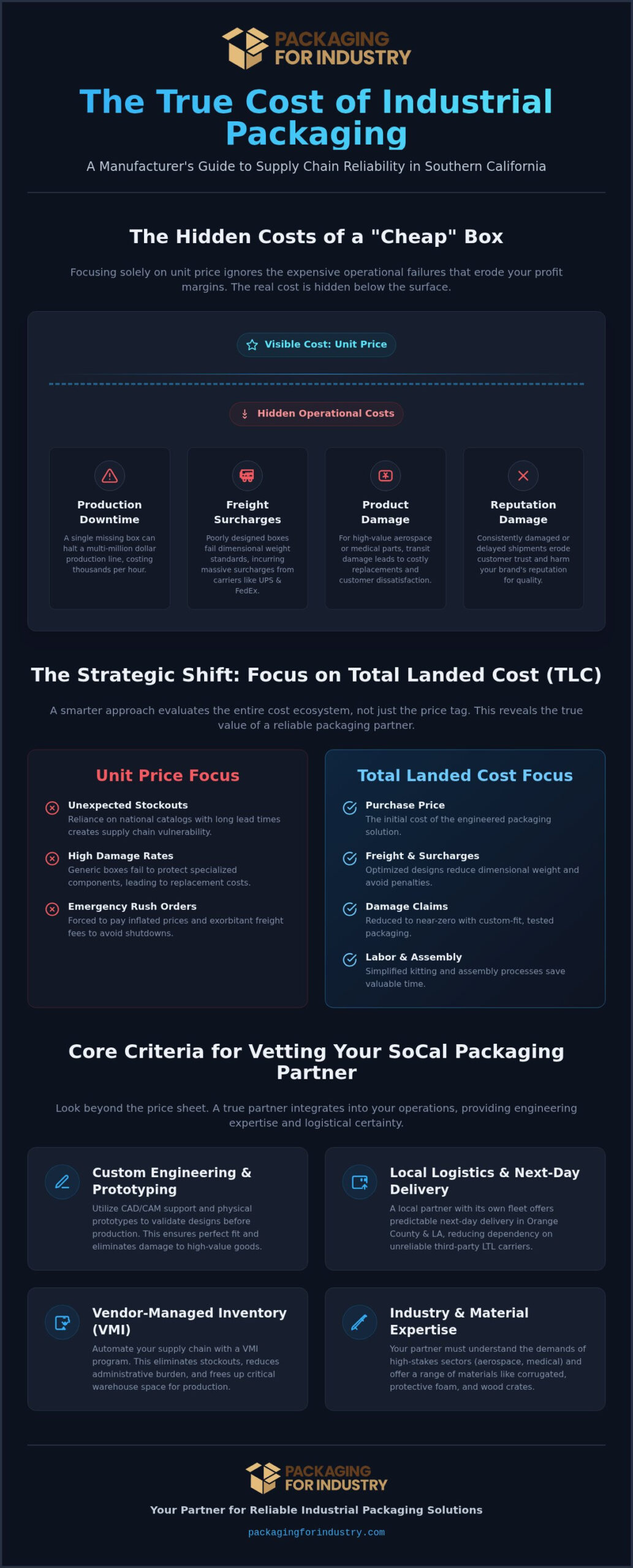
- Identify the hidden operational costs, such as production downtime and shipping surcharges, that stem from unreliable packaging suppliers.
- Evaluate the necessity of CAD/CAM support and packaging prototyping services Southern California to ensure product safety and eliminate shipping damage.
- Compare the long-term fiscal benefits of custom-engineered packaging versus off-the-shelf catalog solutions to reduce freight expenses.
- Audit local logistics capabilities to ensure your partner provides predictable next-day delivery and reduces dependency on third-party LTL carriers.
- Learn how Vendor Managed Inventory (VMI) programs can automate your supply chain and free up critical warehouse space for production.
The High Cost of Unreliable Packaging in Industrial Operations
Industrial packaging is far more than a container; it’s a coordinated system of preparing goods for efficient transport and storage. Many manufacturers focus solely on the unit price of a corrugated box. This narrow focus often hides the true financial impact of logistical failures. When a supplier lacks the precision to deliver on time, the resulting production downtime can cost thousands of dollars per hour. You aren’t just paying for the material; you’re paying for the stability of your entire operation.
Poor communication from a vendor often forces your team into a cycle of emergency orders. These rush shipments carry inflated unit prices and exorbitant freight fees. Over time, these inefficiencies erode your margins and create unnecessary labor waste. By utilizing professional packaging prototyping services Southern California, you can identify these risks early. Prototyping ensures that every component fits perfectly, which eliminates the need for last-minute adjustments or expensive filler materials.
Procurement teams must shift their focus toward Total Landed Cost (TLC). This metric provides a more accurate view of your expenses by accounting for the purchase price, freight surcharges, damage claims, and the labor required to assemble complex kits. Looking at TLC instead of unit price reveals that a slightly more expensive, custom-engineered solution is often the cheaper long-term choice.
The Ripple Effect of Packaging Shortages
A single missing custom box can halt a million-dollar production run. It’s a common scenario for manufacturers who rely on large national catalogs. These suppliers often experience lead-time surprises during peak seasons. When a shortage occurs, operations managers often resort to substitute packaging. This is a dangerous gamble. Using a standard box that doesn’t meet your crush-test specifications increases the risk of catastrophic failure during transit.
Damage Rates and Brand Reputation
In high-stakes sectors like aerospace and medical devices, fragile components must arrive in pristine condition. Transit damage doesn’t just result in the cost of a replacement; it damages your brand reputation. High damage rates also trigger significant UPS and FedEx surcharges when poorly designed boxes fail to meet dimensional weight standards. Reducing shipping damage by just 1% can reclaim substantial profit margins by eliminating the administrative burden and logistical waste of processing industrial returns. Custom engineering through packaging prototyping services Southern California provides the structural integrity needed to survive the modern supply chain.
Core Criteria for Vetting SoCal Industrial Packaging Manufacturers
Vetting a supplier in a competitive market like Orange County or the Inland Empire requires looking beyond the price sheet. You need a partner capable of integrating different materials, such as corrugated, protective foam, and heavy-duty wood crates, into a single, cohesive solution. This versatility is a pillar of manufacturing supply chain best practices because it reduces the administrative burden of managing multiple vendors. A single-source provider ensures that every component of your packaging system works together to protect your product.
Material diversity must be matched by technical expertise. A supplier who only offers stock sizes can’t help you optimize for dimensional weight or specialized protection. When you evaluate a manufacturer, ask about their experience with high-stakes sectors like aerospace and medical devices. These industries demand a level of precision that off-the-shelf catalog vendors simply can’t provide. You can compare packaging pricing and capabilities to see how a specialized local partner offers more value than a generic distributor.
Engineering and Prototyping Capabilities
High-value industrial goods require more than a standard RSC box. Utilizing packaging prototyping services Southern California allows you to validate a design before committing to a full production run. This process involves CAD/CAM support to create precise digital models, followed by physical prototypes that undergo rigorous drop testing and foam density analysis. Custom design packaging isn’t a luxury for manufacturers; it’s a technical requirement to prevent structural failure during transit. Prototyping ensures the fit is correct the first time, which prevents the waste associated with re-runs and modifications.
Compliance and Specialized Standards
If your operations involve government contracts or international shipping, vetting for compliance is mandatory. Ensure your supplier understands military packaging (Mil-Spec) standards, which dictate specific barrier materials and labeling. For global distribution, verify that their wood crates meet ISPM-15 heat-treatment requirements to avoid customs delays at the port. Electronics manufacturers should also look for specialized ESD (electrostatic discharge) protection to safeguard sensitive semiconductor components. These standards aren’t suggestions; they’re critical benchmarks that protect your business from legal and financial liability.
Scalability is the final benchmark for reliability. Your supplier must have the financial stability to maintain inventory levels that match your production volume. A partner who can’t scale with your growth will eventually become a bottleneck. By choosing a local manufacturer with its own fleet and engineering team, you secure a supply chain that’s both agile and dependable.
Custom Engineering vs. Catalog Suppliers: Making the Strategic Choice
Choosing between a catalog distributor and a custom manufacturer is a choice between convenience and optimization. Catalog vendors offer speed for standard sizes, but they don’t provide the engineering depth required for complex industrial logistics. When you compare the unit price of an off-the-shelf box to an engineered solution, the catalog option often looks cheaper on paper. This initial saving disappears when you account for the excessive labor required to wrap parts in bubble wrap or the high freight costs associated with oversized containers. A strategic partner focuses on your specific product geometry to eliminate these hidden expenses.
When Off-the-Shelf Fails
Generic packaging creates a reliance on void fill, which is a major point of failure for heavy industrial equipment. If a box is too large, the contents shift during transit, which leads to the structural damage that halts production lines. By utilizing packaging prototyping services Southern California, you can develop custom foam packaging that locks components in place. This precision eliminates the need for manual wrapping and significantly reduces the exterior dimensions of the shipment. With West Coast diesel prices averaging $6.20 per gallon as of August 2026, right-sizing your boxes is the most effective way to combat rising dimensional weight (DIM) pricing and fuel surcharges that can account for over 30% of a freight invoice.
The Integrated Solution Advantage
A fragmented supply chain increases the risk of error and logistical delays. If you source custom corrugated boxes from one vendor and foam inserts from another, you assume the risk of a poor fit. An integrated manufacturer designs both components simultaneously to ensure a seamless interface. This approach is essential for packaging kitting, where multiple parts are organized into a single assembly-ready unit. When you consolidate your procurement, a single point of accountability improves quality control because one engineering team oversees the entire protective system from CAD design to final delivery. This streamlines your assembly line and reduces the labor hours spent on the warehouse floor, allowing your team to focus on production rather than packaging assembly.
Ultimately, custom engineering transforms packaging from a commodity into a tool for fiscal responsibility. It allows you to move away from the “one size fits most” mentality of catalog distributors and toward a system that protects your bottom line as much as your product.
Auditing Local Logistics and Delivery Reliability
Southern California’s manufacturing landscape is geographically vast, making logistical proximity a critical factor in your supplier selection. If your packaging partner is shipping from a different time zone, your operation is at the mercy of national freight delays and volatile LTL carrier schedules. A supplier headquartered in Anaheim provides a strategic advantage for surrounding industrial hubs in Irvine, Torrance, and Ontario. This proximity allows for local next-day delivery, which is the only way to truly support a just-in-time production model.
When you audit a potential partner, evaluate their delivery fleet. Many distributors rely entirely on third-party LTL carriers, which introduces layers of risk and unpredictable surcharges. A manufacturer that operates its own trucks maintains total control over the delivery schedule. This reliability ensures that your custom corrugated boxes and foam inserts arrive exactly when your assembly line needs them. For companies with multiple U.S. locations, ensure your Southern California partner also possesses nationwide shipping capabilities to maintain consistency across all facilities.
Southern California Logistical Hubs
The Anaheim and Orange County corridor serves as the central nervous system for regional manufacturing. This location offers logistical advantages for businesses in Los Angeles County and the Inland Empire by reducing the transit time for heavy-duty pallets and crates. Local warehousing mitigates the risk of national supply chain disruptions by keeping critical inventory within a two-hour drive of your facility. This physical presence is a safeguard that catalog distributors located across the country cannot offer.
Lead Times and Responsiveness
Responsiveness is the byproduct of local engineering and manufacturing. When you utilize packaging prototyping services Southern California, you gain the ability to iterate on designs in real time. If a product spec changes on Monday, a local partner can often have a new prototype on your desk by Tuesday. Ask potential suppliers about their specific rush order policies and whether you’ll have a dedicated account manager. A single point of contact who understands your warehouse logistics is far more valuable than a generic customer service queue. Local manufacturers are inherently more agile than overseas sources, allowing you to pivot your packaging strategy without waiting for a container ship to cross the Pacific.
Inventory Management: The Ultimate Reliability Benchmark
Engineering a superior box is only the first step in a reliable supply chain. The most advanced packaging prototyping services Southern California offers are ineffective if the resulting custom corrugated boxes aren’t available when your production line hits peak volume. Reliability in industrial packaging is measured by your supplier’s ability to manage the data behind your usage patterns. Manufacturers often struggle with the “feast or famine” cycle of inventory, where they either sit on too much capital or face a line-stopping shortage. A professional inventory review identifies these inefficiencies and replaces guesswork with a structured replenishment system.
Managing your own packaging stock consumes more than just capital; it consumes the physical floor space you need for manufacturing. By partnering with a supplier that offers integrated stocking programs, you can reclaim your warehouse for revenue-generating activities. This shift moves the burden of storage and tracking from your team to the experts who understand your logistical flow. When your supplier handles the oversight, your team can focus on assembly and quality control rather than counting pallets of stretch film or corner boards.
Eliminating Shortages with VMI
Transitioning from manual ordering to Vendor Managed Inventory (VMI) is the most effective way to eliminate emergency shortages. In this model, your supplier performs weekly or monthly usage reviews to monitor stock levels on your behalf. This proactive approach ensures that replenishment happens automatically before a critical low point is ever reached. The primary goal of a VMI program for a manufacturing plant is to guarantee 100% packaging availability while reducing the administrative labor required for procurement. It transforms your packaging from a recurring headache into a silent, reliable utility.
Just-In-Time (JIT) Logistics
For high-volume users in sectors like aerospace or medical device manufacturing, Just-In-Time inventory management is essential for maintaining healthy cash flow. JIT logistics reduce the amount of capital tied up in slow-moving inventory by delivering only what you need for the immediate production cycle. This is particularly valuable for bulky, long-lead items such as custom wood crates or specialized foam packaging. PFI leverages its local Anaheim footprint to handle the stocking of these materials, delivering them to your facility as needed. This model ensures you don’t pay for packaging until it’s ready to be used, which significantly improves your operational flexibility. By combining packaging prototyping services Southern California with a robust JIT strategy, you secure a supply chain that’s both engineered for protection and optimized for fiscal performance.
Optimize Your Supply Chain with Strategic Packaging Partnerships
Transitioning from a generic catalog supplier to a strategic local manufacturer is a fundamental shift in operational efficiency. It’s the difference between reacting to shortages and proactively managing your logistical flow. By prioritizing engineering precision and proximity, you eliminate the hidden costs of production downtime and shipping damage. Utilizing professional packaging prototyping services Southern California ensures that your custom solutions are validated for fit and durability before they ever reach the assembly line.
PFI provides the technical expertise and logistical infrastructure needed to support high-stakes sectors like aerospace and defense. With free prototyping, design reviews, and local next-day delivery across Orange County and Los Angeles, we help you maintain a lean, responsive supply chain. Implementing vendor-managed inventory and just-in-time delivery will stabilize your stock levels and free up critical warehouse floor space.
Frequently Asked Questions
How do I know if I need a custom box or a stock size?
You need a custom box if stock sizes leave more than two inches of void space or require excessive bubble wrap to secure the product. High-value or heavy industrial components often require custom corrugated boxes to ensure structural integrity during transit. Stock sizes are cost-effective for general goods, but engineered solutions prevent the damage and high freight costs associated with poorly fitting packaging. We provide packaging prototyping services Southern California to help you determine the most efficient dimensions for your specific application.
What is the typical lead time for custom industrial packaging in SoCal?
Lead times for custom industrial packaging depend on the complexity of the design and the materials used. Local manufacturing in Anaheim significantly reduces transit time compared to national catalog distributors. While custom crates or specialized foam assemblies require engineering time, our proximity to the Orange County and Los Angeles corridors allows us to move from approved prototype to final delivery faster than out-of-state vendors. We also offer stocking programs to ensure your recurring orders are always available.
Can a local packaging supplier help reduce my shipping damage rates?
A local supplier reduces damage rates by conducting a professional packaging review of your current shipping methods. We analyze where structural failures occur and engineer integrated solutions using custom foam inserts and heavy-duty corrugated materials. This targeted approach eliminates the movement inside the box that typically causes transit damage. By validating these designs through packaging prototyping services Southern California, we ensure your fragile aerospace or medical components are protected against the rigors of the modern supply chain.
Do you offer free prototypes for custom foam inserts?
Yes, we offer free prototyping and design reviews to ensure your custom foam inserts and boxes provide a perfect fit before you commit to a full production run. This process allows your operations team to test the packaging with actual products on your assembly line. Providing these samples is a standard part of our engineering process, as it eliminates the risk of costly re-runs and ensures that the final protective solution meets your exact technical specifications.
What industries in Southern California do you specialize in?
We specialize in high-stakes sectors that require precision and compliance, including aerospace and defense, electronics, semiconductor manufacturing, and medical device production. Our team understands the specific requirements for mil-spec packaging and ESD protection. We also serve the automotive, industrial equipment, and food and beverage sectors throughout Southern California. Our expertise is focused on B2B manufacturers and warehouses that require consistent, high-quality packaging for recurring production needs rather than one-time residential or retail purchases.
How does a Vendor Managed Inventory (VMI) program work?
A Vendor Managed Inventory (VMI) program automates your replenishment process through scheduled usage reviews. We monitor your stock levels on a weekly, biweekly, or monthly basis and trigger new orders when you reach a predetermined minimum. This system eliminates the need for manual ordering and prevents emergency shortages that can halt your production line. It also frees up valuable warehouse floor space by delivering only the packaging you need for your immediate production or shipping schedule.
Do you provide next-day delivery in Orange County and Los Angeles?
We provide local next-day delivery throughout Southern California, including Orange County, Los Angeles County, the Inland Empire, and San Diego. Our headquarters in Anaheim allows us to reach industrial hubs in Irvine, Torrance, and Santa Fe Springs quickly using our own fleet of trucks. This reliable delivery schedule supports just-in-time manufacturing models and ensures you don’t have to wait for third-party LTL carriers or national freight companies to deliver your critical shipping supplies.
Can you help me avoid UPS and FedEx dimensional weight surcharges?
We help you avoid UPS and FedEx dimensional weight surcharges by engineering right-sized packaging that minimizes the exterior volume of your shipments. Many companies use oversized boxes from catalogs, which leads to high surcharges because they’re paying for empty space. By custom-designing your boxes and foam inserts to fit your product exactly, we reduce the DIM weight of your parcels. This optimization leads to significant freight savings without compromising the protection of your high-value industrial components.