
A single shipment of moisture-damaged industrial components can trigger a cascade of replacement costs, expedited shipping fees, and strained client relationships. For manufacturers in Southern California, where coastal humidity and complex logistics are constant factors, relying on standard packaging is a gamble that rarely pays off. You’ve likely seen the results of failed containers: collapsed walls, saturated liners, and compromised inventory that leads to expensive surcharges from carriers. It’s frustrating to deal with inconsistent supply from large catalog distributors who treat your specialized needs as an afterthought.
We understand that protecting high-value goods requires more than just a thicker box. This guide will show you exactly how to specify and source the correct water-resistant corrugated boxes for shipping to ensure your inventory remains structurally sound throughout the supply chain. You’ll learn the technical differences between high-performance grades like W5c and V3c, and how custom-engineered solutions can eliminate dimensional surcharges. We will also preview how a local partnership in Orange County or Los Angeles can provide the reliable, vendor-managed inventory your warehouse needs to maintain peak efficiency and lower your total operational costs.
Key Takeaways
- Understand the critical distinction between waterproof claims and weather-resistant board treated with specialized wet-strength resins and adhesives.
- Learn how to specify the correct board grade, comparing W5c for moderate exposure against the 350# heavy-duty V3c for extreme shipping conditions.
- Discover how to integrate water-resistant corrugated boxes for shipping with custom foam and moisture barrier bags to create a comprehensive protection system.
- Identify sector-specific requirements for aerospace and medical device shipping to ensure compliance and inventory integrity.
- Optimize your supply chain with local Southern California delivery and Vendor Managed Inventory to prevent stockouts and reduce total packaging costs.
Understanding Weather-Resistant vs. Waterproof Packaging
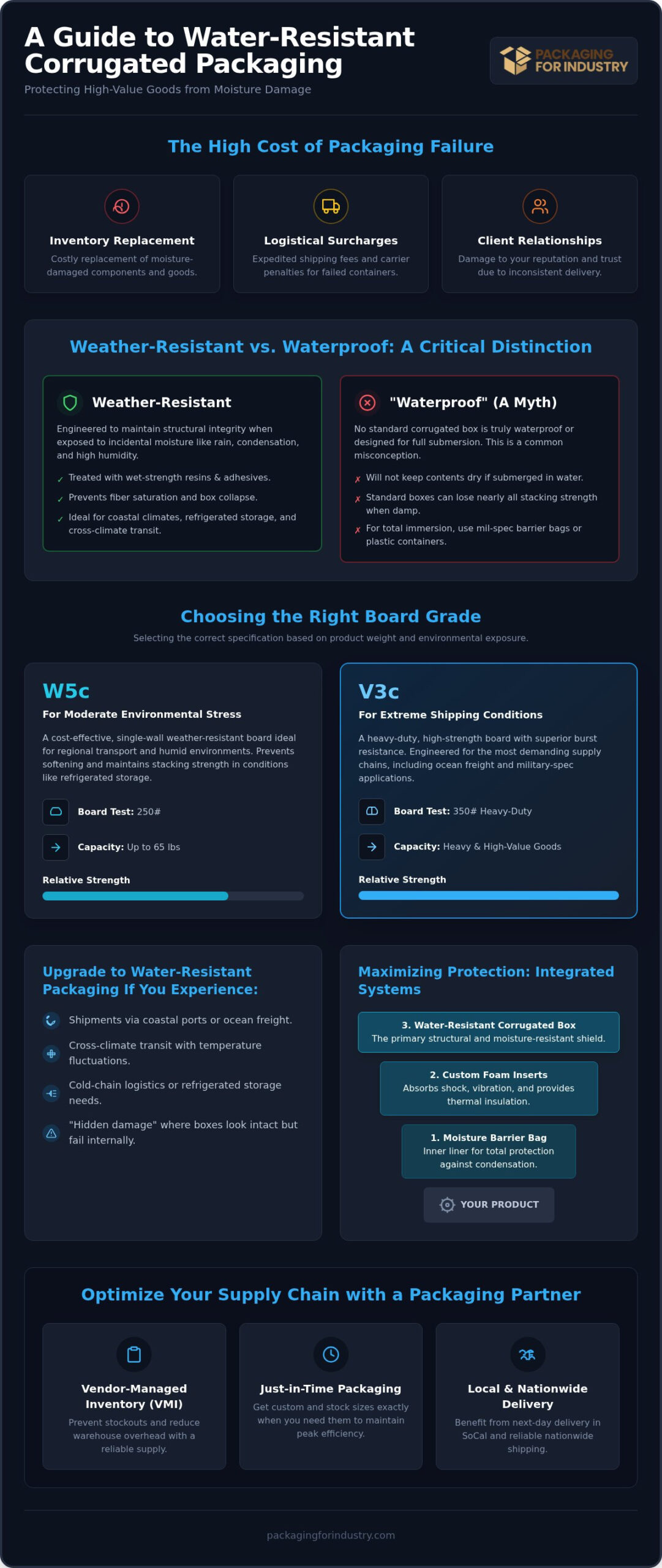
Many procurement managers use the terms “waterproof” and “weather-resistant” interchangeably, but in industrial logistics, this distinction is vital. True water-resistant corrugated boxes for shipping are engineered with specialized wet-strength resins and water-resistant adhesives. These chemical additives prevent the paper fibers from absorbing moisture and losing their structural bond. While a standard box might disintegrate when exposed to rain or high humidity, a weather-resistant container maintains its integrity. This ensures your high-value inventory remains protected from the point of origin to the final destination.
It is essential to address the “waterproof” myth directly. No corrugated product is truly submersible or capable of keeping contents bone-dry if dropped into a body of water. Weather-resistant packaging is designed to withstand incidental moisture, heavy condensation, and high-humidity environments. If your shipment requires total immersion protection, you should look toward specialized mil-spec barrier bags or plastic containers rather than fiberboard alone. For the majority of industrial applications, however, weather-resistant grades provide the necessary balance of protection and cost-efficiency.
Failure to account for moisture during long-haul transit can be catastrophic. Sea containers often experience “container rain,” where temperature fluctuations cause moisture to condense on the ceiling and drip onto the cargo. Standard corrugated loses nearly all its stacking strength when damp, leading to pallet collapses and crushed goods. You can request a packaging quote to evaluate how moisture-tolerant materials can safeguard your bottom line against these transit risks.
The Role of Wet-Strength Resins
The resilience of these boxes comes from the manufacturing process of Corrugated fiberboard. During production, wet-strength resins are added to the pulp to create a chemical bond that resists water penetration. This is paired with water-resistant adhesives at the glue line. Standard starch-based adhesives often dissolve when wet, causing the liners to peel away from the fluting. By utilizing resins, we ensure the box remains a cohesive unit even in refrigerated storage or tropical climates where humidity levels frequently exceed 80%.
When to Upgrade from Standard Corrugated
Upgrading to weather-resistant grades is a strategic decision based on risk and economics. You should consider an upgrade if your shipping routes involve coastal ports, cross-climate transit, or cold-chain logistics. If you’re experiencing a high rate of “hidden damage” where the box looks intact but the internal structural strength has failed, it’s time to switch. While the initial cost per unit is higher, the reduction in transit damage and carrier surcharges typically results in a lower total cost of ownership. We help our clients lower packaging costs by identifying exactly where these high-performance materials are necessary and where standard corrugated suffices.
W5c vs. V3c: Comparing Technical Board Grades
Understanding technical specifications is the first step in optimizing your industrial logistics. The “W” and “V” prefixes originate from established military and industrial standards, specifically ASTM D5118/D5118M. In this nomenclature, “W” denotes weather-resistant board, while “V” indicates higher-strength weather-resistant board with superior burst resistance. Selecting the correct grade of water-resistant corrugated boxes for shipping depends entirely on your product’s weight and the severity of environmental exposure during its journey.
W5c: The Standard for Light-to-Medium Industrial Goods
The W5c grade is a 250# test single-wall construction. It’s engineered to provide reliable protection for goods weighing up to 65 pounds under moderate environmental stress. While it isn’t designed for extreme ocean freight, it excels in refrigerated storage and regional transport where high humidity is a constant factor. In coastal regions like Orange County or Los Angeles, where morning marine layers can spike humidity levels, W5c prevents the box from softening. It’s a pragmatic, cost-effective choice for manufacturers who need more protection than standard kraft but don’t require heavy-duty military specifications. Stacking strength remains stable even when the ambient moisture increases, protecting your bottom-line inventory from crushing.
V3c: High-Performance Protection for Heavy Equipment
For more demanding applications, V3c is the industry benchmark. This is a 350# test single-wall board that offers significantly higher burst strength and puncture resistance than W5c. It’s the preferred choice for aerospace components and military-spec kitting because it maintains its structural integrity even when saturated. In many cases, V3c outperforms standard double-wall corrugated boxes in wet conditions. While a standard double-wall might offer more initial cushioning, the specialized adhesives in V3c ensure the box doesn’t delaminate when exposed to standing water or extreme condensation. It’s built to handle heavier loads, often up to 90 pounds, without compromising the safety of the internal components.
Selecting the wrong grade often leads to avoidable surcharges and damaged inventory. If you’re shipping heavy machinery or high-value medical devices, the added security of V3c pays for itself by reducing replacement claims. You can compare packaging pricing for both W5c and V3c to determine which grade offers the best balance of protection and fiscal efficiency for your specific load requirements.
Selecting the Right Box for Your Industry
Choosing the correct packaging requires a deep understanding of your specific industry’s logistical hurdles. In sectors like aerospace or medical manufacturing, the cost of a failed box extends far beyond the loss of the container itself; it includes the high replacement cost of the components and the professional stress of delayed production lines. By selecting water-resistant corrugated boxes for shipping that align with your sector’s standards, you can mitigate these risks. This strategic choice allows you to lower packaging costs by reducing transit damage and eliminating the need for excessive secondary over-packaging.
Aerospace and Defense Compliance
Compliance is non-negotiable in the Aerospace and Defense sector. These industries often require strict adherence to the ASTM D5118 Standard, which governs the fabrication of fiberboard shipping boxes for military and commercial use. Whether you’re shipping oversized engine components or sensitive avionics, the structural integrity of your packaging must withstand the rigors of international military logistics. Weather-resistant boxes prevent the delamination that often occurs during long-haul sea freight or outdoor storage on tarmac locations. For manufacturers in Orange County and San Diego, having a partner who understands these mil-spec requirements ensures that every shipment meets regulatory scrutiny without delay.
Medical and Electronics Protection
Medical device and electronics manufacturers face unique challenges with moisture control. In temperature-controlled shipping, rapid changes in ambient heat can lead to condensation inside the container. Using weather-resistant grades ensures the exterior remains rigid, while integrated protective foam packaging provides the necessary cushioning. For electronics, we often combine these moisture-resistant properties with ESD-safe materials to prevent static discharge. This dual-layered approach is essential for maintaining cleanroom-compatible standards where exterior debris or box failure could contaminate sterile equipment. We provide custom sizes available to ensure a snug fit that prevents internal shifting during transit.
Precise engineering is the most effective way to optimize your supply chain. Standard catalog sizes often result in wasted space, which increases freight costs through dimensional weight surcharges. By utilizing custom-sized water-resistant corrugated boxes for shipping, you maximize pallet density and improve stacking stability in your warehouse. For our partners in Los Angeles and the Inland Empire, this tailored approach ensures that your logistics stay lean and your high-value inventory remains secure, regardless of the environmental conditions it faces.
Maximizing Protection: Integrated Packaging Systems
While weather-resistant containers provide the first line of defense, high-value industrial goods often require an integrated system to survive extreme transit conditions. Relying on the box alone is a common mistake that leads to internal damage. By combining water-resistant corrugated boxes for shipping with specialized internal components, you create a comprehensive barrier against both physical impact and environmental moisture. This holistic approach is why we emphasize the intersection of engineering and economics; it’s far more cost-effective to build a robust system than to replace a mission-critical aerospace component or medical device.
To achieve a truly airtight seal, many manufacturers utilize poly bags or mil-spec moisture barrier bags as a secondary layer within the box. This ensures that even if the outer packaging faces prolonged exposure to standing water, the internal environment remains bone-dry. This multi-layered strategy is particularly effective for shipments moving through the Port of Los Angeles or Long Beach, where salt air and high humidity are constant threats to metal components prone to corrosion. We help our clients lower packaging costs by engineering these systems to be as lean as possible without compromising safety.
Foam Inserts and Moisture Control
Suspension is key for moisture-sensitive products. By using Custom Foam Packaging, we design end caps that keep your product from touching the box walls. This air gap prevents moisture transfer if the outer liner becomes saturated. We recommend closed-cell polyethylene foam for these applications because it doesn’t absorb water like open-cell alternatives. Our packaging kitting services streamline this process by delivering pre-assembled inserts and boxes to your warehouse, reducing labor costs and assembly errors.
Sealing and Stabilization Strategies
The seams of a box are its most vulnerable points. Standard packaging tape often fails when exposed to the high humidity found in sea containers or coastal warehouses in Orange County. You must use high-grade industrial adhesives designed to bond with weather-resistant liners. For total humidity control, we often include desiccants inside a moisture barrier bag before sealing the box. On the pallet level, applying the right stretch film and Corner and Edge Protection ensures the stack remains stable. These edge boards are critical in damp environments because they maintain the vertical stacking strength of the pallet, preventing the “bottom box collapse” that ruins entire shipments.
Why Partner with PFI for Custom Water-Resistant Boxes
Large catalog distributors prioritize volume over precision. While they offer speed, they often lack the technical depth required to solve complex industrial packaging challenges. We position ourselves as a consultative partner, bridging the gap between engineering and economics. By integrating our custom-engineered water-resistant corrugated boxes for shipping into your workflow, you gain a partner dedicated to total logistical optimization. We don’t just sell boxes; we provide a comprehensive system that protects your high-value inventory while protecting your bottom line.
The PFI Custom Engineering Process
Our approach starts with a deep dive into your product’s specific dimensions and transit risks. We provide custom design and free prototyping supported by CAD/CAM technology. This ensures a perfect fit for even the most complex aerospace or medical components. Unlike standard RSC boxes that require excessive dunnage, our custom-sized solutions eliminate wasted space. This precision is vital for manufacturers looking to lower packaging costs. By optimizing the box size to the product, we effectively eliminate the dimensional weight surcharges often imposed by carriers like UPS and FedEx. You can test these weather-resistant designs through our prototyping phase before committing to full-scale production, ensuring the material performance meets your exact requirements.
Southern California Logistics Advantage
Proximity is a major asset for your supply chain. We serve industrial hubs like Anaheim, Los Angeles, and the Inland Empire with local next-day delivery. This regional focus allows us to offer just-in-time delivery, which frees up valuable floor space in your warehouse. You don’t have to tie up capital in massive amounts of safety stock when you have a reliable local partner.
To further streamline your operations, we provide a robust Vendor Managed Inventory (VMI) program. We monitor your stock levels and replenish your supply automatically, eliminating the risk of packaging stockouts that can halt production lines. This proactive management, combined with our direct access to packaging experts for ongoing cost-reduction reviews, ensures your logistics remain lean and efficient. When you’re ready to move beyond generic catalog options, you can compare packaging pricing for a custom solution tailored to your specific industrial needs. We are here to ensure your water-resistant corrugated boxes for shipping arrive exactly when you need them, engineered to perform in the toughest environments.
Secure Your Industrial Supply Chain Against Moisture Damage
Protecting high-value inventory requires a shift from generic catalog boxes to engineered solutions. By specifying high-performance grades like W5c or V3c and integrating them into a comprehensive packaging system, you eliminate the risk of transit damage and the professional stress of inventory loss. Our consultative approach ensures your water-resistant corrugated boxes for shipping are sized with precision, directly lowering your total operational costs and carrier surcharges. You don’t have to settle for inconsistent supply or failed containers.
PFI specializes in high-stakes aerospace and medical device logistics, providing the technical expertise needed for complex compliance. We offer free prototyping and CAD/CAM support to ensure your custom designs perform under real-world stress. With our local next-day delivery across Orange County, Los Angeles, and the Inland Empire, you can maintain a lean warehouse while ensuring your production lines never stall.
We are ready to help you optimize your logistics and secure your shipments for the long haul.
Frequently Asked Questions
Are weather-resistant corrugated boxes completely waterproof?
Weather-resistant corrugated boxes are not completely waterproof and cannot be submerged. They’re engineered with wet-strength resins and water-resistant adhesives to withstand high humidity and incidental moisture. While they prevent the box from softening during damp transit, they don’t provide a hermetic seal. For products requiring total immersion protection, we recommend combining these boxes with mil-spec moisture barrier bags to ensure your inventory remains bone-dry throughout the entire supply chain.
What is the primary difference between W5c and V3c grades?
The primary difference lies in their burst strength and moisture tolerance levels. W5c is a 250# test single-wall board suitable for moderate moisture exposure and loads up to 65 pounds. In contrast, V3c is a 350# test heavy-duty board designed for extreme conditions and high-burst requirements. V3c is often the preferred choice for aerospace and military components because it maintains superior structural integrity even when exposed to severe condensation or standing water.
Can I order custom-size weather-resistant boxes in bulk?
You can certainly order custom-size weather-resistant boxes in bulk through our custom engineering program. We don’t just sell off-the-shelf catalog sizes; we specialize in designing boxes around your specific product dimensions. This precision helps you avoid the high costs of oversized packaging. Bulk procurement through PFI ensures a consistent, reliable supply of specialized materials like W5c or V3c, allowing your production lines to remain active without lead-time surprises or inventory shortages.
Do moisture-sensitive products still require foam or poly liners inside the box?
Moisture-sensitive products typically require an integrated system that includes foam or poly liners for maximum safety. While water-resistant corrugated boxes for shipping protect the exterior structure, internal liners provide a critical secondary barrier against condensation. Using closed-cell polyethylene foam end caps suspends your product away from the box walls. This prevents moisture transfer and adds impact protection. We help you design these multi-material kits to streamline your warehouse assembly and reduce transit damage.
How do weather-resistant boxes help lower my total shipping costs?
These boxes help lower your total shipping costs by reducing transit damage rates and eliminating expensive carrier surcharges. Standard boxes often fail in humid sea containers, leading to crushed inventory and replacement fees. By using custom-sized water-resistant corrugated boxes for shipping, you also avoid the dimensional weight penalties common with UPS and FedEx. Our packaging reviews focus on identifying these cost-reduction opportunities, ensuring you don’t pay for unnecessary space or failed protection.
Does PFI offer local delivery for weather-resistant boxes in Orange County?
PFI provides local next-day delivery for weather-resistant boxes across Orange County and the surrounding Southern California regions. Our fleet serves Anaheim, Irvine, Huntington Beach, and Santa Ana daily. This local logistics advantage allows you to utilize our Vendor Managed Inventory (VMI) services. We monitor your stock levels and replenish your supply as needed. This process frees up valuable warehouse floor space and improves your cash flow by preventing unnecessary over-stocking of bulky materials.
Can weather-resistant boxes be printed with custom company branding?
We offer custom printing for all our weather-resistant corrugated products to support your company branding. You can add logos, handling instructions, or part numbers directly to your W5c or V3c boxes during the manufacturing process. This professional appearance is essential for medical and electronics sectors where clear labeling is a requirement. Printed boxes help your logistics team identify specific parts quickly in the warehouse, improving operational flow and reducing picking errors during the fulfillment process.
How do I request a quote for a custom weather-resistant packaging solution?
You can request a packaging quote directly through our website or by contacting our Anaheim headquarters. Our team will review your specific product requirements, shipping routes, and volume needs to develop a cost-effective solution. We offer free prototyping and CAD/CAM support to ensure your weather-resistant design is a perfect fit before you commit to a full production run. This consultative approach helps you transition from expensive catalog suppliers to a more reliable, custom-tailored industrial partnership.