
Is your logistics budget being drained by the dead weight of traditional wood crates? With major carriers implementing a 5.9% general rate increase in 2026 and additional handling surcharges for packages over 50 pounds, the cost of heavy packaging has become a significant bottom-line liability. Many manufacturers across Los Angeles and Orange County now realize that heavy-duty triple wall boxes for industrial parts SoCal provide the structural integrity of timber without the prohibitive freight penalties.
We understand that protecting critical components during LTL transit is non-negotiable, yet wasting warehouse space on bulky crate inventory is no longer efficient. You can significantly lower outbound shipping costs and eliminate transit damage by transitioning to high-strength corrugated materials. This guide will show you how to replace heavy wood crates with precision-engineered triple-wall solutions to protect your components and improve operational flow. We will cover technical specs like ECT-90 ratings, dimensional weight optimization using the current 139 divisor, and the benefits of partnering with a local supplier for next-day delivery in the Inland Empire and beyond.
Key Takeaways
- Discover how 7-ply triple-wall corrugated provides ECT-90 strength to replace heavy timber crates while reducing packaging tare weight by up to 40%.
- Learn to mitigate 2026 carrier rate increases by using custom-sized heavy-duty triple wall boxes for industrial parts SoCal to optimize dimensional weight.
- Eliminate the need for ISPM-15 heat treatment and simplify international compliance for aerospace and automotive shipments with fiber-based packaging.
- Reduce your on-site storage requirements through local next-day delivery and Vendor Managed Inventory programs tailored for Orange County and Los Angeles manufacturers.
- Identify the critical data points needed to request a packaging quote that ensures maximum protection for high-value components during LTL and air freight transit.
Understanding Triple-Wall Corrugated: Engineering Strength for Heavy Loads
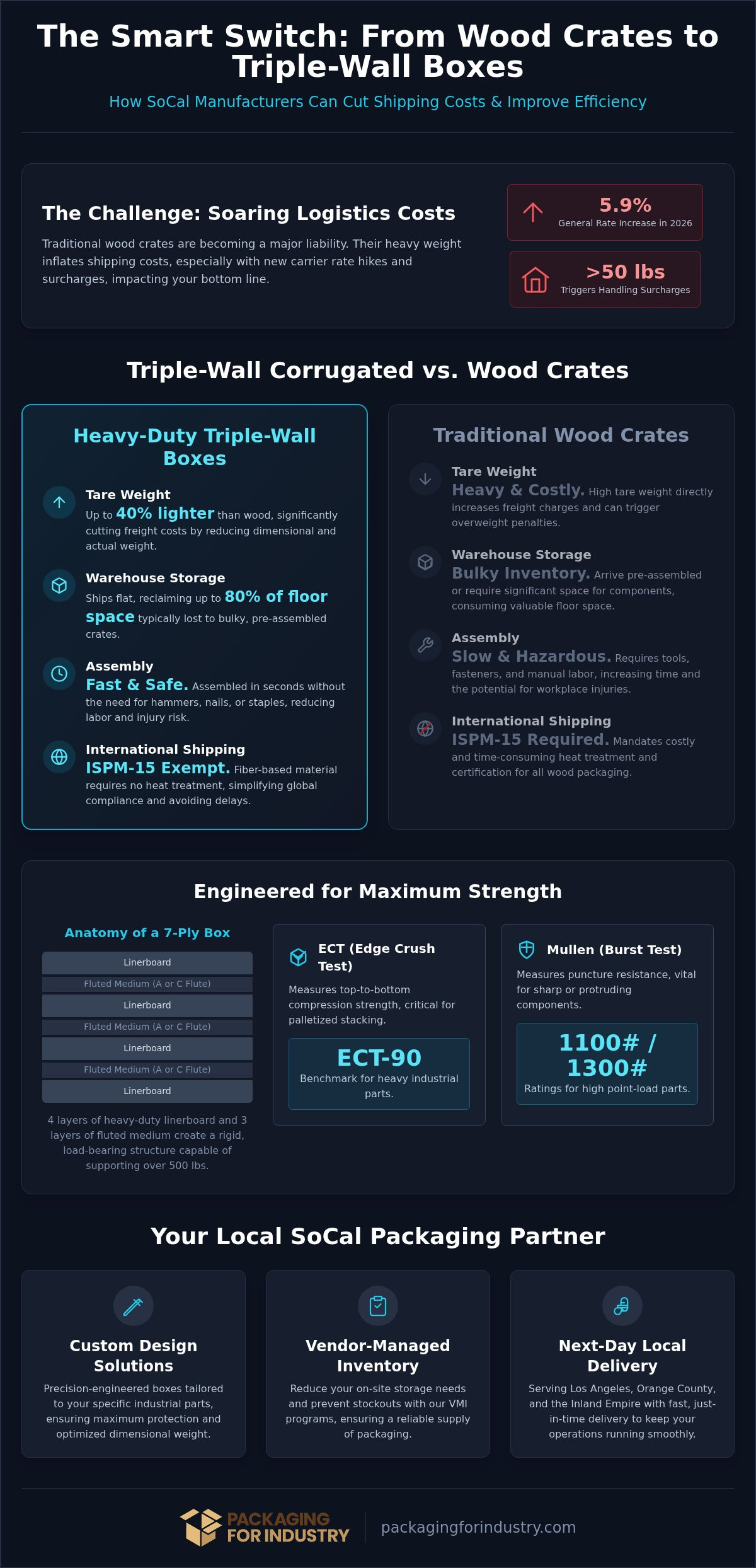
Triple-wall is a 7-ply industrial material designed to support loads exceeding 500 lbs. This high-performance material serves as a precision-engineered alternative to traditional timber, offering a superior strength-to-weight ratio for demanding logistics. The structure consists of four heavy-duty linerboard layers that sandwich three distinct layers of fluted medium. This specialized corrugated fiberboard engineering creates a rigid composite that effectively mimics the structural integrity of a wood crate. By aligning the internal flutes vertically, the box walls act like a series of structural columns. This orientation provides the immense stacking strength required to prevent collapse in high-density warehouse environments.
When engineering heavy-duty triple wall boxes for industrial parts SoCal, we focus on the specific stresses of LTL and air freight. Standardizing on these materials allows regional manufacturers to move away from heavy crates without sacrificing the safety of their critical components.
Anatomy of a 7-Ply Industrial Box
The durability of a triple-wall container depends on the specific combination of its internal components. Unlike standard shipping cartons, these boxes utilize a mix of flute profiles to achieve different performance goals. We often utilize AAA or AAC fluting patterns. The large “A” flutes provide maximum vertical compression for stacking, while the tighter “C” flutes offer enhanced puncture resistance and surface protection. To ensure reliability in the varied climates of Southern California, we use moisture-resistant adhesives. This prevents the 7-ply bond from delaminating when exposed to humidity or temperature fluctuations during transit. Our custom design packaging process ensures that each layer is optimized for the weight and fragility of your specific industrial part.
ECT vs. Mullen Test: Which Metric Matters for Your Parts?
Choosing the right specification for heavy-duty triple wall boxes for industrial parts SoCal requires an understanding of two primary industry metrics. The Edge Crush Test (ECT) is the most critical factor for palletized loads. It measures the board’s ability to withstand top-to-bottom pressure. For heavy industrial applications, an ECT-90 rating is often the benchmark, ensuring that the bottom box in a stack won’t buckle under thousands of pounds of pressure.
The Mullen Test, or burst strength, measures the force needed to puncture the material. This is vital when shipping heavy machinery with sharp edges or protruding bolts. Industry standards like 1100# and 1300# triple-wall refer to these burst strength ratings. If your parts have high point-load concentrations, a higher Mullen rating is necessary to prevent internal components from punching through the box walls. You can find these high-strength options in our corrugated boxes inventory, where we match the material grade to your specific shipping environment.
Triple-Wall vs. Wood Crates: A Cost and Efficiency Comparison
Replacing traditional timber with heavy-duty triple wall boxes for industrial parts SoCal offers immediate logistical advantages. The most significant shift is in tare weight. Triple-wall corrugated is up to 40% lighter than equivalent wood crates, which directly impacts your shipping budget. For international shipments, corrugated solutions eliminate the complexities of ISPM-15 compliance. Since fiber-based materials don’t require heat treatment or certification stamps, you can bypass the delays and costs associated with wood export regulations. This makes triple-wall the industry standard for triple-wall containers when speed and regulatory ease are priorities.
Operational efficiency also improves at the warehouse level. We ship triple-wall boxes flat, allowing you to reclaim up to 80% of the floor space typically occupied by pre-assembled wood crates. Assembly is faster and safer, too. Your team can set up a corrugated container in seconds without the need for hammers, nails, or heavy-duty staplers. This reduction in labor hours, combined with a lower risk of workplace injuries, makes corrugated a superior choice for high-volume manufacturing environments.
Total Cost of Ownership (TCO) Analysis
The financial benefits of triple-wall extend far beyond the initial purchase price. In the 2026 shipping climate, carriers like UPS and FedEx have standardized a dimensional weight divisor of 139. This means that every pound of tare weight you remove can lead to substantial savings on regional LTL and air freight. By reducing the overall weight of your shipment, you also lower the risk of triggering Additional Handling Surcharges, which currently apply to packages exceeding 50 lbs. You can find a deeper dive into ROI on our cost savings page, where we analyze how weight reduction compounds across thousands of shipments. To see how these savings apply to your specific logistics model, you can compare packaging pricing for your current part dimensions.
When Wood Crates Are Still the Right Choice
While corrugated is highly versatile, certain applications still demand the rigidity of timber. We identify a “break point” for our clients where extreme weight, irregular centers of gravity, or the need for multiple reuse cycles makes wood the more responsible choice. For these scenarios, we often engineer hybrid solutions. These designs use triple-wall corrugated sleeves for the body of the container while utilizing wood skids or pallets for the base. This provides the puncture resistance of fiberboard with the forklift-ready durability of traditional shipping crates. Our engineering team evaluates your part’s footprint and shipping environment to determine if heavy-duty triple wall boxes for industrial parts SoCal are sufficient or if a timber-based structure is required for total security.
Custom Triple-Wall Solutions for SoCal Industrial Sectors
Southern California’s manufacturing landscape requires specialized engineering to handle the diverse needs of the aerospace, automotive, and medical sectors. When we design heavy-duty triple wall boxes for industrial parts SoCal, we move beyond generic dimensions to create sector-specific protection systems. For aerospace firms in Orange County, this often involves protecting sensitive flight hardware that cannot withstand even minor vibrations. Automotive Tier 1 suppliers, conversely, require the extreme durability of triple-wall to transport heavy engines and transmissions without the box walls bowing or failing under high-volume throughput. Medical device manufacturers also benefit from the clean, fiber-based protection of triple-wall when shipping large-scale diagnostic equipment that requires a rigid, dust-free environment.
Customization options allow these containers to integrate seamlessly into your existing workflow. We can include die-cut handles for better ergonomics during manual handling, or access panels that allow technicians to inspect parts without fully unpacking the container. For high-volume manufacturing, integrated bulk bins (Gaylords) provide a stable solution for collecting and transporting thousands of smaller components in a single, high-capacity unit.
Integrated Protection: Triple-Wall and Foam Inserts
Protecting a heavy industrial part requires more than just a strong outer shell; it requires internal shock absorption. While the triple-wall provides the stacking strength, die-cut foam packaging serves to suspend the part and dissipate impact energy. This is a critical component of the “Total Cost of Ownership” because a single damaged aerospace component can cost more than an entire year’s worth of packaging inventory. For defense and electronics applications, we offer ESD (electrostatic dissipative) foam options. These specialized inserts protect sensitive circuit boards from static discharge while the 7-ply box provides the physical armor needed for LTL shipping.
Specialized Industrial Designs: Gaylords and Bulk Bins
Triple-wall is the preferred material for high-capacity bulk bins used across Los Angeles and Inland Empire warehouses. These containers, often called Gaylords, are engineered to hold upwards of 2,000 lbs of material. To improve part retrieval, we design boxes with bottom-discharge or side-access panels, which reduce the strain on warehouse staff. To maintain structural integrity during multi-stacking, we recommend reinforcing the corners. Utilizing specialized edge protection ensures that even when boxes are stacked three high, the vertical columns of the corrugated board won’t collapse under the weight. This engineering approach maximizes your vertical warehouse space while keeping your inventory secure.
Sourcing Strategy: Why a Local SoCal Supplier Matters
Shipping empty heavy-duty triple wall boxes for industrial parts SoCal from distant mills is a common logistical oversight that inflates your procurement costs. Because these 7-ply containers are bulky even when shipped flat, the freight cost to move them across state lines can negate the material savings. By sourcing from a supplier with facilities in Anaheim or Santa Fe Springs, you eliminate these inflated inbound freight charges. This proximity allows for local next-day delivery, which is essential for keeping production lines moving without maintaining a massive on-site inventory of packaging materials.
We offer Vendor Managed Inventory (VMI) and Just-In-Time (JIT) delivery to help you optimize your warehouse floor space. Instead of dedicating hundreds of square feet to stacks of unused boxes, you can receive exactly what you need for the week’s production. This strategy frees up high-value manufacturing space for actual assembly and machining. Our team monitors your stocking levels to prevent shortages, ensuring that a sudden spike in aerospace or automotive orders doesn’t leave you without the protection required for outbound shipping.
Service Areas: Anaheim, Los Angeles, and the Inland Empire
Our strategic location in Anaheim allows for rapid response times throughout Orange County and the surrounding regions. While we maintain nationwide shipping capabilities for clients with multi-state distribution centers, the primary value for local manufacturers lies in our ability to perform on-site consultations. A PFI packaging engineer can visit your facility in Torrance or Carson to review your current shipping damage and recommend heavy-duty triple wall boxes for industrial parts SoCal that are optimized for your specific components. This face-to-face partnership ensures that your packaging is optimized for the specific handling risks of Southern California’s LTL hubs.
Free Prototyping and CAD/CAM Support
Transitioning from wood crates to triple-wall requires precision engineering to ensure structural success. You shouldn’t commit to a high-volume order without verifying that the 7-ply structure can handle your specific part’s weight and center of gravity. Our custom design services include free prototyping and CAD/CAM support to eliminate the guesswork. We create a physical sample that you can test in your actual shipping environment before full-scale production. This right-sizing process reduces material waste and ensures the box dimensions align perfectly with your internal foam inserts, preventing the part movement that leads to transit damage.
How to Request a Quote for Heavy-Duty Triple-Wall Boxes
Securing a precise quote for heavy-duty triple wall boxes for industrial parts SoCal requires more than just basic measurements. Because these containers are engineered to replace timber crates, we need a technical profile of your shipment to ensure the material grade matches the physical risk. Follow these four steps to provide the necessary data for an accurate industrial quote.
- Step 1: Define your part weight and dimensions. Provide the exact length, width, and height (L x W x H) of your component. We also need the total weight to determine if the box requires a reinforced base or double-wall bottom.
- Step 2: Identify the shipping environment. Tell us if your parts move via LTL, Air Freight, or International ocean transit. Each mode presents different stacking pressures and vibration levels that influence the final box design.
- Step 3: Determine internal protection needs. Specify if you require custom foam packaging to suspend the part or if the box will be used with existing wood pallets.
- Step 4: Consult with a PFI expert. We will help you choose between 1100# or 1300# ECT ratings based on your stacking requirements and the fragility of the internal components.
Specifying for Bulk and Recurring Orders
If your facility handles high-volume production, providing usage data allows us to build a more efficient procurement model. We can perform a cost-reduction analysis that compares your current wood crate spend against a 7-ply corrugated alternative. By sharing your monthly or quarterly volume, we can integrate your needs into our VMI or JIT stocking programs. This transition often positions PFI as a significant cost-saving alternative to large catalog suppliers who lack the flexibility of custom industrial engineering. We focus on the intersection of engineering and economics to ensure your bulk orders are optimized for both protection and your bottom line. Our goal is to ensure you don’t overpay for strength you don’t need while guaranteeing your parts arrive without a scratch.
Ready to Lower Your Packaging Costs?
Our team is ready to help you transition away from heavy, expensive wood crates to high-strength corrugated solutions. We provide rapid response times and deep industrial expertise to manufacturers across Southern California. Whether you need local support in San Diego, Riverside, or San Bernardino counties, our engineers are available to review your specs and provide a competitive quote. Request a packaging quote today to begin your cost-reduction analysis and secure reliable, next-day delivery for your industrial operations. We understand the pressure of warehouse logistics and work as your proactive partner to eliminate shipping damage and reduce freight expenses.
Transitioning to High-Performance Industrial Logistics
Transitioning to heavy-duty triple wall boxes for industrial parts SoCal allows your operation to reclaim valuable warehouse space and slash freight expenses without compromising on component safety. By utilizing 7-ply corrugated engineering, you can eliminate the labor intensive assembly of wood crates while bypassing complex ISPM-15 export regulations for international shipping. We specialize in aerospace and industrial packaging, providing the technical expertise needed to protect high-value hardware throughout Los Angeles, the Inland Empire, and Orange County. Our engineering approach focuses on the intersection of durability and economics, ensuring your logistics budget is optimized for the 2026 shipping landscape.
We’re ready to support your next project with free custom prototyping to ensure a perfect fit for your specific components. With local next-day delivery and proactive inventory management, we help you maintain a lean, efficient operation that responds quickly to market demands. We look forward to becoming your trusted partner in industrial protection and helping you achieve significant long-term savings.
Frequently Asked Questions
What is the maximum weight capacity of a triple-wall corrugated box?
Triple-wall corrugated boxes can support loads exceeding 2,000 pounds when engineered as bulk bins or Gaylords. For standard industrial shipping, they easily manage weights over 300 pounds while maintaining high stacking strength. The specific capacity depends on the flute combination and the footprint of the part. We evaluate your product’s weight distribution to ensure the chosen board grade prevents side walls from bowing during long-term storage.
Can triple-wall boxes replace wood crates for international shipping?
Yes, triple-wall boxes are an ideal replacement for wood crates in international shipping because they don’t require ISPM-15 heat treatment. This material is exempt from the strict regulations governing raw timber, which eliminates the need for specialized stamps and documentation. By switching to fiber-based solutions, you reduce the risk of customs delays and lower your export costs while providing equivalent protection for sensitive aerospace or automotive components.
What is the difference between 1100# and 1300# triple-wall ratings?
The 1100# and 1300# ratings refer to the Mullen test, which measures the burst strength or puncture resistance of the board. An 1100# rating is the industry standard for most heavy machinery, while 1300# board offers maximum protection for parts with sharp edges or extreme weights. Both grades are common in heavy-duty triple wall boxes for industrial parts SoCal, providing the necessary durability for the rigors of LTL freight.
Do triple-wall boxes require special tape or closure methods?
Closing 7-ply corrugated requires more than standard packaging tape to maintain structural integrity. We recommend using 3-inch wide reinforced water-activated tape or heavy-duty industrial staples for a secure bond. Because the material is significantly thicker than standard cardboard, the closure method must be strong enough to withstand the internal pressure of heavy parts. Proper sealing ensures the box maintains its column strength during multi-pallet stacking in your warehouse.
How much warehouse space can I save by switching from crates to triple-wall?
You can reclaim approximately 80% of your warehouse floor space by switching from pre-assembled wood crates to triple-wall corrugated. These boxes ship and store flat, allowing you to keep a larger inventory on-site without crowding your production area. This efficiency is a core benefit of our VMI programs in Anaheim and Los Angeles. It enables you to manage high-volume shipping needs while keeping your facility organized and focused on manufacturing.
Are triple-wall boxes recyclable after use in industrial environments?
Triple-wall corrugated is 100% recyclable and fits into standard industrial paper recycling streams. Unlike heat-treated or chemically-treated wood crates, which often require specialized disposal and contribute to landfill waste, fiber-based packaging supports your company’s sustainability goals. This recyclability is increasingly important for compliance with California’s SB 54 regulations, which took effect in May 2026 and prioritize the reduction of single-use waste in the regional industrial supply chain.
Does PFI offer custom-sized triple-wall boxes for specific parts?
PFI specializes in designing and manufacturing custom-sized heavy-duty triple wall boxes for industrial parts SoCal tailored to your specific product dimensions. We don’t force your components into standard catalog sizes that lead to wasted space and higher shipping fees. Our team provides free prototyping and CAD/CAM support to ensure your box fits perfectly with internal foam inserts. This custom approach minimizes part movement and reduces the risk of transit damage.
What is the typical lead time for custom heavy-duty boxes in SoCal?
Typical lead times for custom heavy-duty boxes depend on the design complexity, but our local Anaheim facility ensures rapid turnaround for Southern California clients. For businesses enrolled in our Vendor Managed Inventory (VMI) programs, we provide local next-day delivery to keep your production lines moving. We maintain a steady supply of raw materials to ensure that custom orders for the Inland Empire or San Diego arrive without long lead-time surprises.