
How many of your components survive the transit only to fail weeks later in the field? Latent defects caused by electrostatic discharge are the silent killers of electronics manufacturing, often tracing back to inadequate protection during the shipping process. Selecting the correct anti-static packaging for sensitive electronics is not just a logistical checkbox; it’s a critical engineering requirement for maintaining product integrity. You understand that standard off-the-shelf solutions often fail to meet the rigorous demands of MIL-SPEC or aerospace standards, yet overpaying for catalog-brand packaging that doesn’t fit your custom parts is equally unsustainable.
This guide provides the technical roadmap you need to eliminate shipping damage and ensure full compliance across your supply chain. We’ll break down the essential differences between anti-static, dissipative, and static shielding materials to help you make informed procurement decisions. You’ll learn how to integrate custom foam inserts with ESD-safe corrugated boxes to achieve zero-defect shipping for PCBA and sensitive sensors. By the end of this article, you’ll have a clear strategy for streamlining your logistics through vendor-managed inventory while significantly lowering your total packaging costs and improving overall reliability.
Key Takeaways
- Identify the critical differences between catastrophic failure and latent defects to prevent “walking wounded” components from reaching your customers.
- Select the appropriate level of protection by mastering the technical distinctions between dissipative materials and anti-static packaging for sensitive electronics.
- Understand how to implement the Faraday Cage effect using metallic shielding layers to protect high-value assemblies from external electrostatic fields.
- Combine custom-engineered ESD foam inserts with specialized corrugated solutions to ensure both physical durability and electrical compliance for aerospace and medical sensors.
- Optimize your procurement strategy and lower total logistical costs by leveraging Vendor Managed Inventory (VMI) and local next-day delivery in Southern California.
Understanding ESD Risks in Industrial Electronics Logistics
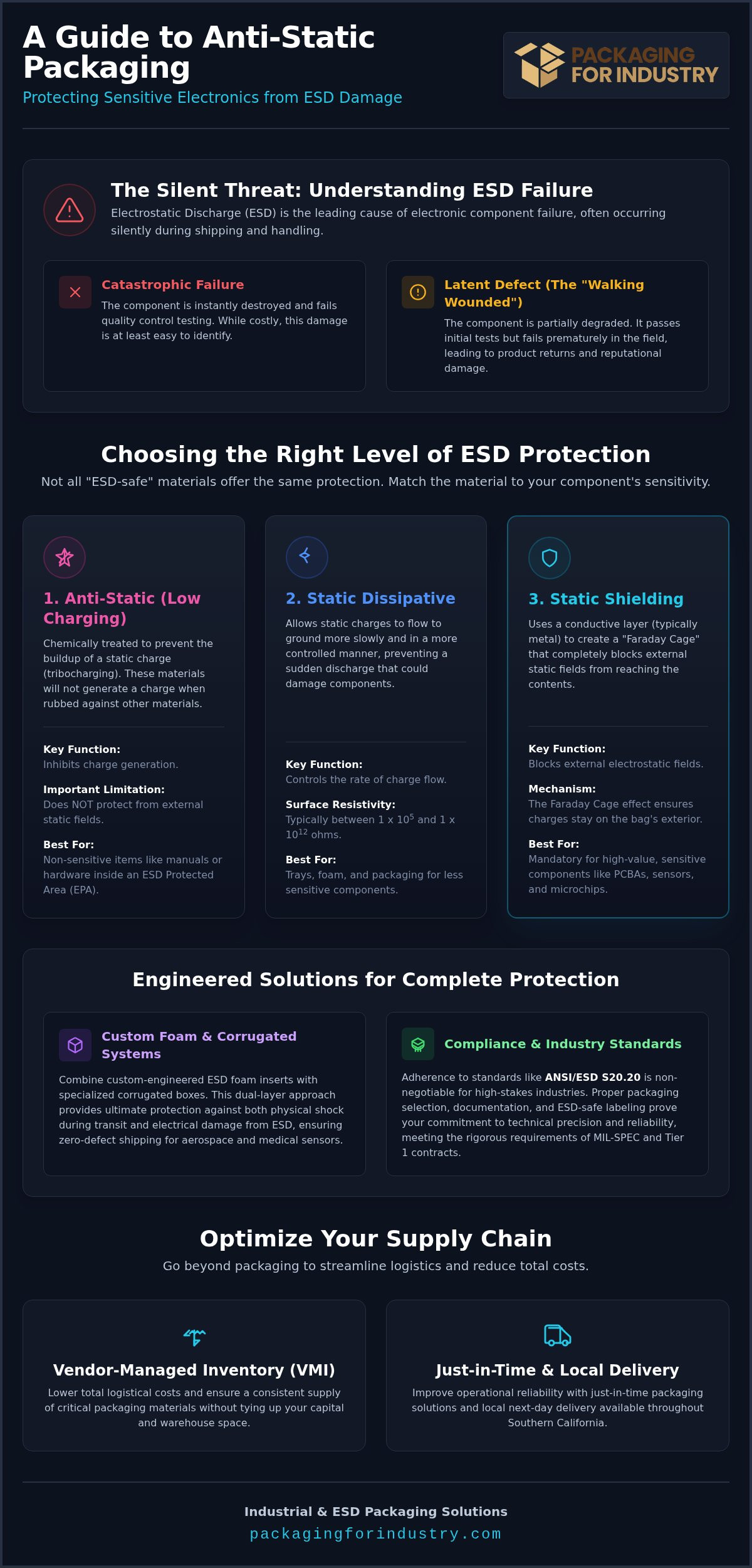
Electrostatic Discharge (ESD) represents the single greatest threat to modern semiconductor reliability. It occurs when two objects with different electrical potentials come into contact or close proximity, resulting in a sudden surge of energy. For high-value components, even a discharge of less than 100 volts can be fatal to internal circuitry. While catastrophic failures are easily caught during quality control, latent defects, often called the “walking wounded,” are far more damaging to your bottom line. These components pass initial inspection but fail prematurely once they reach the end user. This leads to high rejection rates in manufacturing and erodes customer trust. Implementing robust anti-static packaging for sensitive electronics is the only way to mitigate these risks across the supply chain.
High-risk environments exist at every stage of the journey. Manufacturing floors, long-haul freight, and warehouse storage all present unique challenges. Without a coordinated strategy, your components are vulnerable to discharge from personnel, machinery, and even the packaging itself. The cost of quality isn’t just about the price of a replacement part. It includes the labor of re-testing, the logistics of returns, and the potential loss of future contracts due to reliability concerns.
The Mechanics of Triboelectric Charging
Triboelectric charging is the primary driver of static buildup during transit. As components shift inside a box, friction between the part and the packaging material generates a surface charge. Constant vibration during long-haul freight accelerates this process. Standard corrugated and plastic materials act as insulators. They accumulate and hold these charges rather than allowing them to dissipate safely. Utilizing an Antistatic bag or dissipative foam is essential. These materials are engineered to prevent the buildup of static electricity through specialized chemical additives or conductive layers that provide a safe path to ground.
Industry Standards: ANSI/ESD S20.20 and Beyond
Compliance isn’t optional for Tier 1 suppliers or aerospace contractors. Adhering to standards like ANSI/ESD S20.20 ensures that your facility and logistics partners maintain a controlled environment. Documented workflows for anti-static packaging for sensitive electronics are now a standard requirement in most high-stakes procurement contracts. This includes the use of verified ESD-safe labels and tapes to maintain a secure chain of custody. Proper documentation and material selection prove to your partners that you prioritize technical precision and operational reliability.
Anti-Static vs. Static Shielding: Choosing the Right Material
Selecting the correct anti-static packaging for sensitive electronics requires a clear understanding of material classifications. Not all “ESD-safe” materials provide the same level of protection. To optimize your logistics and lower packaging costs, you must match the material to the component’s specific sensitivity. The industry typically categorizes these materials into three functional levels: anti-static (low charging), dissipative, and shielding. While anti-static materials prevent the buildup of static electricity, they do not protect against external electrostatic fields. For true protection against high-voltage surges, a shielding layer is mandatory.
Static shielding materials utilize a metallic layer to create a “Faraday Cage” effect. This physical property ensures that any external electrical charge travels around the outside of the package rather than through the sensitive component inside. In contrast, Pink Anti-Static (PAS) materials are best reserved for non-sensitive items used within an Electrostatic Protected Area (EPA), such as nuts, bolts, or instruction manuals. If your components are sensitive to both ESD and humidity, Moisture Barrier Bags (MBB) provide the necessary dual protection. These bags are significantly thicker and feature multiple layers of foil to prevent moisture vapor transmission during long-term warehouse storage. To ensure your selection meets rigorous industrial requirements, you can request a quote for custom-sized shielding solutions.
The Role of Surface Resistivity
Surface resistivity is the primary metric used to define material performance, measured in Ohms per square. According to ESD Association standards, dissipative materials fall between 10^4 and 10^11 Ohms. It’s vital to recognize that “Pink Poly” often relies on topical chemical coatings that migrate to the surface. These coatings have a limited shelf life and can fail over time, especially in low-humidity environments. For long-term reliability in aerospace or medical electronics, permanent conductive materials or shielding bags are the safer, more cost-effective investment.
Shielding Bags and the Multi-Layer Defense
A high-quality static shielding bag is a complex laminate of polyester, aluminum, and polyethylene. You’ll generally choose between “metal-in” and “metal-out” construction. Metal-in bags are the industrial standard because the aluminum layer is buried between plastic films, protecting it from abrasion. Metal-out bags allow for faster charge dissipation but are more susceptible to physical damage. We don’t recommend re-using ESD bags for high-value parts; every fold and wrinkle creates microscopic cracks in the metallic layer, which eventually compromises the Faraday Cage integrity and puts your sensitive sensors at risk.
Custom Engineering: ESD Foam and Corrugated Solutions
While shielding bags provide an essential electrical barrier, they don’t address the physical impact or internal movement that occurs during transit. High-value assemblies require custom foam packaging to secure components and eliminate triboelectric charging caused by friction. Standard off-the-shelf foam sheets from catalog suppliers often leave gaps that allow parts to shift, creating surface charges that lead to latent defects. By engineering a total solution that combines custom foam with custom corrugated boxes, you create a comprehensive protection system. With custom sizes available for every component, this integrated approach is essential for anti-static packaging for sensitive electronics in the aerospace and medical sectors.
Material selection is the foundation of any custom ESD solution. You must choose between Polyethylene (PE) and Polyurethane (PU) based on the component’s weight and fragility. Anti-static PE is a closed-cell, rigid foam that offers excellent durability for heavy assemblies or recurring production lines. Anti-static PU is a softer, open-cell material better suited for cushioning extremely lightweight or fragile sensors. Integrating these foams into a single kitting solution simplifies your assembly process and ensures that every part has a dedicated, ESD-safe home during shipping and storage.
Precision Die-Cut ESD Foam Inserts
Precision is the priority when handling sensitive sensors and PCBAs. Our die-cut ESD foam inserts are designed using CAD/CAM technology to ensure a zero-tolerance fit. This level of accuracy eliminates part movement, which is the primary cause of static buildup during long-haul freight. Because every component has unique geometries, a one-size-fits-all approach often fails to meet rigorous industrial standards. PFI offers free prototyping for these inserts, allowing your engineering team to validate the fit and ESD performance before committing to a full production run. This proactive design phase helps you avoid costly rejections and ensures your logistics remain streamlined.
Heavy-Duty ESD Corrugated Containers
Industrial-grade corrugated containers move beyond standard cardboard by incorporating conductive coatings or dissipative liners. We provide specialized RSC boxes that are treated to ensure the container itself doesn’t become a source of static discharge. For high-value or heavy electronics, we utilize double and triple-wall corrugated board to provide superior structural integrity. Adding internal partitions and dividers prevents part-on-part contact in bulk shipments, which is a common failure point in high-volume manufacturing. These containers can also be designed as conductive bins for internal factory transport. This ensures components remain protected from the moment they leave the cleanroom until they arrive at the final assembly line, allowing you to maintain a secure chain of custody while you lower packaging costs.
Selecting ESD Packaging for Specialized Industries
Selecting the right anti-static packaging for sensitive electronics requires a systematic approach that balances technical specs with logistical realities. First, you must identify your component’s Static Discharge Sensitivity (SDS) voltage. High-precision sensors often fail at thresholds below 100 volts, necessitating the highest tier of shielding. Next, determine if your production requires cleanroom compliance alongside ESD protection. Finally, evaluate the shipping environment. Long-haul freight introduces significant vibration, which increases triboelectric charging risks, while varying humidity levels can degrade the performance of topical anti-static coatings. Don’t overlook these environmental factors during the design phase.
Matching materials to specific aerospace or medical standards is the next critical phase. Defense contracts often mandate specific barrier materials that provide both electrical and moisture protection. Once you’ve selected your materials, you must prototype and test the integrated solution. This ensures that the custom foam, shielding bags, and corrugated outer containers work in unison to provide a comprehensive safety net. Engineering a multi-layered defense is the only way to achieve zero-defect shipping for high-value electronics.
Aerospace and Defense Requirements
Meeting MIL-PRF-81705E standards is a foundational requirement for defense contractors. This specification governs the performance of shielding and moisture barrier materials used for high-value avionics. Packaging these parts for global transit or long-term storage requires an expert understanding of material shelf life and durability. Our military packaging expertise ensures your shipments don’t fail compliance audits and remain protected against the harsh conditions of military logistics. We focus on providing materials that withstand extreme pressure changes and temperature fluctuations common in aviation freight.
Medical Device and Semiconductor Cleanrooms
Medical electronics and semiconductors demand a dual-focus strategy. You must prevent electrostatic discharge while also eliminating chemical contamination. Standard ESD materials can “outgas,” releasing chemicals that ruin sensitive optics or silicon wafers. We utilize low-outgassing ESD materials and Class 100 cleanroom-compatible poly bags to maintain environmental purity. This approach balances ESD safety with the strict sterilization requirements necessary for medical-grade electronics. It’s a precise science that requires cleanroom-certified materials and specialized handling to ensure the final product remains pristine and functional.
Optimizing Your Supply Chain with PFI’s ESD Solutions
Technical compliance is the baseline for quality, but fiscal responsibility drives long-term operational success. Many procurement teams overpay for catalog-brand supplies that don’t solve specific shipping damage issues or fit their unique component geometries. When you compare packaging pricing against standard stock options, PFI’s custom-engineered approach often yields a lower total cost of ownership. By utilizing anti-static packaging for sensitive electronics that is specifically designed for your part’s weight and sensitivity, you eliminate the waste associated with oversized or under-performing materials. This ensures your protection levels are optimized without the inflated overhead of unnecessary bulk.
Scheduled inventory reviews and planned replenishment through Vendor Managed Inventory (VMI) provide the reliability needed for high-volume electronics production. Instead of managing complex ordering cycles, your operations team can rely on PFI to maintain agreed-upon stocking levels based on actual usage. This model is particularly effective for manufacturers in Anaheim and Irvine, where warehouse floor space is at a premium. We provide local next-day delivery throughout Southern California, ensuring that your production lines never stop due to a supply shortage or lead-time surprise.
Reducing Lead Times for Custom Protection
Speed to market is a critical competitive advantage in the electronics sector. Because we manufacture locally in Southern California, we can significantly accelerate the prototyping phase for custom foam inserts and specialized containers. You don’t have to wait weeks for samples to arrive from national distributors. Our team can perform on-site packaging reviews to identify specific failure points in your current workflow and provide immediate cost analysis. Integrating just-in-time inventory management ensures that your facility isn’t cluttered with bulky packaging materials, as we deliver precisely what you need for your recurring production cycles.
Nationwide Support for Electronics Distributors
While our local roots are deep, PFI provides comprehensive nationwide support for electronics distributors with multiple warehouse locations. We help you consolidate your shipping supplies to lower packaging costs across your entire network. By standardizing your anti-static packaging for sensitive electronics, you ensure consistent protection and compliance regardless of where a component is shipped. This commitment to dependability makes PFI a steady partner for critical logistics. We provide the total oversight and accountability needed to protect your high-value assets from the initial design phase to final delivery, simplifying your purchasing process and improving supply reliability.
Eliminate Latent Defects with Engineered ESD Protection
Mastering the technical requirements of your logistics cycle is the only way to ensure the long-term reliability of your product. Effective anti-static packaging for sensitive electronics requires a coordinated system of shielding layers, custom-engineered foam, and high-strength corrugated materials. By moving away from generic catalog supplies and adopting a custom-tailored approach, you can eliminate the “walking wounded” components that erode customer trust and drive up warranty costs.
PFI serves as a seasoned partner for manufacturers who require precision and compliance. We specialize in Aerospace and Medical Device ESD standards, providing the expertise needed for high-stakes logistics. Our team offers free prototyping and CAD support for custom foam inserts to ensure a zero-tolerance fit for every part. With local next-day delivery throughout Southern California, we provide the purposeful speed your production line demands.
Take the first step toward a zero-defect shipping strategy today. We look forward to helping you optimize your supply chain and protect your most valuable electronic assets.
Frequently Asked Questions
What is the difference between pink anti-static bags and silver shielding bags?
Pink anti-static bags contain chemical additives that prevent the generation of static electricity but do not block external electrostatic fields. Silver shielding bags utilize a multi-layer construction including a metallic layer to create a protective barrier. For anti-static packaging for sensitive electronics, silver shielding is the industrial standard for any component vulnerable to external discharge. Pink bags are generally reserved for non-sensitive parts used within a protected work area.
Does anti-static foam have an expiration date?
Pink anti-static foam typically has a functional shelf life because it relies on topical chemical surfactants that migrate to the surface. These chemicals can dissipate or dry out over time, especially in low-humidity environments, which reduces their effectiveness. Permanent conductive or dissipative foams don’t have this limitation. We recommend checking your inventory every six to twelve months to ensure your protective materials still meet the required surface resistivity standards.
Can I reuse static shielding bags for multiple shipments?
You shouldn’t reuse static shielding bags for high-value or critical components. Every fold, wrinkle, or staple hole creates a break in the metallic layer that provides the Faraday Cage effect. While a bag might look intact, microscopic cracks can compromise its ability to block external fields. To maintain zero-defect shipping standards in aerospace or medical manufacturing, it’s safer and more cost-effective to use new, verified shielding materials for every shipment.
What type of packaging is best for shipping high-value PCBAs?
The most reliable method for shipping high-value PCBAs is an integrated kitting solution. This starts with a custom-engineered ESD foam insert to eliminate part movement and triboelectric charging. The assembly is then placed in a static shielding bag and secured within a heavy-duty conductive corrugated box. This multi-layered approach provides both physical cushioning and total electrical protection, ensuring your sensitive electronics arrive without latent defects or catastrophic failures.
How do I know if my packaging meets MIL-SPEC ESD requirements?
Compliance is verified by matching your material specifications against the MIL-PRF-81705E standard. This regulation defines the requirements for transparent, heat-sealable, ESD-protective barrier materials. At PFI, we specialize in aerospace and defense logistics, ensuring our anti-static packaging for sensitive electronics meets these rigorous criteria. We provide the necessary documentation and testing data to help your facility pass audits and maintain Tier 1 supplier status within the defense industry.
Do you offer free prototypes for custom ESD foam inserts?
Yes, PFI offers free prototyping and CAD support for all custom ESD foam inserts. We understand that a zero-tolerance fit is essential for protecting sensitive sensors and complex assemblies. Southern California manufacturers can leverage our local design center in Anaheim to quickly iterate on designs. This ensures the geometry is validated before you commit to a full production run, helping you lower packaging costs and reduce shipping damage.
What is the “Faraday Cage” effect in electronics packaging?
The Faraday Cage effect is a physical phenomenon where a conductive outer layer protects the contents of a package from external electrical fields. In a shielding bag, the metallic layer distributes the charge around the exterior of the bag rather than allowing it to penetrate the sensitive component inside. This is the primary defense mechanism against high-voltage surges during transit and warehouse handling, making it a critical feature of professional electronics packaging.
How does VMI help electronics manufacturers save on packaging costs?
Vendor Managed Inventory (VMI) streamlines your procurement by allowing PFI to monitor and replenish your packaging stock automatically based on actual usage. This eliminates the risk of production stops caused by shortages and prevents expensive emergency rush orders. By delivering materials on a scheduled basis to production lines in Orange County, Los Angeles, San Diego, and the Inland Empire, we help you reduce warehouse space dedicated to bulky inventory. This improves your cash flow and ensures your team stays focused on manufacturing.