
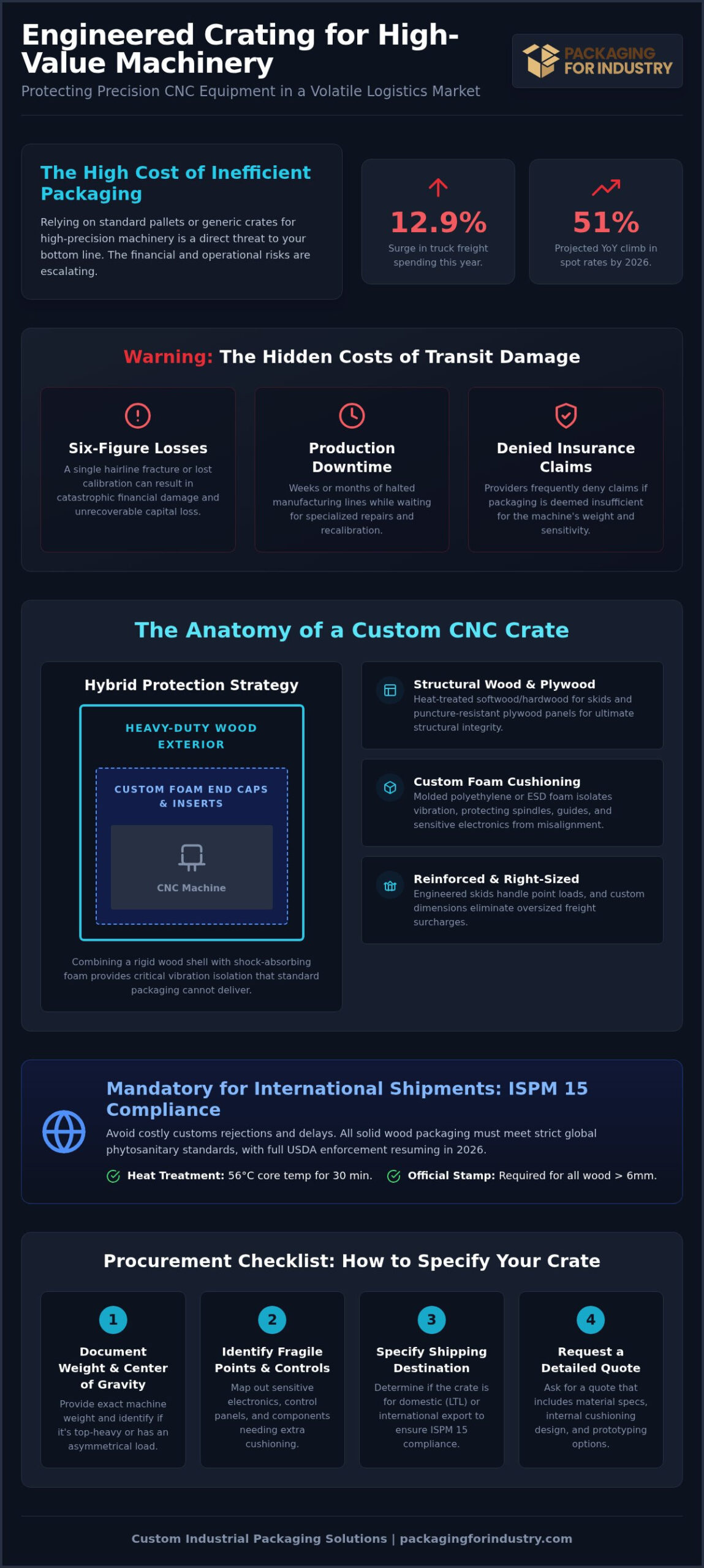
U.S. shippers are facing a 12.9% surge in truck freight spending this year, making inefficient packaging a liability your operations can no longer afford. When you’re moving high-precision 5-axis equipment or laser cutters, the margin for error is nonexistent. You already know that a single hairline fracture or lost calibration during transit results in six-figure losses and weeks of production downtime. Procuring custom crates for shipping CNC machines isn’t just about building a wooden box; it’s about engineering a system that survives a volatile 2026 logistics market where spot rates are projected to climb by 51% year-over-year.
This guide will show you how to specify custom-engineered crates that eliminate transit damage while keeping your shipping costs under control. We’ll break down the 2026 ISPM 15 hyphen requirements for international compliance and explain why a hybrid approach of structural wood and custom-molded foam is the best way to isolate vibration. From optimizing crate dimensions to avoid freight surcharges to ensuring predictable lead times for your facility, you’ll learn exactly how to protect your equipment and your bottom line.
Key Takeaways
- High-precision CNC machinery requires custom-engineered internal cushioning to prevent vibration-induced calibration loss and structural damage during transit.
- Specifying custom crates for shipping CNC machines with ISPM 15 heat-treatment compliance is mandatory for international delivery to avoid costly customs rejections in 2026.
- Right-sizing your crates through custom engineering helps lower packaging costs by eliminating excessive freight surcharges associated with oversized, one-size-fits-all containers.
- Successful procurement depends on documenting exact machine weight and fragile points before requesting a custom packaging quote that includes prototyping options.
- A hybrid protection strategy combining heavy-duty wood exteriors with custom foam end caps provides the vibration isolation that standard pallets cannot deliver.
Why Custom Crates for Shipping CNC Machines are Non-Negotiable
CNC machines are not just heavy equipment; they are high-precision instruments where a few microns of misalignment can result in a total loss of production capability. Relying on a standard pallet for these assets is a logistical liability. It provides no protection against lateral impacts or environmental hazards during long-haul transit. A professional shipping crate is designed as an extension of the machine’s own engineering, providing the structural rigidity needed to maintain alignment through every stage of the supply chain.
Procuring custom crates for shipping CNC machines ensures your logistics team accounts for the equipment’s unique center of gravity. Most CNC units are top-heavy or feature asymmetrical weight distributions that make them unstable. Without custom-engineered skids and internal blocking, these machines are prone to tipping during forklift maneuvers or sudden stops. Protecting sensitive electronics and fragile control panels requires a comprehensive solution that goes beyond a simple wooden shell.
The High Cost of Transit Damage
Repair bills for damaged spindles or cracked castings are only the beginning of the financial impact. The true cost lies in production downtime, which can halt entire manufacturing lines for weeks while waiting for specialized parts. Insurance providers frequently deny claims if they determine the packaging was insufficient for the machine’s weight or sensitivity. Using off-the-shelf shipping containers creates hidden costs through increased insurance premiums and the risk of unrecoverable capital losses that hit your bottom line directly.
Precision Calibration and Vibration Isolation
CNC spindles and linear guides require specialized blocking and bracing to prevent mechanical misalignment caused by road vibration. Shock-absorbing bases and custom foam inserts play a critical role in isolating the machine from the constant harmonic frequencies found in truck and ocean freight. This isolation is vital for maintaining the factory-set tolerances of your equipment. Beyond physical impacts, long-haul transit exposes equipment to moisture and rust. High-quality custom crates for shipping CNC machines incorporate vapor barrier bags and desiccant packs to guard against corrosion. This ensures the tool arrives in floor-ready condition without the need for extensive recalibration or rust removal.
Engineering Specifications for Heavy-Duty CNC Crates
Building effective custom crates for shipping CNC machines requires a material-first strategy that balances structural rigidity with weight efficiency. While heat-treated softwood is the industrial standard for its strength-to-weight ratio, hardwood is often necessary for the base skids of multi-ton machining centers. Plywood is frequently utilized for side panels to provide a puncture-resistant barrier against forklift tines. Every material choice impacts both the protection level and the final freight cost, making engineering precision a financial necessity.
Structural integrity depends on reinforced corners and heavy-duty skids that can withstand the rigors of LTL freight environments. A CNC machine’s weight creates extreme point loads rather than a distributed footprint. Skids must be engineered to bridge these loads across the container floor to prevent the crate from buckling. For complex setups, we integrate custom internal kitting to organize tool changers, bar feeders, and accessories within the same unit. This reduces the number of individual shipments and ensures all components arrive together. For high-value interface screens and sensitive controls, custom foam packaging provides the vibration damping that wood alone cannot offer. You can request a packaging quote to see how these engineering specs fit your specific machine model.
Wood Standards and ISPM 15 Compliance
International machinery exports require strict adherence to global phytosanitary standards. As of January 1, 2026, the USDA has resumed full enforcement of the ISPM 15 hyphen requirement. All solid wood packaging thicker than 6mm must be heat-treated to a core temperature of 56°C for a minimum of 30 minutes. PFI specializes in custom design packaging that ensures every export crate is stamped on at least two opposite sides with the official IPPC mark. Verifying these stamps before the unit reaches the port is the only way to avoid costly customs rejections and shipment delays.
Internal Protective Systems: Foam and Bracing
Securing the machine inside the crate involves more than just external walls. We use high-density polyethylene foam for high-load cushioning around the machine base to absorb road shocks. Sensitive CNC control boards and AI-native processors require anti-static (ESD) foam inserts to prevent discharge damage during handling. Blocking and bracing techniques are then used to bolt or strap the machine directly to the crate floor. This multi-layered approach ensures that even if the crate experiences a lateral impact, the internal components remain stationary and calibrated.
Comparing Crate Types: Export vs. Domestic Logistics
Selecting the right architecture for custom crates for shipping CNC machines depends primarily on the destination and the transit method. For domestic shipments within North America, open-slat crates provide a cost-effective solution. These designs prioritize visibility and airflow, allowing logistics teams to inspect the load without unboxing. However, if your equipment is bound for international ports, fully enclosed solid-wall crates are the gold standard. These units create a total physical barrier against the harsh conditions of ocean freight, including salt air and potential impact from adjacent cargo in a shared container.
Innovation in crate design has introduced hood-style options that significantly simplify the unboxing process. Instead of dismantling a traditional box piece by piece, the end-user removes the entire top and side assembly to reveal the machine already positioned on its base. This reduces the risk of accidental damage during the final rigging stage at the customer’s facility. When evaluating the ROI of your packaging, consider whether a reusable design is appropriate. While one-way crates are suitable for final sales, manufacturers moving precision tools between their own regional hubs often find that durable, reusable custom crates for shipping CNC machines pay for themselves within three to four transit cycles.
Environmental Protection Layers
Machinery crossing different climate zones is susceptible to condensation and oxidation. VCI (Vapor Corrosion Inhibitor) liners are a standard industrial solution; they release protective vapors that prevent rust on bare metal surfaces without requiring messy grease or oils. For long-term storage or trans-Pacific voyages, vacuum-sealed barrier bags provide a more robust hermetic seal. We also integrate desiccants to manage internal humidity levels. Every export-bound crate must also comply with U.S. regulations regarding Wood Packaging Materials to ensure smooth passage through international customs checkpoints.
Load Stabilization and Rigging Requirements
The structural integrity of a crate is only as strong as its base. Engineering teams must calculate the dynamic load capacity to ensure the crate survives the G-forces of sudden braking or turbulent seas. Safe handling requires integrated forklift pockets and clearly marked lift points for crane rigging. We utilize heavy-duty corner and edge protection to prevent the crate structure from collapsing or splintering when high-tension tie-down straps are applied. This reinforcement ensures the crate remains a rigid protective shell throughout the entire logistical journey.
Procurement Guide: How to Order Custom CNC Crates
Efficient procurement of custom crates for shipping CNC machines involves more than just selecting a vendor. It requires a structured process that aligns packaging engineering with your specific production schedule. By following a standardized workflow, you can eliminate the guesswork that often leads to shipping delays or unexpected freight costs.
- Step 1: Technical Documentation. Record the machine’s exact footprint, overall height, and total weight. Identify fragile components like spindles, control panels, and external cabling that require specialized blocking or foam isolation.
- Step 2: Quoting and Prototyping. Submit your specifications to a supplier that offers prototyping. Verifying the fit through a physical or digital prototype prevents costly manufacturing errors in the final crate run.
- Step 3: Logistics Integration. Evaluate the manufacturer’s ability to provide just-in-time inventory management. This ensures that crates arrive exactly when your equipment is ready for rigging, freeing up valuable warehouse floor space.
- Step 4: Design Finalization. Schedule on-site measurements if the machine has an irregular center of gravity or complex geometry. CAD-based design reviews allow for precise adjustments to internal bracing before production begins.
Selecting a Local Southern California Supplier
For manufacturers operating in the Orange County service area, local production offers a distinct competitive edge. Sourcing from an Anaheim-based supplier eliminates the long lead times and high shipping costs associated with national catalog distributors. Local next-day delivery provides the agility needed for urgent aerospace or medical equipment shipments. This proximity also allows for immediate on-site consultations, ensuring that your custom packaging is tailored to your specific rigging and loading requirements.
Cost Reduction Strategies for Bulk Orders
Lowering your total cost of ownership starts with right-sizing. Carriers utilize dimensional weight formulas to calculate freight rates; oversized crates trigger heavy surcharges. Custom engineering ensures the crate is no larger than necessary while still maintaining structural integrity. Implementing vendor managed inventory (VMI) further optimizes your budget by allowing the supplier to monitor and replenish your stock levels automatically. You can also consolidate your procurement by sourcing crates, custom foam, and heavy-duty stretch film from a single partner to reduce administrative friction.
The PFI Advantage: Custom CNC Packaging Solutions
Choosing Packaging For Industry (PFI) means moving away from the limitations of catalog-style packaging. Standard suppliers often provide one-size-fits-all options that fail to address the specific center of gravity or fragile interface points of modern CNC centers. We focus on industrial-grade protection that prioritizes the structural needs of the manufacturing and aerospace sectors. Our engineering team understands that a 5-axis machine requires a different load-bearing strategy than a vertical mill, and we design every crate to reflect that reality.
We provide free prototyping and CAD/CAM support to ensure a perfect fit for every CNC model before production starts. This proactive approach eliminates the risk of on-site rigging failures or the need for last-minute modifications. While we maintain nationwide shipping capabilities, our deep local expertise in Southern California allows us to respond with the speed required by high-demand production environments. We don’t just sell boxes; we provide an integrated system of protection that optimizes your logistical flow.
Integrated Foam and Crate Engineering
Our solution is fundamentally a hybrid one. We combine heavy-duty wood exteriors with precision-cut foam packaging to provide both structural rigidity and vibration isolation. This integration is essential for protecting high-value aerospace components where even microscopic surface scratches can lead to part rejection. To further streamline your operations, we offer custom kitting services. We can organize machine manuals, specialized tools, and ancillary parts within the same unit, ensuring your customer receives everything they need for immediate setup. This comprehensive oversight has helped our partners significantly reduce damage rates across complex supply chains.
Request Your Custom Crating Quote Today
PFI simplifies the purchasing process for operations managers by acting as a single-source partner for all industrial packaging needs. Whether you’re moving a single prototype or managing recurring machinery lines, we provide the technical expertise and logistical support to protect your assets. Our Anaheim headquarters serves as the hub for our Southern California service centers, allowing us to offer local next-day delivery and on-site consultations. You can Request a Packaging Quote today to compare our pricing and see how our custom crates for shipping CNC machines can lower your total cost of ownership.
Secure Your Machining Assets for 2026
Protecting capital equipment requires more than a standard wooden box. As the 2026 logistics market becomes increasingly volatile, the intersection of engineering and economics is where your operations will find the most value. Prioritizing vibration isolation through custom foam and ensuring strict ISPM 15 compliance eliminates the threat of customs rejections and mechanical misalignment. These proactive steps turn your packaging from a simple expense into a strategic asset that protects your bottom line.
PFI provides the technical oversight needed to secure your high-precision tools. We specialize in aerospace and industrial equipment, offering free prototyping for all custom designs to ensure a perfect fit before production begins. For manufacturers in Southern California, our local next-day delivery and Anaheim-based support provide the agility needed to meet tight production deadlines. Investing in custom crates for shipping CNC machines is the most effective way to eliminate transit damage and lower your long-term packaging costs.
Your high-precision assets deserve industrial-grade protection. We look forward to helping you streamline your next shipment and ensuring your equipment arrives ready for the floor.
Frequently Asked Questions
What is the best wood for shipping heavy CNC machines?
Hardwood is the preferred choice for the base skids of multi-ton CNC machines due to its superior load-bearing capacity. For the crate walls and framing, we typically use heat-treated softwood or plywood to balance structural integrity with weight efficiency. This combination ensures the unit survives the high-pressure point loads of heavy machinery while remaining light enough to minimize total freight costs for domestic or international transport.
How do I ensure my custom crate is ISPM 15 compliant for export?
You must ensure all wood packaging thicker than 6mm is heat-treated to a core temperature of 56°C for 30 minutes. Every export crate must feature the official IPPC stamp on at least two opposite sides. PFI manages this entire process, verifying the 2026 hyphen requirements to prevent customs rejections. Our custom crates for shipping CNC machines are built exclusively with HT-certified lumber to ensure smooth international passage.
Can PFI provide custom foam inserts for my CNC machine’s control panel?
Yes, we specialize in engineering custom foam inserts specifically for delicate interface screens and control boards. We often utilize anti-static (ESD) foam to prevent electrical discharge during handling and transit. By combining precision-cut polyethylene foam with a rigid outer shell, we provide a multi-layered defense system that isolates high-value electronics from the harmonic vibrations common in long-haul truck and ocean freight environments.
What is the lead time for a custom-engineered shipping crate in Southern California?
Our proximity to manufacturers in Anaheim and Orange County allows us to offer local next-day delivery for many established packaging programs. For new custom-engineered designs, the timeline depends on the complexity of the machine’s geometry and the prototyping phase. We prioritize agile production to support urgent aerospace or medical shipments, helping you avoid the long lead times typical of large national catalog suppliers.
How do custom crates help reduce UPS or FedEx freight surcharges?
Custom crates reduce freight surcharges by eliminating the dimensional weight penalties applied to oversized packaging. Standard crates often include unnecessary void space that carriers use to inflate shipping rates. By engineering a crate that tightly conforms to your machine’s actual footprint, we minimize the total volume. This precise sizing ensures you only pay for the space your equipment actually occupies during transit, lowering your overall logistics spend.
Does PFI offer on-site measurements for large machinery crating?
Yes, we provide on-site measurements for large or irregularly shaped machinery throughout Southern California. This service is critical for identifying the machine’s exact center of gravity and fragile interface points. Our engineers use these dimensions to develop CAD/CAM designs and physical prototypes. This ensures a perfect fit, preventing the equipment from shifting or tipping during complex rigging and loading procedures at your facility.
What is the difference between a skid and a fully enclosed shipping crate?
A skid is a heavy-duty wooden base designed to bridge the machine’s weight across a transport floor, offering no lateral protection. A fully enclosed shipping crate adds walls and a lid to provide a complete physical barrier against impacts, dust, and moisture. While skids are suitable for short-distance rigging, enclosed custom crates for shipping CNC machines are the standard for long-distance LTL or ocean freight.
How does a Vendor Managed Inventory (VMI) program work for recurring crate needs?
Our VMI program involves scheduled reviews of your packaging stock to ensure production never stops due to shortages. We monitor your actual usage and replenish custom crates or foam inserts at agreed-upon intervals. This managed stocking program frees up your warehouse floor space and capital. You only store what you need for immediate production while we manage the long-term supply and lead times for your facility.