
A single damaged surgical tool doesn’t just represent a lost sale; it can halt a scheduled procedure and damage your reputation with a hospital system permanently. You’re likely already aware that relying on oversized catalog boxes and generic bubble wrap is a recipe for both high transit damage and inflated shipping costs. Finding the right protective packaging for medical instruments Los Angeles manufacturers need shouldn’t feel like a compromise between safety and your bottom line. When your devices are high-value and your margins are tight, generic solutions from national catalogs often fail to provide the precision required for specialized medical logistics.
Discover how to secure your high-value medical devices with custom-engineered packaging solutions specifically designed for the Southern California manufacturing landscape. This 2026 guide explores how transitioning from bulky stock inventory to optimized, local designs can lead to zero-damage shipments and lower per-unit costs. We’ll preview the latest in specialized foam inserts, vendor-managed inventory programs, and the advantages of reliable next-day delivery in the Los Angeles area. By the end of this article, you’ll have a clear roadmap for streamlining your operations while ensuring your sensitive instruments arrive in perfect condition every time.
Key Takeaways
- Identify the material differences between Polyethylene and Polyurethane foam to select the optimal cushioning for precision surgical tools.
- Learn how to lower packaging costs by replacing generic stock boxes with custom-engineered corrugated solutions that reduce dimensional weight and transit damage.
- Streamline your operations with Vendor Managed Inventory (VMI) and local next-day delivery to eliminate warehouse clutter and ensure supply reliability.
- Secure the protective packaging for medical instruments Los Angeles hubs require, including ESD protection and custom wood crating for large-scale diagnostic imaging systems.
- Leverage free prototyping and CAD/CAM support to validate your packaging design, ensuring a precise fit for high-value devices before placing a bulk order.
The Critical Role of Protective Packaging in the Los Angeles Medical Sector
Los Angeles County stands as a primary engine for global medical innovation. With a dense network of manufacturers and researchers, the region manages a massive volume of sensitive diagnostic equipment and surgical tools. However, the logistical environment here is demanding. Shipments moving through the Port of Los Angeles or across the congested regional freight networks face constant vibration, temperature fluctuations, and mechanical shocks. Standard off-the-shelf corrugated boxes frequently fail to provide the structural integrity required for these precision devices. High-performance protective packaging for medical instruments Los Angeles manufacturers rely on requires an engineered approach that considers the entire transit cycle from the assembly line to the operating room.
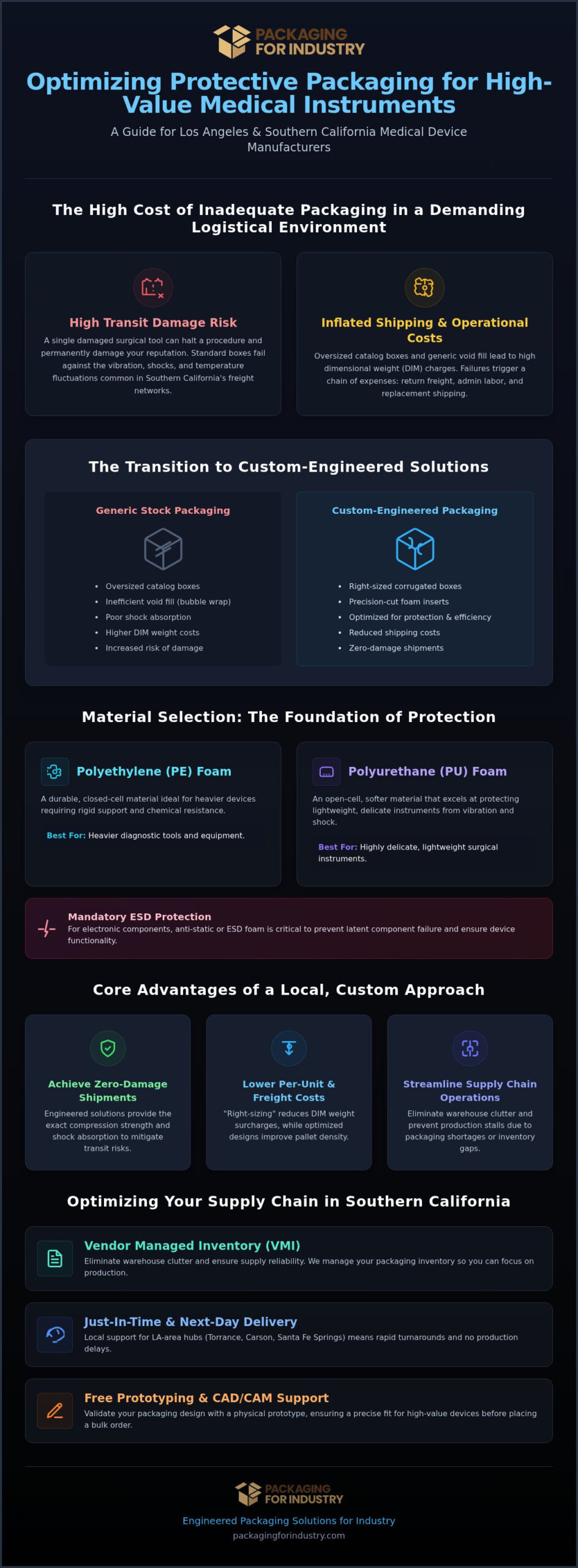
Integrating Medical device packaging standards into your supply chain isn’t just about compliance; it’s about protecting your capital. Precision instruments often feature delicate calibrations that can be knocked out of alignment by minor impacts. When standard packaging fails, the result is more than just a broken box. It’s a compromised instrument that requires expensive recalibration or total replacement. This is why a custom-engineered solution is necessary. It provides the exact compression strength and shock absorption needed to mitigate the risks inherent in Southern California’s complex shipping lanes.
Meeting the Standards of LA Medical Hubs
Manufacturers located in industrial centers like Torrance and Carson face specific logistical pressures. These hubs require rapid turnaround times and high-density storage solutions to remain competitive. Working with a local Southern California supplier allows for shorter lead times and reduced shipping costs compared to national catalog vendors. For distributors in Santa Fe Springs, proximity to the supplier means that custom sizes and emergency restocks are available via next-day delivery. This localized support ensures that production lines don’t stall due to packaging shortages or inventory gaps.
The Economic Impact of Packaging Failures
The true cost of inadequate packaging extends far beyond the price of the materials. Every damaged shipment triggers a chain of expenses including return freight, administrative labor, and expedited replacement shipping. Beyond these direct costs, frequent damage claims erode your brand reputation with hospital procurement departments. Custom-engineered protective packaging for medical instruments Los Angeles specialists provide is a strategic investment in your bottom line. Optimized designs tackle these fiscal drains by focusing on “right-sizing.” By reducing the outer dimensions of a carton while maintaining internal protection, you can significantly lower FedEx and UPS dimensional weight surcharges. Improving pallet density through custom corrugated boxes ensures you move more product for every dollar spent on freight.
Selecting Materials: Custom Foam and Corrugated Solutions
Material selection is the foundation of any successful logistical strategy. For medical manufacturers, the choice between Polyethylene (PE) and Polyurethane (PU) foam depends entirely on the instrument’s weight and fragility. PE foam is a durable, closed-cell material ideal for heavier diagnostic tools that require rigid support and chemical resistance. Conversely, PU foam is an open-cell, softer material that excels at protecting lightweight, highly delicate surgical instruments from vibration. For electronic components, using anti-static or ESD foam is mandatory to prevent latent component failure. Adhering to the FDA Quality System Regulation means every material choice must be documented and validated to ensure it maintains the device’s functionality throughout the supply chain.
Engineering Custom Foam Inserts
Standard foam planks often require manual cutting in the warehouse, which leads to inconsistent protection and wasted labor hours. Utilizing custom foam packaging allows for repeatable, precise protection through professional die-cutting. This process creates a perfect cavity for complex instrument geometries, ensuring zero internal movement during transit. For larger diagnostic gear, foam end caps suspend the equipment in the center of the shipper. This design creates a critical buffer zone that absorbs impact energy before it ever reaches the sensitive internal components of the device.
Corrugated Box Specifications for Medical Gear
The outer container must be as robust as the internal cushioning to ensure a successful delivery. Heavy diagnostic machinery often requires heavy-duty double-wall or triple-wall custom corrugated boxes to prevent structural failure during high-stacking in freight trailers. While standard RSC boxes work for bulk supplies, die-cut corrugated styles offer more structural versatility for uniquely shaped surgical kits. If you’re shipping internationally from the Port of Los Angeles, specify weather-resistant corrugated materials. These specialized boards protect against the high humidity levels common in sea freight and international regional transit.
When you integrate engineered foam with the right corrugated grade, you create a total solution for protective packaging for medical instruments Los Angeles manufacturers can rely on for high-value exports. If you’re looking to optimize your current setup and eliminate shipping damage, you can request a packaging quote to see how custom sizing reduces material waste and lowers your per-unit costs.
Compliance and Security: Custom Crating and ESD Protection
Large-scale medical imaging systems and diagnostic gear represent a massive capital investment for any healthcare facility. Moving these units across the Los Angeles freight network requires more than just a heavy-duty box. Custom-engineered wood crates provide the structural rigidity needed to prevent frame warping or internal component shifting during transit. For manufacturers exporting from Southern California, all wood packaging must meet ISPM-15 international standards. This requires heat-treated pallets and crates to prevent the spread of pests, ensuring your shipments aren’t delayed or quarantined at international ports.
Stabilizing these heavy loads also requires high-performance corner and edge protection. These components distribute the tension of stretch film and prevent impact damage during forklift handling. When shipping high-value diagnostic systems, the goal is to create a rigid, unified load that resists the lateral forces encountered in sea and air freight. This level of security is a standard part of the protective packaging for medical instruments Los Angeles manufacturers use to safeguard their most expensive assets.
Advanced Crating for High-Value Instruments
Engineering a high-performance crate involves more than just lumber. Foam-lined crates combine the external strength of wood with internal cushioning to absorb high-frequency vibrations that can knock sensitive calibrations out of alignment. For companies that manage recurring equipment servicing or rentals, reusable packaging systems offer a significant long-term ROI. These systems use durable fasteners and reinforced structures designed for multiple transit cycles. If your equipment has unique dimensions or weight distributions, you can request a packaging quote for bespoke oversized crates tailored to your specific hardware.
ESD Shielding and Moisture Barriers
Sensitive medical electronics require protection from invisible threats like electrostatic discharge (ESD) and humidity. In sterile medical environments, packaging must prevent contamination while shielding printed circuit boards from latent electronic failures. Static shielding bags create a Faraday cage effect, protecting components from external charges during handling. For instruments stored long-term or shipped via sea freight, moisture barrier bags are essential. These bags, often combined with desiccant packs, maintain a dry internal environment to prevent corrosion. Integrating ESD-safe cushioning ensures that your protective packaging for medical instruments Los Angeles strategy addresses both mechanical shock and electrical sensitivity. This holistic approach is critical for maintaining the integrity of diagnostic sensors and specialized control modules that are susceptible to even minor static events.
Optimizing the Supply Chain: VMI and Just-In-Time Delivery
Managing a medical manufacturing facility in Los Angeles requires precise coordination of both raw materials and finished goods. Bulky inventory like double-wall corrugated boxes and foam planks consumes valuable warehouse square footage that’s better utilized for production. The protective packaging for medical instruments Los Angeles companies rely on is only effective if it’s available exactly when the assembly line needs it. Vendor Managed Inventory (VMI) solves this logistical bottleneck by transferring the responsibility of stock levels to the supplier. Instead of your team manually tracking box counts, the supplier monitors usage and replenishes stock automatically. This proactive approach reduces purchasing administrative costs by eliminating constant reordering and the stress of emergency rush shipments.
The Benefits of Packaging VMI
Implementing Vendor Managed Inventory is a cornerstone of lean manufacturing for the medical sector. It prevents critical stockouts of custom-engineered foam inserts and specialized shippers that could otherwise halt a high-volume production line. From a fiscal perspective, VMI significantly improves cash flow. You don’t have to tie up capital in months of safety stock; instead, you only pay for the packaging you actually use. This system ensures that every surgical kit or diagnostic tool has its dedicated protection ready for immediate kitting and dispatch without wasting warehouse space on bulky inventory.
Local Logistics and Next-Day Service
The geographical advantage of PFI’s Anaheim headquarters provides a strategic edge for Los Angeles County manufacturers. Proximity to major medical hubs allows for reliable, local next-day delivery that national catalog vendors can’t match. This localized support is essential for Just-In-Time inventory management, where packaging arrives in sync with your specific production schedules. Whether your facility is in Torrance, Carson, or Santa Fe Springs, having a Southern California partner means your supply chain is resilient against the freight delays common in national networks. For organizations with distributed facilities, these local efficiencies are backed by nationwide shipping capabilities, ensuring consistency across all your medical manufacturing sites.
Why Medical Manufacturers Choose Packaging For Industry (PFI)
Selecting the right partner for protective packaging for medical instruments Los Angeles hubs require is a decision that impacts your entire operational efficiency. National catalog suppliers offer convenience but often lack the technical depth to address specialized medical logistics. PFI operates as a dedicated industrial consultant, providing a cost-saving alternative through custom-engineered solutions rather than generic stock items. Our focus remains on lowering your total cost of ownership by optimizing every component of your packaging system, from material selection to final delivery.
The PFI Engineering Advantage
Precision is the hallmark of our custom design packaging process. We leverage CAD/CAM support and free prototyping to ensure a perfect fit for your instruments before you commit to a bulk production run. This engineering-first approach allows us to perform thorough packaging reviews that identify hidden shipping costs, such as excessive dimensional weight or redundant materials. For manufacturers of sensitive medical electronics, these custom-tailored designs have proven effective in reducing transit damage by providing exact shock absorption and vibration dampening that stock boxes simply cannot provide.
Streamlining Your Procurement
Managing a fragmented supply chain with multiple vendors for boxes, foam, and crates creates unnecessary administrative friction. PFI serves as a single, reliable Southern California partner that consolidates these needs into one streamlined workflow. We simplify complex orders through packaging kitting and assembly, delivering ready-to-use sets that include the outer shipper, internal cushioning, and any required labels or ribbons. This integration ensures that your protective packaging for medical instruments Los Angeles operations remain lean and responsive to market demands.
Our dedicated account management team focuses on long-term reliability rather than transactional sales. We understand the specific pressures of the Los Angeles manufacturing landscape and provide the proactive problem-solving needed to maintain your logistical flow. You can reach out to PFI for a custom medical packaging analysis to evaluate your current setup and discover how custom engineering can improve your bottom line while securing your high-value assets.
Secure Your Medical Supply Chain for 2026
Transitioning from generic catalog supplies to engineered solutions is a strategic necessity for high-value device manufacturers. By integrating custom die-cut foam with heavy-duty corrugated boxes, you effectively eliminate transit damage while lowering your total cost of ownership. Our review of the protective packaging for medical instruments Los Angeles landscape shows that proximity to a specialized supplier remains the most reliable way to maintain lean inventory through VMI and JIT programs. PFI brings deep expertise in medical, aerospace, and electronics packaging to every project, ensuring your sensitive hardware meets all compliance and safety standards.
Utilizing our free prototyping and CAD design services allows you to validate every dimension before production begins. This methodical approach removes the guesswork from your logistics and guarantees a precise fit for complex surgical kits and diagnostic systems. With our local Southern California headquarters, we provide the steady partnership and next-day delivery needed to navigate the region’s complex freight networks and international export requirements.
We’re ready to help you optimize your warehouse space and protect your reputation with every shipment. Let’s build a more resilient and cost-effective packaging system for your business today.
Frequently Asked Questions
What is the best foam for protecting sensitive medical instruments?
Selection depends on the instrument’s weight and fragility. Polyethylene (PE) foam provides rigid structural support for heavier diagnostic tools, while Polyurethane (PU) foam offers soft cushioning for delicate surgical kits. We also provide anti-static versions of these foams for electronic components. By matching the foam density to your product’s fragility, we ensure maximum shock absorption during transit through Southern California’s freight networks.
Do you provide custom-sized corrugated boxes for medical devices in Los Angeles?
We manufacture a full range of custom corrugated boxes, including RSC styles and complex die-cut designs, from our Anaheim headquarters. These aren’t limited to standard sizes found in catalogs. We specialize in heavy-duty double-wall and triple-wall boxes for large medical machinery. Local manufacturers can specify exact internal dimensions to reduce dimensional weight surcharges and eliminate the need for excessive void fill materials.
Can PFI help reduce my shipping damage rates for high-value medical gear?
Yes, our engineering team performs comprehensive packaging reviews to identify the root causes of transit damage. We replace generic off-the-shelf supplies with engineered protective packaging for medical instruments Los Angeles companies rely on for high-value shipments. By creating custom foam inserts and right-sized containers, we stabilize products and absorb impact energy, significantly lowering your return rates and protecting your brand reputation with healthcare providers.
Do you offer ESD or anti-static packaging for medical electronics?
We offer a complete suite of ESD and cleanroom-ready packaging materials. This includes static shielding bags, moisture barrier bags, and anti-static foam inserts specifically designed for medical electronics. These materials prevent latent component failures caused by electrostatic discharge during handling and shipping. We also provide ESD-safe cushioning and labels to ensure your sensitive printed circuit boards and diagnostic sensors remain fully functional upon delivery.
How does your Vendor Managed Inventory (VMI) program work for manufacturers?
Our Vendor Managed Inventory (VMI) program involves scheduled on-site reviews of your packaging stock levels. We monitor your actual usage of custom boxes, foam, and stretch film, then replenish items automatically based on agreed-upon minimums and maximums. This proactive system prevents production stops caused by shortages and frees up valuable warehouse floor space. It simplifies your procurement process by eliminating the need for constant manual reordering.
Is next-day delivery available for medical packaging supplies in Los Angeles County?
Local next-day delivery is a standard service for our customers throughout Los Angeles County and the greater Southern California region. Because we operate from our Anaheim headquarters, we aren’t subject to the long lead times of national catalog suppliers. This proximity allows us to support Just-In-Time (JIT) production schedules in hubs like Torrance, Carson, and Santa Fe Springs, ensuring your packaging arrives exactly when your team needs it.
Can I get a prototype of a custom foam insert before placing a bulk order?
We provide free prototyping and CAD/CAM support to ensure your custom design fits perfectly before production. Our engineers create physical samples of die-cut foam inserts or corrugated partitions, allowing you to test the assembly with your actual instruments. This validation step is a core part of our protective packaging for medical instruments Los Angeles service, helping you avoid costly design errors and ensuring total product protection from day one.
Are your wooden crates compliant with international export standards for medical equipment?
All our custom wood crates and pallets are fully compliant with ISPM-15 international export standards. We use heat-treated lumber to prevent pest infestation, which is mandatory for medical equipment shipping through the Port of Los Angeles or international airports. Each crate is stamped with the required certification mark, ensuring your high-value diagnostic systems pass through customs without being quarantined or delayed at international borders.