
Are you tired of paying premium freight rates just to ship air? For industrial operations dealing with bulky items like triple-wall corrugated boxes and custom foam inserts, the cost of moving empty packaging often rivals the cost of the materials themselves. With West Coast diesel prices averaging $6.497 per gallon and carrier fuel surcharges hovering near 25 percent, understanding how to reduce inbound freight costs on packaging isn’t just a logistics goal; it’s a financial necessity. You’ve likely seen your LTL invoices climb as carriers strictly enforce the 139 dimensional weight divisor, turning lightweight protective materials into expensive, high-volume liabilities.
We understand that balancing inventory levels against shipping minimums feels like a constant losing battle. You want to avoid stockouts without turning your warehouse into a graveyard for over-ordered pallets. This guide will show you exactly how to eliminate hidden surcharges and lower your total landed cost through smarter procurement and engineering. We’ll explore how localized supply chains, custom CAD design, and Vendor Managed Inventory (VMI) programs can shrink your warehouse footprint while ensuring your production line never stops.
Key Takeaways
- Learn how to reduce inbound freight costs on packaging by prioritizing material density and localized sourcing to minimize transit mileage.
- Discover how custom CAD design increases pallet counts by engineering corrugated boxes and foam inserts that fold flatter or nest more efficiently.
- See how Vendor Managed Inventory (VMI) eliminates expensive emergency shipments and consolidates multiple items into single, streamlined deliveries.
- Gain a practical framework for conducting a freight audit to identify the specific bulky items that are inflating your total landed costs.
What is Inbound Freight and Why is it Killing Your Packaging Budget?
Inbound freight refers to the specific cost of transporting packaging materials from your supplier’s dock to your facility. While most procurement managers focus on the per-unit price of a corrugated box or foam insert, the logistics of moving these items often consume a disproportionate slice of the budget. Industrial packaging is inherently inefficient to transport. Items like triple-wall boxes and polyethylene foam are bulky but lightweight, meaning you’re essentially paying to ship air. This is the “bulky item” trap. If you’re looking for how to reduce inbound freight costs on packaging, you must first recognize that the price listed in a catalog is just a starting point.
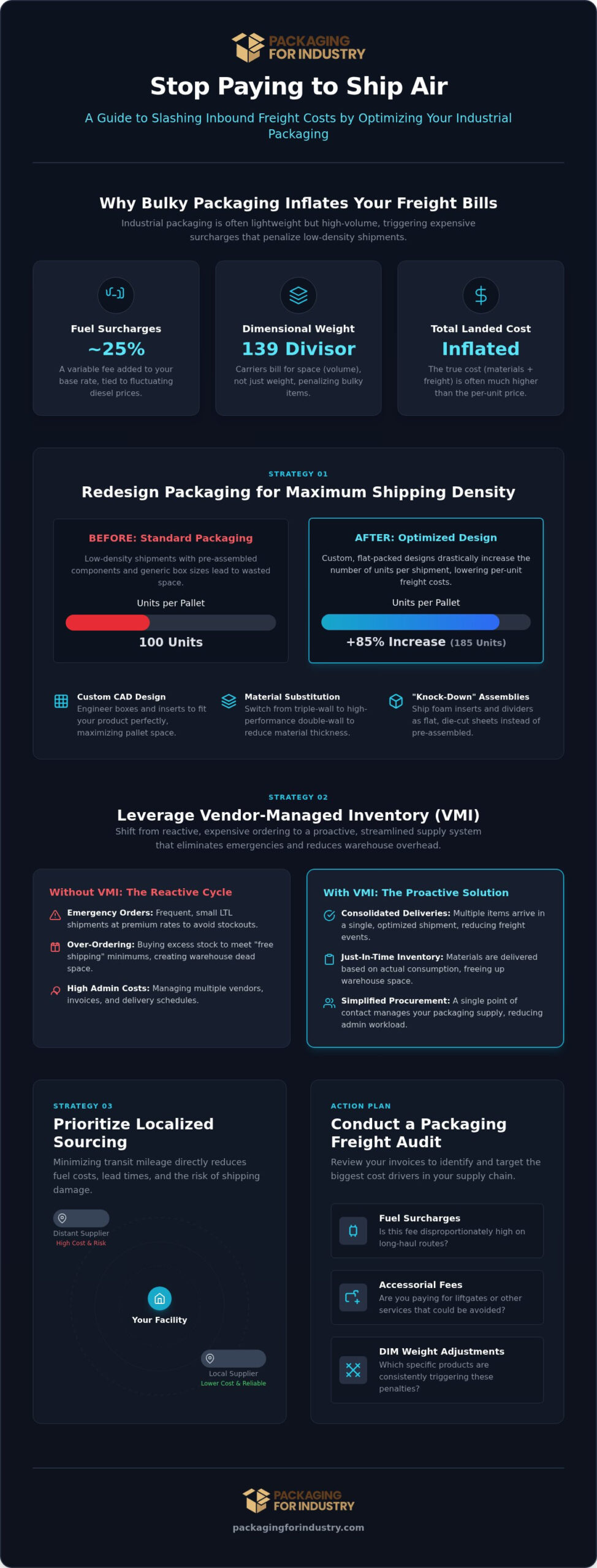
Carriers prioritize density. When your shipment lacks it, they apply Less-Than-Truckload (LTL) rates that penalize high-volume, low-weight freight. Combined with fuel surcharges, which have remained near 25 percent throughout 2026, these hidden expenses can inflate your total landed cost by double digits. Restructuring your procurement strategy is the first step in learning how to reduce inbound freight costs on packaging effectively.
The True Cost of Bulk Stock Orders
Many catalog suppliers offer “free shipping” thresholds. While this sounds like a saving, it often forces operations to over-order materials they won’t use for months. This creates “dead space” in your warehouse, where expensive square footage is dedicated to storing empty boxes instead of finished goods. Landed cost represents the total expense of a product from the point of manufacture to the moment it arrives at your facility’s receiving dock. Over-ordering to save on freight simply shifts the cost from the logistics budget to the facility’s overhead. A more proactive approach is Vendor Managed Inventory (VMI), which balances delivery frequency with actual consumption to keep your footprint small.
Identifying Freight Surcharges in Your Current Invoices
To find opportunities for Packaging Cost Savings, you must audit your current freight invoices. Common line items often include:
- Fuel Surcharges: Variable fees based on current diesel prices, which are currently averaging $6.497 on the West Coast.
- Liftgate and Residential Fees: Charges for specialized delivery equipment or non-industrial zones.
- Dimensional Weight (DIM) Adjustments: Costs added when a package’s volume exceeds its actual weight.
The DIM divisor of 139 means carriers bill you for the space your bulky foam or boxes occupy, not just their weight. Understanding these metrics is vital for optimizing your supply chain, similar to how Reverse logistics optimizes the return flow of goods for maximum efficiency. By identifying these specific surcharges, you can begin to engineer your packaging for better density and lower costs.
Optimizing Packaging Design to Increase Inbound Shipping Density
Standard stock boxes are often the primary culprit behind bloated freight bills. Because these containers aren’t designed for your specific product dimensions or pallet configurations, they frequently result in “shipping air.” Engineering your materials for maximum density is a core strategy for how to reduce inbound freight costs on packaging. When you move away from one-size-fits-all solutions, you can increase the number of units per pallet, which lowers the freight cost per unit before the materials even reach your assembly line.
Material substitution plays a critical role in this optimization process. Many industrial operations rely on heavy-duty triple-wall corrugated because it’s the traditional choice for protection. However, switching to high-performance, engineered double-wall can often provide equivalent stacking strength while significantly reducing the material’s thickness. This reduction in volume allows for more flat-packed boxes per pallet. Similarly, shipping pre-assembled polyethylene foam inserts is inherently inefficient. By designing die-cut foam components that ship in high-density flat sheets and utilize “knock-down” assembly, you can drastically improve the density of your inbound shipments.
Maximizing Pallet Utilization for Inbound Shipments
Standard 48×40 pallets provide a fixed footprint that must be utilized with precision. Custom box dimensions should be calculated to eliminate overhang, as even an inch of wasted space prevents the carrier from maximizing truck capacity. We often recommend integrating corner and edge protection into your inbound shipment specifications. These reinforcements allow for higher stacking of corrugated bundles without risking crush damage to the bottom layers. By safely adding two or three extra tiers to a pallet, you can often fit the same amount of inventory into fewer truckloads, which is a practical way to manage how to reduce inbound freight costs on packaging.
The Role of Prototyping in Freight Reduction
Effective logistics starts in the design lab. Utilizing Custom Design Packaging services allows you to leverage CAD/CAM support to visualize shipping density before a single sheet of material is cut. Our engineers use digital prototyping to simulate how custom designs will nest together. For example, an aerospace client recently transitioned from pre-assembled foam kits to nested, die-cut sheets. This change allowed them to fit 40 percent more units on a single inbound pallet, directly lowering their landed cost. If you aren’t sure if your current designs are optimized for density, you can request a packaging quote for custom-engineered alternatives that prioritize shipping efficiency.
Leveraging VMI to Eliminate Emergency Freight and Over-Ordering
If you’ve optimized your box dimensions but still see high shipping line items, the issue likely lies in your replenishment frequency. Many operations fall into the trap of ordering only when stock is critical, which leads to emergency freight charges that can double the total cost of materials. Implementing a Vendor Managed Inventory (VMI) program is a proactive strategy to stabilize these costs. By allowing PFI to monitor your usage levels, we can consolidate multiple items like corrugated boxes, protective foam, and stretch film into a single, efficient delivery. This consolidation is a primary method for how to reduce inbound freight costs on packaging because it replaces multiple high-rate LTL shipments with one streamlined truckload.
A common misconception is that you must purchase a year’s worth of supplies to secure bulk shipping rates. This “Just-in-Case” mentality ties up capital and consumes valuable floor space. VMI allows you to access bulk-tier pricing and lower freight rates through consolidated local deliveries while only keeping a few days of stock on-site. When you compare packaging pricing between a catalog supplier and a VMI partner, the difference in freight often reveals the true value of a managed supply chain. It’s a reliable way to manage how to reduce inbound freight costs on packaging without sacrificing liquidity or production uptime.
The Mechanics of a Packaging VMI Program
A successful VMI program relies on regular usage reviews to ensure replenishment matches your actual production needs. Whether it’s weekly or bi-weekly, our team monitors your inventory levels and triggers shipments before you reach a critical low. We often incorporate kitting into these managed programs, where we pre-assemble custom foam inserts and corrugated boxes into ready-to-use sets. This service reduces handling time at your facility and ensures that all components of a protective system arrive in a single, high-density inbound stream. By removing the “panic order” from your workflow, you eliminate the premium freight rates that typically accompany last-minute requests.
Freeing Up Warehouse Space for Production
Transitioning from “Just-in-Case” to Just-In-Time inventory management offers a significant economic benefit. Every square foot of your warehouse used to store empty boxes is space that isn’t being used for manufacturing or shipping finished goods. VMI acts as a strategic buffer against supply chain disruptions by maintaining safety stock at our facility rather than yours. This shift reduces your warehouse footprint and allows you to use your floor space for high-value operations. If you’re ready to see how a managed program can lower packaging costs, you can request a packaging quote to evaluate your current inventory logistics.
Strategic Supplier Selection: The Local Advantage in Southern California
Logistics costs are heavily influenced by the physical distance between your supplier’s dock and your receiving bay. When you’re evaluating how to reduce inbound freight costs on packaging, the geographical location of your partner is often the most significant factor. National catalog suppliers often ship from centralized hubs located hundreds of miles away, which subjects your orders to volatile long-haul freight rates and high fuel surcharges. By choosing a local partner in Anaheim or Orange County, you effectively eliminate the “miles traveled” component of your freight bill. PFI leverages a local fleet to provide next-day delivery across Los Angeles and the Inland Empire, ensuring your supply chain remains agile without the premium cost of long-distance transport.
Bypassing the middleman is another critical step in lowering your landed costs. Many online packaging retailers act as resellers, adding a layer of markup and extra handling to every order. Buying direct from a local manufacturer and distributor allows you to capture these savings while maintaining a direct line to the engineering team. While we provide nationwide support for multi-location companies, our core strength lies in our ability to serve regional hubs with the efficiency of a local specialist. This proximity doesn’t just lower costs; it also reduces the risk of transit damage that frequently occurs during multiple transfers in a national LTL network.
Serving the Southern California Industrial Corridor
Our delivery routes are optimized for the specific needs of manufacturers in Irvine, Santa Fe Springs, and Carson. Local supply chains are inherently more sustainable because they require significantly less fuel for transport. By reducing the carbon footprint of your inbound logistics, you meet corporate sustainability goals while simultaneously protecting your bottom line. Short-range transport also means we can offer more flexible delivery windows, which is essential for operations running lean production schedules that can’t afford a single day of downtime.
Comparing PFI to Large National Catalog Suppliers
Large national suppliers often advertise “free shipping” to attract buyers, but in the industrial sector, these costs are almost always baked into a higher per-unit price. Additionally, catalog suppliers force you to choose from a limited range of stock dimensions. This often results in you buying oversized boxes that cost more to ship both inbound to your facility and outbound to your customers. We focus on precision engineering, and with custom sizes available for every corrugated and foam product we manufacture, we ensure your packaging is right-sized for your specific application. This is a proven method for how to reduce inbound freight costs on packaging by eliminating wasted volume.
How to Conduct a Packaging Freight Audit for Your Facility
Conducting a systematic review of your logistics data is the only way to uncover where your budget is leaking. If you want to know how to reduce inbound freight costs on packaging, you must move beyond looking at simple invoice totals. A formal audit provides the visibility required to transition from a reactive purchasing model to a strategic procurement system. By analyzing the flow of materials into your warehouse, you can identify the specific inefficiencies that inflate your total landed cost. Follow these five steps to evaluate your current operations:
- Step 1: Calculate your “Freight-to-Sales” ratio for packaging materials over the last 12 months. This identifies how much of your material spend is actually being consumed by transportation.
- Step 2: Identify your top five bulkiest items, such as large RSC boxes or foam blocks, and analyze their pallet density. Low density is the primary driver of high freight costs.
- Step 3: Review your ordering frequency. Determine if you’re paying for multiple small, high-rate shipments instead of consolidating into a single truckload.
- Step 4: Evaluate your “Damage-on-Arrival” rates. Freight that arrives damaged from national LTL carriers represents a 100 percent loss in both material cost and the freight paid to move it.
- Step 5: Contact PFI for a comprehensive packaging cost-reduction analysis to identify specific engineering and logistics improvements.
KPIs for Packaging Procurement Managers
To maintain long-term efficiency, you should track three key performance indicators. First, monitor your landed cost per unit rather than the catalog price. This ensures you’re accounting for every fuel surcharge and delivery fee. Second, assess your warehouse utilization rate for packaging inventory. If empty boxes are consuming more than 10 percent of your floor space, your inbound frequency is likely unoptimized. Finally, track the number of emergency or expedited freight instances per quarter. A high number here indicates a failure in inventory planning that’s costing you a premium in logistics fees and disrupting your production flow.
Moving Toward an Integrated Packaging Strategy
The most effective way to manage how to reduce inbound freight costs on packaging is to move toward an integrated supply model. Rather than sourcing from multiple distant vendors, you can combine your foam packaging and corrugated boxes into a single inbound stream. This strategy often involves the use of corner boards to allow for higher pallet stacking without risking structural failure of the bottom layers. By maximizing the vertical space on every truck, you reduce the number of deliveries required. While custom-engineered solutions may require an initial design phase, the long-term ROI is realized through lower freight rates and reduced warehouse overhead. Contact us today to start your inbound freight reduction plan and optimize your industrial supply chain.
Optimizing Your Inbound Logistics for Long-Term Profitability
Controlling your packaging spend requires a shift from simple procurement to strategic supply chain management. By prioritizing material density through custom CAD prototyping and localizing your supplier network, you can effectively address how to reduce inbound freight costs on packaging. These engineering and logistical adjustments ensure you aren’t paying premium rates to ship empty space or managing the stress of last-minute emergency orders. PFI provides the expert oversight needed to transition your operations from a reactive model to a high-efficiency system that protects both your products and your bottom line.
Our partners typically see cost savings between 15 percent and 40 percent compared to standard national catalog suppliers. With local next-day delivery across Southern California and dedicated VMI programs, we handle the logistical complexity so your team can focus on production. It’s time to stop letting hidden surcharges erode your margins and start leveraging a partnership built on transparency and precision.
We’re ready to help you conduct a full audit and implement a more reliable, cost-effective packaging strategy today.
Frequently Asked Questions
How do custom box sizes reduce my inbound freight costs?
Custom box sizes eliminate “shipping air” by matching your product’s footprint and the standard 48×40 pallet precisely. This optimization allows you to fit more units on every incoming truckload. When you maximize pallet density, you lower the freight-to-unit ratio significantly. This is a primary strategy for how to reduce inbound freight costs on packaging because it prevents carriers from charging you for unutilized volume under strict dimensional weight rules.
What is the difference between unit price and landed cost in packaging?
Unit price refers only to the base cost of the material, while landed cost includes the total expense of getting that product to your facility. This includes freight charges, fuel surcharges, and warehouse overhead. For industrial buyers, focusing solely on unit price is misleading. A low-cost stock box from a distant catalog supplier often results in a higher landed cost due to expensive LTL shipping and the floor space required for bulk storage.
Can a VMI program really eliminate my expedited shipping charges?
A Vendor Managed Inventory (VMI) program eliminates expedited shipping by maintaining a strategic buffer of your materials at our local hub. We monitor your usage through weekly or bi-weekly reviews to trigger replenishment before stock reaches critical lows. This proactive approach removes the need for emergency overnight air freight. By stabilizing your supply chain, VMI ensures your production lines stay moving without the financial penalty of last-minute premium shipping rates.
Why is local next-day delivery better than national LTL shipping?
Local next-day delivery in Southern California bypasses the volatility and high fuel surcharges of national LTL networks. Shipping from Anaheim to Los Angeles or the Inland Empire involves fewer miles and less handling than cross-country routes. This proximity reduces the risk of transit damage and eliminates the “middleman” markups found in large catalog shipping models. It provides a reliable, short-range supply chain that supports just-in-time manufacturing schedules while keeping logistics costs predictable.
How does custom foam packaging impact shipping density?
Custom foam packaging increases density by utilizing die-cut designs that ship in flat, nested sheets rather than pre-assembled kits. This engineering approach allows you to fit significantly more protective material on a single inbound pallet. By reducing the physical volume of the shipment, you lower the billable dimensional weight. This is a highly effective method for how to reduce inbound freight costs on packaging, especially for lightweight but bulky polyethylene or ESD foam components.
Is it cheaper to buy stock boxes in bulk or custom boxes through VMI?
While stock boxes might have a lower unit price in massive quantities, custom boxes managed through VMI are often cheaper when looking at the total landed cost. Buying stock in bulk forces you to pay for the freight of shipping oversized boxes and consumes valuable warehouse space. VMI allows you to receive exactly what you need in optimized sizes. This reduces both the inbound shipping expense and the hidden costs of storing months of inventory.
Does PFI provide freight-reduction audits for aerospace manufacturers?
Yes, PFI specializes in conducting cost-reduction audits and providing CAD/CAM support for aerospace manufacturers. These high-value operations often require complex foam inserts and heavy-duty crates that are expensive to ship. Our team analyzes your current pallet density and shipping methods to identify opportunities for consolidation and redesign. We provide free prototyping to ensure your custom aerospace packaging is optimized for both product protection and maximum inbound shipping efficiency.
What industries benefit most from reducing inbound packaging freight?
Manufacturers, aerospace suppliers, medical device companies, and electronics distributors benefit most from optimizing their inbound logistics. These sectors often deal with bulky corrugated boxes or specialized protective foam that carries high freight-to-weight ratios. Any operation in Southern California that relies on recurring packaging supplies can see immediate benefits. By reducing the volume of inbound shipments and localizing supply, these industries can free up warehouse space and significantly lower their operational overhead.