
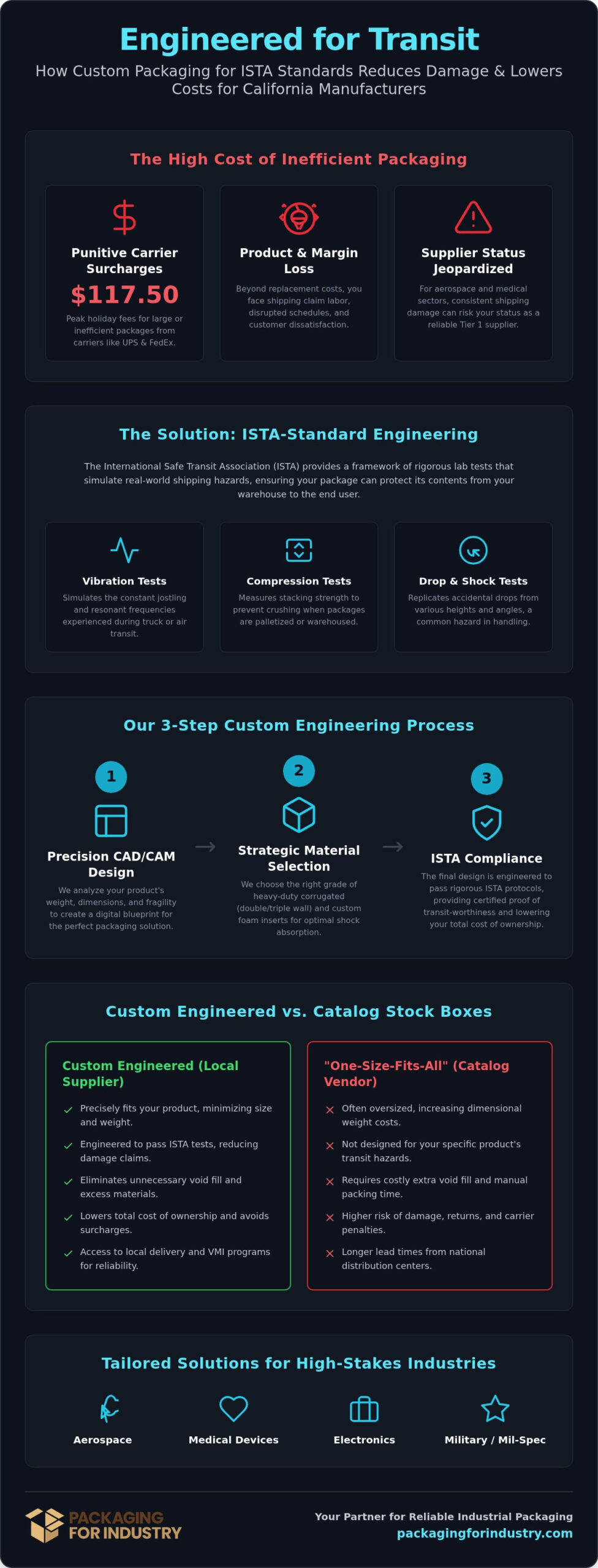
If your current corrugated boxes are failing transit tests or triggering the latest UPS and FedEx “Demand Surcharges,” you aren’t just losing product; you’re overpaying for the privilege. With 2026 holiday surcharges for large packages now reaching as high as $117.50, inefficient packaging has become an unsustainable operational expense. We understand that California manufacturers face a unique set of pressures, from meeting the strict mandates of SB 54 to ensuring aerospace or medical components arrive without a scratch.
You likely agree that your packaging should be a silent protector of your margins, not a source of constant shipping claims. By utilizing custom packaging engineered for ISTA standards California businesses can finally bridge the gap between lab-tested durability and fiscal efficiency. This article explains how to reduce shipping damage and lower your total cost of ownership by partnering with a local supplier. We’ll explore why moving away from national catalog suppliers for custom sizes and local packaging delivery in Orange County, Los Angeles, and San Diego is the fastest way to stabilize your supply chain. Whether you need to request a packaging quote for heavy-duty boxes or specialized foam inserts, the path to reliability starts with engineering.
Key Takeaways
- Understand how ISTA testing protocols simulate real-world shipping hazards to help you reduce shipping damage and avoid punitive carrier surcharges.
- Discover why custom packaging engineered for ISTA standards California manufacturers trust is more cost-effective than relying on “one-size-fits-all” catalog options.
- Learn how precision CAD/CAM design and strategic material selection, such as heavy-duty corrugated and custom foam, ensure your products pass rigorous transit tests.
- Identify specialized industrial packaging solutions tailored for high-stakes sectors, including aerospace, medical device manufacturing, and military logistics.
- Explore how local next-day delivery and Vendor Managed Inventory (VMI) programs eliminate lead time delays and improve supply reliability for your warehouse.
What is ISTA Testing and Why Do California Manufacturers Need It?
The International Safe Transit Association (ISTA) serves as the global authority on package performance. It isn’t just a set of rules; it’s a rigorous framework designed to ensure your products survive the modern supply chain. When we talk about ISTA protocols, we’re discussing laboratory tests that replicate the real-world vibration, compression, and drop shocks your shipments endure between your warehouse and the end user. For manufacturers in the Inland Empire or Orange County, these tests provide the data needed to prove a package is ready for the road.
California’s high-tech sectors, particularly aerospace and medical device manufacturing, rely on these standards to protect sensitive equipment. Utilizing custom packaging engineered for ISTA standards California businesses can trust ensures that high-value components arrive in pristine condition. This isn’t just about safety; it’s about fiscal responsibility. Custom design packaging leads to fewer insurance claims and a significant reduction in the total cost of ownership for your logistics operation.
The Consequences of Non-Compliant Industrial Packaging
Failing to meet these standards creates a cascade of hidden costs. Beyond the immediate loss of the product, you’re looking at replacement freight, labor for damage inspections, and disrupted production schedules. This is why investing in custom packaging engineered for ISTA standards California manufacturers require is a better long-term strategy than buying stock boxes. Carriers like UPS and FedEx have also increased their 2026 holiday surcharges, with large package fees reaching up to $117.50 during peak windows. If your packaging is bulky or inefficient, you’re paying these penalties on every shipment. In the aerospace industry, consistent damage can even jeopardize your Tier 1 supplier status, as reliability is a non-negotiable metric for major contractors.
Common ISTA Test Series for Industrial Goods
Most industrial manufacturers focus on two primary categories. Series 1 provides a basic integrity test to screen for obvious weaknesses in a box’s design. However, Series 3 offers a more comprehensive general simulation of the transit environment. ISTA 3A has become the gold standard for small parcel delivery because it accurately mimics the hazards of a carrier’s automated sorting and delivery network. ISTA 3B serves as the definitive testing protocol for products moving via truckload shipments, simulating the distinct mechanical stresses found in heavy freight transport.
Engineering Custom Packaging for ISTA Standards: The PFI Process
Successful ISTA compliance isn’t an accident; it’s the result of rigorous engineering. At PFI, we use CAD/CAM support to develop precision industrial packaging designs that account for every dimension of your product. This level of detail is essential when designing custom packaging engineered for ISTA standards California manufacturers need for high-stakes shipping. We don’t just guess which box will work. Our team analyzes the weight, fragility, and orientation of the item to determine if a heavy-duty double-wall or triple-wall corrugated solution is necessary to survive the transit environment.
The choice of material significantly impacts the outcome of compression and vibration tests. While triple-wall corrugated board provides superior stacking strength for heavy industrial components, it must often be paired with custom foam packaging to address internal shock. This integrated approach aligns with the technical foundations set by the ASTM Committee D10 on Packaging, which governs the evaluation of material performance under stress. By combining the external durability of a corrugated box with the internal dampening of foam, we create a total system of protection that lowers your total cost of ownership.
Designing Custom Foam Inserts for Shock Absorption
Choosing the right foam is a matter of physics and material science. Polyethylene foam is often preferred for its durability and closed-cell structure, making it ideal for heavier industrial parts. In contrast, polyurethane foam offers a softer cushion for lighter, highly sensitive electronics. Our engineers use die-cut foam end caps to isolate products from the box walls, effectively managing G-force levels during a drop. We engineer the foam density specifically to meet the deceleration requirements of your target ISTA test series, ensuring the product remains functional upon arrival.
The Prototyping Phase: Reducing Risk Before Rollout
Theoretical designs only go so far; physical samples are the cornerstone of the custom design packaging process. We provide free prototyping to our clients so they can verify the fit and function of the solution before committing to a full production run. This phase allows us to identify potential failure points, such as weak corners or insufficient clearance, which might lead to a failed ISTA test. Prototyping effectively eliminates the risk of mass-producing a flawed design, saving your company thousands in potential shipping losses and replacement costs. If you are preparing for a new product launch, you can request a packaging quote to start the prototyping process today.
California Packaging Supplier vs. Catalog Vendors: Lowering Total Costs
Purchasing managers often default to national catalog vendors for convenience, but the hidden costs of “one-size-fits-all” boxes are substantial. When a container isn’t sized perfectly for your product, you pay twice: first for the excess cushioning materials needed to fill the void, and second for the increased dimensional weight. Since major carriers have implemented steep surcharges for oversized packages in 2026, shipping air has become an expensive operational mistake. Transitioning to custom packaging engineered for ISTA standards California manufactures need allows for a precision fit that eliminates waste and significantly lowers packaging costs.
The Pitfalls of Catalog Boxes for Industrial Applications
Big-box distributors sell commodities rather than engineered solutions. They lack the technical staff to explain why a stock RSC might fail a vibration test or how to optimize a pallet load for stability. Relying on stock boxes often leads to over-packaging, where extra layers of wrap or foam are used to compensate for a poorly fitting container. For high-volume manufacturers, this inefficiency inflates bulk packaging pricing and complicates warehouse logistics. Following established ISTA Test Procedures with a custom-built solution ensures your protection levels are exactly what the product requires, no more and no less.
The Southern California Advantage: Proximity and Agility
Sourcing locally from an Anaheim or Irvine supplier provides logistical benefits that national vendors cannot match. We offer local packaging delivery across San Diego, Riverside, and the Inland Empire, often with next-day service for recurring orders. This proximity allows you to operate with a leaner warehouse because you don’t need to stockpile months of inventory to guard against lead-time surprises. By partnering with a regional expert, you gain a consultant who understands your specific production workflow and can react quickly to design changes. This local presence ensures your custom packaging engineered for ISTA standards California remains both reliable and fiscally responsible.
ISTA-Certified Solutions for Specialized Industries in California
California’s manufacturing landscape is diverse, but the need for reliability is a constant across every sector. When we provide custom packaging engineered for ISTA standards California manufacturers in the aerospace sector rely on us to meet both ISTA and Mil-Spec requirements simultaneously. These are often high-value, low-volume components where a single failure can halt a multi-million dollar project. By engineering specialized military packaging, we ensure that sensitive guidance systems and structural aircraft parts arrive without compromised integrity.
In the medical device field, our focus shifts to ensuring sterile barrier integrity through vibration-resistant designs. A failed transit test in this industry doesn’t just mean a broken part; it means a non-sterile product that cannot be used in a clinical setting. Similarly, for electronics and semiconductor manufacturers, we utilize ESD foam and anti-static materials within ISTA-compliant boxes to prevent latent static damage. For the heaviest industrial gear, we design heavy-duty wooden crates that offer the rigid protection necessary for sea or air freight.
Aerospace Packaging Standards in Southern California
Southern California remains the heart of the global aerospace industry, with major hubs throughout Los Angeles and Orange County. We understand that these clients don’t just need a box; they need an engineered system. We often integrate custom-built crates with precision foam-lined interiors to isolate delicate sensors from the shocks of ground handling. This level of detail is why custom packaging engineered for ISTA standards California aerospace firms use is considered an essential part of their quality control process.
E-commerce and Fulfillment Logistics
The rise of regional fulfillment centers has changed the demands on ecommerce packaging. Products now face more “touches” than ever before, increasing the risk of damage. We help brands reduce their “ship-in-own-container” (SIOC) costs by designing packaging that passes ISTA 6-Amazon.com testing. Using high-quality custom corrugated boxes doesn’t just improve your brand’s image at the doorstep; it ensures the product survives the chaotic parcel delivery environment without requiring a second, outer shipping box.
Streamlining Supply with Vendor Managed Inventory (VMI)
Engineering custom packaging engineered for ISTA standards California manufacturers rely on is a critical first step, but the long-term success of your shipping operation depends on a reliable supply chain. Even a perfectly designed box fails to save money if it isn’t available when your production line is ready to ship. This is where Vendor Managed Inventory (VMI) becomes an essential logistical tool. By allowing PFI to monitor and replenish your stock, you eliminate the risk of packaging shortages that cause costly shipping delays.
Implementing a VMI program provides several operational advantages for high-volume manufacturers:
- Just-In-Time delivery ensures that custom corrugated and foam components arrive exactly when they’re needed for production.
- Warehouse clutter is significantly reduced because you only store the packaging required for current orders, freeing up valuable floor space in your Anaheim or Inland Empire facility.
- Supply reliability is guaranteed through our local Southern California delivery network, ensuring next-day replenishment for recurring needs.
Eliminating Lead-Time Surprises
Custom die-cut boxes and specialized foam inserts often have longer manufacturing lead times than generic stock items. We take a proactive approach by conducting scheduled inventory reviews and managing the replenishment cycle for these long-lead items on your behalf. This strategy prevents “emergency” orders that often come with high rush fees and carrier surcharges. By maintaining a lean inventory level through our “Just-In-Time” management, you also improve your company’s cash flow. You no longer have thousands of dollars in capital tied up in excess packaging stock sitting on a pallet for months.
Request a Packaging Quote for Your ISTA Needs
The most effective way to lower your total cost of ownership is to treat your industrial packaging supplier as a strategic partner. We offer comprehensive packaging reviews to identify where engineering can reduce damage and where VMI can streamline your operations. Whether you’re shipping medical devices from Irvine or aerospace components from Los Angeles, a local partnership ensures that your packaging is as efficient as your manufacturing process. Request a packaging quote today to begin your cost-reduction analysis and secure a more reliable supply for your warehouse.
Optimize Your Logistics with Engineered Protection
Adopting custom packaging engineered for ISTA standards California manufacturers trust is more than a compliance measure; it’s a strategic investment in your bottom line. By moving away from oversized catalog boxes and integrating precision CAD-designed solutions, you eliminate the excessive void fill and carrier surcharges that erode your margins. Specialized industries like aerospace and medical manufacturing require this level of technical oversight to maintain supplier status and product integrity. It’s about ensuring every shipment reaches its destination without compromise.
PFI provides the engineering bridge you need with free prototyping and dedicated CAD support to ensure every design passes the test. Our local next-day delivery across Orange County, Los Angeles, and San Diego, combined with robust Vendor Managed Inventory programs, ensures your warehouse stays lean without risking shortages. You don’t have to settle for high damage rates or unreliable lead times from national distributors. Our team is ready to help you stabilize your supply chain and lower your total cost of ownership through proven industrial solutions.
We look forward to helping you protect your products and your profits with a more reliable packaging partnership.
Frequently Asked Questions
How do I know which ISTA test series I need for my product?
Your choice of ISTA test series depends on your specific shipping environment and product sensitivity. Series 1 provides basic integrity testing for initial screening, while Series 3 offers a more comprehensive general simulation of transit hazards. We typically recommend ISTA 3A for small parcel delivery systems and ISTA 3B for larger truckload shipments. Our engineering team can review your logistics workflow to help you select the most appropriate protocol for your validation needs.
Can a local California packaging supplier help me pass ISTA testing?
Yes, a local supplier like PFI provides the technical expertise and CAD/CAM support necessary to pass rigorous transit tests. We act as the engineering bridge between your product and the laboratory, designing custom packaging engineered for ISTA standards California manufacturers require. By identifying potential failure points during the design phase, we ensure your heavy-duty corrugated boxes and foam inserts are optimized for durability before you ever send them to a testing facility.
What is the cost difference between custom engineered packaging and stock boxes?
While custom engineered packaging involves an initial design phase, it often results in a lower total cost of ownership compared to stock boxes. Catalog boxes frequently require excessive cushioning materials to fill empty space, which increases your material spend and dimensional weight. Custom sizing eliminates these hidden costs and helps you avoid expensive UPS and FedEx large package surcharges. We provide a cost-reduction analysis to compare packaging pricing and demonstrate the long-term savings of tailored solutions.
Does PFI provide free prototypes for ISTA-compliant designs?
We provide free prototyping and physical samples as a standard part of our custom design process. This allows your team to verify the fit and protective qualities of our corrugated boxes and foam components before committing to a full production run. Testing a physical prototype is the most reliable way to identify weaknesses that could lead to shipping damage or failed ISTA tests. It’s a critical step in ensuring your industrial packaging is ready for the modern supply chain.
How does custom foam packaging help in passing ISTA drop tests?
Custom foam packaging is essential for managing the deceleration and G-forces experienced during ISTA drop tests. We utilize materials like polyethylene and polyurethane to create die-cut inserts and end caps that isolate your product from the box walls. By engineering the foam density to match your product’s weight and fragility, we ensure that the internal shock is absorbed by the packaging rather than the sensitive components inside. This precision protection is vital for high-value aerospace and medical devices.
What industries in Southern California require ISTA-certified packaging?
ISTA-certified packaging is standard across several high-stakes industries in Southern California, including aerospace, defense, medical device manufacturing, and electronics. These sectors ship fragile, high-value equipment that cannot afford transit failures. Additionally, e-commerce fulfillment centers increasingly require ISTA 6-Amazon.com compliance to reduce “ship-in-own-container” costs. Whether you are in Orange County or Los Angeles, meeting these standards is often a prerequisite for maintaining Tier 1 supplier status or fulfilling major retail contracts.
Does PFI offer local next-day delivery for bulk industrial orders?
Yes, we provide local next-day delivery for bulk industrial packaging orders across Southern California. Our fleet services manufacturers and warehouses in Anaheim, Orange County, Los Angeles, San Diego, and the Inland Empire. This local proximity allows our customers to maintain leaner inventory levels and avoid the high freight costs associated with shipping bulk corrugated boxes from national suppliers. We prioritize fast, reliable delivery to keep your production and shipping lines moving without interruption.
How can a VMI program help with my custom packaging inventory?
A Vendor Managed Inventory (VMI) program eliminates lead-time surprises by allowing us to monitor and replenish your custom packaging engineered for ISTA standards California on your behalf. We handle the stocking of long-lead items like die-cut foam and custom boxes, ensuring you always have the right materials available for production. This proactive approach prevents emergency rush orders, reduces warehouse clutter, and improves your cash flow by ensuring you only store the inventory you actually need for current shipments.